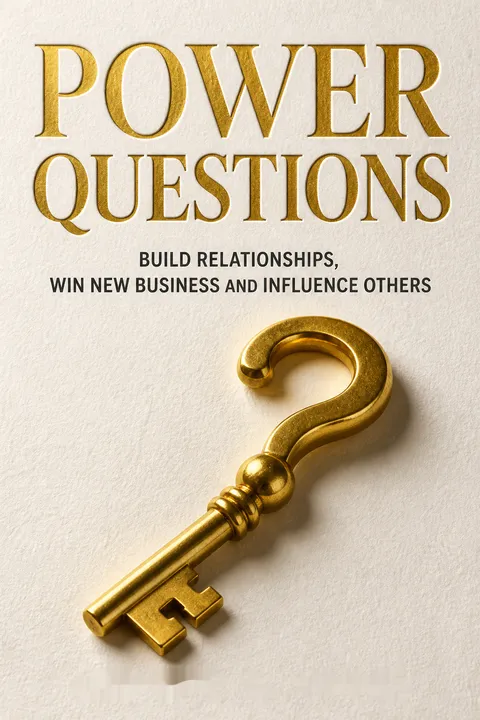


Key Takeaways
Ask better questions before proving how much you know
Curiosity beats the pitch. In one early sales meeting, a young consultant spends half an hour describing his firm, its history, and its methods. The clients leave without discussing their own needs. A year later, his experienced colleague answers the same broad invitation by asking what the clients want to understand. They explain their priorities, including a previous provider’s failure to coordinate across countries. The conversation earns the firm another meeting and, over time, a lasting client relationship.
The book calls a deliberately chosen question that opens understanding, trust, or action a power question. Its central claim is practical: expertise matters, but questions reveal whether that expertise is relevant. A pitch displays what the seller knows. A good question uncovers what the other person needs.
The contrast is not between talking and asking questions at any cost. It is between making the conversation about the speaker’s credentials and making it useful to the listener. A question also gives the other person a chance to correct assumptions before a proposal hardens around them. That makes inquiry a form of preparation, not a substitute for it. The approach can become mechanical if questions are deployed as sales tricks. Its credibility depends on whether the asker responds to the answer rather than simply waiting to resume the pitch.
Clarify what someone wants before answering a broad question
Aim before answering. When a prospect says, in effect, tell me about your firm, the novice consultant launches into a long presentation. His senior colleague instead asks what the prospect wants to know. The client specifies its interest in the firm’s capabilities in Asia and how its teams work together. That focus opens a substantive discussion and reveals the client’s reason for seeking help.
Broad prompts invite irrelevant answers. The same applies when someone asks about a person’s background: there could be a lifetime of detail, but only some of it matters now. A brief clarification can save time and prevent a polished answer to the wrong question. It also gives the other person control over the conversation’s direction.
Clarification is a small act of shared agenda-setting. Rather than assuming that a question has one obvious meaning, the respondent makes its scope explicit and lets the asker choose what matters. This can reduce conversational waste and show respect for limited time. It is especially useful when the topic is broad or the stakes are high. The risk is over-clarifying ordinary exchanges until conversation feels like a form. A simple check is most valuable when several plausible answers would lead in different directions.
Listen long enough for the real answer to emerge
Invite the other view. A university vice chancellor complains that his leader talks through meetings without asking the staff for their views. The question he wishes to hear is simple: what do you think? It asks for an opinion rather than a yes-or-no response, and it signals that the answer deserves attention. The book urges the asker to listen carefully, including when the response is uncomfortable.
Listening also means resisting the urge to rescue a pause. The authors describe a seasoned consultant who asks a question, then lets the client think instead of repeating it or filling the silence. A follow-up such as asking someone to explain more can uncover the next layer of meaning. The point is not to collect words, but to understand what matters to the speaker.
A question creates an opening; attention determines whether it becomes a real exchange. Pauses can give people time to formulate thoughts they have not yet put into words, while follow-up questions show that the first answer was heard. This is why listening cannot be reduced to staying quiet until the other person stops talking. It requires tracking what they say and adjusting the next question accordingly. The book’s confidence in listening as a source of influence is persuasive, provided influence means earning participation, not steering someone covertly.
Diagnose a buyer's readiness before investing in a pitch
Check the conditions. A sale requires more than a persuasive presentation. The book’s four conditions for a sale are: the buyer sees a meaningful problem or opportunity; the buyer owns it and can act; the buyer is dissatisfied enough with current options to change; and the buyer trusts the proposed provider. Without these conditions, more selling may only consume time.
The Segway illustrates the missing-need problem: despite extraordinary expectations, it addressed no sufficiently urgent need for many buyers. Quadraphonic sound struggled against satisfied stereo users, while the proposed management of American ports by Dubai Ports World ran into a trust barrier. These examples point to different reasons a proposal can stall. Ask which condition is absent before writing another slide or proposal.
The four conditions separate problems that sales conversations often blur together. A buyer may acknowledge a need but lack authority, or have authority but see no reason to abandon the current solution. Treating these as distinct questions makes a stalled sale diagnosable rather than mysterious. The cases also show that willingness is shaped by context, not just product quality. A framework cannot predict every decision, and trust may reflect perceptions beyond a seller’s control. Its practical value is in revealing where further effort could matter, and where it probably will not.
Keep asking why until the requested fix reveals the real problem
Question the first explanation. The Socratic Method, as presented here, uses questions to uncover assumptions, clarify meanings, and help people reason toward a better understanding rather than accept a lecture. One practical version is the five Whys: ask why repeatedly to trace a request or symptom toward its underlying cause.
A sales chief asks for training because he wants more new customers. Further questioning reveals the deeper pressure: his company is losing 20 percent of existing customers each year. He believes competitors’ low prices are responsible, but interviews with customers who left point instead to quality and delivery failures. Training would not have fixed those causes. Repeated why-questions changed the proposed project from a workshop into an operational investigation.
The useful move is not asking why five times by rote. It is staying curious as an explanation changes, then testing claims against evidence. The sales chief’s account illustrates how a plausible story about competitors can divert attention from a problem inside the company. Questions can expose that gap without immediately accusing anyone of being wrong. Tone matters: why can sound like a challenge to a person’s judgment. Asked with genuine interest, it examines the explanation; asked as cross-examination, it may shut down the very inquiry it is meant to start.
Anchor major choices in purpose, not momentum
Return to the mission. A health-care CEO wants to acquire a smaller hospital’s strong cardiac program. His organization’s stated purpose, however, is to provide caring treatment and effective prevention at low cost. When asked how the takeover would advance that mission, he recognizes that the opportunity is attractive mainly because he is ambitious, not because the acquisition serves the organization’s stated purpose.
The question is useful when a decision demands substantial time, money, or attention. It brings stated values into contact with the choice at hand. That can expose a gap between what an organization says it exists to do and what its leaders are pursuing. The test is not whether an idea is ambitious or makes the organization bigger, but whether it advances the reason the organization exists.
Purpose is most useful when it constrains choices, not when it decorates a website. Asking how a move serves the mission gives a leader a way to examine the difference between an appealing opportunity and a strategically coherent one. It can also make hidden motives discussable without reducing the conversation to accusation. Yet mission statements are often broad enough to justify almost anything. The question works best when the purpose is specific enough to rule out some options, and when the answer is examined against real effects on the people the organization serves.
Ask about the dream behind someone's résumé
Make room for aspiration. After years focused on his demanding career, Ben realizes he has never asked his wife, Liz, what she wants to do when their children grow up. When he finally asks about her dreams, she is moved to tears, and they spend hours talking about her hopes and concerns. The conversation reveals a part of her life that their familiar routines had left unspoken.
A similar question helped a consultant connect with a highly accomplished chief executive nearing retirement. Instead of reciting more analysis, the consultant asked whether there was anything else the leader hoped to accomplish. The executive paused and shared a personal ambition. Questions about dreams, fulfillment, or an unfinished goal can make a relationship more human than a conversation limited to roles and accomplishments.
Asking about aspiration treats a person as more than the position they occupy or the tasks they perform. It can surface wants that routine conversation leaves hidden, and it shows interest without immediately proposing a solution. The question is powerful partly because it is rarely asked plainly. It also deserves tact: a personal question can feel intrusive if the relationship has not earned that depth, or if the listener is not prepared to hear a difficult answer. The invitation matters only when the other person remains free to decline it.
Match the question to the moment: explore openly, decide directly
Choose the right shape. Open questions help people explain what they think, want, or fear. Direct yes-or-no questions are better when a clear commitment or fact is needed. A business owner confronting a trusted employee about missing money first receives evasive explanations. When he asks directly whether the employee took it, then waits, the employee confesses.
The book calls evasive circling around a clear answer Gorilla Dust. Directness can cut through it, but should not replace exploration in every conversation. When an exchange has gone badly for another reason, a restart can help: a fundraiser who began by demanding a large gift apologizes, asks to begin again, and discovers that the donor cares about a different university program. The form of the question should fit the task.
Open and closed questions do different jobs. Exploration is useful when the facts, interests, or feelings are unclear; direct questions matter when ambiguity itself blocks a decision. The contrast helps explain why no single conversational style is always best. But pressure can make a closed question feel like a demand for compliance, and an apology does not erase the effects of a serious breach. Directness is most constructive when the asker has a legitimate reason to require clarity and is prepared to act responsibly on the answer.
End meetings with decisions, not just a list of tasks
Separate action from agreement. At a planning meeting about a new customer-focused initiative, participants readily assign follow-up tasks. But when asked what the group has actually decided, they discover that they disagree on three of five supposed decisions, including the initiative’s main goal. The meeting needs another discussion before execution can make sense.
A useful meeting has a clear purpose, identifies decisions that need to be made, and checks at the end whether those decisions were reached. The book also recommends asking what the most important issue is when a client seems distracted or disengaged. These questions prevent activity from masquerading as progress. Tasks are useful only after the group agrees on the outcome they are meant to produce.
A task list can create the appearance of momentum while leaving the central choice unresolved. Asking participants to state decisions in plain language makes disagreement visible while there is still time to address it. It also distinguishes a meeting’s output from its busyness. This discipline is not a demand that every discussion end with consensus: some meetings are for discovery, and some decisions require more information. Naming that purpose explicitly is still progress, because it prevents follow-up work from being mistaken for a decision.
Audit your life by naming its mission, relationships, values, and plan
Turn reflection into direction. The book adapts Peter Drucker’s five organizational questions to personal life: What is your mission? Who are the people you want to invest in? What do they value? What expectations should be clear between you? What is your plan? The sequence moves from purpose to relationships, mutual understanding, and action.
A related exercise asks people to imagine having three years left and write what they would hope to change or accomplish. In the book, this reflection is prompted by the story of Gene O’Kelly, a chief executive who learned he had an inoperable brain tumor and documented his remaining time. The point is not to predict a future, but to make priorities visible while there is still time to act on them.
The framework makes personal reflection concrete by linking identity to the people around a person and to choices in the calendar. A mission without a plan can remain an attractive abstraction; a plan without a mission can become efficient drift. The limited-time exercise intensifies the same inquiry by forcing trade-offs into view. Such exercises do not supply a ready-made answer, and mortality prompts can unsettle rather than inspire. Their value depends on allowing reflection to lead to small, credible changes, not demanding an instant reinvention of an entire life.
Analysis
Power Questions is best understood as a story-driven field guide to conversational judgment, not a scientific taxonomy of question types. Its short episodes make techniques memorable by showing a visible change in a meeting, a sale, or a relationship. That design is also the book’s main evidentiary limit: vivid anecdotes illustrate possibilities, but do not establish how consistently a question produces the reported outcome. The stories are strongest as demonstrations of practice, not guarantees.
The underlying skill is epistemic humility: the willingness to treat one’s account of a situation as incomplete. The inexperienced consultant assumes the client wants a company biography. The banker assumes the client’s losses are caused by price. In each case, a question invites missing information into the decision. This resembles good diagnosis in medicine and engineering: distinguish symptoms from causes before prescribing a fix. It also shows why question lists alone are insufficient. The asker must revise their understanding when the answer contradicts the initial theory.
The book’s approach can be organized by conversational purpose: questions can clarify a request, discover needs, examine motives, support reflection, or secure a decision. Confusion arises when those purposes are mixed. A vulnerable person may need attentive exploration, not a rapid sequence of probing questions. A stalled commitment may need a direct answer, not more open-ended discussion. Skill lies in recognizing which task the conversation currently faces.
The authors sometimes describe asking as a source of influence. That influence is ethically ambiguous unless paired with transparency and respect for refusal. A question can empower someone to find their own answer, but it can also steer them toward the asker’s preferred outcome. The most durable principle is therefore not to ask clever questions. It is to let answers change the conversation, and to use what is learned in service of the other person’s actual priorities.
Review Summary
Power Questions receives mixed reviews, with an average rating of 3.83 out of 5. Many readers find it insightful and practical, praising its collection of strategic questions for improving communication and relationships. Some appreciate the real-life examples and concise chapter summaries. However, critics argue that some questions are obvious or unprofessional, and the writing style can be off-putting. The book is generally recommended for those in sales, consulting, or leadership roles, though its effectiveness may vary based on individual experience and needs.
People Also Read








Glossary
power questions
Questions that open understandingThe book’s term for deliberately selected questions that help a conversation reach important information, assumptions, motivations, or decisions. A power question is not simply clever or dramatic. Its value depends on its fit with the moment and on the asker’s willingness to listen to the answer and respond to what it reveals.
Socratic Method
Inquiry that tests assumptionsA teaching and discussion approach associated in the book with Socrates. Rather than primarily lecturing, the questioner asks people to define ideas, examine assumptions, and reason through a subject. In everyday use, it means replacing unsupported assertions with questions that help participants clarify what they mean and discover where their understanding may be incomplete.
five Whys
Repeated questions to find causesA questioning technique in which a person asks why repeatedly about a request, symptom, or explanation to uncover the underlying cause. The book illustrates it with a company that initially requests sales training, then reveals substantial customer losses and product quality and delivery problems. The number five is a guide, not a requirement to keep asking after the root issue is clear.
four conditions for a sale
Tests for buyer readinessThe book’s diagnostic for understanding whether a buyer is prepared to purchase a product, service, or idea. The buyer must see a meaningful problem or opportunity, have ownership and authority to act, feel dissatisfied enough with existing options to change, and trust the proposed provider. A missing condition can explain why further persuasion is ineffective.
Gorilla Dust
Evasive talk without commitmentThe book’s metaphor for circling around a direct question without giving a clear answer. It describes conversational evasion when someone avoids stating whether they agree, will commit, or did something. A direct closed-ended question can sometimes cut through this ambiguity, although directness should be used with care and for a legitimate purpose.
Peter Drucker's five questions
A framework for organizational focusA set of questions Drucker used with organizations, concerning mission, customers, what customers value, expected results, and plans. The book adapts them to personal life by asking about purpose, important relationships, other people’s priorities, mutual expectations, and concrete plans. Together, they connect what a person or organization exists to do with whom it serves and how it will act.
FAQ
What's "Power Questions" about?
- Purpose of the Book: "Power Questions" by Andrew C. Sobel and Jerold Panas is about using strategic questions to build relationships, win new business, and influence others effectively.
- Focus on Questions: The book emphasizes that asking the right questions can be more powerful than providing answers, as they challenge thinking and uncover deeper insights.
- Real-Life Examples: It includes 35 chapters with real-life examples of how power questions have transformed conversations and situations.
- Additional Resources: The book also provides an additional 293 power questions for various professional and personal scenarios.
Why should I read "Power Questions"?
- Improve Communication: It offers practical guidance on enhancing your communication skills by asking insightful questions.
- Build Relationships: The book provides strategies to deepen relationships with clients, colleagues, and friends through meaningful dialogue.
- Professional Growth: It helps professionals in sales, leadership, and consulting to engage more effectively with clients and stakeholders.
- Personal Development: The questions can also be applied to personal life, helping to understand and connect with others on a deeper level.
What are the key takeaways of "Power Questions"?
- Questions Over Answers: Good questions can reframe problems, challenge assumptions, and lead to more productive conversations.
- Listening is Crucial: The book highlights the importance of listening intently to the answers to build trust and credibility.
- Diverse Applications: Power questions can be used in various contexts, from sales meetings to personal relationships, to achieve desired outcomes.
- Continuous Learning: The book encourages a mindset of curiosity and continuous learning through questioning.
How can "Power Questions" help in building relationships?
- Deepen Connections: By asking thoughtful questions, you can engage others in meaningful conversations that deepen relationships.
- Show Genuine Interest: Questions demonstrate that you care about the other person's thoughts and feelings, building trust.
- Uncover Needs: They help uncover the needs and motivations of others, allowing you to respond more effectively.
- Create Emotional Bonds: Engaging in dialogue through questions can create emotional bonds and mutual understanding.
What are some examples of power questions from "Power Questions"?
- "What do you think?" This question invites others to share their opinions and shows that you value their input.
- "How did you get started?" It encourages storytelling and helps you learn about someone's background and motivations.
- "What are your dreams?" This question opens up a conversation about aspirations and long-term goals.
- "What is the greatest achievement in your life?" It prompts reflection on personal successes and values.
What is the Socratic method mentioned in "Power Questions"?
- Question-Based Learning: The Socratic method involves teaching through asking a series of thought-provoking questions.
- Uncover Assumptions: It helps uncover assumptions and encourages critical thinking by challenging the status quo.
- Engage Minds: This method engages the minds of others, leading them to discover answers themselves.
- Historical Context: The book references Socrates, who used this method to teach and transform the thinking of his students.
How does "Power Questions" suggest handling difficult conversations?
- Use Open-Ended Questions: Start with open-ended questions to understand the other person's perspective and concerns.
- Listen Actively: Pay close attention to the responses, showing empathy and understanding.
- Clarify and Reflect: Use questions to clarify points and reflect on what has been said to ensure mutual understanding.
- Guide to Solutions: Lead the conversation towards solutions by asking questions that focus on positive outcomes.
What are the best quotes from "Power Questions" and what do they mean?
- "Good questions trump easy answers." This quote emphasizes the power of questions to provoke thought and lead to deeper understanding.
- "Silence can be the best answer." It highlights the importance of allowing space for reflection and letting others find their own solutions.
- "What do you think?" This simple question is powerful in showing respect for others' opinions and fostering open dialogue.
- "Is this the best you can do?" A question that challenges individuals to strive for excellence and push beyond their limits.
How can "Power Questions" be applied in a sales context?
- Identify Needs: Use questions to uncover the client's needs and pain points, ensuring your solution is relevant.
- Build Trust: Asking insightful questions demonstrates expertise and builds trust with potential clients.
- Clarify Objectives: Questions help clarify the client's objectives and align your proposal with their goals.
- Overcome Objections: Address concerns and objections by asking questions that lead to mutual understanding and agreement.
What is the significance of the question "What are your dreams?" in "Power Questions"?
- Explore Aspirations: This question invites others to share their long-term goals and aspirations, providing insight into their motivations.
- Build Emotional Connection: Discussing dreams can create a strong emotional connection and deepen relationships.
- Encourage Reflection: It encourages individuals to reflect on what truly matters to them and what they want to achieve.
- Facilitate Support: Understanding someone's dreams allows you to offer support and guidance in helping them achieve their goals.
How does "Power Questions" address the concept of mission and goals?
- Align Actions with Mission: The book emphasizes the importance of aligning actions and decisions with one's mission and goals.
- Clarify Purpose: Questions help clarify the purpose and ensure that efforts are directed towards meaningful objectives.
- Evaluate Consistency: Regularly asking about mission and goals ensures consistency in actions and decisions.
- Guide Decision-Making: Understanding mission and goals provides a framework for making informed and strategic decisions.
What is the role of listening in "Power Questions"?
- Essential for Understanding: Listening is crucial for understanding the responses to your questions and building rapport.
- Demonstrates Respect: It shows respect for the other person's views and fosters a sense of being valued.
- Enhances Communication: Active listening enhances communication by ensuring clarity and reducing misunderstandings.
- Builds Trust: By listening intently, you build trust and credibility, strengthening relationships and influence.
Download PDF
Download EPUB
.epub digital book format is ideal for reading ebooks on phones, tablets, and e-readers.








