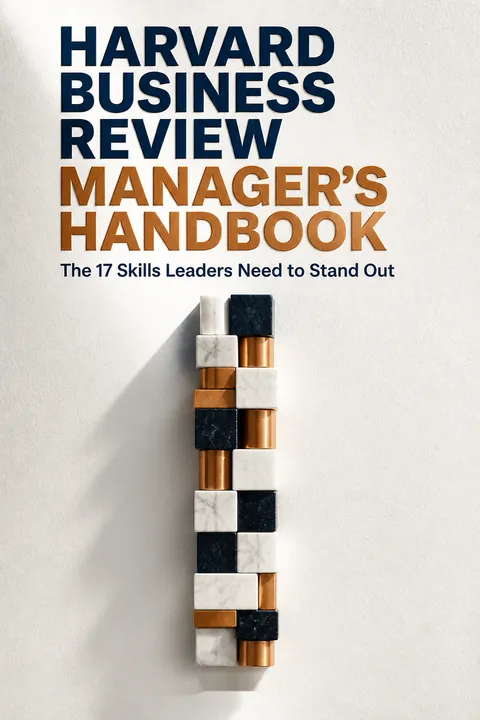


Key Takeaways
Your promotion changes the job: success now means results through others
The work shifts from doing to enabling. A strong individual contributor is rewarded for personal output. A manager is responsible for setting direction, coordinating resources, and helping other people deliver. The former sales star who steps into management may find it painful to watch a less experienced colleague handle an account. Yet taking the work back would preserve the manager's old identity at the expense of the team's growth. Success now includes developing people, setting clear expectations, and removing obstacles.
Use both sides of leadership. Management brings order through planning, budgeting, and staffing. Leadership sets direction, aligns people, and helps them respond to change. These are complementary modes, not competing job titles. The transition can bring anxiety, loss of expertise, and loneliness, especially in the first months. Naming the feeling and finding its source helps a new manager respond deliberately rather than retreat to familiar tasks.
The central shift is a change in the unit of achievement: from the individual to the team. That can unsettle people whose professional identity was built on being the most capable person in the room. The practical test is whether the manager's expertise makes others more capable, or simply keeps the manager indispensable. There is a real tension here: delegating too little bottlenecks the group, while stepping too far back can leave people unsupported. The most useful posture is active enablement, with responsibility retained for the conditions and outcomes of the work.
Earn trust with reliable character and visible competence, not title
Trust has two foundations. Character means intentions and actions align. Competence means the manager understands the work and can navigate the organization to secure what the team needs. Neither substitutes for the other: a well-meaning manager who cannot deliver loses credibility, while an effective manager who takes credit for others' work loses trust. Consistency, emotional restraint, respectful habits, questions, and public recognition of employees' contributions make character visible.
Show that you can deliver. Early in a new role, choose three or four important, manageable problems and solve them without overreaching. Explain the evidence and reasoning behind decisions, admit what is not known, and invite people to test ideas. Authentic leadership means acting from values, but it does not require copying an old style forever. A manager can experiment with new behaviors while remaining honest about underlying intentions.
Trust is treated here as an observable pattern rather than a warm feeling. That is useful because employees cannot inspect a manager's intentions; they infer them from repeated choices, especially who gets credit, who receives support, and how mistakes are handled. Quick wins can provide evidence of competence, but they should not become a performance of instant certainty. In unfamiliar roles, an honest account of what remains unknown may be more credible than confident answers that later need to be withdrawn. Trust grows when promises, decisions, and explanations remain consistent over time.
Treat your mood as part of the team's operating environment
Emotional intelligence is a working skill. The book describes it through self-awareness, self-regulation, motivation, empathy, and social skill. A manager's mood can spread through a group, influencing how people experience pressure and uncertainty. In one example, a marketing executive learns through 360-degree feedback that colleagues experience him as intimidating. He practices empathy by getting to know employees and coaching outside work, gradually making habitual reactions visible and changeable.
Interrupt the automatic response. Notice recurring triggers, name the emotion, and create a pause before acting. When an employee becomes upset, listen for the underlying concern, restate it to check understanding, and uphold team norms without humiliating the person. Shared rules for disagreement, decision-making, and support make emotional safety a team practice, not just a manager's private virtue.
The manager's emotional state is not merely personal because authority gives it social consequences. A tense reaction from a supervisor can make ordinary uncertainty feel like danger, while calm inquiry can make it discussable. The chapter's emphasis on self-observation is valuable precisely because intentions are poor substitutes for impact. Still, emotional steadiness should not be confused with suppressing emotion or requiring constant optimism. Anger, grief, and concern can carry useful information. The leadership task is to express them in ways that illuminate a problem rather than make others manage the leader.
Build influence before you need it, then tailor your case to people
A title grants authority, not commitment. Positional power comes from formal rights to assign work or allocate resources. Personal power grows through relationships, a reputation for useful judgment, and a history of helping others succeed. Build that influence by solving real problems, sharing expertise, respecting colleagues, and understanding what motivates your boss and peers. These ties make cross-team work less dependent on commands and more likely to earn cooperation.
Choose the right channel for the idea. A proposal may need to reach people's reasoning or their emotional concerns. Use relevant data, clear questions, or a concrete story, depending on the audience and decision. Strong communication also takes craft: organize writing before drafting, structure presentations as a story, and run meetings with an agenda, clear roles, participation, and follow-up. Charisma is not magic; voice, facial expression, gestures, and memorable contrasts can be practiced.
Influence is presented as a form of reciprocal capacity, not office manipulation. That distinction matters: a network is useful when it enables shared work, not merely access to powerful people. Persuasion also improves when the audience is treated as a source of information rather than an obstacle to overcome. The heart-versus-mind distinction is a helpful prompt, but real decisions rarely divide so neatly. A decision maker may need both evidence and a credible account of human consequences. Good communicators prepare for that mixture instead of labeling people by job title or stereotype.
Guard attention deliberately, because an unmanaged calendar becomes your strategy
Measure time before redesigning it. Log activities for several days, group them into categories, and compare actual use with important priorities. Then reserve calendar blocks for high-value work, allowing more time than a task first appears to need. Interruptions can consume far more time than their brief appearance suggests, so protect focus by silencing alerts, organizing the workspace, and setting boundaries around requests. Stress is not proof of weak character; when overload overwhelms attention, judgment and problem-solving suffer.
Build a career with purpose, not just upward motion. The book uses a career lattice rather than a ladder: growth can come through lateral moves, redesigned roles, temporary assignments, and new skills. Clarify what work matters, seek opportunities inside the organization, and ask for candid feedback. A strengths exercise gathers specific examples from people who know the employee, helping reveal where their work and best contribution align.
The time log is powerful because it turns vague busyness into a visible allocation problem. It may also reveal a structural issue rather than a personal failing: an employee cannot time-box their way out of chronic understaffing or conflicting demands. The career lattice similarly widens the idea of progress beyond promotion, which is especially useful when organizations have few senior posts. Its promise depends on real access to lateral opportunities, however. Managers should distinguish genuine development from simply adding responsibilities without authority, compensation, or time.
Delegate for growth, then coach without taking the work back
A useful handoff is designed, not improvised. Before delegating, clarify why the work matters, what must be delivered, who is suited to it, when milestones are due, and how much authority and support the employee will have. A written plan prevents misunderstandings and helps match the assignment to capacity and development goals. If a project is too important to hand over entirely, divide it so the manager retains the part requiring unique expertise.
Stay accountable without hovering. Agree on progress updates and use them to check milestones, surface obstacles, and offer coaching. Micromanaging communicates distrust; disappearing leaves the employee stranded. Reverse delegation occurs when the employee returns every decision or the manager takes over at the first sign of trouble. Instead, ask the employee to diagnose the problem and propose options. Intervene directly when a roadblock exceeds their authority or resources.
Delegation is often framed as a time-saving device, but its deeper value is distributing judgment and building capacity. A careful handoff makes autonomy concrete: the employee knows the outcome, boundaries, and available support. The key nuance is that autonomy should match experience and risk. A novice facing a high-consequence task may need tighter checkpoints than a seasoned colleague handling familiar work. That is not necessarily micromanagement if the oversight is agreed upon, proportionate, and designed to taper as competence grows.
Give feedback early enough to change the outcome, not just record it
Timely feedback is easier to use. The production worker who falls behind may be struggling because a process change was misunderstood, not because of poor effort. Raising the issue early lets the manager uncover the cause while there is still time to correct it. Describe observable behavior and its impact, ask for the employee's account, and avoid treating an initial interpretation as proven fact. If disagreement arises, ask more questions rather than escalating to defend authority.
Use the right conversation for the need. Coaching is a forward-looking dialogue in which the employee develops insight and an action plan, rather than simply receiving instructions. Formal reviews add documentation, goals, and compensation or promotion consequences. Talent development extends beyond fixing present performance: discuss interests, skills, and future opportunities, including stretch assignments. High performers may be only 5 to 10 percent of a team, but they still need specific recognition, sustainable workloads, and thoughtful boundaries.
The distinction between feedback, coaching, and appraisal prevents one conversation from being asked to do everything. Immediate correction can solve a process error; coaching can strengthen an employee's own judgment; a formal review creates a record and sets longer-term expectations. These practices work best when they are not saved for a single annual encounter. Yet frequent feedback can become surveillance if every action is evaluated. Managers need to make clear which moments are developmental, which are corrective, and which carry formal consequences.
Design team norms so difference produces ideas instead of lasting friction
A team needs both complementary skills and shared rules. Begin by checking whether the group has the expertise required, then agree on its purpose, shared performance goals, and norms for respect, participation, decisions, and conflict. Cultural differences can create friction around directness, hierarchy, language fluency, and decision speed. Virtual teams add problems of isolation and uneven participation, making clear communication routines and informal social contact especially important.
Make creativity safe and concrete. Short, well-planned sessions can use brainstorming, mind maps, or catchball, where participants successively improve an idea. Invite quiet members in and keep dominant voices from closing debate too soon. Hiring and retention are part of the same system: define the role, assess potential as well as credentials, and understand what gives employees meaningful work, fair treatment, and a reason to stay. Replacing an employee can cost roughly one-third of their annual salary.
Diversity does not automatically produce innovation. It expands the perspectives available, but without norms for listening and disagreement, differences can harden into status contests or silence. Structured idea methods help by making participation less dependent on spontaneous confidence. The same logic applies to hiring: selecting for cultural fit can protect coordination, but if fit means similarity, the team may reproduce its blind spots. Stronger hiring asks what capabilities and viewpoints are missing while making expectations explicit enough for newcomers to contribute.
Connect strategy, financial evidence, and a business case people can back
Strategy is a choice about distinctive value. A company may position itself around particular customer needs, a narrow range of offerings, or access to a specific market. Managers should connect their team's goals to that choice, examine external threats and internal capabilities, and organize work so its activities reinforce one another. Strategy is not just doing existing processes more efficiently; it asks whether those processes are the right ones.
Make the proposal legible to decision makers. Financial statements describe different things: the balance sheet shows assets and obligations at a point in time, the income statement reports performance over a period, and the cash flow statement tracks cash in and out. For a business case, identify the need, estimate costs and benefits, test risks, and explain the expected value. Consult affected employees and a champion before presenting, so the proposal has evidence and allies.
This final skill set links strategic choice to operational proof. Financial measures can discipline a proposal, but they do not make every important outcome measurable; culture, trust, and service quality may resist neat conversion into dollars. The handbook's insistence on questioning assumptions is therefore essential. A business case is not just a spreadsheet with a persuasive cover. It is a negotiated account of what problem matters, which evidence counts, who bears the costs, and what uncertainty remains. Strong proposals make those assumptions visible rather than disguising judgment as arithmetic.
Analysis
The handbook is best understood as a practical operating system for management, not as one unified theory. Its seventeen skills move from personal transition to influence, individual development, team coordination, and business judgment. The sequence matters: financial tools and strategy are difficult to use well if a manager cannot earn trust, communicate across boundaries, or organize other people's work. The implicit thesis is that managerial effectiveness comes from linking human capability to organizational purpose.
Its strongest contribution is integration. Delegation is connected to development, feedback to trust, team norms to creativity, and a business case to stakeholder interests. This prevents management from being reduced either to interpersonal warmth or to spreadsheet control. The book also makes the new manager's emotional transition visible, recognizing that the move from expert contributor to accountable leader involves loss of mastery and social distance, not merely a new list of tasks.
The format is also its limitation. As a handbook assembled from many HBR sources, it offers checklists and usable procedures more often than a single explanatory model. Its advice assumes managers have meaningful discretion, access to decision makers, and enough time to conduct listening tours, coach employees, and redesign roles. In workplaces constrained by severe hierarchy, understaffing, or precarious labor, individual skill cannot erase institutional barriers. Some advice also sits in tension: authenticity must coexist with experimentation; transparency with the need to project steadiness; employee development with retention pressures. These are not contradictions to eliminate but trade-offs to manage.
A useful way to apply the book is to treat its methods as diagnostic prompts rather than universal scripts. A time log can reveal priorities, but also impossible workloads. A feedback conversation can surface a misunderstanding, but also a broken process. A strategy exercise can clarify distinctive value, but only if the organization can act on what it learns. The manager's craft is to move repeatedly between people, systems, and results, asking which level is actually producing the problem.
Review Summary
Harvard Business Review Manager's Handbook receives mostly positive reviews, with an average rating of 4.14/5. Readers appreciate its comprehensive coverage of essential management skills, practical advice, and actionable tips. Many find it valuable for new managers and a useful reference for experienced leaders. Some reviewers note that while it covers many topics, it doesn't delve deeply into any single area. The book is praised for its clear writing, case studies, and focus on both personal development and team management. Several readers recommend it as a go-to guide for managers at all levels.
People Also Read









Glossary
Emotional intelligence
Recognize and manage emotionsThe capacity to notice and understand one's own emotions and other people's emotions, interpret what those emotions signal, and respond deliberately. The handbook presents it through five components: self-awareness, self-regulation, motivation, empathy, and social skill. For managers, it supports steadier decisions, more effective relationships, and healthier team interactions.
Social capital
Trust-based organizational influenceThe value accumulated through work relationships, reputation, reciprocity, institutional knowledge, and informal understanding of how an organization operates. Social capital helps a manager gain cooperation without relying solely on formal authority. It grows when people solve problems, share useful information, support colleagues, and follow through on commitments.
Time boxing
Schedule tasks in fixed blocksA time-management technique that divides a schedule into blocks and assigns each block to a work category or specific task. The manager reviews upcoming obligations, prioritizes work, and reserves calendar time for important activities. Tracking actual time afterward improves future estimates and reveals whether the schedule matches real priorities.
BATNA
Best alternative to agreementA negotiation term meaning a person's best alternative if no agreement is reached. In a team dispute, asking each side to state its BATNA makes the likely consequences of continued disagreement explicit. Comparing those alternatives can help participants reconsider whether a workable negotiated solution serves them and the team better.
Progress principle
Meaningful progress fuels engagementThe idea that making progress in meaningful work is a particularly important source of positive emotion, motivation, and productive perception during the workday. Managers can support it by setting clear, attainable short-term goals, allowing employees appropriate autonomy, and recognizing progress. It emphasizes the motivational value of day-to-day movement, not only distant rewards.
Need-based positioning
Serve a defined customer group's needsA strategic position built around meeting most or all of the needs of an identifiable set of customers. Those customers may value low prices, unusually personal service, or offerings tailored to their circumstances. The approach distinguishes a company by whom it serves and how its activities satisfy that group.
Reflected Best Self exercise
Map strengths through others' examplesA structured self-development exercise in which a person asks a broad range of people for specific stories that reveal their strengths. The person groups recurring themes, interprets what those examples show about their best contribution, and writes a short portrait of their best self. The portrait can guide career choices and small changes to current work.
FAQ
What's Harvard Business Review Manager's Handbook about?
- Leadership Skills Focus: The book outlines 17 essential skills for leaders to excel in their roles, emphasizing the transition from individual contributor to manager.
- Practical Guidance: It offers practical tips, step-by-step instructions, and real-world examples to help managers navigate their responsibilities effectively.
- Comprehensive Structure: Divided into five parts, it covers developing a leader mindset, managing oneself, individuals, teams, and the business, creating a holistic management approach.
Why should I read Harvard Business Review Manager's Handbook?
- Skill Development: Ideal for enhancing management skills, it addresses common challenges and provides actionable solutions for both new and seasoned managers.
- Research-Based Insights: The content is grounded in research and best practices from leading management and leadership experts.
- Real-World Application: Includes stories from real managers, making it relatable and applicable to everyday situations.
What are the key takeaways of Harvard Business Review Manager's Handbook?
- Transition to Leadership: Understanding the shift from individual contributor to manager is crucial, focusing on team achievements.
- Building Trust and Credibility: Establishing trust is fundamental, requiring managers to demonstrate character and competence.
- Emotional Intelligence Importance: Emotional intelligence is a key determinant of successful leadership, enhancing self-awareness, self-regulation, and empathy.
What are the best quotes from Harvard Business Review Manager's Handbook and what do they mean?
- "Set direction for your team": Emphasizes the manager's role in guiding their team towards organizational objectives.
- "Leadership is a learnable skill": Highlights that anyone can develop leadership skills through practice and learning.
- "Trust is the most powerful tool": Underscores the importance of trust in team dynamics for better collaboration and results.
How does Harvard Business Review Manager's Handbook define emotional intelligence?
- Definition of EQ: Emotional intelligence is the ability to perceive and manage emotions effectively in oneself and others.
- Components of EQ: Includes self-awareness, self-regulation, motivation, empathy, and social skills, all crucial for leadership.
- Impact on Leadership: High EQ is a more powerful determinant of good leadership than technical competence or IQ.
What strategies does Harvard Business Review Manager's Handbook suggest for effective delegation?
- Create a Delegation Plan: Develop a written plan outlining the task, purpose, and expected outcomes for clarity and accountability.
- Choose the Right Person: Select employees based on skills, availability, and motivation to ensure successful task completion.
- Monitor Progress: Regular check-ins support employees and keep projects on track without micromanaging.
How can I build trust and credibility as a manager according to Harvard Business Review Manager's Handbook?
- Demonstrate Character: Align actions with stated values to establish trust and reinforce credibility.
- Show Competence: Demonstrate technical and operational knowledge to build confidence in abilities.
- Invite Feedback: Actively seek feedback to show commitment to self-improvement and foster a culture of trust.
What is the importance of self-development in Harvard Business Review Manager's Handbook?
- Proactive Career Management: Individuals must take charge of their growth and development in a rapidly changing work environment.
- Aligning Goals: Self-development helps align personal aspirations with organizational needs, benefiting both parties.
- Continuous Learning: Ongoing skill enhancement is necessary to adapt to new challenges and remain competitive.
How does Harvard Business Review Manager's Handbook suggest managing stress and maintaining productivity?
- Time Management Techniques: Track time usage to identify patterns and prioritize tasks effectively.
- Finding Focus: Minimize distractions and create a conducive work environment to enhance concentration.
- Stress Management Practices: Incorporate routines like breaks, exercise, and mindfulness to mitigate stress.
What are the key components of effective communication as outlined in Harvard Business Review Manager's Handbook?
- Finding Your Voice: Develop an authentic communication style using rhetorical techniques to engage the audience.
- Mastering Written Communication: Ensure messages are clear and impactful through preparation, drafting, and editing.
- Conducting Effective Meetings: Plan inclusive meetings with clear objectives and follow-ups to maintain accountability.
How does Harvard Business Review Manager's Handbook address delegation?
- Clear Definition of Tasks: Clearly define tasks before delegating to ensure team members understand responsibilities.
- Trusting Your Team: Empower team members by trusting them to complete tasks without micromanaging.
- Monitoring Progress: Regular check-ins help ensure projects stay on track and provide opportunities for feedback.
What strategies for giving effective feedback are discussed in Harvard Business Review Manager's Handbook?
- Timeliness is Key: Provide feedback in real-time to reinforce positive behaviors and correct issues promptly.
- Constructive Criticism: Use a balanced approach, combining praise with constructive criticism to encourage growth.
- Focus on Development: Frame feedback to highlight opportunities for skill improvement and development.
About the Author
Other books by Harvard Business Review








Download PDF
Download EPUB
.epub digital book format is ideal for reading ebooks on phones, tablets, and e-readers.








