

Key Takeaways
Ask questions that make people feel heard, not cross-examined
Questions create value. Research described in the collection found that people who asked more questions in short conversations were better liked and learned more about their partners. Follow-up questions were especially effective because they showed attention rather than simply moving to a new topic. In sales calls, analysis of more than 500,000 conversations found that top performers asked questions throughout the conversation, with roughly 11 to 14 questions associated with the strongest conversion rates.
Match the method to the moment. Open questions help uncover ideas, while specific closed questions can be more useful when a counterpart may evade. Gradually deeper questions can build relationships; beginning with sensitive questions can make later, less intrusive questions easier to answer. Tone matters too: a casual, low-pressure approach can encourage candor.
The key distinction is between asking to understand and asking to extract. A question can invite someone into a conversation, or make them feel like a witness under examination. Follow-ups work because they demonstrate that the answer changed what the questioner wants to know next. The advice also implies a useful discipline: share something of oneself, and leave room for the other person to decline. Without reciprocity or choice, even well-designed questions can damage trust.
Find new strategy by challenging assumptions, not merely analyzing the status quo
Use creativity deliberately. Traditional analysis helps explain an existing market, but it may not reveal how to remake one. The article offers four routes to fresh thinking: challenge accepted assumptions, combine previously separate offerings, turn a limitation into an advantage, and borrow a solution from a distant context. Netflix, for example, questioned the video-rental model of nearby stores, limited inventory, and late fees. Mailing DVDs and working with studios allowed it to offer a different service.
Make the leap practical. Tesla treated the absence of a dealer network as a reason to sell directly, rather than as a fatal weakness. Intel borrowed the idea of branding an ingredient from consumer goods and applied it to an invisible computer component. These are not invitations to reject analysis. They use creative exploration to generate options, then analysis to test whether those options can create and capture value.
This is a useful corrective to strategy work that begins and ends with competitor maps. A market’s conventions can look like facts simply because organizations have built routines around them. The four routes create different prompts for noticing those conventions. Their value is strongest when the resulting ideas face operational and economic tests: an unusual strategy is not automatically a good one. Creativity supplies candidates; evidence and execution determine which survive.
Fix unequal workplace conditions before trying to fix women
Look for context, not presumed traits. The authors review meta-analyses that find small or negligible average differences between men and women in negotiation outcomes, confidence, and risk taking. Reported effect sizes were 0.20 for negotiation, 0.10 for confidence, and 0.13 for risk taking. The collection argues that workplace gaps often reflect unequal access to information, feedback, assignments, and tolerance for mistakes, rather than inherent differences in ambition or ability.
Test the explanation. At one firm, mothers were penalized by a forced performance ranking that compared their partial-year work with colleagues’ full-year output. Changing the policy helped keep them on a promotion path. A practical response is to question the prevailing story, identify a plausible organizational cause, change the conditions, and assess the results. Continue learning rather than treating one intervention as a universal fix.
The central move is from diagnosing a person to investigating the environment that shapes what a person can safely do. That shift matters because organizations can alter appraisal rules, access to informal networks, and the consequences of visible mistakes. The evidence also counsels precision: group averages do not predict every individual, and small average differences do not prove that every workplace process is fair. The useful question is not whether bias explains every disparity, but which conditions can be measured and improved.
Design AI to amplify human judgment, not simply eliminate labor
Combine different strengths. In a study of 1,500 companies, the authors report the strongest performance gains when people and AI work together. Machines can process data quickly and at scale; people contribute judgment, creativity, social understanding, and accountability. Humans also train AI, interpret outputs that are difficult to explain, and monitor systems for unsafe or unfair results.
Redesign the work. Stitch Fix illustrates the model: Algorithms use customer profiles and feedback to recommend clothing, while human stylists review and can change each shipment. The company served more than two million active clients and employed over 80 data scientists. Its system also used data to manage inventory and improve clothing designs. The point is not to imitate human intuition with software, but to create a workflow in which data and human expertise correct and strengthen one another.
The strongest version of this argument treats AI adoption as organizational design, not a software purchase. A tool that improves prediction can still worsen a decision if workers cannot question its output or if its incentives reward speed over care. Human review is not automatically a safeguard, either: reviewers need authority, time, and relevant expertise. The promise of augmentation depends on making responsibility explicit, including who notices errors and who can stop a harmful process.
Compare four routes to market before committing a start-up
Choose the competitive posture. The Entrepreneurial Strategy Compass helps founders examine two choices: collaborate with incumbents or compete against them, and protect control of an innovation or move quickly into the market. These choices produce four routes: license or protect intellectual property, disrupt incumbents, become a specialized value-chain partner, or build and control a new market architecture.
Make assumptions visible. RapidSOS, which developed technology to send mobile callers’ locations to 911 systems, considered several paths. It could replace emergency response, partner with established suppliers, serve insurers, or begin with a focused patient group. The founders chose a path aligned with their aim of improving emergency services for particular patients, then built wider support. Comparing routes does not remove uncertainty. It helps founders see what each route demands in customers, technology, capabilities, and partnerships before deep commitments make alternatives costly.
The compass is valuable because a promising invention does not dictate a single business model. A start-up can have a strong product and still choose a poor route to customers or give away too much bargaining power. The framework also makes founders confront identity: a company built to license a component needs different capabilities from one trying to own a platform. Purpose can help choose among viable options, but it cannot substitute for testing demand, partner incentives, and the resources each path requires.
Scale agile by changing the organization around teams, not just launching them
Start with the work. Agile teams are small, multidisciplinary groups that solve complex problems through prototypes, close customer feedback, and frequent adaptation. They suit uncertain innovation better than routine activities such as accounting. At scale, leaders should map potential teams around customer experiences, business processes, and technology systems, then sequence launches according to value, readiness, and organizational constraints.
Remove the surrounding friction. Bosch’s leaders learned that agile could not remain a special program run from the top. They worked as an agile leadership group, tested approaches, and addressed barriers across the company. Other functions need to support teams through compatible decision rights, architecture, talent systems, and funding. Large efforts can use teams of teams, as Saab did in developing its Gripen fighter aircraft. Scaling is not a headcount target; it is a redesign of how teams and the rest of the organization work together.
Agile methods are often mistaken for a meeting format or a license for teams to move fast in isolation. The deeper change is a shift in where decisions sit, how work connects across functions, and how support departments define their customers. That makes leadership behavior a practical constraint, not a slogan. There is also a boundary: routine work does not become more adaptive simply by being renamed agile. The method should fit the uncertainty and learning demands of the task.
Make hidden work visible when it increases trust and appreciation
Reveal effort, not theater. Operational transparency means deliberately showing customers and employees parts of the work that create a service’s value. In a travel-site experiment, people who could see the site searching airlines rated the service as more valuable and were less sensitive to waiting. In a wallet study, showing the costs and steps behind production was associated with a 26% increase in sales.
Let visibility run both ways. At a university dining hall, customers who could see chefs preparing food reported greater satisfaction; when chefs could also see customers, satisfaction rose 22% and chefs worked 19% faster. But visibility can create anxiety, expose poor performance, or damage trust when it reveals unfair practices. Managers should show real work at a useful moment, let customers choose whether to look, and give employees feedback that helps them improve.
Transparency is not a synonym for publishing everything. It is a design choice about which work becomes legible, to whom, and with what consequences. Showing invisible effort can correct a customer’s mistaken impression that a service is effortless or automatic. Yet visibility without agency can feel like surveillance, particularly for workers. The strongest cases connect observation to feedback and improvement, rather than using exposure as a substitute for accountability or as a way to manufacture admiration.
Put social purpose into targets, structures, hiring, and leadership decisions
Build both aims into operations. The authors call this approach hybrid organizing: managing social and financial goals as core organizational responsibilities, rather than treating social impact as a side project. Its four levers are setting and monitoring both kinds of goals, structuring work to support them, hiring and socializing employees around both, and practicing leadership that takes both seriously.
Make trade-offs discussable. Grameen Veolia Water aimed to provide safe, affordable water in rural Bangladeshi villages while sustaining itself through sales. It added urban sales to help subsidize village service, while keeping the social goal explicit. The company tracked both financial capacity and measures of access and regular consumption. The broader lesson is that good intentions are fragile when revenue pressure rises. Clear measures, decision rules, and forums for resolving conflict help prevent one purpose from quietly displacing the other.
Dual-purpose management is more demanding than adding a mission statement because goals can conflict over budgets, growth, and the people served. The collection’s examples show why organizational design matters: teams need ways to bring trade-offs into the open instead of assuming that shared values will settle them. Metrics can help, but social outcomes are often harder to attribute than sales. A sound system pairs indicators with qualitative review and checks whether the organization is measuring impact, not just activity.
Spend executive time where strategy needs personal attention
A calendar reveals priorities. Researchers tracked 27 CEOs of large companies for 13 weeks, recording nearly 60,000 hours. The CEOs worked an average of 62.5 hours a week, spent 72% of work time in meetings, and used 43% of work hours on activities advancing their own agendas. Yet they devoted only about 3% of work time to customers. These numbers show how easily urgent requests and inherited routines can crowd out strategic work.
Design the schedule deliberately. CEOs need a clear agenda, regular checks that their time matches it, and capable direct reports who can own decisions. They should protect time for reflection, personal health, and family, while leaving room for spontaneous contact and emerging problems. Meetings that exist mainly by habit deserve scrutiny. The calendar is not just a productivity tool: It signals what the leader considers important and where the organization should focus.
The time study makes leadership unusually concrete: priorities are not only what a CEO says, but what receives scarce hours. Still, averages are diagnostic, not a universal schedule. The sample covers 27 CEOs, only two of them women, and large companies with demanding external obligations. Its most general lesson is the audit itself. Leaders can compare intended priorities with actual time and decide which activities require their presence, which can be delegated, and which persist only through inertia.
Build products and workplaces for longer, multigenerational lives
Treat longevity as a design challenge. The collection reports that about 10,000 people in the United States turn 65 each day, and one in five Americans is projected to be 65 or older by 2030. Older adults are not only future retirees; many are healthy, skilled workers and significant consumers. People over 50 accounted for $7.6 trillion in U.S. consumer spending and related economic activity in 2015.
Change the systems around age. Employers can offer flexible schedules, phased retirement, mentorship, and age-friendly workspaces. Companies can also build mixed-age teams so experience and newer skills complement each other. On the customer side, products and communications should reflect older adults’ varied needs without patronizing them. A longevity strategy connects workforce practices with product and market choices, rather than treating aging as a problem for HR or health care alone.
The collection reframes demographic aging from a dependency calculation into a question about institutions: which people are counted as contributors, and what designs enable them to contribute? That is a powerful shift, but it should not romanticize older workers or assume that every person can or wants to remain employed. The practical response is to widen options, remove age-based barriers, and design for varied abilities and goals. Better age inclusion can improve systems used by workers and customers across generations.
Analysis
This collection is not one management theory so much as a series of challenges to managerial reflexes. Ask instead of assume. Search for a new business model rather than polishing the familiar one. Treat AI as a partner in redesigning work, not merely as a machine for removing labor. Make operations visible when invisibility prevents customers or employees from recognizing value. Across the articles, learning depends on better signals: questions reveal information, workplace experiments test explanations, customer feedback shapes products, and agile teams shorten the distance between action and response.
That common thread gives the anthology coherence, but its evidence is varied. Some claims draw on meta-analyses or large datasets, such as the CEO time-use study and sales-conversation analysis. Others rely on company cases that illustrate how a strategy can work without proving it will work everywhere. The distinction matters. A memorable success story can suggest a useful experiment, but it cannot establish a universal recipe. Managers should treat frameworks as lenses for generating and testing options, not as laws that relieve them of judgment.
The strongest ideas also resist easy slogans. Transparency can build trust, yet exposure can create anxiety or reveal unfairness. Agile can improve innovation, yet routine work may need stability. Social and financial aims can reinforce one another, but they can also compete. Human-AI collaboration can create better outcomes only when people have the authority and skills to challenge machine output. These tensions are not defects in the advice. They are the operating conditions the advice asks leaders to confront.
The collection’s practical message is therefore less about adopting the newest management fashion than about making assumptions inspectable. Define the problem, identify what current routines hide, try a bounded change, and watch who benefits or bears the cost. That approach turns surprise into a method: not a reason to discard expertise, but a prompt to update it.
Review Summary
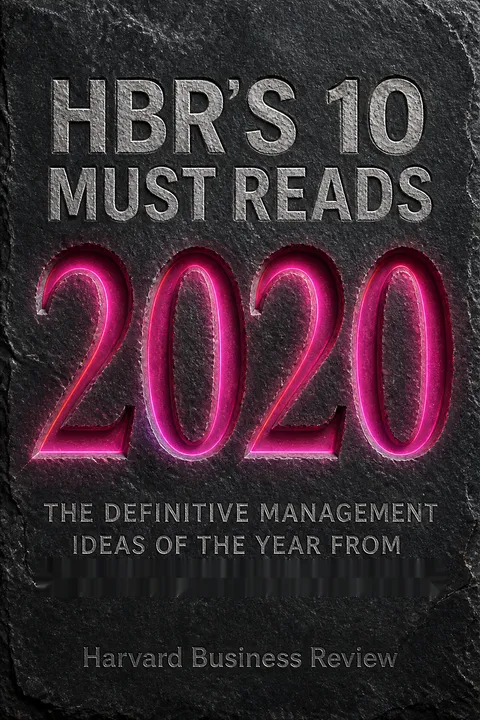
HBR's 10 Must Reads 2020 receives mixed reviews, with an average rating of 3.88 out of 5. Readers appreciate the diverse topics covered, including leadership strategies, operational transparency, and addressing an aging workforce. Some find the articles insightful and challenging to the status quo, while others consider them less groundbreaking. Highlights include discussions on CEO time management, intergenerational collaboration, and the balance between profit and social responsibility. The book is praised for its practical advice and strategic perspective, though some reviewers found only a few articles relevant to their needs.
People Also Read









Glossary
operational transparency
visible service workThe deliberate design of ways for customers and employees to see work normally hidden inside an organization. The purpose is to help people recognize the effort, expertise, and value involved in a service. Transparency can also reveal poor performance or create anxiety, so its timing, audience, and degree need careful design.
collaborative intelligence
human and AI partnershipA way of organizing work in which people and artificial intelligence improve one another’s contributions. Machines can process information rapidly and at scale, while people supply judgment, creativity, social understanding, and oversight. The concept requires redesigned processes and human roles for training, interpreting, and responsibly maintaining AI systems.
fusion skills
skills for human-AI workCapabilities that help employees work effectively where human expertise and AI meet. They include deciding which tasks to delegate to a system, combining machine output with human judgment, teaching intelligent tools, asking them useful questions, and checking that their use is responsible.
Entrepreneurial Strategy Compass
start-up route comparisonA framework for comparing go-to-market strategies along two choices: whether to collaborate with incumbents or compete with them, and whether to protect control of an innovation or prioritize getting it into the market. The resulting routes help founders examine customers, technology, company identity, and competitors before committing resources.
hybrid organizing
organizing for dual goalsAn organizational approach that embeds social and financial aims in core activities. It involves setting and monitoring both kinds of goals, structuring work to support them, hiring and socializing employees around both, and using leadership practices that address tensions rather than allowing one purpose to displace the other.
longevity strategy
planning for longer livesA company strategy for responding to population aging through both internal workforce practices and external products or services. Internally, it can include age-inclusive hiring, retention, flexible work, and intergenerational collaboration. Externally, it addresses older customers’ varied needs while avoiding stereotypes and patronizing assumptions.
cognitive distance
distance from familiar thinkingThe mental gap between a current problem and ideas or solutions that are not immediately familiar. The strategy article uses the concept to explain why analogies, combinations, constraints, and examples from distant contexts can help strategists move beyond options suggested by existing industry routines.
relationship closeness induction
structured relationship buildingA research technique that uses a sequence of questions, beginning with less personal topics and moving toward greater self-disclosure, to encourage connection between strangers. The technique illustrates how the order and depth of questions can shape a conversation, rather than merely determine what information it contains.
agile teams
adaptive innovation groupsSmall, multidisciplinary teams that address complex work through modular tasks, rapid prototypes, frequent feedback, and adaptation to changing conditions. They are designed to stay close to customers and take responsibility for outcomes. At scale, they depend on supportive leadership, compatible systems, and effective coordination with non-agile functions.
About the Author
Other books by Harvard Business Review







Download PDF
Download EPUB
.epub digital book format is ideal for reading ebooks on phones, tablets, and e-readers.








