

Key Takeaways
Treat the sermon as a bridge from the text's claim to present obedience.
A crafted message. Ramesh Richard compares sermon preparation to wood sculpture. A sculptor works with material already given; a preacher works with Scripture, shaping its message for a particular congregation. The preacher’s skill matters, but it does not license changing the source. The aim is not merely to explain an ancient passage. It is to communicate its central claim in a way that informs understanding, engages the heart, and shapes conduct.
More than technique. Richard calls preaching both a spiritual relationship and a disciplined craft. Study, interpretation, and communication require practice, while prayer and dependence on the Holy Spirit belong throughout the work. Neither polished technique without spiritual seriousness nor spiritual enthusiasm without preparation is enough.
The sculptor image captures an important distinction between interpretation and invention. Skilled communication does not compete with fidelity; it makes fidelity audible to people who do not share the original setting. This resembles translation more than free composition: meaning must survive a change of audience and idiom. The theological premise that Scripture is divinely authoritative is specific to Richard's tradition, not a neutral starting point for every preacher. Even within that tradition, authority is not secured by confidence alone. It depends on showing how the sermon follows from the passage.
Let the passage set the agenda, not your favorite moral or topic.
Text before theme. Richard distinguishes textual exposition, where a passage determines the sermon’s subject and direction, from topical exposition, where the preacher chooses the subject and gathers relevant texts. A topical sermon can address an urgent event or teach a biblical theme, but it demands care: selected verses must support the argument rather than decorate a message chosen in advance. Preaching through successive passages can reduce the weekly temptation to choose only familiar or comfortable subjects.
A warning in miniature. A sermon on Jesus’ entry into Jerusalem turns the borrowed donkey into a symbol for believers, then builds advice from that analogy. The sermon may sound useful, but the passage itself does not establish that meaning. For Richard, a moral lesson is not automatically the passage’s message.
This approach treats the source text as a constraint on the speaker, a valuable check against motivated reasoning. In legal interpretation and historical scholarship, the same discipline asks whether an argument is supported by the evidence or merely attached to it. Yet textual preaching does not eliminate selection: the preacher chooses the passage, its boundaries, and the emphasis of the sermon. Consecutive preaching can reduce selective avoidance, but it cannot make those choices neutral. Accountability requires making the interpretive path visible to listeners.
Observe first, interpret second, and consult authorities only after your own work.
Notice before explaining. Begin by marking significant, repeated, or unusual words, then examine how the sentences and scenes relate. Richard urges preachers to ask about grammar, logic, chronology, setting, literary form, and the surrounding biblical book. A verse about Job’s hope, for example, changes its force when read within the book’s debate about suffering rather than treated as a free-standing Easter slogan.
Questions discipline insight. Ask what a word meant in its original setting, what an author is arguing, and what the text’s details contribute. Then compare possible answers against the passage’s unity, context, simplicity, and the interpreter’s own assumptions. Richard recommends consulting study tools after an initial independent reading, so commentaries inform judgment instead of quietly supplying it.
The sequence protects against anchoring, the cognitive tendency to let an early suggestion shape later judgment. Reading the passage before opening commentaries gives the interpreter a chance to notice what a secondary source may overlook. Still, solitary reading is not automatically unbiased, and the book itself encourages later comparison with other scholars. A healthy method combines independent observation with informed correction. Its strongest safeguard is not the order of tools alone, but the willingness to revise a conclusion when grammar, context, or better evidence challenges it.
Let the author's structure, including tiny connecting words, shape your outline.
Small words steer thought. Words such as because, but, therefore, and so that can reveal whether a passage gives a reason, contrast, result, or purpose. Richard asks preachers to identify structural signals, distinguish major divisions from minor ones, determine what the signals mean, and outline the passage accordingly. In Ezra’s resolve to study, practice, and teach the law, repeated grammatical links reveal three related actions rather than three ideas imposed from outside.
Follow the literary movement. Grammar is not the only guide. A shift in topic, speaker, place, or type of statement can mark a new section. Narrative, poetry, prophecy, and letters also communicate differently, so the outline should reflect the kind of writing being interpreted. Verse divisions can help, but they are clues rather than the author’s final authority.
This is a close-reading practice with a practical payoff: the outline becomes an argument about how the passage works, not just a list of themes. In rhetoric, conjunctions and transitions often carry more argumentative weight than their small size suggests. The method also gives listeners a way to inspect the preacher’s reasoning. A caution is necessary: a connector can bear different force in different contexts, and translations may conceal ambiguity. Structural analysis should sharpen interpretation, not create a false sense that every outline is mechanically certain.
Reduce each passage to one accurate, adequate sentence before composing the sermon.
Name the passage's claim. Richard calls this sentence the central proposition of the text. It has a theme, what the author discusses, and a thrust, what the author says about it. Both parts matter. Calling Psalm 117 a song about praise is true but incomplete: its argument gives a reason for universal praise, grounded in God’s enduring loyalty and truth. The summary should capture the passage’s distinctive emphasis without becoming a vague slogan.
Let the outline earn the sentence. The proposition is not a catchy idea chosen at the start. It grows from studying the words and structure, then checking whether it accounts for the passage’s major sections. A clear sentence helps the preacher and congregation recognize what belongs in the sermon and what is interesting but secondary.
A single governing claim reduces cognitive load. Listeners can retain a central idea more readily than a sequence of disconnected observations, while the supporting details give that idea substance. The risk is compression that erases tension or ambiguity, especially in poetry and narrative. Richard’s standard of both accuracy and adequacy helps: the sentence should be concise without pretending the passage is simpler than it is. It is best treated as a testable summary, not a substitute for the text’s texture.
Use audience need to choose the sermon's aim, not to rewrite Scripture.
Build a purpose bridge. Richard’s purpose bridge connects the passage’s central claim to what a particular audience needs to understand or do. The preacher asks what response the text supports, then checks two things: whether that aim fits the passage’s meaning and whether it addresses the congregation’s actual condition. One passage can support different sermons for different audiences, but only within limits set by its central claim.
Context changes emphasis. Richard describes preaching Isaiah’s vision of future reconciliation among Israel’s neighboring nations during the 1991 Gulf War. He could have emphasized future hope or the reach of salvation; for a divided American audience, he chose to address how faith in that future might help people face present conflict. The audience shaped the sermon’s aim without replacing the passage’s subject.
This bridge resembles audience design in communication: a message becomes effective when its purpose meets the listener’s situation. The example shows that relevance is not an ornamental application added after interpretation; it influences what the sermon emphasizes. But audience needs can also distort. A preacher may define a congregation’s problem too narrowly or mistake personal preference for shared need. The dual test, textual compatibility and attentive knowledge of listeners, is therefore crucial. Relevance should guide the route through the text, not dictate its destination.
Preserve a narrative's actual point before drawing a lesson for today.
History is not a fable. Richard warns against turning every biblical event into a generalized moral illustration. In Luke’s account of Jesus calling disciples, for instance, the fish-catching details should not automatically become a set of universal tips for successful ministry. The narrative’s climax and purpose matter more than the preacher’s ingenuity. Likewise, Jonah’s journey is not a warning against boats; its movements serve the story’s account of a prophet resisting a known assignment.
Apply through warranted links. Richard calls the risky move principilization: extracting a broad principle and applying it without showing that the passage supports it. A responsible application distinguishes what happened then from what listeners should do now, and explains the connection. The story remains a particular event with its own theological emphasis, not a blank screen for advice.
This distinction is central to responsible historical reading. A real event does not become a universal rule merely because a modern speaker can find a resemblance between past and present. The same caution appears in anthropology, where interpreters avoid reducing unfamiliar practices to familiar categories too quickly. Yet application cannot stop at historical distance: a sermon must explain why the event matters now. Richard’s solution is disciplined analogy, with the text’s purpose controlling the connection. That is harder than extracting a slogan, but it is also more intellectually honest.
Build an argument listeners can follow, remember, and test against the passage.
Design for comprehension. Richard divides a sermon into an opening, a body, and a conclusion. The opening should capture attention, raise a need, introduce the theme, and state the sermon’s aim. The body should develop the passage’s main movements in a clear order, with transitions that show how one point leads to another. The conclusion gathers the argument and brings the audience to the destination named at the beginning.
Make each point accountable. A main point should be stated clearly, anchored in the passage, justified from its details, explained in familiar language, and applied where appropriate. Richard calls this sequence SAVE (a) Point. Illustrations help listeners grasp unfamiliar ideas, but they should clarify the claim rather than become the sermon’s main attraction. A final title or memorable phrase can aid recall without controlling interpretation.
The structure joins classical rhetoric’s concerns with attention, proof, and audience response. It also offers a practical antidote to sermons that feel like either a lecture dump or an entertaining story without an argument. The requirement to anchor and validate each point makes the sermon’s logic inspectable. Still, a single outline cannot fit every genre or congregation. Narrative preaching may need suspense, while a tightly argued letter may suit a more direct progression. The framework is strongest as a diagnostic, not as a mandatory script.
Application must answer what it means, why it matters, and what to do.
Make relevance actionable. Richard distinguishes explaining a truth from showing its present importance and specifying a response. He calls these the what, the so what, and the now what. Application may concern belief, values, or conduct, and it should be shaped for the people actually listening. Telling a congregation to forgive, for example, is incomplete if the sermon never considers what forgiveness might require in strained relationships or what objections listeners may have.
Avoid vague commands. Application should be concrete enough that people can picture an act of obedience, and it should remain grounded in the passage. Richard urges preachers to consider different areas of life and to anticipate resistance rather than assume that listeners will apply the lesson automatically. The sermon’s ending should clarify the response, not introduce a fresh topic.
This is a theory of implementation, not merely inspiration. In behavioral science, an intention is more likely to guide action when it is connected to a concrete situation and an identifiable next step. Richard’s emphasis on anticipated objections recognizes that listeners do not receive advice in a vacuum. There is a necessary boundary, however: specificity must not become overreach. A preacher should distinguish a text’s demand from one possible strategy for meeting it, especially when listeners face different constraints or serious personal circumstances.
Prepare fully, then deliver freely, with craft serving spiritual dependence.
Writing clarifies thought. Richard recommends writing out the sermon before preaching, even for speakers who plan to use no notes. A manuscript exposes weak transitions, unsupported claims, missing illustrations, and excessive length. It also gives the preacher a record for review and adaptation. The goal is to internalize the message rather than recite it from memory, so the speaker can communicate naturally while remaining clear about the argument.
Delivery carries meaning. Facial expression, eye contact, gestures, pace, pitch, and volume can reinforce or undermine spoken content. Richard advises recording and evaluating sermons to identify distracting habits. He also insists that technique cannot replace spiritual preparation: prayer, ethical self-examination, and dependence on the Holy Spirit belong to the whole process, from study through delivery.
The distinction between preparation and spontaneity is useful well beyond preaching. Expertise often creates freedom because deliberate rehearsal makes the performer less dependent on moment-to-moment improvisation. Writing can also expose gaps that confidence conceals. The book’s account of spiritual dependence is theological rather than experimentally measurable, but it serves a practical purpose: it limits the preacher’s temptation to claim control over listeners or outcomes. Delivery skill matters, yet it should communicate the message rather than turn the speaker into its spectacle.
Analysis
Richard’s method is an integrated account of interpretation, rhetoric, and pastoral responsibility. Its distinctive move is the bridge between a passage’s claim and a congregation’s need. Without that bridge, textual study can become an academic lecture; without the textual constraint, relevance can become a preacher’s preference dressed in biblical language. The book’s sequence makes those risks visible: attend to the passage, map its movement, formulate its central claim, identify a justified purpose, and then shape a message for particular hearers.
The method is especially strong where it resists convenient readings. The donkey sermon demonstrates how a plausible metaphor can generate advice without textual warrant. The warning against turning narratives into moral parables protects their historical and literary particularity. Likewise, the insistence on a complete central proposition helps prevent sermons from dissolving into loosely related observations. These disciplines make interpretation more accountable, even for readers who do not share the author’s theological assumptions.
The main tension is between a stable proposition and the fluidity of live communication. A sermon needs focus, but passages can contain ambiguity, emotional texture, or competing emphases that a single sentence risks flattening. Audience analysis also depends on judgment: a preacher can mistake a personal diagnosis for a congregation’s real condition. Richard’s answer is not to eliminate judgment, but to test it against the passage and the people. That is a defensible standard, though it cannot produce certainty by formula.
The book is best understood as a training system, not a guarantee of persuasive or faithful preaching. Its mechanics require practice, while its spiritual claims remain convictions that the preacher must embody rather than merely announce. Its lasting contribution is a disciplined humility: the preacher is neither free to make the text say anything nor excused from making it intelligible now.
Review Summary
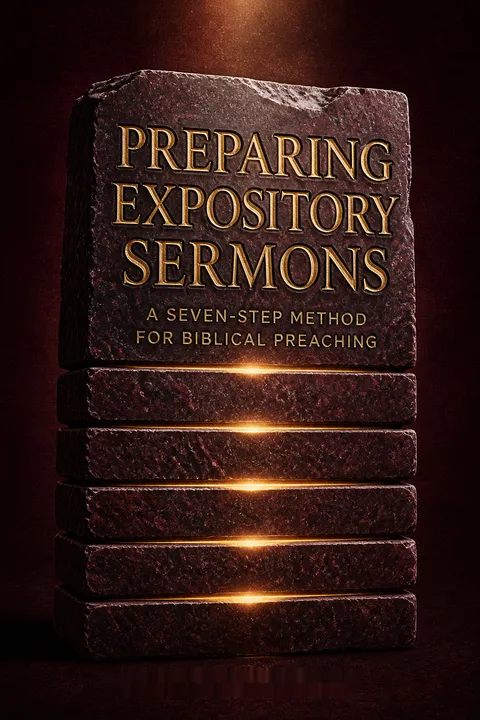
Preparing Expository Sermons receives mixed reviews, with an average rating of 4 out of 5. Readers appreciate its concise, structured approach to sermon preparation, particularly for beginners. The seven-step method is praised for its technical proficiency and helpfulness in crafting well-structured sermons. However, some find it rudimentary and lacking depth for experienced preachers. Critics note its dated content and suggest other resources may be more comprehensive. The book's appendices are considered valuable additions, though some reviewers find the writing style dry and overwhelming at times.
People Also Read







Glossary
Scripture Sculpture
A text-to-sermon methodRichard’s name for a seven-part process of developing an expository sermon. The preacher studies and outlines a biblical passage, identifies its central claim, determines a purpose for a particular audience, formulates the sermon’s main idea, structures the message, and prepares its delivery. The sculpture metaphor emphasizes shaping the sermon from material supplied by Scripture.
central proposition of the text
The passage's governing claimA complete sentence summarizing the main thought that unifies a biblical passage. It has a theme, the subject the author discusses, and a thrust, what the author asserts about that subject. Richard uses this proposition as a check on whether the sermon’s claims and applications arise from the passage rather than from the preacher’s preferences.
purpose bridge
Text-to-audience connectionThe reasoning step that connects a passage’s central claim to a sermon’s intended effect on a particular audience. The preacher asks what the audience should understand or obey in light of the passage, then tests whether that aim fits both the text and the listeners’ actual situation. It shapes the sermon’s emphasis without granting permission to alter the text’s meaning.
central proposition of the sermon
The sermon’s unifying messageA concise statement of what the sermon is about and what it aims to establish or explain for its present audience. It grows from the passage’s central proposition, filtered through the sermon’s purpose, and is expressed in language listeners can grasp and remember. It guides the introduction, body, illustrations, application, and conclusion.
principilization
Generalizing a text into a principleRichard’s term for extracting a broad, seemingly universal lesson from a passage and applying it to modern life. He warns that this move can ignore a text’s historical setting, literary form, and particular purpose, especially in narrative. A proposed principle should be demonstrably rooted in the passage rather than imposed on it as a convenient moral.
SAVE (a) Point
A point-development checklistRichard’s checklist for developing a sermon point: state it clearly, anchor it in the passage, validate the reasoning behind it, explain it, and apply it when appropriate. The sequence helps the listener understand both the claim and its textual basis. Application may be delayed in a sermon whose structure builds toward a later conclusion.
Download PDF
Download EPUB
.epub digital book format is ideal for reading ebooks on phones, tablets, and e-readers.








