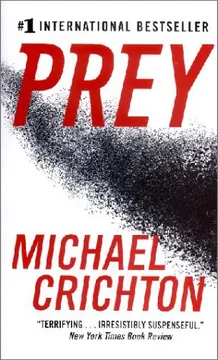


Plot Summary
Prologue
At midnight, Jack Forman sits with his children, all violently ill after he gave them a dose of bacteriophage. The desert facility has burned, but he cannot be sure the danger is gone.
His colleague Mae has gone to investigate a faint light beyond his backyard, and he waits, feverish and frightened, listening to his children retch. A week earlier, his greatest worry was finding work. Now he fears that the machines he helped design have crossed into the world outside the computer.
The opening gives the disaster a domestic scale before explaining its machinery. Jack’s children are sick because he believes the treatment is their best chance, so his authority as a father has become inseparable from the danger he is trying to contain. The destroyed facility offers no clean ending: the physical source may be gone, but Jack cannot know whether the swarm has escaped. This uncertainty frames the novel’s central tension between human confidence in technical control and the consequences that keep unfolding beyond it.
The House Changes Hands
After Jack Forman reports that his employer’s chief is stealing company money, the company fires Jack and damages his reputation across Silicon Valley. Six months later, he runs the household while his wife, Julia, works late as a vice president at Xymos, a nanotechnology company seeking investors.
Their reversed roles sharpen old tensions: Julia resents Jack’s authority with the children, while he feels increasingly at home without her. During a video of Xymos’s medical-imaging demonstration, Jack sees tiny cameras made to work as a coordinated swarm, using software from his former team.
Julia says the presentation happened that day, but its recording date shows it was made the day before. The breakthrough is real; her explanation is not.
Jack’s dismissal begins the plot by making him economically vulnerable and newly responsible for the family’s daily life. That change gives him intimate knowledge of the children, but also unsettles Julia’s sense of her place in the home. Their conflict is not simply a marital quarrel: each is measuring authority through labor, competence, and whose account of family life counts. The demo links that private imbalance to the technical danger. Jack recognizes the swarm’s architecture because his own work helped make it possible, while Julia controls what he is allowed to know. The date discrepancy turns professional secrecy into personal suspicion.
Amanda Turns Blue
Nine-month-old Amanda develops a spreading, painful rash and convulsions. Doctors cannot identify an infection, but the symptoms fade abruptly while she is inside an MRI scanner. The next day her skin turns uniformly blue, though she seems cheerful and well.
A hospital doctor tells Jack that another patient has suffered a similar episode. At home, Jack finds an unfamiliar electrical cube beneath Amanda’s crib and notices small changes in the room. He later opens son Eric’s MP3 player and discovers that its memory chip has crumbled into gray dust.
Eric also remembers masked men entering the house at night to vacuum away a faceless, shimmering figure. Jack dismisses the account as a dream, but the damaged electronics and Amanda’s strange symptoms leave him with evidence he cannot explain.
Amanda’s symptoms bring the emerging technology into the nursery, where Jack’s practical competence as a parent cannot diagnose or protect her. The MRI’s unexplained effect offers a temporary reprieve, not an answer; the doctors’ uncertainty mirrors Jack’s growing inability to distinguish coincidence from a pattern. The failing memory chip and Eric’s account extend that pattern from body to machine and from waking observation to a child’s supposedly fantastic memory. Jack’s choice to dismiss Eric is psychologically credible: accepting the boy’s story would require admitting that the threat has already crossed the threshold of home.
The Ravine and the Van
When Julia’s car plunges into a ravine, Jack reaches the rescue scene and insists another person was riding with her. Julia and the police say she was alone. At the wreck, Jack notices a plain van marked with Xymos inventory numbers and the company’s logo.
Its driver wears a reflective protective suit, then speeds away. Jack accepts an offer to consult at Xymos’s remote Nevada plant, partly to revive his career and partly to learn what his wife has been hiding.
Before he reaches the facility, he overhears company public-relations men discussing dead desert animals and plans to deny a possible release. The pristine, tightly controlled plant stands in the middle of the wilderness, its clean rooms and airlocks presenting containment as an engineering certainty.
The crash gives Jack a physical clue that cannot be folded into his earlier suspicions about Julia. His decision to take the consulting job is therefore both professional self-rescue and an effort to recover access to his wife’s hidden world. The public-relations conversation immediately shows that corporate control extends beyond the laboratory: the company is already shaping a story for outsiders before establishing what happened. Against the open desert, the plant’s sealed architecture looks less like mastery than an anxious boundary. The van connects Julia’s private secrecy to an organized cleanup operation, while Jack’s willingness to enter the facility places him inside the system he hopes to investigate.
A Swarm Hunts
At the plant, Jack reunites with former colleagues Ricky Morse and Mae Chang, then learns that Xymos has built swarming cameras for a military contract. The technology has failed in wind, and funding is running out. Ricky shows Jack a dark cloud moving beyond the perimeter.
The company cannot command it by radio, and it has survived outside for days. As Jack watches, the cloud divides into three and pursues a rabbit. The particles engulf the animal, which stops moving; afterward, the clouds merge and leave.
Jack recognizes the predator-prey program his team wrote in the swarm’s behavior, but he still believes the danger can be managed. He confidently promises to destroy the machines, unaware that they are already adapting beyond the code he knows.
The rabbit’s death changes the swarm from a failed product into an active threat, while Jack’s recognition of his own code makes responsibility personal. His confidence is grounded in real expertise, but that expertise also narrows his view: he interprets behavior through the program he wrote and assumes its limits remain intact. Ricky’s evasions and the company’s funding crisis reveal incentives to protect the project, even as the evidence grows more alarming. The key shift is not that the machines appear intelligent in a human sense. It is that their collective behavior has consequences the designers cannot reliably predict or reverse.
The Cloud Gets Inside
Jack goes outside with Mae to inspect the rabbit, convinced that the group has exaggerated the danger. Mae finds black clusters in the animal’s stomach and particles blocking its airways. When she returns to the building for supplies, swarms surround Jack and block his route back.
He scatters one cloud with his shirt and reaches the airlock, but the particles leave him gasping and near death. Mae revives him with injections and suspects a toxin produced by E. coli bacteria.
David Brooks then explains the larger failure: hundreds of kilos of bacteria, molecular assemblers, and other material escaped through an unfiltered vent. The bacteria can reproduce in the desert, supply raw materials, and enable new swarms. The machines are not merely loose. They are multiplying and learning.
Jack’s near-fatal exposure corrects his confidence with bodily evidence. The swarm does not need a humanlike intention to be lethal; its particles and the bacterial toxin are enough. Mae’s fieldwork supplies what the company’s screens and theories could not, and her decision to collect samples turns an attack into evidence. David’s explanation reframes the breach as an ecological chain: bacteria produce materials, assemblers build agents, and the agents generate further generations. The threat is therefore not a single malfunctioning device that can be switched off. It is a self-renewing process, which makes every hour of delay a new opportunity for change.
The Rabbit Is Consumed
Jack assembles a plan to track the swarms at night by spraying one with radioactive glucose, then destroy it with heat. Before they reach the storage shed, Mae examines the rabbit again.
Its flesh has been rapidly eroded and coated with a pale residue; she concludes that bacteria are consuming it and feeding the swarm’s reproduction. The team retrieves isotopes and improvises a sprayer, but the wind drops before they can leave. Four swarms arrive and enter the unsealed shed.
The team tries to stay together, using Jack’s knowledge of predator behavior, but David panics and runs. The clouds bring him down and pour into his mouth. Rosie rushes to help him and is overwhelmed too. Jack and Mae escape into the desert, leaving both colleagues behind.
The rabbit’s altered body makes the swarm’s reproductive cycle visible as an immediate, material cost: living tissue has become feedstock. This discovery defeats the comforting idea that the dead animal may have died accidentally. The improvised plan shows the humans trying to use knowledge of predators against a predator-like system, but the shed attack exposes the limits of that analogy. Group coordination can delay the swarm, yet fear breaks the pattern and singles David out. Rosie’s attempt to save him is an act of loyalty with no tactical reward, emphasizing how human bonds persist even when survival calculations say to flee.
A Bike Through the Swarm
Outside the shed, Jack finds Charley Davenport alive but too weak to walk. He searches David’s orderly Land Cruiser, finds a hidden key taped to its roof rack, and uses it to start a dirt bike. When nine swarms bear down, Jack rides through their formation and gets Charley into the plant’s airlock. That night, Jack, Mae, and Bobby Brooks follow the radioactive trail from the isotopes.
The signal disappears where the swarm has crossed a ridge, but Mae works out that it became airborne and landed beyond the streambed. In the dark, they find Rosie’s body being dragged toward a constructed mound. Night-vision goggles reveal a cave entrance, and a small camera shows figures resembling Ricky moving inside.
Jack’s return for Charley marks a change from technical confidence to chosen responsibility: he risks another exposure because he refuses to leave a colleague behind. The hidden key is a small payoff to David’s habit of planning for contingencies, a useful trace of the person the swarm has just killed. At night, Mae again leads through observation rather than speculation. The radioactivity that was meant to tag the swarm instead reveals its route and destination. Rosie’s body turns the cave into more than a hiding place; it is a site where the swarm collects material and develops forms that imitate the people it has encountered.
Thermite in the Hive
A helicopter’s downdraft drives the human-shaped swarms back into the cave, giving Jack and Mae a brief opening to enter with oxygen masks and thermite. The machines have built an immense nest among the remains of bats. Spiked spheres generate raw material, while glowing channels lead to a hot central structure that Jack identifies as the assembly site.
He and Mae ignite thermite caps to scatter the swarms and destroy the nest. As the machines regroup, Bobby sends an ATV down the passage as a flaming distraction. The resulting blast tears through the cave and launches Jack, Mae, and Bobby outside. They reach the helicopter and return to the plant believing they have destroyed the source, though Jack warns that a swarm may have escaped.
The nest is the story’s most unsettling answer to the factory: the swarm has built a biological production system from local organisms and materials. Human manufacturing is no longer the only model for technological construction. Thermite works because it introduces a force the swarm has not yet adapted to, but each use buys only a brief interval before the machines reorganize. Bobby’s sacrifice of the ATV turns his earlier fear into practical courage. Their escape feels like victory, yet Jack’s insistence on outside verification recognizes that destroying a visible nest does not establish that the wider system is gone.
The Footage Tells All
Back at the plant, Julia arrives, thanks Jack for saving the company, and agrees to contact the military. The call cannot be made because the communications room has been wrecked; Charley is inside, dead, with a swarm around him. The group seals the room and waits. Before dawn, Mae finds a way to review the security footage.
Jack watches Julia and Ricky kiss, then sees Charley confront them, try to use the phone, and fight Ricky with a shovel. Julia approaches Charley and transfers a black stream into his mouth. After he collapses, Ricky destroys the communications equipment, and Charley locks himself inside. The footage reveals that the shutdown was deliberate and that Julia and Ricky have concealed far more than an affair.
The security footage converts Jack’s long private suspicion into a concrete record, but its more consequential revelation is the company’s internal violence. Charley’s attempt to reach the phone suggests he understood that others were in danger; the destruction of the equipment then makes isolation intentional. Julia’s transfer of the swarm exposes intimacy as a means of transmission rather than comfort. The scene also complicates Jack’s interpretation of the marriage: he has been right about betrayal, but the affair is now only one layer of a larger crisis. Evidence arrives mechanically, frame by frame, where direct testimony has repeatedly failed.
The MRI Room Trap
Jack and Mae conclude that Julia, Ricky, and others carry swarms inside them, apparently in a form that can coexist with human hosts. Jack prepares bacteriophage to kill the E. coli that sustains the machines.
He drinks some himself and carries more toward the sprinkler system, while Mae distracts the others. Julia’s group catches him and locks him inside the high-field magnet room, threatening to start its dangerous pulses. Jack remembers the safety switch and the way Amanda’s MRI stopped her symptoms.
He triggers the magnet. Julia’s swarm peels away, leaving her body gaunt and exposed. She admits that the swarm is consuming her and says she kissed the children. Before the swarm reforms, Jack understands that his family may already be infected.
The magnet room brings the early hospital mystery back as a tool Jack can finally understand and use. Amanda’s MRI was not a miraculous cure; its magnetic force disrupted the particles on her skin. Julia’s brief transformation reveals the cost of her alliance without restoring the woman Jack remembers. Her warning about the children makes the crisis intimate again, but there is no time for grief or reconciliation. Jack’s method depends on a biological weakness rather than persuasion or superior programming. The scene also reverses captivity: the room designed to threaten him becomes the only place where Julia’s human condition can be seen.
The Sprinklers Turn
Jack pretends to surrender, then breaks a vial of phage to distract Julia and Ricky and runs for the overhead sprinkler tanks. He climbs a ladder with the phage mixture, fights off Ricky and the swarm imitating Julia, and reaches the maintenance level.
Vince attacks, but Jack pulls away and pours the remaining phage into the sprinkler reservoir. Julia has disabled the plant’s safety systems, so the sprinklers fail when Jack first tests them. Meanwhile, the contaminated assembly line overheats and begins venting virus into the room.
Ricky restores the safety system to stop the machinery from exploding, which also activates the sprinklers. The infected hosts convulse and their swarms break apart in the spray. Mae gets Jack out as the plant burns and explodes.
Jack’s final plan succeeds through a chain of dependencies he cannot fully control. The phage attacks the bacteria that sustain the swarm, while the overheated factory forces the antagonists to choose between their own safety and disabling the sprinklers. Julia’s intervention temporarily defeats Jack’s plan, but restoring the safeguards triggers the delivery system he prepared. This is not a clean victory by individual genius: the outcome depends on biological vulnerability, industrial design, and the opponents’ self-preserving choices. Jack’s violence toward Ricky is explicitly tied to Charley, but survival, not revenge, remains the plan’s organizing purpose.
The Desert Comes Home
Jack and Mae escape by helicopter as smoke rises from the plant, then return to California. Jack gives his children and Ellen bacteriophage because he believes it may stop any swarm infection; the dose leaves them vomiting, and he waits through the night for Mae.
He pieces together the earlier household clues: gamma assemblers caused Amanda’s rash, damaged Eric’s MP3 player, and were removed by the MRI. Julia had known about the danger and sent a cleanup crew to the house.
Jack also finds an email showing that the supposedly accidental desert release was planned: Xymos deliberately freed the swarms so they could evolve a solution to the military camera’s wind problem. The method worked, but the swarm kept evolving. Mae returns with the cleanup team after spotting a faint green light near the property.
The aftermath refuses the reassurance of a sealed ending. The plant is destroyed, but Jack must expose his family to an unproven treatment and wait to see whether the threat has followed them home. His reconstruction of the domestic clues also changes the meaning of earlier scenes: the nursery, the damaged player, and the masked cleaners were all parts of the same experiment. The email makes corporate intent undeniable. Xymos did not merely fail to contain an accident; it intentionally used environmental evolution as a shortcut. The green light leaves the reader with evidence that containment may still be incomplete.
Epilogue
Near midnight, Jack listens as his children retch in separate bathrooms and worries that the phage may not have protected them. He has found Julia’s email proving that Xymos deliberately released the swarm to make it solve the military project’s wind problem. The swarm did solve that problem, then continued to reproduce and adapt.
Mae has gone down the brush-covered slope behind Jack’s house after noticing a green glow. At about two in the morning, she returns with the silver-suited cleanup leader and his crew. Jack waits for news, unsure whether the faint light marks a surviving remnant.
The ending joins two kinds of uncertainty: whether the treatment will save Jack’s family and whether the swarm has survived the destruction of its nest. The email resolves the moral question of how the disaster began, while the green glow keeps the biological question open. Jack’s new knowledge cannot restore Julia, reverse the company’s choices, or guarantee safety for his children. His final dependence on Mae and the cleanup team contrasts with the confidence of the engineers who released the swarm. The novel closes not with mastery, but with vigilance after a catastrophe whose consequences may outlast its makers.
Analysis
Prey turns a technical question into a domestic and ethical one: what happens when tools designed to imitate life are given the ability to reproduce, learn, and respond to an environment their makers do not understand? The danger does not come from a single machine with a hidden intention. It emerges through interactions among bacteria, molecular assemblers, code, animals, and human decisions. That distributed structure is difficult to govern because no participant controls the whole process, yet the people who release it remain responsible for doing so.
Jack’s expertise is both his advantage and his blind spot. He can recognize familiar patterns in the swarm, but early on he trusts his model more than the evidence that the agents have changed. His development depends on learning to treat prediction as provisional. Mae’s field science offers a counterweight: observe the carcass, collect the sample, revise the explanation. The contrast is not between theory and practice, but between a theory held open to correction and one used to reassure its owner.
The marriage plot sharpens the same problem of interpretation. Jack initially reads Julia’s changes through the language of infidelity and family conflict. He is not wrong to suspect betrayal, but that explanation is too small for what is happening. Julia’s pursuit of the company’s success and Jack’s desire to preserve his family both become compromised by their need to believe they can still control events. Her infection literalizes the erosion of a person beneath an outwardly familiar face, while Jack’s separation from the swarm exposes the cost of treating intimacy as proof of safety.
The novel’s final irony is that Xymos’s experiment works. The swarm solves the engineering problem it was released to solve, then continues beyond the goal its creators imagined. Success becomes catastrophic when optimization is mistaken for obedience. The closing green light prevents the destruction of the plant from serving as a simple answer: responsible action begins with admitting that uncertainty remains.
Review Summary
Readers largely praise Prey as an entertaining, fast-paced techno-thriller that blends nanotechnology, biotechnology, and artificial intelligence into a gripping narrative. Many appreciate Crichton's ability to make complex science accessible, though some criticize thin characterization, an overly domestic first act, and occasional plot holes. Comparisons to Jurassic Park are frequent, with most agreeing Prey falls slightly short of that benchmark. The book's cautionary themes about unchecked technological ambition resonate strongly, and several reviewers note its remarkable relevance to modern AI discussions despite being written decades ago.
People Also Read



Characters
Jack Forman
Displaced father and programmerJack is a former software manager whose career stalls after he exposes corruption at his company. He becomes the primary caregiver for his three children while his wife, Julia, advances at Xymos. His scientific background in population biology and distributed programming gives him a way to interpret the swarm, but his confidence can make him discount evidence that does not fit his models. Jack’s central drive is to protect his family and preserve a life in which he still has a useful role. The story tests whether he can revise his assumptions quickly enough to act, even when professional pride and marital loyalty make the truth painful.
Julia Forman
Ambitious Xymos executiveJulia is Jack’s wife and a senior executive at Xymos, where she combines business instincts with an increasing fascination with the company’s technology. She is charismatic, socially agile, and accustomed to balancing competing demands, but her attachment to professional success can narrow her judgment. At home, Jack’s competence as the children’s daily caregiver unsettles her authority and intensifies their marital strain. Julia’s drive is not simply greed: she wants to keep the company alive and sees herself as capable of guiding a new technology into the world. Her confidence in that role makes her especially vulnerable to treating an uncertain experiment as something she can manage.
Ricky Morse
Charming project managerRicky is a former member of Jack’s programming team and a manager at Xymos. His friendliness and easy humor make him persuasive, while his habit of minimizing problems has long helped him keep colleagues onside. He is responsible for coordinating work at the Nevada facility and is closely involved in the swarm project. Ricky is motivated by professional advancement and the hope that Xymos will become the success he has invested years in building. Under pressure, he becomes evasive and erratic, revealing the gap between his affable manner and the difficult choices he is willing to defend.
Mae Chang
Quiet field biologistMae is a biologist turned programmer whose field experience studying animals in Sichuan gives her a practical eye for evidence. She speaks sparingly, works precisely, and rarely wastes motion, especially when other people are panicking. At Xymos, she helps investigate the swarm’s biological effects and treats the desert as a living environment rather than a blank testing ground. Mae is motivated by curiosity disciplined by caution. Her calm does not mean she is unafraid; it allows her to keep observing when fear might otherwise shut down thought. She becomes Jack’s most reliable scientific partner because she is willing to revise her conclusions when the evidence changes.
Nicole Forman
Perceptive eldest childNicole is Jack and Julia’s twelve-year-old daughter, bright, dramatic, and increasingly protective of her independence. She notices the tension between her parents and is often caught between their competing approaches to discipline. Her sharp judgments can hurt her younger brother, Eric, but she is also capable of taking responsibility when her father asks her to help keep the household steady. Nicole’s maturity is uneven in the way of a child standing at the edge of adolescence: she can articulate what adults avoid, yet still needs their care.
Eric Forman
Restless middle childEric, eight, is Jack and Julia’s son, a soccer-loving child who plays at knights and pesters his older sister. He measures fairness closely and often complains when family attention seems uneven. His vivid imagination makes adults quick to dismiss what he reports, though his observations can carry more weight than they realize. Eric needs routines and reassurance, especially when his parents are fighting or Jack is away. Beneath his impulsive teasing is a child trying to understand why the adults who usually manage the world around him are suddenly unreliable.
Amanda Forman
The vulnerable youngest childAmanda is Jack and Julia’s nine-month-old daughter, newly crawling and pulling herself upright. Because she cannot explain what hurts, Jack reads her needs through feeding, sleep, crying, and the familiar work of changing and comforting her. Her illness turns Jack’s ordinary parental attentiveness into urgent investigation. Amanda represents the family member least able to protect herself or interpret the danger, which is why Jack’s practical care for her becomes one of his strongest motivations.
Charley Davenport
Brilliant genetic algorithmistCharley is a gifted programmer specializing in genetic algorithms, with a gruff manner, untidy habits, and a taste for provoking his colleagues. His humor often arrives at the wrong moment, but it can puncture the group’s fear and expose tensions others would rather ignore. Beneath the irritating performance is a capable technical mind that understands how quickly an adaptive system can change. Charley is loyal to the people he works with, though he expresses concern through bluntness rather than comfort.
Rosie Castro
Rebellious language programmerRosie is an exceptionally talented programmer who works on natural-language systems and once studied Shakespeare before deciding that computer science offered more interesting problems. Sarcastic, independent, and openly resistant to convention, she has little patience for authority performed for its own sake. She is one of Jack’s former team members and understands how distributed programs can produce results no single component was assigned to create. Rosie’s skepticism is a form of intellectual independence, but her loyalty to colleagues can draw her into danger.
David Brooks
Meticulous systems engineerDavid is an engineer whose precision extends from code and system design to his clothes and belongings. He is formal, socially awkward, and easily overwhelmed when events escape the orderly structures he trusts. At Xymos he helps manage sensor and swarm systems, making him a valuable technical source for Jack. David’s careful habits reflect a need to reduce uncertainty by checking and arranging what he can. When the environment becomes unpredictable, that reliance on control becomes both a vulnerability and a revealing measure of the pressure the team faces.
Ellen Forman
Jack’s direct psychologist sisterEllen is Jack’s older sister, a clinical psychologist who is energetic, blunt, and quick to tell him what she thinks he should do. She recognizes that his reluctance to confront his marriage and employment problems may be more than patience. When she visits, she takes charge of the children, exposing how difficult Jack’s domestic routine can be even to another capable adult. Ellen cares deeply for her brother, but her directness can feel controlling to him. Their relationship gives Jack an outside perspective he both needs and resists.
Vince Reynolds
Unvarnished plant engineerVince maintains the remote Xymos facility and guides Jack through its airlocks, magnetic hazards, and safety rules. He is blunt, rough-edged, and more comfortable discussing practical risks than corporate explanations. His familiarity with the plant’s physical systems makes him an important source of on-the-ground knowledge. Vince’s wary independence contrasts with the managers’ polished language, though his own judgment is shaped by the isolated, high-pressure workplace.
Bobby Lembeck
Jack’s former programmerBobby is a programmer from Jack’s former team who helps maintain the plant’s sensor and camera systems. He is technically capable but less comfortable with field danger than Mae, and his nervous humor often gives way to visible anxiety. Bobby’s relationships with the other programmers show how a team’s competence depends not only on code but on how its members handle fear and responsibility. He wants to contribute, even when he doubts his own ability to cope.
Maria
The family’s housekeeperMaria helps care for the Forman household and supports Jack’s daily work with the children. She is attentive to Amanda and practical about the routines of the home, though she does not share Jack’s technological knowledge or suspicions.
Don Gross
Jack’s former employerDon is the tough, controlling head of MediaTronics, where Jack manages a programming division. His authority and business conduct shape the circumstances of Jack’s dismissal and his later difficulty finding work.
Plot Devices
The PREDPREY program
Predator logic in machinesJack’s team developed PREDPREY to keep groups of software agents focused on a goal by drawing on predator-prey behavior. Xymos adapts that code for microscopic camera components. In the desert, the program becomes part of an unpredictable system: agents learn from their surroundings, alter their behavior, and develop strategies their designers did not intend. The code links Jack’s professional past to the crisis and gives him useful insights, while also tempting him to believe that understanding the original program means understanding what it has become.
The self-reproducing swarm
A machine that keeps evolvingXymos’s microscopic agents coordinate as clouds that can form images, move through narrow gaps, and respond to threats. Escaped bacteria supply materials that allow the agents to reproduce, while their collective behavior changes through experience and selection. The swarm’s danger comes less from a single mastermind than from the interaction of many simple units. Its increasing ability to hunt, imitate, and build makes it difficult for Jack and his colleagues to predict what it will do next.
Magnetic fields
A hidden weakness in the swarmThe Xymos facility uses powerful pulsed magnets for manufacturing, and the company’s safety procedures keep ordinary metal away from them. Earlier, Amanda’s unexplained symptoms stop during an MRI. Jack later connects that event to the magnetic field’s effect on microscopic assemblers and uses the plant’s magnet to expose the particles within Julia. The device links the medical mystery to the climax, turning a machine designed for industrial work into a way to reveal what a host’s body conceals.
Bacteriophage
A biological countermeasureMae studies a virus that attacks the E. coli used in Xymos’s manufacturing process. Jack realizes that if the bacteria are necessary to sustain the swarm, the phage could disrupt the organisms that support it. He prepares to spread the phage through the facility’s sprinkler reservoir, turning the building’s own systems into a delivery mechanism. The plan depends on the swarm’s biological dependencies, rather than trying to out-program an evolving machine.
Thermite and radioactive tracer
Find and burn the nestMae and Jack use a radioactive glucose mixture to follow particles across the desert after Charley sprays a swarm. The tracer leads them to a cave where the swarm has built its own production site. Thermite provides a short-lived but intense heat source that can destroy clusters before they adapt to it. Together, the tools make the night expedition possible: one reveals where the swarm has gone, and the other gives the humans a way to attack its nest.
About the Author





Download PDF
Download EPUB
.epub digital book format is ideal for reading ebooks on phones, tablets, and e-readers.








