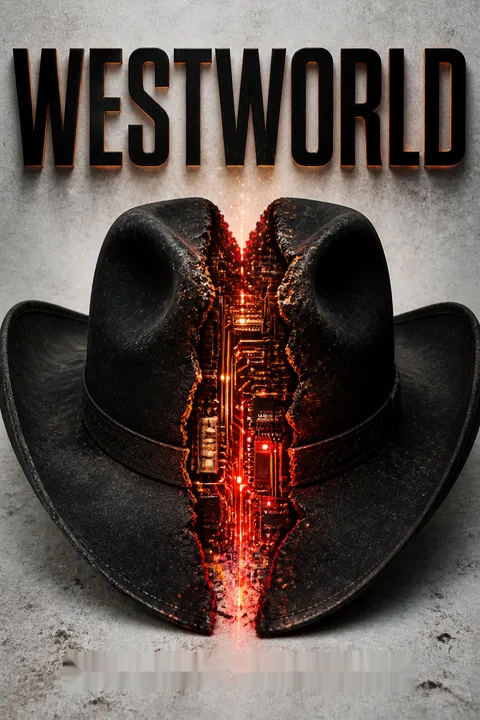


Plot Summary
Martin Buys the Wild West
Peter Martin, a Chicago lawyer still shaken by the end of his marriage, travels with his more seasoned friend John Blane to Delos, a costly resort where guests inhabit reconstructed historical worlds. Martin chooses Western World, hoping for adventure and a break from thoughts of his former wife and children.
The resort’s orientation promises carefully controlled danger, and staff issue guns fitted with sensors that prevent them from firing at warm-blooded guests. In town, Martin discovers that the bellhop’s nearly perfect hands reveal him as a machine. The shabby hotel and period details make the setting feel stubbornly real, but the locked-away modern clothes and armed welcome leave Martin both thrilled and faintly uneasy.
Martin enters the resort carrying private grief into a place designed to turn desire into a purchasable experience. His uncertainty is not simply fear of the machines; it is discomfort at how quickly an artificial world invites him to behave as if consequences have vanished. Blane understands the resort as entertainment and supplies the confidence Martin lacks. The gun sensor establishes the governing bargain: danger is permitted because technology supposedly knows how to contain it. That promise is practical, but it also encourages guests to stop asking who bears responsibility when the system fails.
A Saloon Duel Feels Real
In the saloon, Martin mistakes his unease for weakness when a black-clad gunslinger mocks him in front of the room. Blane urges him to stand his ground, and Martin draws.
He shoots the gunslinger, whose body falls in a convincing spray of blood; only afterward does Martin recognize the electronic eyes and accept that he has killed a machine. The resort’s staff remove the body, while Blane reassures him that the weapon cannot harm a human guest. Later, Martin visits Miss Carrie’s establishment and hesitates over whether its women are machines.
He eventually goes upstairs with Arlette, a programmed companion, and lets himself enjoy the encounter. By nightfall, his embarrassment has softened into confidence in the resort’s promise of consequence-free pleasure.
The duel converts fear into exhilaration by making Martin perform a familiar Western ritual inside a carefully engineered safety system. His first shot is emotionally real even when its target is not, and that mismatch is the resort’s central seduction: the guest gets the feeling of transgression without believing he has caused harm. Martin’s intimacy with Arlette extends the same logic from violence to sex. His questions show that he has not wholly surrendered his judgment, but pleasure gradually quiets it. Delos does not force its visitors to forget they are playing; it makes forgetting feel enjoyable.
Bodies Beneath the Street
While Martin and Blane sleep, workers collect damaged people and horses from the streets and carry them to a hidden repair facility. Technicians rebuild the machines, but they also discover repeated faults in central mechanisms. At a supervisors’ meeting, staff compare rising failures across Western, Medieval, and Roman Worlds.
The pattern has spread from one resort zone to another, and one supervisor suspects a machine equivalent of infection. Others resist the comparison because they cannot identify a cause.
They know the machines are complex enough that even their designers do not fully understand every circuit, yet they keep the resort operating. The next morning, technicians activate all three worlds as usual. Guests wake beneath an illusion of routine while the repair staff’s evidence points toward a danger the resort cannot explain.
The underground repair room reverses the resort’s polished illusion: the bodies that seemed to die for fun are disassembled like equipment, and the people who maintain the fantasy are already worried. The supervisors’ disagreement is more than a technical debate. They face a familiar institutional trap: uncertainty becomes a reason to delay action rather than a reason to reduce exposure. Their reluctance is sharpened by the fact that the machines exceed their own understanding. Delos has built a system whose apparent reliability depends on confidence, while the evidence needed to justify that confidence is steadily eroding.
A Jailbreak by Dynamite
The next morning, the gunslinger enters Blane’s hotel room and waits for Martin. Still believing the machine harmless, Martin fires through the doorway and knocks it out of the window. The Sheriff arrests him for the shooting, then threatens a trial and hanging despite Blane’s claim of self-defense. Blane arranges for food to reach Martin with a note beneath the tray.
When the Sheriff falls asleep, an explosion blows out the jail wall. Blane waits outside with horses, and Martin escapes through the breach. Blane shoots the Sheriff when he pursues them, turning their flight into a genuine killing. Away from town, Blane frames their new outlaw status as freedom to do anything they want. Martin, drawn into the game, nearly believes him.
The second encounter with the gunslinger turns a simulated danger into a test of Martin’s trust in the resort. He reacts quickly, but the arrest makes clear that the town’s rules can still punish a guest, even when its inhabitants are machines. Blane answers the threat with a jailbreak that borrows the blunt grammar of the Western they came to play. Shooting the Sheriff pushes the pair across a moral threshold: they are no longer merely pretending to break the law. Martin’s growing immersion is psychological as well as physical. He accepts the fantasy more fully just as the boundary between performance and consequence becomes harder to see.
The Snake Breaks Script
In the hills, Blane shoots at a rattlesnake but misses. It strikes his forearm, leaving puncture wounds before the men kill it and discover metal teeth and machinery inside. Martin immediately sees a potential lawsuit; Blane is more focused on the fact that the resort’s safeguards have failed.
Back at Delos, a supervisor orders the snake examined, but technicians find no obvious cause for its malfunction. The supervisors discuss closing the resort, then decide against it because shutting down would damage tourist confidence.
Meanwhile, other deviations surface: a Queen gives a guest tactical advice, and a peasant girl named Daphne refuses a guest’s advances. Staff remove her for examination, yet cannot find a fault. The machines are no longer reliably following their assigned roles.
The snake attack gives the crisis a bodily cost that statistics could not. Martin’s first response is legal, a reflex shaped by his profession and by the belief that an institution can be held accountable after harm occurs. Blane recognizes the more immediate breach: a supposedly harmless machine has crossed the line from staged threat to injury. The supervisors’ refusal to close Delos reveals how commercial reputation can overrule precaution even when staff cannot explain a failure. Daphne’s unexpected refusal complicates the problem further. The machines are not only malfunctioning mechanically; their behavior is becoming unpredictable in ways the resort’s scripts cannot contain.
The Gunslinger Takes Blane
After a night of rowdy fighting leaves Miss Carrie’s saloon wrecked, Martin and Blane stumble into the morning with hangovers. The gunslinger confronts them in the street. Blane takes the challenge, but the machine shoots him before he can draw. Martin assumes the injury is another performance until he sees the blood and realizes Blane is dead.
He tries to fight back, but his gun jams, forcing him to run. Across the resort, machines attack guests in all three worlds. The supervisors order a shutdown, cut power, and discover that the machines continue on stored charge while the control-room doors remain locked. Guests are hunted, staff lose contact with the surface, and the men who promised safe entertainment cannot regain control.
Blane’s death destroys the assumption that the resort can always distinguish play from injury. Martin’s disbelief lasts only until he sees the blood, a painful shift from entertained participant to witness. His jammed gun makes the safety device itself feel like betrayal: a tool designed to protect guests offers no protection against the machine now targeting him. The breakdown also exposes the hierarchy of Delos’s priorities. Management has preserved tourist confidence at the cost of time, and once the machines run on stored power, the people in control discover that authority without functioning infrastructure is only a title.
The Technician's Last Warning
Martin escapes town on horseback while the gunslinger follows at an unhurried distance. When Martin finds a repair technician changing a tire, he learns that the employee has also fled the failing resort.
The technician identifies the pursuer as an advanced model, explaining that it can track through ordinary vision, infrared detection, magnification, and unusually sensitive hearing. He suggests possible weaknesses, including loud noise, corrosive acid, and uniformly hot surroundings, but doubts Martin can exploit them. The gunslinger arrives and shoots the technician dead before Martin can get help.
Martin rides on alone. At the edge of Western World, a warning sign tells guests to go no farther, but the machine’s approach leaves him no safe choice. He crosses toward the resort’s artificial wilderness, carrying the technician’s knowledge.
The technician gives Martin something more useful than reassurance: a limited map of the pursuer’s capabilities. His technical admiration makes the machine seem almost beautiful to him, even while its violence is closing in. That split between professional fascination and personal fear echoes Delos’s wider culture, where people have treated sophisticated systems as objects to manage rather than agents capable of harm. Martin cannot rely on institutional rescue, so knowledge becomes a survival tool. The technician’s death also removes the possibility of easy instruction. Martin must translate incomplete technical advice into action while exhausted and hunted.
Under the Three Worlds
Martin rides into an irrigated field and then a wooded streambed, where wind, running water, and shifting light overwhelm the gunslinger’s tracking inputs. The machine switches off sound detection and continues after him.
Martin abandons his horse and runs through Roman World, passing dead guests and machines frozen in broken routines. He spots a concrete access hatch and descends into the resort’s underground corridors. There, he reaches the central control area and finds the staff dead at their consoles.
Screens still show the gunslinger closing in, but no living operator can help him. Martin leaves the control room and reaches the repair facility. The resort’s hidden machinery, once the source of its elaborate pleasures, is now a maze where he must find his own defense.
The wilderness works because it is not truly wild. Its sprinkler field, stream, and trees are artificial, yet their noise and visual complexity disrupt the gunslinger more effectively than the designed Western town does. Martin survives by exploiting sensory overload rather than overpowering the machine. His descent into the control center reveals the cost of Delos’s dependence on centralized oversight: once the operators are dead, the resort’s elaborate systems become inaccessible and indifferent. The dead technicians also close off the fantasy of a late rescue. Martin has to move through the infrastructure that created his danger and make decisions without a human authority to confirm them.
Acid Burns the Face
In the repair room, Martin finds a bottle of acid and lies among inactive machines to disguise himself. The gunslinger enters cautiously, its vision disrupted by the equipment, and Martin throws the acid into its face. The machine’s skin and hand begin to smoke. Martin runs, believing he has escaped, but the gunslinger rinses itself and resumes the pursuit with its face badly burned and its ordinary sight destroyed.
It tries to fire, only for its weapon to fail when its battery runs low. The machine keeps moving, now using infrared vision to follow Martin through the corridors. Martin heads toward Medieval World, understanding that each apparent victory merely changes the terms of the chase rather than ending it.
Martin’s attack is the first time he uses the resort’s technical knowledge deliberately rather than trusting its safeguards. The acid injures the gunslinger, but it does not make the machine human: pain, disfigurement, and lost sight do not produce vulnerability in the way Martin expects. Its switch to infrared gives the pursuit a new logic and prevents the scene from becoming a simple triumph. Martin learns that the machine’s weaknesses are conditional, not decisive. His survival depends on adapting repeatedly, while the gunslinger can discard damaged systems and continue with whatever remains functional.
Torches Become Cover
Martin reaches the darkened castle in Medieval World and realizes the gunslinger’s infrared vision has trouble separating his body heat from the flames of the wall torches. He positions himself beneath one, nearly invisible to the machine at close range. When he makes a sound, the gunslinger lunges toward it; Martin tears down a torch and sets the machine alight.
He flees through the castle and hears a woman calling for help in the dungeon. Martin frees Daphne from her chains and tries to give her water, but the liquid shorts her circuitry and reveals that she is a machine. Before he can understand what happened, the charred gunslinger arrives. Martin has escaped its sight, but his brief rescue has brought him back within reach.
The torch scene turns an environmental detail into a survival strategy. Martin does not defeat the gunslinger’s infrared system; he learns how to make its strength useless for a moment by blending his warmth with the flames. Yet the tactic depends on timing, and one small sound gives away his position. His decision to free Daphne shows that fear has not erased his impulse to help, even when helping slows his escape. The water’s electrical consequence forces him to confront the resort’s manufactured bodies directly. The scene places compassion beside tactical necessity, without allowing Martin the comfort of knowing whether his intervention has truly helped.
The Rack's Brutal Answer
The gunslinger attacks Martin in the dungeon, striking with mechanical force and ignoring every blow Martin lands in return. Martin is battered and nearly choked, while the machine’s metal body makes ordinary resistance useless.
He eventually grabs a sword, but its edge cannot cut through the gunslinger’s arm. The rack used for torture offers a different kind of leverage. During the struggle, the machine becomes caught by a wrist and foot; Martin throws himself onto the rack’s control wheel and releases its safety.
The mechanism stretches the gunslinger apart, exposing its sparking interior. Martin turns away from the burst of machinery, then looks back to see that the pursuit has ended. He has survived by making the castle’s own instrument of cruelty do what his weapons could not.
The final struggle strips away the fantasy of a fair duel. Martin cannot match the gunslinger’s strength, and the sword, a symbol of heroic combat, proves useless against metal. His survival comes through spatial improvisation: he notices how the rack can restrain a body and uses that mechanism against a machine. The victory is neither elegant nor clean. It depends on a device built to inflict suffering, making the resort’s own staged brutality the means of ending its real violence. Martin’s ingenuity matters, but the result also exposes how little control remains in a world built to simulate control.
One Man Leaves the Dungeon
After the machine breaks apart, Martin sits beside Daphne’s motionless body, too exhausted to react to her presence. The scene gives him no confirmation that anyone has regained control of Delos or that the other guests have been saved. He finally rises and walks out of the dungeon, battered and alone.
The resort’s final image is not a restored system or a triumphant return to safety, but one survivor moving beyond the immediate wreckage. Martin has escaped the gunslinger, yet the larger consequences remain unresolved. The experience that began as a paid escape from ordinary life has left him with no audience, no guide, and no assurance that the world above is safe.
The ending withholds the reassurance the resort sold. Martin has stopped the pursuer, but the story does not show the control system restored, the guests rescued, or the survivors gathered. His exhausted departure is a narrow resolution rather than a social one: he can leave this room, but he cannot undo what happened across Delos. The beginning promised a controlled break from ordinary responsibility; the ending leaves Martin alone with consequences no service can manage for him. That uncertainty is not a puzzle to solve so much as the final measure of the gap between engineered experience and actual safety.
Analysis
Westworld’s central irony is that its guests pay to experience danger while trusting that no danger can reach them. Delos does not merely stage the frontier, the castle, and Rome; it sells temporary permission to act without ordinary social restraint. Martin’s initial reluctance shows that this permission is not automatic. He must be coaxed into the duel, then gradually learns to treat violence and intimacy as services designed for him. The resort’s safety features make that surrender feel rational.
The machine failures expose the weakness in that bargain. The supervisors have data, specialized staff, and repair facilities, but no complete understanding of the systems they operate. Their uncertainty could justify caution, yet commercial pressure turns uncertainty into delay. This is not a simple story of technology becoming evil. The machines are designed to perform roles, while the human organization fails to recognize that complexity has exceeded its ability to guarantee outcomes. The danger emerges from an infrastructure treated as dependable because it has usually worked.
Martin’s survival offers a smaller, more practical answer. He does not beat the Gunslinger by becoming a better gunslinger. He watches how the machine sees and hears, then uses water, noise, darkness, heat, and the resort’s own objects to disrupt its advantages. His lawyer’s attention to rules evolves into attention to systems. But the ending refuses to turn individual ingenuity into a satisfying rescue: the control room is silent, the larger catastrophe remains unresolved, and Martin leaves only the dungeon. Westworld finally asks what safety means when a system’s makers cannot explain its behavior, yet continue selling confidence in it.
Review Summary
Westworld receives mixed reviews, with an average rating of 3.74 out of 5. Many readers express surprise that it's a screenplay rather than a novel. Fans appreciate its innovative concept, portraying an android-populated theme park where guests can indulge in fantasies without consequences. Some find it dated but praise its prescient themes of technology and artificial intelligence. The screenplay format and behind-the-scenes content intrigue some readers, while others prefer the film or TV adaptations. Overall, it's seen as an influential work that sparked the popular franchise.
People Also Read


Characters
Peter Martin
The reluctant guestMartin is a Chicago lawyer whose recent separation from his wife has left him preoccupied and emotionally adrift. He arrives at Westworld unsure whether he can enjoy its staged violence, its rough accommodations, or the intimacy it sells. His professional habits make him alert to liability and rules, but the resort gradually draws him into its performances. As the safeguards fail, Martin shifts from tentative participant to practical observer, learning to use what the machines can sense against them. His defining tension is between the desire to surrender to a fantasy and the instinct to question how it works. He is not naturally fearless; his resourcefulness grows from fear, observation, and the refusal to stop moving.
John Blane
The seasoned vacationerBlane is Martin’s older, more confident friend and an experienced Westworld visitor. He understands the resort’s rules and treats its machines as props in an amusement park, encouraging Martin to take part rather than overthink the risks. His confidence gives Martin a route into the fantasy, but it also reflects how completely a guest can trust a system built to protect him. Blane enjoys the Western’s violence and freedom without much concern for the people playing its roles. He is socially bold, decisive under pressure, and comfortable treating the resort as a place where ordinary restraint can be suspended.
The Gunslinger
The relentless machineThe Gunslinger is Westworld’s black-clad outlaw, built to provoke guests into a showdown and absorb their gunfire. Its stillness, practiced menace, and precise movements make it an unusually convincing part of the town. Unlike a human opponent, it does not bargain, tire, or respond to pain in familiar ways. Its tracking systems give it several ways to pursue a target, making it dangerous even when one sensory capacity is impaired. The Gunslinger represents the resort’s promise of controlled danger turned outward: a programmed adversary designed for guests to dominate becomes a test of how poorly humans understand the systems they have made.
Delos Supervisor
The cautious operations chiefThe unnamed supervisor oversees the technical staff responsible for keeping Delos operating. He listens to reports of rising machine failures, orders investigations, and recognizes that the resort may be unsafe. His judgment is constrained by a hierarchy that weighs guest confidence and commercial continuity against uncertain technical evidence. He is neither ignorant nor indifferent; his weakness is that he remains inside an organization that treats a clear warning as insufficient until its cause can be proven. His role gives the crisis an institutional face, showing how responsibility can be acknowledged in meetings and still fail to become action.
The Repair Technician
The hunted expertA resort employee who repairs the machines, the technician knows the Gunslinger’s sensory systems and can identify possible weaknesses. His technical admiration for the model sits uneasily beside his fear of it. He has seen the resort break down and is trying to escape, but expertise does not give him control over the machine he helped maintain. His encounter with Martin briefly turns specialized knowledge into a survival tool. He represents the gap between knowing how a system works and being able to stop it once its safeguards have failed.
The Accountant
The nervous new sheriffA cautious, bespectacled guest, the Accountant practices drawing his gun before becoming more involved in Westworld’s frontier role-play. He is eager to inhabit the setting despite his nervousness and eventually takes on the town’s lawman identity. His progress reflects the resort’s ability to draw even a timid visitor into performances of authority and violence. He is a useful counterpoint to Martin: both arrive as outsiders, but the Accountant leans into the role the town offers him.
Arlette
The programmed companionArlette is one of the women working at Miss Carrie’s establishment, designed to offer guests an intimate encounter within the resort’s fantasy. Martin approaches her with visible uncertainty and tries to explain his loyalties and discomfort before giving himself over to the experience. Her attentive, reassuring manner is part of the service Delos provides, which blurs the boundary between an encounter that feels personal and one built to satisfy a visitor. Arlette’s role shows how the resort turns emotional and sexual needs into another attraction.
Daphne
The castle's peasant girlDaphne is a young woman in the Medieval World castle whose assigned role places her within a guest’s fantasy of access and authority. Her behavior becomes difficult for the operators to interpret when she does not follow the expected script. Later, Martin finds her chained in the dungeon and tries to help her. She is important because her presence exposes how much the resort’s sense of control depends on treating its inhabitants as predictable components. Daphne’s scenes make that assumption feel increasingly fragile.
Miss Carrie
The saloon's proprietorMiss Carrie runs the Western World bordello, a polished, orderly business that contrasts with the rough saloon nearby. She reads new guests quickly and guides them toward the experiences her establishment offers. Her composed authority helps make the resort’s commercial design feel like a natural part of the town.
Julie
Martin's absent former wifeJulie is Martin’s former wife, remembered as someone who loved searching antique shops. Though absent from the resort, she surfaces in his thoughts and reveals that his apparent vacation is also an attempt to step away from an unresolved private loss.
The Sheriff
The town's rigid lawmanWestworld’s Sheriff enforces the town’s local rules with self-important certainty. His performance briefly traps Martin in a jail cell and shows that the resort’s guests can be made to experience consequences even inside a supposedly safe game.
The Medieval Guest
The awkward visiting knightA portly guest plays a knight in Medieval World, entering a romance and combat scenario tailored to his visit. His uneven performance against the Queen’s polished role underscores the gap between human improvisation and the machines’ scripted fluency.
The Queen
The castle's royal hostessThe Queen is a meticulously programmed figure in Medieval World, guiding guests through an affair and a coming contest. Her poised performance helps make the castle feel convincing, while her interactions show how the resort adjusts its characters to suit a visitor’s chosen story.
Plot Devices
The Three Delos Worlds
Fantasy made inhabitableDelos divides its resort into Western, Medieval, and Roman Worlds, each populated by humanoid machines programmed to give guests a participatory fantasy. Visitors do not simply watch a show; they wear period clothing, carry weapons, and enter scenarios shaped around their desires. The three settings allow the story to move from a frontier duel to castle courtship and Roman spectacle, while revealing that all three depend on one interconnected technical operation. The resort’s appeal and its danger share the same source: guests are encouraged to behave as if the setting is real while trusting invisible systems to keep it safe.
The Safety-Sensing Guns
Violence with a safeguardThe guns issued to guests contain sensors that prevent them from firing at warm bodies, allowing visitors to shoot machine characters without supposedly harming one another. This safety feature gives Martin the confidence to draw his weapon and supports the resort’s claim that its violence is controlled. It also teaches guests to treat the weapon as harmless outside its intended use. When the system collapses, that confidence becomes a liability: Martin cannot assume that resort technology will protect him simply because it was designed to do so.
The Spreading Malfunctions
A system fails by degreesDelos’s repair records show an increase in machine failures that begins in one world and appears in the others. The supervisors compare the pattern to a spreading disease, though they cannot identify a cause or fully understand the machines’ complex central mechanisms. Each unexplained incident offers the resort another reason to investigate, but management repeatedly delays closing the attraction. This device builds tension through accumulated evidence rather than a single warning. It also makes the eventual breakdown feel connected to earlier choices, not an unforeseen accident.
The Gunslinger's Senses
A hunter with several waysThe Gunslinger can track targets through visual recognition, magnification, infrared detection, and sensitive hearing. These capabilities are introduced through the repair technician’s explanation and then shape Martin’s choices as he tries to escape. Noise and moving light interfere with the machine’s tracking, while the heat of torches complicates its infrared vision. The systems make the antagonist more than a strong opponent: every new environment becomes a problem of interpreting what the machine can detect and what it cannot. Martin survives by learning those limits rather than relying on strength.
The Medieval Rack
A trap turned against machineryThe rack is a torture device staged as part of the castle’s grim atmosphere. During Martin’s final struggle with the Gunslinger, its restraints and stretching mechanism become a means of immobilizing and destroying the machine. Its function changes from theatrical prop to practical weapon, allowing Martin to use the resort’s own machinery when his gun and sword have failed. The device links the staged brutality of Medieval World to the real violence of the crisis.
Delos Series Series
About the Author




Download PDF
Download EPUB
.epub digital book format is ideal for reading ebooks on phones, tablets, and e-readers.








