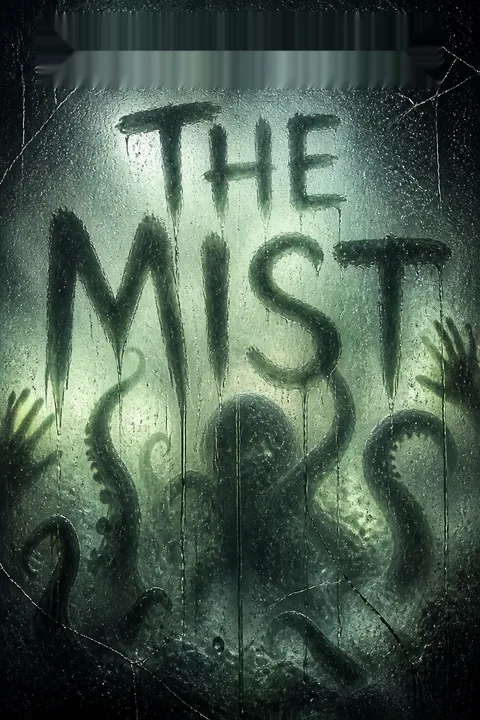


Plot Summary
Storm Damage, White Water
David Drayton,1 an illustrator living beside Long Lake, rides out a violent thunderstorm with his wife,3 Steff,3 and their five-year-old son,2 Billy.2 Falling trees smash a picture window and damage the family boathouse, while live power lines make the grounds dangerous. The next morning, David1 and Billy2 survey the wreckage and spot an unnaturally straight front of white mist advancing across the lake.
David1 has heard rumors about the nearby Arrowhead Project, but nothing explains the silent, unsparkling fog. He takes Billy2 and Brent Norton,4 a difficult neighbor whose car and chainsaw were damaged in the storm, to the Bridgton supermarket for supplies. Steff3 stays home, expecting them back.
The storm first appears as familiar catastrophe: broken glass, fallen trees, power lines, insurance claims. The mist changes the meaning of that damage by arriving as something orderly and almost engineered. David’s practical explanations keep the family moving, but his decision to leave Steff behind becomes a private vulnerability as much as a plot necessity. The domestic world has not yet vanished; it is already becoming unreachable.
The Loading Bay Tentacles
At the supermarket, shoppers initially treat the strange fog as a curiosity. Their mood changes when a bloodied man reports that something outside has taken a local mechanic, then the mist rolls over the parking lot and hides the town. David1 keeps Billy2 inside as a scream from the fog silences the people crowding the exit.
When the generator fills the storeroom with exhaust, a young bagger volunteers to clear its blocked vent by raising a loading door. Tentacles seize him and pull him outward. David1 tries to hold him, but lets go when more feelers reach for them and remembers Billy2 is alone nearby. He shuts the door with a broom handle, severing one tentacle, and tells the others what he saw.
The attack turns uncertainty into a problem of responsibility. David cannot save the bagger and protect his son at the same time, so his choice is not heroic in any clean sense; it is parental triage under pressure. The supermarket’s ordinary systems, including its generator and loading door, become dangerous precisely because people keep treating them as manageable. Fear begins not with a monster’s appearance, but with the failure of familiar judgment.
Norton's Last Test
David1 and store assistant manager5 Ollie Weeks5 persuade the shoppers that the tentacles are real by showing them the severed piece outside the loading door. Some still reject the warning, led by Norton,4 who suspects a local trick and resents being treated as an outsider. The group stacks bags of fertilizer against the supermarket windows, leaving narrow openings for watchers, and prepares torches from mop handles and lighter fluid.
Norton4 leads four skeptics outside, despite David’s1 offer of a clothesline tied around one man’s waist as a safety measure. The line jerks, whips violently, and comes back slack with its end bloodied and torn. No one inside can mistake what happened. The crowd stays, but terror has acquired evidence.
The rope is a crude experiment, and its result does not explain the fog, only the cost of pretending it can be explained away. Norton’s skepticism is tangled with wounded pride: accepting David’s account would mean accepting vulnerability from a neighbor he has long opposed. The improvised defenses give frightened shoppers something to do, while the bloody line exposes their limits. They can measure danger, but cannot yet control it.
Wings Above the Windows
After dark, pink, fly-like creatures cling to the windows, followed by a pale, beaked predator that tears into shopper Tom Smalley. David1 and Dan Miller10 ignite a torch and burn the creature; a teacher, Hilda Reppler,9 kills another intruder with insect spray. The survivors block a broken window with heavy crates.
Later, David1 and Ollie5 enter the storeroom for supplies and discover two young soldiers from the Arrowhead Project hanged by their own hands. Ollie5 believes they feared what the project had unleashed, though neither man knows what the facility was doing. Before dawn, David1 seeks comfort in Amanda Dumfries,7 a shopper who has offered her handgun to the group. Their brief intimacy gives way to the urgent need to get Billy2 out.
The supermarket’s first successful defense is improvised from retail goods, not expertise: lighter fluid, a torch, insecticide, crates. That practical ingenuity offers a fragile counterweight to the soldiers’ deaths, which suggest the catastrophe may have begun inside a human institution. David’s encounter with Amanda is not a romantic resolution; it is a moment of bodily comfort amid helplessness, complicated by his fear for Steff and responsibility to Billy.
The Pharmacy Webs
The next morning, David1 joins Ollie,5 Miller,10 Reppler,9 and others in crossing the short distance to the pharmacy. They find its open entrance littered with bodies, and David1 recognizes the pale strands hanging across the shop as webs. Acid-coated threads lash out, slicing Buddy Eagleton’s leg and dragging town selectman Mike Hatlen away.
A huge black spider attacks Miller;10 Ollie5 shoots it, while Reppler9 drives another back with insect spray. David1 spears a smaller spider as the survivors retreat. Only David,1 Ollie,5 and Reppler9 make it back into the supermarket. Billy2 rushes into his father’s1 arms. The brief expedition has proved that the fog’s creatures are not confined to night, and that even a nearby refuge can become a killing ground.
The pharmacy expedition tests whether courage and coordination can recover a larger world. Instead, it turns the distance between buildings into a lethal threshold. The survivors do not prevail through superior force: Ollie’s gun and Reppler’s composure buy seconds, while David’s concern for Billy gives him a reason to keep moving. The mission changes the group’s arithmetic. Staying inside is no longer safety, but leaving is not a reliable escape.
Carmody Names the Sacrifice
As the trapped shoppers weaken, Mrs. Carmody’s6 apocalyptic preaching attracts a growing circle of listeners. She claims the monsters are punishment and insists that blood will end the disaster.
David1 and Ollie5 plan a pre-dawn escape in David’s1 four-wheel-drive Scout, taking Billy,2 Amanda,7 Reppler,9 caretaker Hattie Turman,8 and an elderly shopper. Before they can reach the doors, Carmody’s6 followers block the way. Carmody6 identifies Billy2 as the sacrifice they need, and the group surges forward.
Ollie5 shoots her, breaking their momentum. The followers recoil, and David1 gathers Billy2 as the small party heads outside. Carmody’s prophecy had become dangerous not because it explained the mist, but because it gave frightened people permission to harm someone.
Carmody converts random danger into a moral story with a culprit and a remedy. That story comforts her followers by replacing uncertainty with instructions, but its emotional clarity is purchased through scapegoating. Billy becomes a target because he is vulnerable and because David’s group refuses her authority. Ollie’s shot stops an immediate assault, yet leaves the escape morally costly: survival now includes the use of lethal force against both monsters and neighbors.
The Scout's First Mile
Outside the supermarket, Ollie5 reaches the Scout first, but a huge clawed creature kills him before he can open the doors. A spider pins Hattie Turman8 nearby, and Amanda7 freezes at the sight. Reppler9 slaps Amanda7 back into action and pushes her into the vehicle; David1 gets Billy2 inside and breaks a burning strand of web from his ankle.
He retrieves Ollie’s5 fallen pistol, starts the engine, and waits before driving, watching for anything drawn by its noise or exhaust. Nothing attacks the Scout, so he eases away from the supermarket. Pale faces watch from behind the barricaded windows as the fog closes behind the vehicle. David,1 Billy,2 Amanda,7 and Reppler9 are now alone on roads they cannot see.
The group’s departure strips away the protection of numbers and routines. Ollie’s death happens before his planned escape can become a rescue, while Hattie’s loss leaves David with no comforting illusion that good intentions are enough. Reppler’s brisk intervention is crucial: she recognizes Amanda’s shock and acts before reassurance could reach her. The Scout offers mobility, not mastery. Even its engine becomes a risk that the survivors must endure rather than solve.
Hartford in the Static
David1 drives slowly through cracked roads and fallen trees, first trying the route home. A large pine blocks the final stretch to his house, leaving him unable to learn whether Steff3 is alive. He reverses and heads south with Billy,2 Amanda,7 and Reppler.9
The road carries them past wrecked tollbooths, abandoned cars, and signs of destruction no rescue party has reached. A creature of impossible size crosses the highway, leaving deep tracks around the Scout.
At a Howard Johnson’s near the turnpike, David1 finds a battery radio and believes he hears one place name through the static: Hartford. He keeps the possible destination to himself. The story ends with the survivors still inside the mist, their next journey resting on a single uncertain signal.
The ending refuses the usual division between escape and rescue. David gets away from the supermarket, but cannot reach the house that gave the story its emotional center, and the immense tracks make clear that the threat exceeds local geography. The possible radio message offers direction without confirmation. Hartford is less a promised refuge than a decision to keep moving, while hope remains an act David chooses to protect for Billy.
Analysis
The Mist makes uncertainty an active force. Its creatures are terrifying, but the deeper pressure comes from not knowing what rules govern them, whether home remains reachable, or whether the next decision will save anyone. That uncertainty exposes how people use familiar systems to regain control. David1 watches, tests, and revises; the store workers organize defenses; Norton4 rejects evidence that threatens his pride; Carmody6 turns fear into a doctrine that assigns blame. None of these responses is simply rational or irrational. Each offers a way to endure the unendurable, and each carries consequences for others.
The supermarket is the story’s social laboratory. People who would ordinarily pass one another in aisles must negotiate food, weapons, authority, and risk. Their improvised defenses show the value of cooperation, but the bagger’s death and the pharmacy expedition make clear that competence cannot abolish chance. At the same time, Carmody’s6 congregation demonstrates that a group can become more dangerous than its individual members when shared panic is converted into moral certainty. Her followers do not need to understand the monsters; they need an explanation that tells them what to do.
David’s1 central struggle is more intimate. He is an artist accustomed to interpreting images, yet the mist resists interpretation, and his attention cannot reach Steff3 or guarantee Billy’s2 safety. His brief intimacy with Amanda7 further complicates his self-image without replacing his attachment to his family. By the ending, home has become a blocked road and rescue only a possible word on a radio. David1 keeps moving not because the evidence promises survival, but because Billy2 needs a future to move toward. The novel’s ambiguity is therefore not a puzzle withheld from the reader. It is the condition its characters must inhabit, with hope functioning as a choice rather than a forecast.
Review Summary
The Mist receives mostly positive reviews, praised for its atmospheric horror and exploration of human nature under extreme circumstances. Readers appreciate King's ability to create tension and memorable characters in a short format. Some criticize the ending and occasional sexist undertones. The novella is often compared favorably to its film adaptation. Many readers find the story engaging and suspenseful, with Mrs. Carmody highlighted as a particularly effective antagonist. The book's themes of isolation, fear, and societal breakdown resonate strongly with many readers.
People Also Read

Characters
David Drayton
Painter turned protectorAn illustrator and father, David observes the world with an artist’s attention to shape and detail, but he cannot make the mist legible by looking harder. His first instinct is to protect Steff3 and Billy2, and his choices repeatedly force him to weigh his own safety against other people’s lives. He can be practical and decisive, yet fear and guilt complicate his judgments. The crisis strips away professional ambitions and ordinary routines, leaving him to measure himself by what he can do for his son2.
Billy Drayton
The frightened childDavid1 and Steff’s3 five-year-old son, Billy is observant, serious, and young enough to need adults for safety he cannot provide himself. The storm and separation from his mother3 expose his dependence without making him merely passive: he asks direct questions and registers danger adults would rather explain away. His need for comfort gives David’s1 decisions their emotional urgency, while his fear makes the cost of every risk visible.
Steff Drayton
The family’s steady centerDavid’s1 wife and Billy’s2 mother, Steff is practical, affectionate, and protective. She worries about the strange weather before David1 is ready to share her unease, but she is not defined by superstition or panic. Her decision to remain at home during the supply trip separates her from the central group and makes the family’s ordinary life feel painfully close, even as David1 loses the means to contact her.
Brent Norton
The stubborn skepticDavid’s1 neighbor is a New Jersey lawyer and longtime antagonist in a property dispute. Norton prizes argument, status, and control, and his polished confidence can turn brittle when he feels dismissed. The storm temporarily brings him into David’s1 company, but their uneasy truce never erases old resentments. His presence tests whether evidence can persuade someone whose identity is invested in refusing another person’s account.
Ollie Weeks
Quiet store authorityA supermarket assistant manager, Ollie is mild-mannered and observant, with more resolve than his unassuming manner suggests. He recognizes when procedural order no longer serves the people in the store and helps David1 communicate the danger. His target-shooting experience and willingness to take responsibility make him a practical ally. Ollie’s steadiness is not bravado; it comes from seeing the situation clearly and acting despite what that clarity costs.
Mrs. Carmody
Prophet of catastropheA local antiques dealer known for folk remedies and ominous predictions, Carmody is accustomed to being dismissed as eccentric. She interprets frightening events through religious punishment and speaks with growing certainty when others lose theirs. Her appeal lies in offering a complete explanation and a concrete response, not in evidence. She is perceptive about the crowd’s fear, but her certainty leaves little room for compassion or dissent.
Amanda Dumfries
Armed, unsettled allyA shopper stranded in the supermarket, Amanda carries a handgun her husband encouraged her to keep, though she has little experience using it. She offers the weapon to the group and remains alert to how fear can become collective violence. Her composure is uneven rather than effortless; she can act decisively, but the creatures’ attacks overwhelm her at moments. Her connection with David1 develops amid danger and carries the complications of their separate lives.
Hattie Turman
A gentle caretakerA local woman who sometimes looks after Billy2, Hattie offers him patience and familiar care inside the supermarket. She is worried about her own family, yet makes room for the child’s2 fear and helps preserve a sense of routine through small kindnesses. Her presence reminds David1 that protection is often shared among ordinary people, not supplied by a single heroic figure.
Hilda Reppler
The practical schoolteacherA veteran teacher with a dry manner, Reppler meets strange events with observation and practical action. She arms herself with insect spray and a tennis racket, then proves more capable under pressure than her modest preparations suggest. Reppler does not need a theory of the mist before she can respond to immediate danger. Her brisk interventions help others move when shock has left them unable to act.
Dan Miller
The improvising organizerA summer resident, Miller helps turn a frightened crowd into a working group. He proposes barricades, watches, and improvised torches, then argues that the supermarket cannot remain a permanent refuge. His plans are useful without being foolproof, reflecting a practical mind trying to make decisions with incomplete information. Miller’s confidence comes from organizing action, not from believing that action guarantees safety.
Bud Brown
The rules-bound managerThe supermarket’s manager, Brown clings to store procedures and company authority even as ordinary commerce becomes irrelevant. His instinct to control customers and record violations is a way of preserving a familiar role when the larger world has stopped functioning. He is neither a monster nor a leader suited to the crisis, but a recognizable example of institutional habits continuing past their usefulness.
Plot Devices
The Mist
A moving boundaryThe opaque, unusually bright mist arrives after the storm and consumes the lake, town, and roads. It hides creatures, distorts distance and sound, and makes ordinary travel perilous. Because its cause and limits remain uncertain, characters cannot plan from a reliable map of the danger. It functions both as physical barrier and information barrier, separating David1 from Steff3 while making every apparent route forward provisional.
Arrowhead Project
A suspected human causeA nearby government facility appears in local rumors before the fog arrives, with explanations ranging from agricultural research to dangerous experiments. The two young soldiers’ presence and later deaths deepen suspicion that the project is connected to the catastrophe. But neither David1 nor the other survivors obtains proof or a complete explanation. The project keeps responsibility in view without turning the story’s unknown into a solved puzzle.
The Supermarket
A fragile social shelterThe store gathers strangers, supplies, possible weapons, and competing explanations under one roof. Its doors and windows become defensive boundaries, while the loading bay demonstrates how ordinary infrastructure can expose people to danger. The confined setting lets practical cooperation and social breakdown unfold together: shoppers organize watches and barricades even as Carmody’s6 following grows. Its apparent security eventually becomes another risk the survivors must choose whether to leave.
Carmody’s Prophecy
Fear given a doctrineCarmody6 interprets the creatures as divine punishment and claims that sacrifice can end the disaster. Her explanation gives some survivors a sense of order, but it also redirects their terror toward a human target. The prophecy is therefore not merely a mistaken account of the mist; it becomes a tool for organizing the crowd and legitimizing violence. The story shows how a persuasive explanation can become materially dangerous when fear makes certainty more attractive than evidence.
FAQ
Synopsis & Basic Details
What is The Mist about?
- Sudden, Deadly Phenomenon: A violent thunderstorm is immediately followed by a strange, unnatural mist that engulfs a small Maine town, trapping David Drayton, his young son Billy, and dozens of others inside a local supermarket.
- Isolation and Survival: Cut off from the outside world, the survivors quickly discover the mist contains monstrous, otherworldly creatures, forcing them to barricade themselves and confront the terrifying external threat.
- Internal Human Conflict: As days pass, fear and desperation escalate tensions within the trapped group, leading to clashes over leadership, sanity, and survival strategies, culminating in a dangerous schism influenced by religious fanaticism.
- Desperate Escape Attempt: David, driven to protect his son and find his wife, leads a small group on a perilous journey through the mist, hoping to find safety or at least escape the horrors they've witnessed.
Why should I read The Mist?
- Masterclass in Suspense: Stephen King expertly builds claustrophobic tension and dread, making the supermarket setting feel both mundane and terrifyingly isolated as the external threat looms.
- Deep Dive into Human Nature: The story offers a stark, unflinching look at how ordinary people react under extreme pressure, exploring themes of fear, faith, reason, and the breakdown of societal norms.
- Iconic King Horror: Featuring memorable and bizarre creatures, the novella delivers visceral horror while maintaining a focus on the psychological toll of the unfolding nightmare.
What is the background of The Mist?
- Post-Storm Setting: The story begins immediately after a severe thunderstorm breaks a record-breaking heatwave in rural Maine, suggesting a natural event as a potential catalyst, though the mist's nature quickly proves otherwise.
- Rumors of Government Projects: Local gossip centers around the nearby "Arrowhead Project," a secretive government installation, hinting at a potential man-made origin for the mist and its inhabitants, a common theme in King's work exploring unintended consequences.
- Small-Town Dynamics: The narrative is grounded in a familiar small-town setting, where existing relationships (like David's feud with Norton) and local eccentrics (like Mrs. Carmody) are amplified and distorted by the crisis, highlighting how community structures react under duress.
What are the most memorable quotes in The Mist?
- "It's death to go out there!": Repeated by Mrs. Carmody, this phrase encapsulates the immediate, overwhelming terror of the unknown lurking in the mist and becomes her chilling mantra, solidifying her role as a prophet of doom.
- "Just to see the sun again.": Hattie Turman's simple statement reveals the profound psychological impact of the mist's perpetual gloom, highlighting the survivors' deep longing for normalcy and hope beyond mere physical safety.
- "One of them is Hartford. The other is hope.": David's final whispered words to his sleeping son encapsulate the story's ambiguous ending, balancing a concrete, albeit distant, destination with the abstract, fragile necessity of maintaining hope in the face of overwhelming despair.
What writing style, narrative choices, and literary techniques does Stephen King use?
- First-Person Perspective: Narrated by David Drayton, the story uses a conversational, immediate, and often stream-of-consciousness style ("This is what happened"), drawing the reader directly into his subjective experience, fear, and confusion.
- Building Dread through Detail: King employs meticulous descriptions of the mundane (supermarket aisles, products) juxtaposed with the horrific (creature appearances, sounds), grounding the supernatural terror in a relatable, everyday setting.
- Foreshadowing and Symbolism: Subtle hints, like the initial description of the mist as a "silver veil" or David's dream of God walking and leaving a mist, build anticipation and layer deeper, sometimes ambiguous, meaning into the narrative.
Hidden Details & Subtle Connections
What are some minor details that add significant meaning?
- Broken Communication Lines: The initial inability to use the payphone ("just dah-dah-dah") and the radio silence (WOXO, WBLM off-air) are early, subtle indicators that the event is widespread and has fundamentally disrupted normal life, not just a local weather anomaly.
- The Smell of the Mist: David repeatedly notes the "thin, acrid smell" drifting from the mist, a sensory detail that distinguishes it from natural fog and hints at its unnatural, possibly chemical or biological, origin, linking back to the Arrowhead Project rumors.
- Specific Items Taken by Tentacles: When the tentacles invade the storage area, they grab seemingly random items like a bottle of Pepsi and rolls of toilet paper, a bizarre detail that underscores the alien and incomprehensible nature of the creatures' actions, suggesting instinct rather than intelligence.
What are some subtle foreshadowing and callbacks?
- David's Dream of God: David's vivid dream of a gigantic God stamping the woods into footsteps and covering everything in "smoke... like a Mist" eerily foreshadows the arrival of massive, unseen entities and the pervasive, obscuring nature of the mist itself.
- Mrs. Carmody's "Black Spring" Talk: Her earlier pronouncements about the unusually cold, late spring ("black spring") and linking it to the "end of the world" initially seem like eccentric ramblings but gain chilling weight as the supernatural events unfold, suggesting a cyclical or preordained catastrophe.
- The Picture Window Vision: David's protective vision of the picture window shattering and injuring Steff and Billy during the storm foreshadows the actual breaking of the window later and serves as an early manifestation of his deep-seated fears for his family's safety, which become central to the plot.
What are some unexpected character connections?
- Ollie Weeks' Hidden Competence: The mild-mannered, slightly pudgy assistant manager who seems afraid of girls is revealed to be a skilled target shooter and surprisingly decisive leader, demonstrating that crisis can uncover hidden strengths and subvert initial impressions.
- Mrs. Reppler's Toughness: The seemingly ordinary third-grade teacher transforms into a formidable, pragmatic survivor, wielding bug spray and a tennis racket against the creatures, showcasing unexpected resilience and a no-nonsense approach to the bizarre reality.
- Myron LaFleur's Shift: Initially presented as a somewhat pathetic, hungover local, Myron becomes a fervent, almost gleeful follower of Mrs. Carmody, highlighting how easily fear and desperation can lead individuals to embrace dangerous fanaticism and abandon their former selves.
Who are the most significant supporting characters?
- Ollie Weeks: His calm demeanor, practical skills (reloading the gun), and decisive action (shooting Mrs. Carmody) make him David's most crucial ally and a voice of reason against both the external threat and internal madness.
- Mrs. Carmody: As the antagonist within the market, her religious fanaticism and ability to manipulate fear create a dangerous internal threat, forcing the group to confront the dark side of human nature under pressure.
- Dan Miller: A pragmatic summer resident, he attempts to organize the survivors and devise practical solutions (fortifications, the pharmacy expedition), representing a rational, albeit sometimes flawed, approach to the crisis.
- Amanda Dumfries: Providing emotional support to David and Billy and demonstrating unexpected courage (offering her gun, joining the escape), she represents compassion and resilience amidst the horror, forming a vital bond with the protagonists.
Psychological, Emotional, & Relational Analysis
What are some unspoken motivations of the characters?
- Norton's Need for Control: His insistence on rational explanations ("temperature inversion") and later his desperate, performative exit ("We'll send help back") stem from a deep-seated need to maintain control and dignity in a situation where he feels utterly powerless, exacerbated by recent personal loss (his wife, his T-Bird).
- Mrs. Carmody's Thriving on Crisis: Her fervent preaching and pursuit of "expiation" seem driven not just by belief but by a perverse sense of purpose and power gained from the chaos; she is "thriving on it," suggesting a hidden desire for significance and control over others.
- David's Guilt and Desire for Atonement: His internal reflections on his art career ("curse of expectation," commercial work) and his fleeting attraction to Amanda hint at underlying dissatisfactions and desires; his fierce protectiveness of Billy and relentless drive to find Steff are partly fueled by genuine love but also perhaps an unspoken need to prove himself and atone for perceived shortcomings or disloyal thoughts.
What psychological complexities do the characters exhibit?
- Regression Under Stress: Billy's immediate regression to a younger, more dependent state ("I want my MOTHER!") and the general shift towards primal fear and irrationality among many adults (the stampede, the stupor) illustrate how extreme trauma can strip away adult coping mechanisms.
- The Power of Shared Delusion: Mrs. Carmody's ability to gather followers and convince them of the need for human sacrifice demonstrates the psychological phenomenon of shared delusion or mass hysteria, where fear overrides critical thinking and individuals seek comfort in collective, albeit dangerous, belief systems.
- Desensitization and Adaptation: Despite the initial shock, characters like David, Ollie, and Mrs. Reppler gradually adapt to the horrific reality, developing strategies and even a dark humor, showcasing the human capacity to normalize the abnormal in order to survive.
What are the major emotional turning points?
- The Bag-Boy's Death: Witnessing Norm being dragged away by tentacles is the first undeniable proof of the mist's deadly nature, shattering the initial disbelief and forcing survivors to confront the terrifying reality, marking a shift from unease to outright horror.
- The Pharmacy Expedition Casualties: The brutal deaths of Mike Hatlen and Buddy Eagleton during the trip to the drugstore underscore the extreme danger outside the market and solidify the group's understanding that venturing into the mist is a potentially suicidal act, deepening despair.
- Ollie Shooting Mrs. Carmody: This violent act is a pivotal moment that breaks the spell of Mrs. Carmody's fanaticism and resolves the internal conflict, allowing the rational group to attempt escape, but it also highlights the moral compromises forced by the crisis.
How do relationship dynamics evolve?
- Formation of New Alliances: The crisis forces strangers like David, Ollie, and Amanda to quickly form bonds based on shared goals and trust, demonstrating how extreme circumstances can forge rapid, deep connections.
- Amplification of Existing Tensions: Pre-existing conflicts, such as David's boundary dispute with Norton, are magnified by the stress, leading to bitter confrontations and highlighting how personal grievances can persist even in the face of existential threats.
- Breakdown of Authority and Community: Traditional authority figures (like Bud Brown) lose influence, while new, often unstable, leaders emerge (Mrs. Carmody, Dan Miller), illustrating the rapid collapse of social hierarchy and community cohesion under prolonged duress.
Interpretation & Debate
Which parts of the story remain ambiguous or open-ended?
- The Mist's True Origin: While the Arrowhead Project is heavily hinted at as the cause, the story never definitively confirms it, leaving open the possibility of a supernatural, divine, or entirely unknown source for the mist and its creatures.
- The Fate of Those Left Behind: The narrative explicitly states that David does not know what became of the people who remained in the supermarket, leaving their survival or demise to the reader's imagination and emphasizing the finality of David's choice to leave.
- The Nature of the Creatures: The story presents a variety of bizarre, seemingly unrelated monsters (tentacles, flying bugs, bird-things, spiders, giant six-legged creature), offering no biological or logical explanation for their diversity or sudden appearance, adding to the sense of cosmic horror.
What are some debatable, controversial scenes or moments in The Mist?
- Ollie's Killing of Mrs. Carmody: While presented as a necessary act to prevent her followers from sacrificing Billy and allow the escape, the scene is morally complex; it sparks debate about the justification of killing one person to save others and the nature of self-defense against psychological manipulation.
- David's Relationship with Amanda: The development of a mutual attraction and their sexual encounter, while framed by David's internal conflict and the extreme circumstances, is controversial given the uncertainty of Steff's fate and raises questions about fidelity and coping mechanisms in crisis.
- The Decision to Leave the Market: David's choice to abandon the relative safety of the fortified market, even with the internal threat of Mrs. Carmody, is debatable; it's a high-risk gamble based on a theory about scent and the slim chance of finding safety elsewhere, leading to significant casualties.
The Mist Ending Explained: How It Ends & What It Means
- The Journey South: David, Billy, Amanda, and Mrs. Reppler escape the market in David's Scout, driving south through the mist. They encounter various creatures and evidence of widespread destruction, including massive footprints, confirming the global scale of the event.
- Running Out of Options: As the Scout runs low on gas and they find no signs of human life or safety, David makes the agonizing decision to use the remaining fuel to drive until it's empty, then plans a suicide pact for the group, having lost hope of escape or rescue.
- Ambiguous Signal of Hope: After the car runs out of gas and David has killed the other adults, preparing to kill Billy, he hears a faint radio broadcast repeating the word "Hartford." This signal, possibly from a survivor outpost, offers a sliver of hope, leaving David's final actions and the ultimate outcome uncertain as he drives towards the signal with Billy. The ending is a classic King move, denying a neat resolution and forcing the reader to grapple with the possibility of both salvation and continued horror.
About the Author
Other books by Stephen King



Download PDF
Download EPUB
.epub digital book format is ideal for reading ebooks on phones, tablets, and e-readers.








