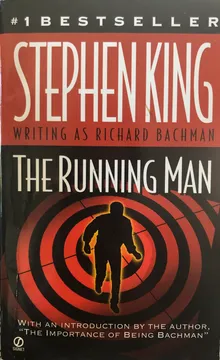


Plot Summary
Cathy's Fever
In 2025, unemployment has left Ben Richards, his wife Sheila, and their eighteen-month-old daughter Cathy in a crumbling Co-Op City apartment. When Cathy develops a dangerous fever, Sheila cannot afford a proper doctor, and Ben refuses to let her keep sacrificing herself for money. He leaves to qualify for the Network's Games, where contestants risk injury or death for cash.
Sheila fears the decision will cost her husband, but Ben sees no other way to get their child medical care. He walks across the neglected city to the Games Building and joins a long line of desperate applicants. His choice begins as an act of fatherhood, but it also places him inside the machine that turns poverty into entertainment.
The crisis is intimate before it is political: a child is sick, and the family cannot buy care. Richards's decision exposes the coercion hidden inside the Games' promise of choice. He volunteers, but only after ordinary work and public services have failed him. Sheila's fear and Ben's resolve arise from the same responsibility, yet the system converts that shared love into leverage, making his family both the reason he enters and the means by which he can be controlled.
Chosen for the Hunt
Richards survives the Games' exhausting physical and psychological examinations, where his intelligence, anger at authority, and lack of drug use make him unusually valuable. Executive producer Dan Killian selects him for The Running Man, the Network's most dangerous contest. Richards learns that he must send in daily video clips while evading professional Hunters and a public encouraged to report him.
He receives a small advance in Games certificates, which he sends to Sheila, along with a token payment to Charlie Grady, the guard who lent him phone money. Before the broadcast, the Network edits Sheila's image to make her appear greedy. Richards signs the release despite the deception, knowing the money may buy Cathy treatment.
The selection process pretends to measure fitness, but it also sorts people by how profitably they can be punished. Richards's literacy and hostility make him a compelling performer; his family's need makes him exploitable. The certificates and the doctored image reveal the contest's double accounting: kindness is converted into a loan, while private relationships are converted into broadcast props. His refusal to perform gratitude leaves him morally distinct, but not outside the Network's machinery.
A Nation Wants Blood
On live television, host Bobby Thompson presents Richards as a dangerous criminal and shows the falsified image of Sheila. Richards condemns the audience for celebrating death, then claims he will last the full thirty days. The crowd's fury nearly spills onto the stage, and he is rushed out with the camera and tape clips required by the contest.
After a taxi driver recognizes him, Richards leaves the cab before it can become a paid sighting. He reaches the black-market broker Molie Jernigan, who forges a new identity and sells him a disguise. Richards boards a shuttle to New York, checks into a hotel, and records a deliberately useless tape. Realizing his route may be traceable, he slips away by bus to Boston.
The broadcast gives Richards a public identity before he has made any move against the public. Its edited portrait teaches viewers how to interpret him, turning fear into a marketable certainty. His first escapes are improvised rather than heroic: he trusts a broker, hides in ordinary transport, and makes a tape that conceals more than it reveals. The spectacle follows him even when he refuses to participate, because the audience has already been trained to mistake the Network's framing for evidence.
Fire Beneath the Y
In a Boston YMCA, Richards hides under another assumed name, but he spots supposed passersby arranging themselves around the building. He reaches the basement through the elevator controls, starts a fire among stored newspapers, and opens a storm drain. The blaze and an exploding oil tank cover his escape through the sewers, though the broadcast later blames him for five officers' deaths.
Emerging from a manhole, filthy and exhausted, he is seized by seven-year-old Stacey, who mistakes him for something demonic. Stacey guides him to a makeshift shelter and fetches his older brother Bradley, a gang member who recognizes the fugitive from television. Instead of turning Richards in, Bradley brings him into his family's home.
The escape depends on Richards's ability to read neglected infrastructure, while the Network turns the resulting deaths into a simple morality play. The fire is both a practical diversion and an accidental escalation: survival now carries a public price in blood. Stacey's shelter offers an unexpected counterpoint to the televised mob. A child who has learned to distrust nearly everyone still chooses to help, opening a small breach in the system's claim that fear has made solidarity impossible.
Bradley's Hidden Lesson
Bradley explains that he and friends have used library books and homemade instruments to investigate the city's pollution. Their findings suggest that industrial air is causing severe illness while the Network suppresses the evidence and keeps effective filters beyond poor families' reach.
Richards, who entered the contest only to save Cathy, begins to see the larger machinery harming children like Bradley's dying sister, Cassie. He records messages about pollution, but the Network strips their sound and replaces them with fabricated threats.
The broadcast also announces that Jimmy Laughlin, Richards's fellow contestant, has been found and killed. Bradley then hides Richards in a car trunk and smuggles him through roadblocks to Manchester, giving him a new disguise and a way to forward his tapes.
Bradley's investigation changes the scale of Richards's anger: the illness in his own home is not an isolated misfortune but part of a managed pattern. Yet information alone cannot compete with a broadcast system that controls both sound and context. The censored tapes demonstrate how propaganda works through substitution, not merely silence. Bradley's help is more than logistics; it makes Richards answerable to people he had once treated as distant from his private struggle.
The Blue Door Betrayal
In Manchester, Richards hides as a priest and keeps sending tapes through Bradley's contacts. After seeing Laughlin's death on television and sensing the Hunters closing in, he drives to Portland, where Bradley's contact Elton Parrakis offers him shelter. Elton's frightened mother, Virginia, calls the police.
When sirens approach, Elton helps Richards escape in an air car, but a gun battle leaves them both badly hurt. Elton directs Richards to an abandoned shopping development, then drives away to draw the pursuers and dies from his wounds. Richards is left with a broken ankle, a bullet wound, and no safe route out. He wraps himself in discarded insulation and realizes the required tapes must still be mailed.
The refuge fails through fear rather than simple malice. Virginia acts to protect her son, while Elton's loyalty overcomes his own terror at the cost of his life. Richards can no longer treat assistance as a resource he merely uses; each helper is exposed to the same violence aimed at him. The unanswered question of whether the tapes can be mailed sharpens this moral pressure, making survival depend on accepting help from strangers he cannot control.
A Boy Carries the Tapes
At dawn, Richards reaches a roadside store and persuades a boy with a dog to mail his clips without revealing his identity. Unable to travel on his broken ankle, he forces a passing driver, Amelia Williams, to take him north toward Derry. She is frightened and convinced by the broadcasts that he is a murderer.
Richards uses her as cover at roadblocks, while explaining the poverty and pollution she has never had to face. Their journey exposes the divide between her protected life and the families living amid illness and unemployment. When police fire at them near Camden, Richards escapes, then contacts a local news station and announces that Amelia is his hostage. The news turns their flight into a public event.
The boy's small errand and Amelia's forced cooperation mark two very different forms of dependence. Richards asks the child for trust but takes control of the adult woman through fear. His political argument does not erase that coercion; instead, their uneasy journey makes the costs of each position visible. The news call is a tactical shift: Richards uses the same communications network that has branded him a monster to make the authorities' actions observable.
The Crowd Opens a Gate
As Richards and Amelia approach Rockland, police build a roadblock and train weapons on their car. Amelia tells officers that Richards is holding her, but they shoot at the vehicle anyway. Richards returns fire, destroys the pursuing cruisers, and has Amelia contact a local news outlet with his location and accusation.
Crowds gather along the road, divided between prosperous spectators and the poor, while cameras record the standoff. The authorities hesitate to kill the pair in full view. Under pressure from the crowd, officers open a narrow passage, and Richards and Amelia drive through toward Derry and Voigt Field. The spectacle has not made the public compassionate, but it has made secrecy harder for the Network to maintain.
The crowd is neither a unified resistance nor a passive audience. Its presence creates leverage because the Network depends on being believed, yet the spectators arrive hungry for drama rather than justice. Richards exploits that contradiction, forcing the police to choose between immediate violence and visible exposure. Amelia's testimony matters because it is difficult to dismiss her as one of Richards's poor, supposedly criminal allies; the spectacle briefly makes the system answer to its own image.
The Handbag Bomb
At Voigt Field, a tank and armed police block the runway. Richards claims he has planted powerful explosives, though his supposed device is Amelia's handbag, and demands a fueled jet. He sends Amelia out to support the story; she confirms enough of his account to keep the authorities from firing. Chief Hunter Evan McCone arrives, but the cameras and the crowd make a quiet execution risky.
After a prolonged standoff, the authorities provide a plane. Richards boards with Amelia and McCone, along with the flight crew, and takes off. The handbag remains hidden in his pocket as the plane enters a holding pattern above Derry. His bluff has carried him beyond the roadblocks, but it has also trapped him in a cabin with the men hunting him.
Richards's most effective weapon is not the imaginary explosive but the possibility of public disbelief. The bluff works because the Network has made spectacle its source of authority, and cannot easily risk showing itself killing a hostage on camera. Amelia's choice to support him complicates her earlier terror without turning her into a simple convert. Once airborne, however, the media shield shrinks; Richards has won visibility, not safety.
Killian's Offer
In flight, Richards learns that Amelia supported his story because he made her feel responsible for a family's suffering. McCone tries to break their alliance, but Richards continues pretending the handbag contains explosives. Dan Killian appears on the plane's Free-Vee and admits the explosive threat is false. He offers Richards a place as Chief Hunter, arguing that the contest has revealed his talent.
Then Killian tells him that Sheila and Cathy were killed in a home invasion while he was away. Richards's grief first empties him, then hardens into a decision: he accepts the offer. He has been running to save his family; now the Network's promise of employment and revenge meets a man who has almost nothing left to protect.
The revelation breaks the motive that has organized every earlier choice. Richards's first impulse is not immediate action but numbness, showing how grief can suspend the very identity that made him run. Killian's offer is strategically precise: it converts rage into recruitment and offers the fugitive a role inside the institution he despises. Acceptance is not proof of reconciliation. It is a pause in which the Network mistakes a devastated man's consent for allegiance.
The Games Building Falls
Richards kills navigator Robert Donahue, the radio operator, and the pilots, then fights McCone in the cabin and kills him as well. Amelia puts on the parachute Richards had found and is swept through the emergency exit when it blows open.
Shot and gravely wounded, Richards crawls to the controls of the plane's automatic guidance system and wrests the aircraft away from its programmed route. He lowers it over Co-Op City, steering toward the Games Building. Dan Killian sees Richards through his office window only moments before the jet strikes the tower.
The impact sets off a vast explosion that lights the city and destroys the physical center of the contest. Richards's flight ends not in escape but in a final attack on the institution that made his private desperation into a national show.
The ending refuses the consolations of a clean victory. Richards destroys the Network's headquarters, but only after the system has taken his family, his allies, and nearly every possibility of a life beyond violence. His final act is at once political and personal: he turns the machinery of mass entertainment against its makers. The crash makes the spectacle impossible to domesticate, yet the book leaves open whether one spectacular rupture can undo the structures that produced it.
Analysis
The Running Man imagines entertainment as a governing system, not a distraction from politics. The Games turn unemployment, illness, and public fear into a continuous program: the poor provide contestants, the audience supplies surveillance, and the Network supplies a story that makes violence seem deserved. Richards's escape repeatedly tests the weakness of that arrangement. He survives not because he can overpower the state, but because the state's need to appear legitimate sometimes restrains its use of force. The crowd at Rockland becomes a temporary safeguard precisely because cameras make the authorities visible.
The novel also complicates its hero's resistance. Richards begins with a sharply private motive, saving Cathy, and only gradually recognizes that Bradley's pollution research describes a larger version of the same abandonment. His growing political awareness does not make him morally pure. He threatens Amelia, kills in self-defense and revenge, and ultimately turns a passenger jet into a weapon. The story asks what happens when a person is denied every peaceful means of protecting those he loves, then refuses to pretend that his violence is clean.
The most disturbing mechanism is the Network's ability to edit reality while presenting itself as the public's window onto it. Richards's tapes are muted, his wife's image is altered, and his actions are narrated before viewers can judge them. Yet his final assault is also staged as an image, impossible to separate from the spectacle he has spent the novel fighting. The ending offers destruction, not reform: the Games Building falls, but the habits of spectatorship and the conditions that created the contest remain unresolved. The novel's warning is therefore not simply that power lies. It is that a public can be trained to enjoy the lie, especially when the lie gives suffering a face to blame.
Review Summary
The Running Man is a fast-paced dystopian thriller set in 2025, where a desperate man enters a deadly reality show to earn money for his sick daughter. Readers praise King's prescient vision of reality TV and social inequality, though some find the dated language problematic. The novel's relentless pace, intense action, and thought-provoking themes keep readers engaged. Many consider it superior to the film adaptation and a precursor to works like The Hunger Games. The ending is particularly impactful, leaving a lasting impression on most readers.
People Also Read







Characters
Ben Richards
Fugitive fatherRichards is an unemployed, self-educated former factory worker who distrusts authority and refuses to hide his contempt for it. His fierce commitment to Sheila and Cathy makes him practical as well as defiant: he enters the Games because he needs money for his daughter's care. At first he thinks mainly in terms of getting through the next hour and protecting his family. Encounters with Bradley's community and the people who shelter him broaden his attention to the conditions surrounding his own home. Richards's intelligence helps him improvise, while his stubbornness can make him reckless. He is most himself when refusing the role the Network writes for him, even as survival repeatedly forces him to use its rules.
Sheila Richards
Wife and fierce protectorSheila is Richards's wife and Cathy's mother, living with the same poverty that drives him toward the Games. She understands the danger of his choice but cannot deny the need for medical care. Her pride makes her resist money gained through degrading work, even when the family is desperate. Sheila is neither a passive reward nor a simple emblem of domestic comfort: her decisions reflect the harsh bargains imposed on poor women. The tenderness between her and Richards is shaped by years of shared hardship and a marriage that has remained unusually close. Her image becomes a battleground between the family's private reality and the Network's public fabrication.
Cathy Richards
The sick childCathy is Ben and Sheila's eighteen-month-old daughter. Her illness is the immediate crisis that sends Ben toward the Games, and her need for treatment gives the contest its brutal leverage over him. Though too young to understand the system around her, she represents the future her parents are trying to preserve.
Dan Killian
The polished producerKillian is the Games producer who recognizes Richards as unusually intelligent, volatile, and compelling television. His manner is urbane and often generous in appearance, but he treats human lives as both programming and institutional risk. He can offer Richards small acts of assistance while remaining part of the structure that profits from his danger. Killian's skill lies in understanding motives and making the Network's interests sound like personal opportunities. He is not merely a bureaucrat who gives orders; he is a strategist who knows that persuasion, spectacle, and controlled concessions can be as useful as force.
Evan McCone
Chief HunterMcCone leads the Hunters charged with finding contestants. He represents the Network's disciplined coercive power: methodical, confident, and accustomed to believing that every human opponent can eventually be read and contained. His composure makes him unsettling, because he treats lethal pursuit as an administrative task. Richards's defiance challenges both McCone's authority and his self-image as an infallible professional.
Bradley
Underground investigatorBradley is an older brother, gang member, and determined investigator who helps Richards after Stacey finds him. He and his friends use library books, coded correspondence, and improvised equipment to investigate pollution and its effects on poor neighborhoods. Bradley distrusts the Free-Vee and understands that knowledge is dangerous when access to it is restricted. His care for his family gives his political anger its human scale, while his willingness to shelter Richards shows that solidarity can survive amid fear. He is a practical organizer, not an idealist untouched by risk.
Stacey
Resourceful young helperStacey is Bradley's younger brother, a resourceful child who has learned to scavenge and mistrust authority. He finds Richards emerging from a manhole, guides him to shelter, and helps connect the fugitive with Bradley. Stacey's courage is mixed with ordinary childhood needs, including his worry for his sick sister. His quick judgment gives Richards help that the adult world has repeatedly denied him.
Amelia Williams
Reluctant hostageAmelia is a prosperous driver whose protected life has left her with a distorted picture of the people the Network labels dangerous. Richards forces her to drive him, making their relationship begin in coercion rather than trust. As they travel, she encounters poverty and state violence directly, and her assumptions become harder to maintain. Amelia's fear remains real, but so does her capacity to respond to another person's suffering. Her presence gives the story a conflicted witness from outside Richards's community, one whose choices affect the public meaning of his escape.
Elton Parrakis
A loyal refugeElton is a shy, kind-hearted vending-machine technician and one of Bradley's contacts in Portland. His friendship with Bradley draws him into Richards's flight, despite his evident discomfort with danger. Elton's loyalty is complicated by his dependence on his frightened mother and by his own self-doubt. He is not a practiced revolutionary; his help comes from attachment and decency rather than confidence.
Virginia Parrakis
Fearful motherVirginia is Elton's aging mother, whose fear and racial resentment shape how she interprets Richards and Bradley's political work. She sees danger everywhere and believes that calling the authorities will protect her son. Her actions grow from a possessive, anxious love, but that love is entangled with prejudice and denial. Virginia shows how private fear can reinforce public power without requiring conscious malice.
Jimmy Laughlin
Fellow contestantLaughlin is a Games contestant Richards meets during screening. A former factory worker with a disabled arm, he is bitter about the injury and job loss that have narrowed his options. His humor is dry and his expectations bleak, making him a sharp counterpoint to Richards's refusal to surrender. Their brief connection shows the different temperaments the Games recruit from the same landscape of unemployment.
Bobby Thompson
The smiling hostThompson hosts The Running Man and gives the Network's account of each contestant a polished, reassuring voice. He turns accusation into entertainment and directs the audience's emotions without appearing openly forceful. His role demonstrates how the contest's violence depends on presentation as much as weapons: the host makes persecution feel like a shared civic pastime.
Plot Devices
The Running Man rules
A hunt with a clockContestants receive money for each hour they remain free, but must submit daily video clips to keep their payments valid. Viewers can report sightings for rewards, and the Hunters pursue contestants while the Network broadcasts a version of events designed to turn the public against them. These rules make hiding, travel, and communication dangerous. They also give Richards a structure to exploit: he sends misleading footage, changes identities, and eventually uses live public scrutiny to limit the authorities' freedom of action.
The video clips
A censored megaphoneThe contestants' required recordings provide the Games with fresh material and help sustain the audience's attention. Richards tries to use his clips to tell viewers about pollution and the suppression of public knowledge. The Network edits or obscures his message, replacing it with threats and incriminating narration. The clips therefore work in two directions: they are a tracking and payment obligation imposed by the contest, but they also give Richards a narrow chance to address people outside the official broadcast.
Forged identities
Brief shelter in disguiseMolie Jernigan provides forged documents and a disguise, allowing Richards to travel under assumed names and pass through hotels, terminals, and roadblocks. Bradley's contacts extend that protection with a priest's clothing, false mailing labels, and a route through Manchester. Each identity buys time rather than safety. The false papers are vulnerable to routine checks and investigative pressure, so Richards must keep moving and alter his appearance when a refuge begins to feel exposed.
The handbag bluff
Visibility becomes leverageAt Voigt Field, Richards claims Amelia's handbag conceals a powerful explosive and demands a jet. The threat is false, but the authorities cannot easily dismiss it while cameras and spectators watch. His bluff exploits the Network's dependence on public credibility: a visible killing could make viewers question the official story. The device becomes less effective once the plane is isolated in the air, where Richards must rely on improvisation rather than the audience's presence.
Download PDF
Download EPUB
.epub digital book format is ideal for reading ebooks on phones, tablets, and e-readers.








