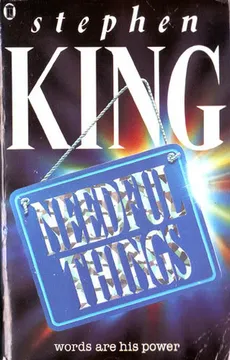


Plot Summary
Prologue
A knowing voice introduces Castle Rock through its grudges: a feud between Baptists and Catholics, Sheriff Alan Pangborn's grief, Polly Chalmers's illness, and the town's old stories of violence. Most residents expect arguments to fade as they always have.
Then a new shop appears on Main Street, its windows hidden and its name, Needful Things, impossible to explain. The narrator points out Brian Rusk, an eleven-year-old walking his bicycle home, and warns that the boy's curiosity will help begin the trouble gathering over town.
The opening makes the town itself feel like the first protagonist. Its ordinary quarrels are already arranged like dry kindling, while the narrator's intimate knowledge of private histories gives the coming disaster a social rather than purely supernatural shape. Brian is singled out before the reader knows why, creating a quiet sense of inevitability. The ominous shop is presented not as an intruder in a peaceful place, but as a visitor arriving where resentment, loneliness, pain, and old shame are already waiting.
Brian's Costly Card
The day before Needful Things officially opens, Brian Rusk slips inside and meets its proprietor, Leland Gaunt, a charming stranger with unsettling eyes. Gaunt finds the exact baseball card Brian longs for: an autographed 1956 Sandy Koufax card, which Brian believes is worth far more than he could afford.
Gaunt accepts Brian's eighty-five cents, then adds a deed to the bargain: Brian must play a trick on neighbor Wilma Jerzyck. Dazed by the card's strange power to summon its past, Brian leaves delighted, though he cannot remember the details of his agreement. He hides the card from his parents, already protecting the secret that will make Gaunt's price harder to refuse.
Brian's bargain begins with a child's understandable hunger for recognition and possession. The card is more than a collectible: its imagined history lets Brian feel close to a hero and to his own father, who nurtured the collection. Gaunt exploits that intimacy by making the price seem trivial and the deed forgettable. Brian's secrecy then converts pleasure into isolation. The supernatural pressure works most effectively not by inventing a desire, but by attaching coercion to something Brian already loves and wants to keep.
A Shop for Longing
On opening morning, Polly Chalmers, who runs the sewing shop nearby, breaks local custom by bringing Gaunt a cake. She likes him at once, though his eyes unsettle her and his handshake feels unpleasant. His store holds an eccentric mix of curios, collectibles, and objects with no visible price tags.
Gaunt tells shoppers to name what they think an item is worth, then makes private bargains with those whose desires he has identified. Nettle Cobb, Polly's shy housekeeper, buys a carnival-glass lampshade for ten dollars and agrees to play a supposedly harmless trick on Buster Keeton. Cora Rusk, Myra Evans, and other residents also leave with prized objects, private instructions, and the belief they have struck favorable deals.
The store turns shopping into a test of self-knowledge. Customers must expose what they want before they can learn what it costs, giving Gaunt access to their private vulnerabilities. The missing price tags make each bargain feel personal, even generous, while separating buyers from the protection of ordinary market rules. Polly's cake and Nettle's lampshade show how quickly kindness and longing can be folded into commerce. The danger is not simply that Gaunt sells strange things; he persuades people to experience manipulation as a choice they have freely made.
Mud on Wilma's Sheets
Brian's promised trick becomes an assault on Wilma's clean laundry. He scoops mud from her garden and flings it across the sheets, then returns home ashamed but protective of his new card. That night, Hugh Priest, a violent-tempered alcoholic, finds a fox-tail in Gaunt's window. It recalls a happier childhood before drink narrowed his life, and Gaunt sells it in exchange for a trick against Nettle.
Hugh briefly imagines sobriety and a future, but fear of losing the fox-tail sends him back to drink. Wilma discovers the muddy sheets and immediately blames Nettle, whose earlier dispute with her over Nettle's dog gives the accusation a ready-made history. A childish prank has become the opening move in a feud.
The scenes show how Gaunt converts emotional memory into leverage. Brian's deed is small enough to disguise as mischief, while Hugh's fox-tail offers a vivid glimpse of who he might have been before addiction. Neither man receives what he truly needs. Brian gets a card he must hide; Hugh gets an object he cannot enjoy without fearing its loss. Wilma's readiness to blame Nettle reveals the social machinery that makes Gaunt's schemes work: old hostility supplies a believable explanation, so manufactured conflict can pass for familiar human behavior.
The Town Takes the Bait
Buster Keeton, Castle Rock's head selectman, has secretly diverted town money to feed a gambling habit and now faces an impending audit. Gaunt sells him an antique racing game called Winning Ticket, which appears to predict real race results. Buster tests it against old races, then uses its selections to win a large sum at Lewiston, mistaking temporary luck for a rescue.
Meanwhile, Nettle carries out Gaunt's instruction by entering the Keetons' house while they are away and covering it with fake traffic warnings that mock Buster. Brian, acting on his own bargain, throws rocks through the Jerzycks' windows. Both boys' actions seem like isolated pranks, but each gives its target an apparent reason to retaliate.
Buster's gambling and Nettle's prank dramatize two versions of surrender. Buster treats a rigged-looking game as a way to outwit the audit, while Nettle accepts Gaunt's authority because his instructions are framed as safe and manageable. Brian's vandalism supplies another link in a chain whose participants cannot see one another. In each case, the deed is designed to produce an interpretation: the victim believes a familiar enemy has acted. The town's own suspicions become Gaunt's most efficient delivery system.
Raider's Last Warning
While Nettle visits Polly with a lasagna, Hugh enters Nettle's home and kills her little dog, Raider, with a corkscrew bearing a threatening note. He believes he is obeying Gaunt and afterward tries to smother his guilt by returning to the fox-tail. Nettle comes home, finds Raider's body, and reads the message as Wilma's work.
Furious and devastated, she takes a cleaver to confront her neighbor. Wilma returns to find her house smashed by Brian's rocks and arms herself with a carving knife, convinced Nettle is responsible. The women meet at the corner of Willow and Ford. Their old feud becomes a brutal fight, and both are mortally wounded before anyone can stop them.
The killings mark the point at which Gaunt's supposedly harmless exchanges become irreversible. A dead dog is not an abstract insult: Raider is Nettle's companion and one of the few sources of safety in her life. The false note directs her grief toward Wilma, while Brian's separate vandalism makes Wilma's suspicion seem confirmed. Each woman acts within a story she believes, but the stories have been arranged to make violence feel like self-defense. Gaunt's method does not erase agency; it narrows the field of interpretation until destructive choices feel inevitable.
Alan Finds the Fracture
Sheriff Alan Pangborn attends the crime scene and then the autopsies, but the simple account of a feud does not satisfy him. Nettle's history of mental illness and Wilma's history of aggression make the deaths plausible, yet details resist that explanation: the timing is tight, the notes do not match Wilma's handwriting, and a large man's bloody prints appear on Nettle's door.
A neighbor recalls seeing a boy with a picnic cooler near the Jerzyck house. Alan recognizes Brian Rusk as a possible witness and questions him after school. Brian describes the noise but hides what he knows, leaving Alan with suspicion rather than proof. At home, Alan's grief over his wife and son continues to shape how he reads every clue.
Alan's police work depends on noticing when a coherent explanation is too convenient. The town can readily label Nettle unstable and Wilma cruel, but those traits do not account for every physical detail. His refusal to settle for the first story is an ethical strength, though his private grief complicates it. He knows that missed warning signs once became part of his guilt over Annie and Todd. The investigation therefore moves on two levels: Alan tests evidence in public while privately trying not to turn uncertainty into another accusation against himself.
Polly Buys Relief
Polly's arthritis reaches a crisis, leaving her unable to manage ordinary tasks without pain. Gaunt offers her a small Egyptian amulet, the azka, which he says will relieve suffering if worn against the skin. Her fingers soon move more freely, and the relief feels unlike any remission she has experienced.
Polly pays for it and agrees to a prank, while Gaunt hints that he knows the truth about her son, Kelton. Years earlier, Polly had hidden her pregnancy from her parents, struggled alone in San Francisco, and lost Kelton in a tenement fire. She told Alan a different story about his death. When Alan's confidential inquiry about her past reaches her, she believes he has betrayed her and withdraws from him.
Polly's bargain reaches beyond pain relief because her illness has made dependence feel like a threat to autonomy. The amulet offers function, but Gaunt's knowledge of Kelton lets him attach that relief to secrecy and shame. Alan's investigation, motivated by love and suspicion of Gaunt, confirms Polly's fear that intimacy will expose her past to judgment. Their rupture is therefore not a simple misunderstanding: both are acting from protective habits, Alan's inquiry and Polly's concealment, that once helped them survive but now undermine trust.
Ace Takes Gaunt's Job
Ace Merrill returns to Castle Rock owing a large debt to the criminal Corson brothers, who have given him until November to repay them. Gaunt hires him as a driver and assistant, then shows him a map of possible buried treasure once owned by Ace's uncle, Pop Merrill. The map seems to offer a way out of debt, and Gaunt supplies cocaine to sharpen Ace's concentration.
He also has Ace transport a Tucker car loaded with automatic weapons and blasting caps from a hidden Cambridge garage. Ace obeys because Gaunt frightens him, but he is also drawn by the promise of money and revenge. When Ace reaches town, Alan confronts him briefly, yet Ace leaves before the Sheriff can discover why he has returned.
Ace's return reconnects the town's present violence to its older history. He has not come home from nostalgia; debt and danger have stripped away his options, and Gaunt offers a path that appears to restore control. The treasure map, cocaine, and extraordinary car turn desperation into a sense of destiny. Ace's submission to Gaunt is not simple gullibility: he recognizes a stronger force and adapts to it, as he has throughout his life. That survival strategy makes him useful to Gaunt, but also makes him dangerous to everyone he blames.
Pranks Become Weapons
Gaunt's customers begin carrying out the deeds attached to their purchases. Myra Evans, whose Elvis picture has become the center of an erotic fantasy, slashes Henry Beaufort's prized Thunderbird after he once kept her car keys. Norris Ridgewick, intent on protecting his new fishing rod, vandalizes Hugh's Buick.
Sally Ratcliffe finds a staged photograph and note suggesting her fiancé, Lester Pratt, has been unfaithful; she confronts him by painting an accusation on his windshield. Gaunt also directs customers to expose Principal Frank Jewett's hidden pornography collection and to provoke religious leaders on both sides of the Casino Nite dispute. Each act is tailored to an existing grievance, so the victims see malice, not orchestration.
The bargains work by converting private fantasy into public injury. Myra's Elvis devotion, Norris's attachment to a fishing rod, and Sally's desire for moral certainty are not interchangeable weaknesses; Gaunt chooses a different emotional trigger for each person. The pranks then alter relationships outside the shop, where no one knows the terms of the exchange. Because the deeds often resemble believable retaliation, victims and witnesses reinforce the deception themselves. The town's moral conflict becomes useful cover: religious factions already expect hostility, so Gaunt's manufactured provocations arrive in a setting prepared to misread them.
A Boy's Cooler
A medical examiner's findings and the bloody fingerprints on Nettle's door make Hugh the leading suspect in Raider's killing. At the same time, Alan learns that Brian was seen near the Jerzyck house with a picnic cooler. He questions the boy, who claims it held trading cards, but Brian's fear and flat manner suggest he is concealing more than a childhood errand.
Alan recognizes that the grief in Brian's face resembles a wound, not ordinary nerves, yet the boy will not explain. The conversation turns when Brian speaks of a monster and of understanding how a magician's trick works. Alan leaves without a confession, sensing that Brian's secret is tied to the new shop and to the deaths that began the crisis.
The cooler is a concrete clue whose meaning depends on listening to a child rather than imposing an adult theory. Alan correctly senses that Brian is frightened, but the boy's refusal to speak shows the limits of ordinary authority when a secret has been bound to shame and possession. The magician metaphor is especially revealing: Brian has learned that apparent wonder can conceal a mechanism, but knowing the mechanism has not freed him from its consequences. Alan's instinct is sound, yet timing and fear prevent him from reaching the truth before the town's violence accelerates.
The False Letter
Gaunt arranges for Polly to receive a copy of a real reply from the San Francisco child-welfare office, where Alan has quietly inquired about her history. The letter exposes his search and appears to confirm her fear that he has been investigating her behind her back. Already hurt by his doubts about the amulet, Polly breaks off their conversation and accepts Gaunt's account of events.
Gaunt then sends her to the old Camber property with a shovel and an envelope for Ace. She digs up a can containing obsolete trading stamps and degrading photographs, replaces it with a taunting message, and burns the contents. She believes the deed is a small payment for her charm, not a trap designed to push Ace toward Alan.
Gaunt's strongest weapon here is not a fabricated past but a selective truth. Alan did make the inquiry, and Polly did hide Kelton's death; each fact can be arranged to make the other person appear untrustworthy. The false letter exploits the difference between seeking understanding and respecting privacy. Polly's errand deepens the breach by making her an unwitting participant in Ace's revenge. Her pride once helped her defend a private life; Gaunt turns that same pride into a barrier between her and the person who might help her.
Buster Turns on Myrtle
Buster's winning streak cannot repair the town funds he has embezzled, and a state audit is closing in. Gaunt's staged traffic warnings convince him that a conspiracy surrounds him. As his paranoia grows, Buster interprets even his wife Myrtle's actions as betrayal. He strikes her repeatedly with a hammer, killing her, then returns to Winning Ticket and briefly regains his confidence under Gaunt's influence.
Elsewhere, private bargains become lethal: Sally's staged evidence drives Lester into a violent attack on John LaPointe, and she later takes her own life after realizing the damage her actions helped unleash. The town's ordinary grievances are no longer contained by embarrassment or apology; they are becoming reasons to kill.
Buster's violence emerges from a collapse of accountability. He has genuinely stolen public money, yet Gaunt supplies him with a persecutory story that turns guilt into victimhood. That reversal lets Buster experience aggression as defense and makes Myrtle, who has little power in their marriage, an easy target. The other crises show similar distortions: betrayal is staged, then treated as fact; shame is converted into retaliation. Gaunt does not create human cruelty from nothing. He gives existing impulses an alibi, allowing people to act without seeing themselves as responsible.
Castle Rock Ignites
Buster and Ace load the yellow newsvan with dynamite and blasting caps taken from the town motor pool, then plant charges around Main Street and the Municipal Building. Gaunt's smaller provocations erupt alongside their larger plan. Stink bombs trap Baptists and Catholics in their meeting halls, and both congregations spill into a violent street fight.
Myra and Cora shoot at each other over Elvis; Henry Beaufort is shot after confronting Hugh, and Eddie Warburton and Sonny Jackett kill one another during a revenge spiral. The bridge, businesses, and Municipal Building explode in succession. State Police rush between fires, bodies, and brawls, while Alan's local deputies are wounded, scattered, or missing.
The spectacle is the endpoint of the town's social fragmentation. Bombs destroy shared civic spaces, while stink attacks and religious taunts turn neighbors into opposing crowds. Gaunt's scheme succeeds because people have already learned to treat public life as a collection of private injuries. The explosive scale does not replace the smaller vendettas; it magnifies them. Authorities cannot restore order by procedure alone because the crisis has made ordinary categories, such as prank, crime, and feud, collapse into one another.
The Tape Changes Everything
Back in the shop, Alan plays Gaunt's cassette and sees what the Sheriff never knew: Ace's green Challenger deliberately bumps the Scout carrying Annie and Todd, forcing it off the road. The revelation turns years of uncertainty into focused rage. Yet when Ace takes Polly hostage, Alan recognizes that Gaunt has used the truth as bait to send him after revenge.
He keeps the focus on Polly, then opens Todd's joke can. The spring snake becomes briefly real and bites Gaunt, disrupting his attack. Alan follows with his collapsing paper flowers, which blaze into a radiant force that drives Gaunt back. Polly stamps on the creature's hand as Alan refuses to surrender the valise containing stolen souls.
The tape is both revelation and trap. It finally identifies the cause of the crash, but Gaunt presents that truth precisely when Alan is most vulnerable to vengeance. Alan's ethical test is not whether he can feel rage; the evidence gives him ample reason. It is whether he will let the new knowledge dictate his next action. Instead, he turns to the tools that belong to his life with Todd and to his craft as a magician. Memory becomes useful not as an injury to repay, but as a resource for resisting manipulation.
The Devil Leaves Town
Gaunt's disguise fails, and the souls he has collected escape when the valise opens. His Tucker transforms into a phantom wagon drawn by a black horse, then rises over the ruined bridge and disappears into the storm. The violence stops as the bargain-driven fury drains from the town, though the dead and wounded remain.
Alan helps Polly and Norris, then leaves Castle Rock with Polly rather than pursue every unanswered question. He accepts that he will never know precisely what happened inside the Scout during its final moments, but he no longer needs to turn uncertainty into self-punishment. Behind them, the town burns; ahead, Alan and Polly carry grief without letting Gaunt decide what it means.
The resolution refuses the comfort of total explanation. Alan learns that Ace caused the crash, but the tape cannot restore Annie and Todd or answer every question about Annie's final thoughts. His release comes from relinquishing the demand that certainty should cure grief. Polly, meanwhile, breaks Gaunt's hold by rejecting pride as the price of love. The ruined town makes the consequences visible, while their departure marks a different response to loss: not denial, revenge, or magical repair, but the difficult choice to continue together.
Epilogue
The closing frame shifts to Junction City, Iowa, where an unnamed local narrator watches retired principal Irma Skillins inspect a new shop. The sign announces Answered Prayers, another store promising customers something they long for.
Irma studies the bright awning, curious despite her age and pain. The dates printed after the scene place it in a different time and place from Castle Rock, suggesting that the shopkeeper's business is not finished. A new town is already being invited to mistake desire for a bargain.
The epilogue turns the apparent victory into a reprieve rather than a final defeat. By carrying the shop's promise into another town, the book shifts attention from one community's catastrophe to the repeatability of the mechanism. The name Answered Prayers makes the temptation sound benevolent, even intimate. Irma's curiosity echoes Brian's first approach to Needful Things, but now the reader recognizes the danger before she does. The final unease comes from the knowledge that the next town's ordinary wants may be just as exploitable as Castle Rock's.
Analysis
Needful Things treats desire as a social force, not a private weakness. Each object appears to answer a specific lack: Brian wants recognition, Hugh wants access to a lost youth, Buster wants a way out of financial ruin, and Polly wants relief from pain. Gaunt succeeds because he does not impose alien appetites. He identifies wants already shaped by childhood, class, illness, religion, loneliness, or shame, then attaches them to actions that seem small enough to excuse. The customers become both victims and agents, which is why the town's violence cannot be explained away as simple mind control.
The novel's sharpest mechanism is misinterpretation. Residents see evidence that fits their existing resentments and treat it as proof. Religious prejudice makes fabricated insults plausible; Wilma and Nettle's history makes accusation feel obvious; Alan and Polly's guardedness allows a real letter to become a false verdict on their relationship. Gaunt thrives where people confuse being correct about a grievance with being justified in retaliation.
Alan's arc turns on his willingness to live without perfect knowledge. His grief has trained him to treat uncertainty as a clue he failed to find, and Gaunt exploits that habit by offering an impossible answer about Annie and Todd. The tape does reveal Ace's role, but it cannot restore the dead or explain every thought Annie had. Alan's decisive act is therefore not solving grief but refusing to let grief dictate revenge. Polly reaches a parallel choice when she abandons pride as a defense against intimacy. Their departure leaves Castle Rock damaged, not morally purified. The ending's force lies in that distinction: resisting the con does not undo what people did, but it can stop the next bargain from being mistaken for a cure.
Review Summary
Needful Things is widely praised for its masterful small-town horror atmosphere, compelling villain Leland Gaunt, and sharp commentary on materialism and human nature. Readers love how King builds an intricate cast of Castle Rock characters whose dark desires are expertly manipulated, creating escalating chaos and violence. Many consider it underrated and rank it among King's best works. Common criticisms include repetitive scenes, an overly slow build, an abrupt ending, and an occasionally unwieldy cast. Overall, it earns strong marks for suspense, dark humor, and its unflinching exploration of greed's corrupting power.
People Also Read






Characters
Alan Pangborn
Grieving town sheriffCastle Rock's sheriff, Alan is observant, physically quick, and practiced at reading the pauses people leave around their words. His wife and younger son died in a car crash, and he carries a habit of reviewing that loss as though a missed clue might still be found. His relationship with Polly offers him intimacy after grief, but his concern can become investigative intrusion. Alan trusts evidence and personal responsibility, yet his work in a town where facts are being manipulated forces him to question what counts as proof. His attachment to magic is not a rejection of reason; it is a way of making wonder tangible, especially in the family life he has lost.
Polly Chalmers
Seamstress guarding old griefPolly owns You Sew and Sew and has lived for years with painful, deforming arthritis. Practical, independent, and guarded, she has built a life in Castle Rock after a long absence, but she keeps painful parts of that history private. Her affection for Alan is genuine, though intimacy makes her fear both judgment and dependence. She is especially sensitive to the distinction between help and control because illness has made ordinary tasks difficult. Polly's wit and competence coexist with a fierce pride that can protect her dignity or isolate her. She longs to be seen as more than her hands, her past, or the person who needs rescuing.
Leland Gaunt
Merchant of private desiresThe proprietor of Needful Things presents himself as a genial tradesman who remembers faces and knows how to find unusual merchandise. He watches people closely, identifying the private attachment beneath an apparently ordinary purchase. Gaunt's courtesy is part of his power: he makes customers feel noticed, then frames their concessions as fair exchanges. He is patient with those who are suggestible and openly contemptuous of people who resist his arrangements. His manner shifts from charming to threatening with unnerving speed, suggesting that the shop's polished hospitality conceals a much older and less human purpose.
Brian Rusk
Boy with a secret cardBrian is an eleven-year-old honor student who attends speech therapy and hides an intense crush on his teacher, Sally Ratcliffe. He is conscientious, imaginative, and eager to share his baseball-card collection with his father, though his shyness makes private possessions especially precious. Gaunt's offer speaks to both his love of baseball and his desire to feel grown-up. Brian's fantasies can briefly shelter him from embarrassment, but they also make it easier for an adult to steer his attention. His relationship with younger brother Sean provides one of his few unguarded bonds.
Ace Merrill
Hometown bully turned fugitiveAce returns to Castle Rock after prison with debts, drug dependence, and an old reputation for intimidation. He thinks in terms of dominance and survival, yet understands enough about power to obey someone he believes stronger than himself. Gaunt appeals to his hunger for money and revenge, offering the possibility of buried treasure and a place in a larger operation. Ace's confidence is often a performance covering desperation. His history with Alan and with the town's children has left him resentful, but he continues to imagine that one decisive score could restore the status he believes he once had.
Danforth Keeton
Gambling town officialKnown to most people as Buster, Keeton is the town's head selectman and a capable administrator whose private gambling has become an obsession. He has concealed embezzlement while trying to preserve both his public authority and the family business. His self-image depends on being competent and respected, which makes financial exposure feel like persecution rather than consequence. Gaunt's racing game flatters Keeton's wish to outsmart chance and recover control. Beneath his bluster is a man increasingly unable to distinguish genuine threats from the explanations that protect him from shame.
Nettle Cobb
Fragile survivor seeking trustPolly's housekeeper, Nettle is shy and easily frightened after years of abuse and institutionalization. She has built a modest independence, including a home of her own and a cherished dog, but still fears authority and conflict. Polly's kindness has helped her feel useful and safe. Nettle's attraction to beautiful household objects is tied to memories of what she once lost, not simple vanity. She wants to believe that a small act of courage can let her rejoin ordinary life.
Wilma Jerzyck
Neighbor who demands controlA forceful, combative woman, Wilma treats marriage and neighborhood life as contests in which someone must have the upper hand. Her husband Pete has learned to appease her, sometimes secretly using medication to calm her anger. Wilma's readiness to quarrel makes her an obvious suspect when conflict erupts, but it also reflects a life organized around never appearing vulnerable. Her disputes with Nettle begin with a dog and escalate through the habits of a person who enjoys confrontation and resents being frightened.
Hugh Priest
Drunk dreaming of changeHugh works for Public Works and drinks heavily, a combination that has repeatedly threatened his job and his freedom. Beneath his temper and bluster is a memory of being young, driving his father's convertible, and imagining a different life. The fox-tail in Gaunt's window gives that memory a vivid object to attach to. Hugh can be unexpectedly gentle, but alcohol, shame, and his fear of losing what little he loves leave him open to coercion.
Norris Ridgewick
Earnest deputy with a grudgeAlan's deputy is awkward, sensitive, and more capable than his coworkers' jokes suggest. Norris dislikes paperwork and is easily embarrassed, but he cares deeply about doing his job well. His father's fishing rod represents a childhood bond he cannot replace, which makes him vulnerable when Gaunt offers an apparently perfect one. Norris's need to be taken seriously can pull him toward choices that contradict the patient, decent officer he wants to become.
Cora Rusk
Elvis fan and Brian's motherCora is Brian and Sean's mother, a talkative local woman whose life often revolves around television, food, and her fascination with Elvis Presley. She tends to gossip while claiming not to, and can be sharp with her children. Gaunt's store offers her a way to turn fandom into personal fantasy. Cora's desire is not merely to own memorabilia; she wants access to an imagined intimacy with the singer and a respite from ordinary domestic life.
Myra Evans
Friend seduced by fantasyMyra is Cora's close friend and an ordinary housewife who discovers that Gaunt's Elvis picture can transport her into an intensely convincing private fantasy. She is initially shy about buying it, then increasingly possessive once she experiences what it offers. The contrast between her self-effacing public manner and her private appetite makes her easy for Gaunt to manipulate. Myra's choices show how fantasy can feel more vivid than life when someone has spent years believing desire should remain unspoken.
Sally Ratcliffe
Teacher caught between idealsSally teaches speech therapy and is engaged to Lester Pratt. She is attractive, devout, and confident in the moral structure that guides her life, yet her crush on Brian and her attachment to a supposed holy relic reveal needs she would rather not examine. Gaunt's manipulations give her a reason to feel betrayed and then offer an outlet for anger. Her faith is sincere, but certainty sometimes shields her from recognizing the difference between evidence and an image arranged to provoke her.
Henry Beaufort
Bar owner and peacemakerHenry owns the Mellow Tiger and tries to keep its regulars from turning drink-fueled grievances into violence. He knows Hugh's habits and has previously refused to let him drive while drunk. Practical and wary, Henry understands the limits of goodwill in a town where people nurse old injuries. His battered jukebox and bar are part of Castle Rock's social life, making him a natural target for anyone who feels rejected or publicly humiliated.
William Rose
Militant Baptist ministerReverend Rose is a Baptist preacher whose conviction that gambling is sinful has hardened into a campaign against the Catholic Casino Nite. He is small, energetic, and fond of treating disagreement as a battle for religious truth. His conflict with Father Brigham gives Gaunt a ready-made public division to exploit. Rose is not merely a caricature of hypocrisy; his certainty offers him purpose and a following, even as it makes compromise feel like betrayal.
John Brigham
Catholic priest with a temperFather Brigham organizes the Catholic fundraiser and refuses to let Reverend Rose dictate what his congregation may do. He is outspoken, proud, and quick to answer insult, especially when he believes his church is being bullied. His temper and sense of duty make him a vivid opposite to Rose, but also help transform a dispute over a charity event into a public contest of authority.
Myrtle Keeton
Buster's lonely wifeMyrtle has spent years trying to understand the cold, belittling husband she once loved. She is gentle, anxious to please, and increasingly drawn to the dolls she collected as a young woman because they offer comfort without criticism. Her brief hopes for warmth in her marriage reveal how deeply she wants affection and how little she expects to receive it. Myrtle is perceptive about emotional changes but lacks the confidence to challenge them directly.
Eddie Warburton
Janitor carrying a grudgeEddie works nights as the Municipal Building's janitor and has never stopped resenting Sonny Jackett over a disputed car repair and a later fire. He knows the town sees him through racial assumptions and feels that complaints against him are rarely treated fairly. Gaunt recognizes how easily old humiliation can be sharpened into revenge. Eddie's quiet manner should not be mistaken for a lack of anger; he has been carrying it for years.
Sean Rusk
Brian's watchful younger brotherSeven-year-old Sean adores his older brother and wants to share ordinary pleasures, especially video games and movies. He is perceptive enough to notice Brian's changed behavior and his mother's absorption in her new sunglasses. His straightforward questions expose how the adults around him are failing to explain the danger, even though he lacks the power to stop it.
Lester Pratt
Sally's athletic fiancéLester teaches physical education and is a devout Baptist who takes pride in his strength, discipline, and relationship with Sally. He is usually good-natured and self-assured, but he expects loyalty and takes his moral standing for granted. Gaunt's staged evidence reaches him through romantic jealousy, threatening the calm identity Lester has built as a respectable Christian and teacher.
Plot Devices
Needful Things
Desire with a hidden priceGaunt's shop offers objects selected to answer each customer's most private longing. Prices are negotiated according to what the buyer believes the object is worth, but the purchase also carries a deed, usually a prank aimed at another resident. The arrangement disguises coercion as a bargain and makes each customer responsible for setting the next conflict in motion. The goods can produce vivid sensations or fantasies, so their value feels undeniable even when the buyer cannot explain why. The store is both a marketplace and a mechanism for turning private need into public harm.
The prank-deeds
Grudges become instructionsCustomers pay partly by carrying out a specific act against someone else. Gaunt calls the acts harmless tricks, but they are carefully chosen to strike existing resentments: mud on laundry, damaged property, forged evidence, humiliating discoveries, or staged threats. Because customers often already dislike their targets, they do not need much persuasion to comply. The targets then interpret the deed through their own suspicions and retaliate. This device turns Castle Rock's social memory into a chain reaction, allowing the next act of violence to appear personal rather than orchestrated.
The azka
Relief that binds its wearerGaunt offers Polly an Egyptian amulet said to ease pain. Polly's arthritis improves, making the charm's promise feel confirmed by her own body. She does not initially understand that the relief is part of a larger bargain or that Gaunt can use her dependence on it to steer her choices. The amulet makes an abstract temptation immediate: it affects whether she can use her hands, work, and manage her home. Its importance grows as she must decide whether to trust the relief or the people urging her to question it.
The false evidence
Suspicion made tangibleGaunt's schemes rely on notes, photographs, messages, and misleading objects that appear to confirm what a person already fears. A staged image convinces Sally that Lester has betrayed her; a delivered letter makes Polly believe Alan has exposed her past; planted warnings and accusations turn Nettle, Wilma, and Buster against one another. The evidence does not need to be perfect. It needs only to arrive when its recipient is angry, ashamed, or afraid. Each person supplies the interpretation that Gaunt leaves strategically incomplete.
The magic tricks
Wonder becomes resistanceAlan's lifelong interest in sleight of hand introduces a counterforce to Gaunt's deceptions. His tricks normally entertain children and friends, relying on attention, timing, and concealed mechanisms. In the climax, familiar props become unexpectedly consequential: the joke can bought for his son and the paper flowers he carries help him resist Gaunt. The tricks matter not because Alan can outdo the supernatural by skill alone, but because his memories of family and his practiced willingness to look closely give him tools that Gaunt underestimates.
About the Author
Other books by Stephen King



Download PDF
Download EPUB
.epub digital book format is ideal for reading ebooks on phones, tablets, and e-readers.








