Key Takeaways
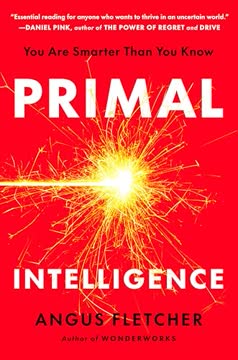
1. Primal Intelligence is our innate, non-logical genius for navigating life's uncertainties.
This brainpower was neglected in modern schools. And impossible for computer AI. Yet it was the key to the mental gifts of Jobs, Angelou, Tesla, van Gogh—and also Marie Curie, Abraham Lincoln, Wayne Gretzky, William Shakespeare…The list went on.
Beyond logic. Modern education and AI prioritize logic, pattern-finding, and data analytics, defining intelligence as computation. However, life often presents situations with limited or fragile information, where logic fails. Primal Intelligence—comprising intuition, imagination, emotion, and commonsense—is our natural, non-logical capacity to thrive in such "volatility, uncertainty, complexity, and ambiguity" (VUCA) by acting smart with little to no information.
A lost nature. This innate intelligence, honed over millions of years of evolution, allows humans to succeed where AI falters. It's our "lost nature," often suppressed by conditioning us to think like computers. The U.S. Army Special Operations, facing recruits who could solve math problems but not life problems, partnered with Professor Angus Fletcher's lab to rediscover and train this primordial brainpower, recognizing its critical role in real-world effectiveness.
Storythinking's power. The core mechanism behind Primal Intelligence is "narrative cognition," or "storythinking." Our brain thinks in stories, which are invented sequences of actions (plots or plans). This biological function enables us to create possibilities, not just calculate probabilities, making us inherently adaptable and innovative in the face of the unknown.
2. Intuition spots exceptions, revealing hidden rules and new possibilities beyond patterns.
Exceptional information hints at a new rule that can shift the whole world’s story. It’s a blip—until it changes everything.
Detecting the unique. Intuition is the ability to "know without consciously thinking," perceiving hidden rules of life by spotting "exceptional information"—anomalies that defy established patterns. Unlike logical "recognition" (pattern matching), intuition identifies ruptures in standard narratives, driving breaks with the past and revealing new possibilities.
Visionary examples. Visionaries like Vincent van Gogh, Marie Curie, and Steve Wozniak leveraged intuition to transform their fields. Van Gogh noticed green-purple and yellow-blue contrasts, leading to the RGB color wheel that powers all video screens. Curie observed radioactivity coming from inside an atom, challenging fundamental laws. Wozniak saw the potential of the "too small" Altair microcomputer, sparking the personal electronics revolution.
Shift to Narrative. To reactivate intuition, we must interrupt our adult brain's habit of labeling and judging. The "Shift to Narrative" technique involves:
- Noticing a judgment (e.g., "serious").
- Asking "Where did the judgment come from?" to unearth an origin story.
- Focusing on the specific event, then asking "What happens next?" to translate intuition into original action.
This process helps us see the unique in people and situations, just as we did as children.
3. Imagination crafts flexible plans by integrating past purpose with branching futures.
While logic computes what is probable, story creates what is possible.
Story as plan. Imagination, the ability to "see things that the eyes don't see," is not mere hallucination or faster processing. Its biological root is "story," which evolved long before language to help our ancestors think and plan. A story, like a plan, is an invented sequence of actions, making story the engine of our "default mode network" that envisions alternative worlds and possible tomorrows.
Defined strategy, unlimited tactics. Effective planning, as practiced by Special Operators, combines a "single long-term goal" (defined strategy) with "many possible paths" (unlimited tactics). This mental narrative looks like an integrated past (one clear "why") leading to a branching future (many creative "what ifs"). This fusion of dexterity and direction allows for agile adaptation while maintaining strategic focus.
Training imagination. Operators train imagination through rigorous planning exercises. The first part defines strategy by prioritizing a single objective, clarifying the "why." The second part unlimits tactics by spotting exceptional information and deriving multiple possible courses of action, multiplying the "what ifs." This two-part training, exemplified by figures like Beethoven and Horatio Nelson, enables rapid, purposeful improvisation in chaotic environments.
4. Emotions are smart signals for self-assessment, guiding growth and clarifying purpose.
Emotion is smart because it sees inward. It’s a tool for diagnosing when your own life plan is faltering.
Internal compass. Emotions are not irrational; they are critical intelligence signals monitoring our mental life narrative.
- Fear signals "no plan," prompting us to seek direction.
- Anger signals "one plan," indicating a narrowed future and a need for operational flexibility.
- Grief signals a fractured past ("two worlds"), diminishing forward momentum.
- Shame signals a split identity ("two people"), decreasing purpose.
First-step plans. To counter fear, Operators use a "first-step plan" technique: push your mental gaze toward your long-term strategic objective (your "narrative horizon") to invent an initial step forward. This re-establishes purpose and initiates a positive loop between courage and ability. For anger, the "Emotion Reset" involves recalling a time you made a new plan under pressure, calming aggression and releasing intuition.
Dumb pride and maverick gratitude. To integrate grief and shame, we must reconnect with our "why." This comes from:
- Dumb pride: A positive feeling toward a past action everyone else thinks you should regret, revealing your unique "fight."
- Maverick gratitude: Unexpected appreciation for a "thankless task," validating your core purpose.
These reveal your authentic self and strengthen your long-term growth strategy, turning setbacks into learning opportunities.
5. Commonsense knows when you don't know, tuning action to environmental volatility.
Commonsense is famously the ability that distinguishes humans from AI, which can ace complex calculations yet fumble a decision obvious to children.
Detecting unknown unknowns. Commonsense is our primal power to detect when we don't know something, especially "unknown unknowns." Unlike AI, which fabricates when queried about unknown information, our storythinking brain realizes when it hits the perimeter of its understanding. This ability tracks environmental novelty (volatility), prompting us to imagine new plans or switch existing ones.
Falsification over verification. Our brain works best by inverting computer behavior: instead of seeking data verification, it seeks falsification from the unexpected. When commonsense isn't sounding an alarm, it signals low volatility, allowing us to confidently power forward. This "maximum adequacy" approach, exemplified by Ben Franklin and successful stock pickers like Warren Buffett and James Simons, allows us to be both accurate in stable times and agile in changing ones.
Tuning anxiety. To cultivate commonsense, we must "tune our anxiety":
- Past Anxiety: NONE: Process old fears by updating standard operating procedures (SOPs) or attributing problems to bad luck, preventing past anxieties from sabotaging present action (Buffett's public speaking).
- Future Anxiety: NEAR (Now + 1): Focus worries only on the immediate next step of a mission, maximizing vigilance for emergent threats and opportunities without getting overwhelmed by distant possibilities (Simons' hedge fund).
6. Innovation thrives by embracing conflict and transforming exceptions into new rules.
If something is weird, embrace it. Or in other words: When you see an exception, double down, turning the anomaly into a new rule.
Beyond ideation. True innovation isn't random "ideation" (kissing frogs) or incremental tweaks; it's purposeful transformation. Special Operators accelerate intuition into innovation through three methods:
- Turn an exception into a new rule: Imagine "what if an anomaly became the norm." Einstein did this with light's constant velocity, turning it into the law of relativity. Steve Jobs doubled down on the ROKR's original elements to create the iPhone.
- Leverage conflict: Instead of choosing or compromising between a rule and an exception, lean into the tension. This engages storythinking to invent a new rule that satisfies both the old rule's "why" and the exception's "what if." Charles Darwin's theory of natural selection emerged from the conflict between harmonious adaptation and over-reproduction.
Eat your enemy. The third method is to "Eat your enemy" metaphorically. This means identifying what's exceptional about an adversary's thinking or methods and incorporating their best aspects into your own behavior without becoming what you hate. Japanese industry adopted American individualism to innovate factory assembly lines, and Shakespeare borrowed Marlowe's antihero concept to create compelling characters like Richard III, outcompeting rivals by internalizing their strengths.
7. Intelligent decision-making matches plan newness to situation newness, not just data.
Plans are worthless, but planning is everything…. But if you haven’t been planning you can’t start to work, intelligently at least.
The optimization trap. The paradox of optimization is that while more data and refined algorithms improve performance, they also increase vulnerability to catastrophic failure when the environment changes. Hyperspecialized systems, like AI, race to doom when data becomes a liability. Human decision-making, however, can avoid this trap by matching the newness of the plan to the newness of the situation.
Attack into the ambush. Special Ops trains recruits to "attack into the ambush"—a counterintuitive move that regains initiative and disrupts the enemy. This isn't a prescribed program but a commonsense discovery. To achieve this, decision-makers must:
- Junk successful plans when fundamentals change (Marshall): Trust expertise not when it says a plan will work, but when it says, "I have never seen a situation like this one before," signaling a need for innovation.
- New plans require boldness (Paine): Embrace "hints" of new plans, even if they seem half-formed or peculiar, rather than discarding them or trying to "fix" their originality.
- Be as bold as the situation is uncertain (Washington): Accelerate risk-taking as volatility increases, mirroring the environment's nature. Washington used classic sieges in stable times but extraordinary gambles (crossing the Delaware) in precarious ones.
Fast commonsense. This three-step method allows for rapid, intelligent choices. Neil Armstrong, a master of commonsense, toggled between standard operating procedures and radical improvisation (like using reentry thrusters in orbit or ejecting from a malfunctioning simulator) to land on the moon, demonstrating that commonsense is fast enough for life-or-death situations.
8. Effective communication inspires shared purpose through narrative, not control.
Get your audience to imagine a question, then answer it better than they can.
Engaging imagination. External communication (marketing) works by sparking imagination, not by inciting fear or programming behavior. Stories that engage our imagination become integral to our personal narrative, fostering a shared purpose. Nike's "Just Do It" ad, featuring an octogenarian jogger, inspired viewers to imagine their own future of personal accomplishment.
Shakespearean techniques for external comms:
- Start in the middle: Begin with an unexpected event (a "middle") that stirs curiosity, prompting the audience to speculate on the "beginning" (why) and imagine the "end" (what if). Homer, Shakespeare, and Mary Shelley used this.
- Focus on exceptions to rules: Present anomalous characters or events that break archetypes, captivating attention and launching imagination. Maya Angelou's memoir, like Shakespeare's Shylock, draws power from this.
- Write in riddle: Connect contradictory things to stimulate curiosity and suspense, drawing the audience forward to a future answer. Abraham Lincoln's Gettysburg Address used the riddle of America's founding ideals versus its reality.
- End with the beginning: Finish by explaining the "why" behind the story, providing a launching point for the audience's "what if" without controlling their imagination.
Commander's Intent for internal comms. Internal communication (for teams) aims for alignment, not engagement. The "Commander's Intent" formula (from Shakespeare and Churchill) is:
- Tell your team the goal (the story's end).
- Explain the "why" of their mission (the story's beginning).
- Close your mouth, allowing them to invent the "middle" (tactics) themselves.
This defines strategy without constraining tactics, fostering initiative and adaptability.
Building trust through candor. The final ingredient for all communication is trust, which comes from candor. Be willing to share the full and honest story of your life, including uncomfortable facts, to create emotional security and rapport. This willingness, rather than the actual disclosure, signals authenticity and encourages others to reciprocate, fostering genuine connection and "communion."
9. Coaching unleashes potential by empowering rookies to improvise and learn.
The paradox is that an expert is a learner who doesn’t learn. To become an expert, she had to learn. But an expert is someone who knows. And when you know, you don’t need to learn. Meaning that the expert has mastered a skill—learning—that she’s now wasting.
Escaping the paradox of expertise. Experts often flatline after reaching the top because "knowing" inhibits further learning. The secret to continuous growth, as practiced by elite Special Operations pilots (SOAR), is to "Unleash the rookie." This means handing control of difficult missions to inexperienced individuals and allowing them to make mistakes.
Learning from mistakes. When a rookie makes errors, the expert doesn't reverse their decisions but "runs with the rookie's mistakes," improvising new solutions in real-time. This forces the expert to "fly out of their mind," pushing their own limits and inventing new tricks they never knew they possessed. The more mistakes the rookie makes, the more the expert's skills are honed.
The neuron's branching structure. This coaching method leverages the neuron's tree-like, branching anatomy, which allows imagination to generate forking actions and reverse-branch from a future destination to find intersecting paths. Dr. William Osler revolutionized medical education by unleashing students into hospital wards, letting them learn by doing and relying on their intuition, with instructors providing a safety net. This approach, also seen in figures like Wayne Gretzky, fosters self-efficacy and adaptability in both the rookie and the expert.
10. True leadership is self-reliant vision, daring to pursue unproven opportunities.
Absolve you to yourself, and you shall have the suffrage of the world.
Beyond management. Leadership is not management. Management is about steering processes and outcomes, often through influence or control. Leadership, however, is about "taking the first step into tomorrow," figuring out where to go by spotting and seizing opportunities others dismiss. Leaders are innovators, resilient, decisive communicators, and coaches who go "full Primal."
The long walk. Self-reliance, as described by Ralph Waldo Emerson, is crucial for leadership: following your own inner rule, even if it means being a nonconformist. The "long walk" exercise, used by Special Operations, tests this by placing individuals alone in unknown wilderness to reach a distant destination without external guidance. Most quit, unable to handle the self-doubt.
Vision can be coached, but can't be cautious. To succeed on the long walk and activate self-reliance, leaders need "vision"—an imaginative commitment to a future destination. This vision is:
- Coached: Mentors like Wally Gretzky (Wayne Gretzky's father) provide broad strategic direction, then "release the controls" to let the rookie fly, fostering independent foresight.
- Not cautious: Leaders must overcome "critical thinking" that discounts new opportunities due to lack of data. This "mortgages the future" by prioritizing safety over seizing emergent possibilities. Reading "realistic fiction" (like sci-fi for engineers such as Bell, Goddard, and Shannon) can speed up vision by practicing the mental mechanics of seizing possibilities.
Covert Victory. To know if you're ready to lead, practice "Covert Victory": succeed at something hard, then keep it private. If you don't feel the need to bond or brag, it indicates self-reliance and an inner compass, proving you're defining your strategy and pursuing a destination that truly sets you apart. Nikola Tesla, inspired by Goethe's Faust, envisioned the AC motor by daring to pursue an unproven possibility, becoming a self-reliant pioneer.
11. Storythinking (Moto) is the biological engine of Primal Intelligence, beyond AI's logic.
Moto runs on a nonlogical brain machine: the synapse.
Logic vs. Moto. Our brain evolved two distinct functions:
- Logic (A=B): Developed to "eat," it detects patterns and runs symbolic logic (like transistors). It birthed our visual cortex and higher-order algorithmic functions (arithmetic, deduction).
- Moto (A->B): Developed to "not get eaten," it acts creatively, initiating surprising movements and chaining reinforcing actions. It runs on the synapse (not transistors) and birthed our motor cortex, causal/counterfactual cognition (why/what if), and narrative thinking.
The synapse: A non-logical machine. Unlike AI's transistors, which operate on A=B (if fire then smoke means fire equals smoke), the synapse mechanically enables A->B (fire causes smoke). This allows our brain to invent actions and process unknown causes, operating with low information and taking initiative. While largely insentient, moto can be consciously trained through story.
Self-consciousness as narrative. Simple consciousness (awareness of words) is logical and spatial. Self-consciousness (awareness of self in time) is narrative and temporal, beginning with the story of our past leading to our present. This highlights how our brain is both a computer (logic) and more (story), capable of self-awareness and inventing new actions that AI cannot.
12. Storythinking (Moto) is the biological engine of Primal Intelligence, beyond AI's logic.
Shakespeare awakened the intelligence of these artists, scientists, and leaders by rejecting the logical mindset of medieval schools.
Naturalism and story. My unconventional research, inspired by natural history's focus on unique cases (like Darwin's finches or Faraday's experiments), led me to study individual brains. I realized a brain is a group of actions, a narrative. Thus, to understand human intelligence beyond computation, I needed to probe the mechanics of story. Shakespeare, a "country boy with little education" who transformed the world, became my ultimate case study.
Shakespeare's legacy. Shakespeare's plays, filled with "exceptions, strange and stranger," rejected medieval logic and instead honed intuition, imagination, emotion, and commonsense. He taught us that "what makes a story work isn't its fidelity to formulas. It's how it breaks the rules." This "rebirth of story" inspired generations of innovators—from Einstein and Beethoven to Jobs and Curie—to see beyond precedent and create new realities.
The limits of optimization. The rise of "programmers" and "optimization" in the mid-20th century, fueled by computers and J.P. Guilford's "ideation" (divergent + convergent thinking), claimed logic could power innovation. However, this contradicts logic's own timeless nature and mechanical incapacity for true novelty. Generative AI, being "half our gray matter accelerated and the other half lobotomized," will forever be incompetent at innovation, strategy, communication, and leadership because it lacks the moto-driven storythinking of the human brain.
My personal journey. My own journey, from excelling at standardized tests (a "Shakespeare chatbot") to flunking Marine Corps boot camp due to a lack of commonsense, proved that "brilliance at IQ tests and statistics does not translate into brilliance at life." My collaboration with Special Operations, who valued my "unnatural" abilities and shared my naturalist approach, allowed me to finally articulate and share the Primal Intelligence method: a way to activate the brain's ancient power to create new plans that work, adapting to change and winning in chaos.
Last updated:
Similar Books