Key Takeaways
1. The Enduring Mystery of Prime Numbers
Is there a general rule or formula for how many that will spare us the trouble of counting them?
Fundamental building blocks. Prime numbers, integers greater than one divisible only by one and themselves, are the fundamental building blocks of arithmetic. While easy to define, their distribution among the natural numbers has puzzled mathematicians for millennia. They appear to thin out as numbers get larger, yet Euclid proved around 300 B.C.E. that there is an infinite supply of them.
Early observations. Carl Friedrich Gauss, at just 15 years old, meticulously counted primes in blocks of 1,000 numbers, observing their decreasing frequency. This empirical work led him to intuit a rule for their average distribution, a profound insight that would take over a century to formally prove. The core challenge was to find a precise mathematical formula to predict how many primes exist below any given number, rather than relying on laborious counting.
The quest begins. This quest for a "prime counting function" (denoted π(N)) became a central problem in mathematics. It spurred the development of new mathematical tools and theories, ultimately leading to the Prime Number Theorem and Bernhard Riemann's groundbreaking work, which introduced the enigmatic Riemann Hypothesis.
2. Riemann's Zeta Function: The Golden Key
Both the sum on the left and the product on the right go all the way to infinity.
A powerful function. Riemann's zeta function, denoted ζ(s), is initially defined as an infinite sum: ζ(s) = 1/1^s + 1/2^s + 1/3^s + ... for complex numbers 's' with a real part greater than 1. This seemingly simple sum holds profound connections to the primes.
Euler's profound link. Leonhard Euler, a century before Riemann, discovered a "Golden Key" linking this infinite sum to an infinite product over all prime numbers: ζ(s) = (1/(1-2^-s)) * (1/(1-3^-s)) * (1/(1-5^-s)) * ... This formula is a cornerstone of analytic number theory, bridging the continuous world of analysis with the discrete world of prime numbers.
Unlocking secrets. The Golden Key reveals that the behavior of the zeta function is intimately tied to the distribution of primes. By studying the properties of ζ(s), mathematicians could gain insights into the seemingly chaotic arrangement of prime numbers, a fusion of arithmetic and analysis that transformed the field.
3. Analytic Continuation: Unveiling the Full Zeta Function
The moral of the story is that an infinite series might define only part of a function; or, to put it in proper mathematical terms, an infinite series may define a function over only part of its domain.
Extending the domain. The initial definition of the zeta function as an infinite sum only converges for complex numbers 's' where the real part is greater than 1. However, mathematicians employ a technique called "analytic continuation" to extend its definition. This allows the function to have a definite value for almost all other complex numbers.
Mathematical tricks. This extension is achieved through clever algebraic manipulations and functional equations, such as relating ζ(s) to the eta function or using Euler's functional equation. These methods allow us to calculate values for ζ(s) even when the original infinite sum would diverge. For example:
- ζ(0) = -0.5
- ζ(-1) = -1/12
- ζ(-2) = 0
Trivial zeros emerge. Through analytic continuation, the zeta function is found to have "trivial zeros" at every negative even integer (-2, -4, -6, ...). These zeros are straightforward to locate and understand, but they are not the focus of Riemann's most famous conjecture.
4. The Riemann Hypothesis: A Precise Guess
All non-trivial zeros of the zeta function have real part one-half.
The central enigma. Bernhard Riemann's 1859 paper, "On the Number of Prime Numbers Less Than a Given Quantity," introduced a profound conjecture about the zeta function's "non-trivial zeros." These are the zeros that are not the easily found negative even integers.
The critical line. Riemann hypothesized that all these non-trivial zeros lie on a specific vertical line in the complex plane, known as the "critical line." This line consists of all complex numbers whose real part is exactly one-half (e.g., 0.5 + 14.1347i, 0.5 + 21.0220i).
- Non-trivial zeros are complex numbers.
- They are known to lie within the "critical strip" (real part between 0 and 1).
- They occur in conjugate pairs (if a+bi is a zero, so is a-bi).
A casual remark, a century-long quest. Riemann himself noted, "One would, of course, like to have a rigorous proof of this, but I have put aside the search for such a proof after some fleeting vain attempts because it is not necessary for the immediate objective of my investigation." This casual remark ignited an obsession that has captivated mathematicians for over 160 years, becoming the greatest unsolved problem in mathematics.
5. The Prime Number Theorem: A Century of Progress
It had been said that whoever proved the PNT would attain immortality.
Approximating prime distribution. The Prime Number Theorem (PNT) provides a powerful approximation for the number of primes less than a given number 'x', denoted π(x). It states that π(x) is asymptotically equivalent to x/log x, or more accurately, to the logarithmic integral function, Li(x). This means the ratio of π(x) to Li(x) approaches 1 as x tends to infinity.
Gauss's early intuition. Carl Friedrich Gauss first conjectured this relationship in 1792, based on his meticulous counting of primes. However, a rigorous proof eluded mathematicians for over a century, despite the efforts of many brilliant minds like Legendre and Chebyshev.
A dual triumph. The PNT was finally and independently proven in 1896 by two mathematicians: Jacques Hadamard of France and Charles de la Vallée Poussin of Belgium. Their proofs relied heavily on the analytical tools and insights provided by Riemann's 1859 paper, particularly his work on the zeta function, solidifying the fusion of arithmetic and analysis.
6. The Error Term: Where the Hypothesis Lives
If the Riemann Hypothesis is true, then π(x) = Li(x) + O(√x log x).
Beyond approximation. With the PNT proven, attention shifted to the "error term"—the precise difference between the actual number of primes π(x) and its approximation Li(x). Riemann's 1859 paper provided an "explicit formula" for π(x) that directly linked this error term to the non-trivial zeros of the zeta function.
A tight bound. The Riemann Hypothesis (RH) offers the tightest possible bound for this error term. Helge von Koch proved in 1901 that if the RH is true, then the error term is O(√x log x). This "big oh" notation means the error's magnitude will not exceed a fixed multiple of √x log x for sufficiently large x. This elegant bound implies a highly regular and predictable behavior for the distribution of primes.
Oscillating differences. Interestingly, G.H. Hardy's collaborator, J.E. Littlewood, proved in 1914 that the error term Li(x) - π(x) oscillates, changing from positive to negative and back infinitely many times. This contradicted earlier beliefs that Li(x) was always greater than π(x), highlighting the subtle and complex nature of prime distribution, even with the RH's elegant bounds.
7. Complex Numbers: The Canvas for Zeta's Secrets
While the real numbers can be spread out for inspection on a line, the complex numbers need a plane—which of course we call 'the complex plane.'
Expanding the number system. Complex numbers, expressed as a + bi (where 'a' and 'b' are real numbers and 'i' is the imaginary unit, √-1), provide the essential framework for understanding the zeta function. Unlike real numbers, which can be ordered on a single line, complex numbers require a two-dimensional "complex plane" for visualization, with a real axis and an imaginary axis.
Visualizing functions. Functions of a complex variable, such as the zeta function, map points from one complex plane (the argument plane) to another (the value plane). This allows for powerful visual representations of their behavior. For instance, the zeta function maps the critical line in the argument plane to a distinctive double spiral in the value plane.
Geometric insights. These "sent to" and "comes from" pictures of the complex plane reveal the intricate patterns of the zeta function. The non-trivial zeros, where the function's value is zero, appear as specific points on these complex mappings. This geometric perspective is crucial for grasping the Riemann Hypothesis, which posits that all these critical points align on a single vertical line.
8. The Hilbert-Pólya Conjecture: A Bridge to Physics
The non-trivial zeros of the Riemann zeta function correspond to the eigenvalues of some Hermitian operator.
Unexpected parallels. Hermitian matrices, a type of complex matrix, possess a remarkable property: all their eigenvalues (the zeros of their characteristic polynomial) are real numbers. This unexpected emergence of real numbers from a complex object struck mathematicians as analogous to the Riemann Hypothesis, which states that the imaginary parts of the zeta function's non-trivial zeros are all real (since their real part is fixed at one-half).
A whispered conjecture. Around 1910-1920, David Hilbert and George Pólya independently conjectured that the non-trivial zeros of the Riemann zeta function might correspond precisely to the eigenvalues of some Hermitian operator. This "Hilbert-Pólya Conjecture," though never formally published by them, suggested a profound, hidden connection between abstract number theory and the world of operators in physics.
Implications for proof. If such a "Riemann operator" could be found, proving its Hermitian nature would automatically prove the Riemann Hypothesis. This conjecture opened a new, highly speculative, but potentially revolutionary avenue of research, hinting that the secrets of prime numbers might be encoded in the laws of physics.
9. Quantum Chaos and Zeta Zeros: The Montgomery-Odlyzko Law
What on earth does the distribution of prime numbers have to do with the behavior of subatomic particles?
Modeling quantum systems. In the 1950s and 60s, physicists like Eugene Wigner and Freeman Dyson used "random Hermitian matrices" (specifically, the Gaussian Unitary Ensemble, or GUE) to model the energy levels of complex quantum systems, such as the nuclei of heavy atoms. The statistical spacing of these matrices' eigenvalues provided excellent fits for observed energy spectra.
A serendipitous discovery. In 1972, number theorist Hugh Montgomery, while investigating the statistical spacing of the Riemann zeta function's non-trivial zeros, discovered a formula for their "pair correlation function." In a chance encounter at Princeton, physicist Freeman Dyson immediately recognized this formula as identical to the "form factor" for the eigenvalues of GUE random matrices.
The Montgomery-Odlyzko Law. This remarkable coincidence led to the "Montgomery-Odlyzko Law," which states that the distribution of spacings between successive non-trivial zeta zeros (when suitably normalized) is statistically identical to the distribution of eigenvalue spacings in a GUE operator. This law, confirmed by Andrew Odlyzko's extensive supercomputer calculations in the 1980s, strongly suggests that a "Riemann operator" exists and models a quantum chaotic system.
10. The Obsession Continues: Computational and Algebraic Pursuits
The Riemann Hypothesis is now the great white whale of mathematical research.
Computational verification. Since Jørgen Gram's initial calculation of 15 zeros in 1903, computational efforts have relentlessly pushed the boundaries of verification. Using advanced algorithms like the Riemann-Siegel formula (discovered in Riemann's unpublished notes by Carl Siegel), researchers have confirmed that the first 100 billion non-trivial zeros indeed lie on the critical line. This empirical evidence, while not a proof, strongly supports the Hypothesis.
Algebraic parallels. Another active front involves algebraic number theory, particularly the study of zeta functions associated with finite fields. Pioneering work by Emil Artin, Helmut Hasse, and Pierre Deligne has led to proofs of "Riemann Hypotheses" for these analogous zeta functions. These successes offer hope that the techniques developed might eventually be adapted to solve the classical Riemann Hypothesis for the field of rational numbers.
Probabilistic insights. Indirect approaches also persist, such as Denjoy's probabilistic interpretation, which links the RH to the random walk of the Möbius mu function, suggesting a 50-50 probability for the number of prime factors in square-free numbers. Harald Cramér's model, which posits that primes are distributed "as randomly as they could be" given their density, also provides statistical links to the RH, hinting at deeper underlying patterns.
11. Hilbert's Challenge: "We Must Know, We Shall Know"
For us there is no Ignorabimus, and in my opinion there is none for the natural sciences either. In place of this foolish Ignorabimus, let our resolution be, to the contrary: 'We must know, we shall know.'
A beacon for the century. In 1900, David Hilbert presented 23 unsolved mathematical problems to the International Congress of Mathematicians, with the Riemann Hypothesis prominently featured as problem number 8. His address, concluding with the defiant declaration "Wir müssen wissen, wir werden wissen" ("We must know, we shall know"), set an optimistic tone for scientific inquiry in the new century.
A persistent stalemate. Despite over a century of relentless effort by the world's finest mathematical minds, the Riemann Hypothesis remains unproven. Researchers often find themselves at a "stalemate," where significant advances are made, but a clear path to a definitive proof or disproof remains elusive. This difficulty underscores the profound depth and complexity of the problem.
Transformative consequences. The resolution of the RH, whether true or false, promises to be one of the most significant intellectual achievements of our time. Its truth would validate countless theorems in number theory, refine our understanding of prime distribution, and potentially unlock new insights in cryptography and quantum physics. The ongoing quest embodies the enduring human drive to explore the unknown and push the boundaries of knowledge.
Last updated:
Review Summary
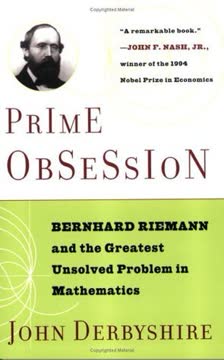
Prime Obsession by John Derbyshire explores the Riemann Hypothesis, one of mathematics' most enduring mysteries. Reviews praise the book's alternating structure between mathematical explanations and biographical chapters, making complex concepts accessible to non-specialists with calculus background. Readers appreciate Derbyshire's clear prose and ability to convey mathematical beauty, though some find the latter chapters challenging and note the required mathematical sophistication. The book successfully explains what the Riemann Hypothesis means and why it matters, earning widespread acclaim as an excellent popular mathematics text despite its demanding nature.
Similar Books