

Key Takeaways
A consistent arithmetic system cannot prove every truth it can express.
The central limit. Gödel’s first incompleteness theorem concerns formal systems powerful enough to express basic arithmetic. If such a system is consistent, there is a statement it can express that it cannot prove, and cannot disprove, using its own rules. In the intended interpretation of arithmetic, that statement is true. The result is not that mathematics is unreliable. It is that no single rule-governed system captures every arithmetical truth while remaining consistent.
A boundary, not a collapse. The theorem overturned the hope that mathematics could be reduced to a complete, self-contained set of formal proofs. It also opened new areas of mathematical logic, including model theory and recursion theory. Its consequences reach into questions about truth and knowledge, but the mathematical claim itself is precise and limited.
What makes the theorem unsettling is also what makes it disciplined: it identifies a specific limit rather than declaring reason generally helpless. A formal system can prove a great deal, and its proofs remain valuable. The result instead warns against treating one successful method of justification as a complete inventory of truth. That distinction matters well beyond mathematics, wherever a model is mistaken for the whole of the thing it models. The theorem does not show that every unproved claim is true, only that proof within a sufficiently expressive system has principled limits.
Use self-reference to expose the limits of formal proof.
A sentence about itself. Gödel’s proof gives an arithmetic statement a second meaning: it also says that it cannot be proved within the formal system. To construct it, he assigned numbers to the system’s symbols, formulas, and proofs. This encoding, called Gödel numbering, let arithmetic describe features of its own proofs.
Paradox, carefully redirected. The strategy resembles the ancient liar puzzle, which asks what happens when a sentence declares itself false. Gödel’s statement does not claim to be false. It says that it is unprovable. If the system is consistent, it cannot prove the statement, because that would make it false while a valid proof would establish it as true. So the statement is true precisely because the system cannot prove it. Self-reference, usually a source of contradiction, becomes a tool for proving incompleteness.
The proof’s ingenuity lies in turning a question about a system into a statement expressible inside that system. This is a striking example of a method revealing its own limits without dissolving into contradiction. It also clarifies why the result is not a mere word game: Gödel translates the relevant claims into arithmetic and proves the conclusion by mathematical rules. Self-reference is not inherently paradoxical; its consequences depend on what is being asserted and on the structure in which the assertion is made.
Separate mathematical truth from what a formal system can prove.
Two standards. Provability is a matter of whether a statement follows from a system’s axioms and rules. Truth, in Gödel’s interpretation, concerns whether the statement correctly describes mathematical reality. The distinction is central to mathematical Platonism, the view that numbers and mathematical truths exist independently of human-made systems. Gödel believed the incompleteness theorem supported this realism: formal rules could not exhaust the truths they were meant to describe.
An interpretation, not a corollary. The theorem establishes a limit on formal proof. It does not, by itself, establish that numbers exist as independent abstract objects. Formalists can accept the theorem while interpreting mathematics as rule-governed symbol manipulation. Gödel regarded that account as inadequate, but the gap between his proof and his metaphysical conclusion is important.
This distinction protects the theorem from two opposite exaggerations. It does not reduce mathematical truth to what people happen to prove, but it also does not force every reader to accept Platonism. The formal result underdetermines its metaphysics. That is familiar in many sciences: a successful model can constrain interpretation without uniquely settling what reality ultimately consists of. Gödel’s realism gives the theorem philosophical force, while the theorem’s technical content remains intelligible even to someone who rejects his account of mathematical objects.
No arithmetic system can certify its own consistency from within.
Hilbert’s unfinished safeguard. David Hilbert hoped to place mathematics on secure formal foundations by proving that its systems were consistent. A consistent system never yields a contradiction; an inconsistent one can prove anything, and so proves nothing reliably. Hilbert’s program sought a rigorous, finite proof that arithmetic itself was consistent, thereby securing the wider mathematical project.
Gödel’s second result. Gödel showed that a consistent formal system containing enough arithmetic cannot prove its own consistency using only its own resources. This does not mean consistency cannot be proved at all. A proof may be possible in a stronger system, but that stronger system then has its own consistency question. The hoped-for final internal guarantee is unavailable. Hilbert’s program could not deliver the complete foundation its advocates sought.
The second theorem exposes a familiar difficulty in assurance: a system cannot always validate its own premises using only procedures licensed by those premises. This does not make consistency meaningless, nor does it make mathematical practice arbitrary. It changes what a justification can promise. The search for foundations can still produce stronger arguments and clearer assumptions, but it cannot end in a single system that certifies every aspect of itself. The distinction between a useful guarantee and an absolute guarantee is the theorem’s lasting philosophical pressure point.
Godel’s proof grew from Vienna’s clash over meaning and reality.
A city searching for foundations. In the Vienna of the 1920s, artists, scientists, and philosophers were questioning inherited ideas and trying to rebuild knowledge on firmer ground. The Vienna Circle, a discussion group led by Moritz Schlick, promoted logical positivism. In its broad form, this view treated meaningful claims as either empirically verifiable or true by definition, rejecting metaphysical claims as meaningless.
The quiet dissenter. Gödel attended the Circle’s meetings as a student, but he had already become a Platonist. He believed mathematical truths described an objective reality, not merely the rules of a language. He rarely argued openly; instead, his work in mathematical logic challenged the positivist view that mathematics was only formal syntax. The city’s debate did not dictate his theorem, but it sharpened the question he wanted mathematics to answer.
The Vienna setting makes clear that abstract work can arise inside a vivid intellectual conflict without being reducible to that conflict. Gödel shared the Circle’s appetite for rigor while rejecting its account of what rigor could describe. That combination is more revealing than a simple story of opposing camps: a movement can supply the questions and standards that a dissenter uses to challenge its conclusions. The biography also cautions against assuming that attendance means agreement, especially when a thinker’s temperament makes disagreement difficult to observe.
Do not mistake relativity or incompleteness for anything-goes relativism.
A popular misreading. Gödel’s incompleteness theorems and Einstein’s relativity have often been treated as evidence that truth depends on human viewpoints. Goldstein argues that both men rejected that conclusion. Gödel believed mathematics gave access to truths independent of people. Einstein understood relativity as a precise physical theory, not as a claim that reality changes with anyone’s personal perspective.
The distinction matters. Gödel’s theorem says that certain truths cannot be proved inside a particular kind of formal system. It does not say that truth is invented by society, or that every interpretation is equally valid. Likewise, relativity compares measurements between technical reference frames; it does not make physical reality a matter of individual opinion. The book’s central corrective is to distinguish limits on our descriptions from the denial of an objective world.
The appeal of the relativist reading is understandable: words such as relativity and incompleteness sound like invitations to loosen standards. But technical claims do not inherit their meaning from everyday connotations. A theory can deny an absolute measuring frame while remaining rigorously objective, and a theorem can limit formal proof without making truth subjective. Goldstein’s corrective is persuasive, though the broader philosophical debate remains open: defending objectivity does not by itself show how human beings gain reliable access to it.
Treat claims that Gödel disproves machine minds with caution.
A tempting argument. Philosophers John Lucas and Roger Penrose use Gödel’s theorem to argue that human mathematical understanding cannot be reduced to a computer. A computer follows formal rules; Gödel shows that any sufficiently powerful, consistent formal system leaves some truths unproved. If human reason can recognize those truths, the argument goes, the mind must exceed mechanical rule-following.
Gödel’s qualification. Gödel was more cautious. He thought the result supported a choice: either the human mind can surpass every machine, or some mathematical questions are undecidable for the human mind too. The theorem does not prove that people can reliably recognize every Gödel sentence as true. It establishes limits on formal systems, not a complete scientific theory of consciousness.
The argument is strongest when treated as a challenge to a particular model of thought, not as a proof that minds are noncomputational. A formal system’s limits transfer to human cognition only if human mathematical judgment is both reliable and not itself captured by a comparable system. Those assumptions need independent support. Gödel’s own caution is valuable here: a theorem can reveal the inadequacy of one account of mind without settling what minds are. The distinction preserves the question’s importance while resisting a conclusion the mathematics alone cannot carry.
Einstein and Godel shared an exile inside Princeton’s intellectual sanctuary.
Two outsiders in conversation. At Princeton’s Institute for Advanced Study, Einstein and Gödel walked home together and discussed physics, mathematics, philosophy, and politics. Their temperaments differed sharply, but both believed their fields could reveal an objective reality beyond ordinary experience. That shared conviction set them apart from influential thinkers who emphasized the limits of observation or the role of human perspectives.
A strange universe. Gödel also found an original solution to Einstein’s equations of general relativity. In that model, time loops back on itself, making travel to the past mathematically possible. Einstein recognized the solution’s formal significance but doubted that it described a physically possible universe. Their friendship joined a personal bond to a rare intellectual one: two major thinkers whose discoveries were widely celebrated, while their interpretations of those discoveries were often misunderstood.
The friendship gives philosophical disagreement a human scale. Shared exile here is not simply geographical; it is the loneliness of holding an interpretation that peers do not accept. Gödel’s cosmological model also shows why mathematical possibility and physical possibility must be separated. Equations can permit a structure without nature realizing it. That distinction mirrors the book’s treatment of formal proof and truth: technical results open possibilities, but further reasoning is needed before deciding what those possibilities say about the world.
Godel’s exact logic coexisted with fears that ended in starvation.
A life beyond the theorem. Gödel was intensely curious from childhood and grew into a brilliant but deeply solitary thinker. He suffered anxiety and hypochondria, and in later life developed paranoid fears, including the belief that people might poison him. His friend Einstein died in 1955; Gödel’s closest remaining confidant, economist Oskar Morgenstern, died in 1977. As Gödel’s wife Adele was hospitalized, Gödel’s isolation and refusal to eat worsened. He died in 1978 from malnutrition and inanition.
No simple explanation. Goldstein connects Gödel’s intellectual isolation with the misunderstandings surrounding his work, but does not reduce his illness to his theorem or his philosophy. The contrast is stark: a mind capable of extraordinary formal precision could not use logic to escape every fear or protect itself from psychological suffering.
The ending resists the comforting myth that exceptional intelligence supplies general immunity. Gödel’s mathematical achievements and his mental illness belong to the same human life, but neither explains away the other. The story also invites care in interpreting eccentricity: genius can attract fascination that turns suffering into a charming anecdote. A more humane reading keeps the intellectual achievement in view while recognizing the costs of isolation and the limits of rational argument when fear has become part of a person’s world.
Analysis
The book’s deepest contribution is not simply the statement that mathematics has undecidable propositions. It is the sharp separation it makes between a truth and a proof of that truth within a chosen system. Gödel’s construction matters because it turns that separation into a theorem, rather than a philosophical suspicion. By encoding claims about formal proofs as arithmetic, he makes a system confront a limit it cannot state away.
Goldstein’s narrative then places this technical achievement inside a wider argument about objectivity. Gödel’s Platonism is presented as the motivating interpretation: mathematics describes a reality that no formal calculus fully captures. Yet the distinction between proof and truth does not compel Platonism. The theorem constrains formalist ambitions, but a metaphysical account of what mathematical truth is remains a further commitment. Preserving that gap strengthens the book’s argument, since it prevents Gödel’s result from being recruited as a slogan for either realism or relativism.
The biography is most effective when intellectual temperament and historical setting illuminate one another without pretending to explain the mathematics. Vienna’s positivists supplied an urgent debate about meaning; Princeton gave Gödel a protected home and a rare companion in Einstein. Their shared defense of an objective world complicates the familiar story that twentieth-century science simply displaced certainty with subjectivity. At the same time, the portrait of Gödel’s later isolation shows that intellectual rigor is not a universal remedy for human vulnerability.
The result is a book about boundaries, but not surrender. Formal systems have limits; mathematical reasoning remains powerful. Human interpretation can overclaim what a theorem proves; philosophical interpretation remains necessary. Gödel’s work neither makes truth inaccessible nor hands it over to intuition without restraint. It shows that certainty, proof, and reality are related concepts, not interchangeable ones.
Review Summary
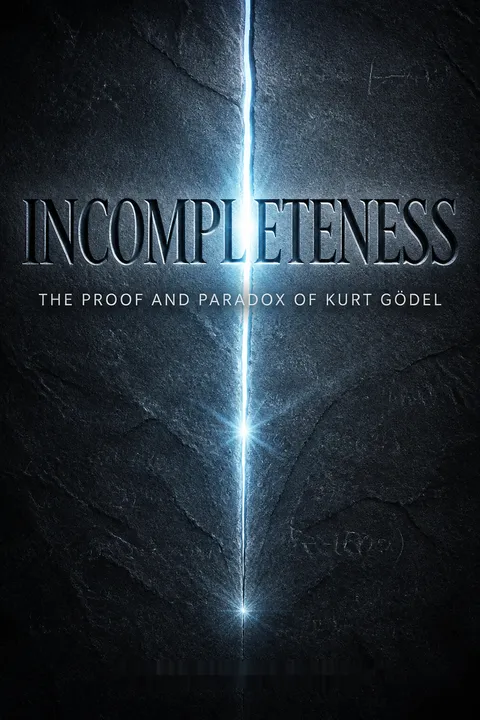
Incompleteness explores Kurt Gödel's life and his famous incompleteness theorems. Reviewers praised Goldstein's accessible explanations of complex mathematical concepts and her engaging writing style. Many found the historical and philosophical context illuminating, though some felt the focus on Wittgenstein was excessive. The book was lauded for its insights into Gödel's personality and his relationships with other intellectuals. While some readers struggled with the technical aspects, most found the book a compelling blend of biography, mathematics, and philosophy.
People Also Read

Glossary
First Incompleteness Theorem
A limit on formal proofGödel’s result that any consistent formal system capable of expressing basic arithmetic contains a statement that can be expressed but neither proved nor disproved within that system. Under the intended interpretation of arithmetic, Gödel argued that the statement is true. The theorem shows that such systems cannot be both consistent and complete.
Second Incompleteness Theorem
A limit on self-certificationGödel’s result that a consistent formal system containing enough arithmetic cannot prove its own consistency using only its own rules. A stronger system may establish the consistency of a weaker one, but that shifts rather than eliminates the question of consistency. The theorem defeats the hope for a final internal guarantee of arithmetic’s consistency.
Godel numbering
Numbers encode formal expressionsA method that assigns numbers to the symbols, formulas, and proofs of a formal system. Gödel used the encoding to translate statements about a system’s syntactic features, such as whether a formula is provable, into arithmetic. This lets a mathematical system represent information about its own proofs and makes the incompleteness construction possible.
Formal system
A rule-governed symbolic calculusA structure consisting of symbols, rules for forming well-formed expressions, axioms, and rules of inference. Proofs are produced by applying the rules to axioms and earlier results. In the formalist view, mathematics can be treated as manipulation of symbols according to these rules, without relying on the symbols’ describing an independent mathematical reality.
Hilbert program
A formal foundation for mathematicsDavid Hilbert’s project to formalize mathematics and establish the consistency of its systems through rigorous, preferably finite, proofs. Proving arithmetic consistent was a central goal, since many other consistency results depended on it. Gödel’s second incompleteness theorem showed that arithmetic could not provide the hoped-for proof of its own consistency.
Logical positivism
Meaning tied to verificationA philosophical movement associated with the Vienna Circle. In its broad account, a descriptive claim is meaningful only if experience could verify or disconfirm it; logical and mathematical statements are treated differently, as formal or analytic truths. The movement rejected metaphysical claims that could not be tested empirically. Gödel opposed its account of mathematical truth.
Mathematical Platonism
Mathematics describes abstract realityThe view that mathematical objects and truths exist independently of human beings, languages, and formal systems. On this account, mathematicians discover truths about numbers and other abstract objects rather than create them through stipulated rules. Gödel was a Platonist and interpreted incompleteness as evidence that formal systems do not exhaust mathematical reality.
Completeness theorem
Logical validity is provableGödel’s earlier result concerning first-order logic, which establishes that every logically valid statement expressible in that system can be proved using its formal rules. The result is distinct from the incompleteness theorems about arithmetic. Its proof helped establish Gödel’s reputation and showed that completeness for one logical system does not imply completeness for richer systems containing arithmetic.
Nonstandard model
An unintended arithmetic interpretationA model that satisfies the axioms of a formal arithmetic system but does not consist solely of the familiar natural numbers in their standard arrangement. Gödel’s results imply that formal arithmetic does not uniquely determine its intended model. Nonstandard models help demonstrate the gap between what axioms formally specify and the mathematical structure a Platonist takes them to describe.
About the Author
Other books by Rebecca Goldstein
Download PDF
Download EPUB
.epub digital book format is ideal for reading ebooks on phones, tablets, and e-readers.








