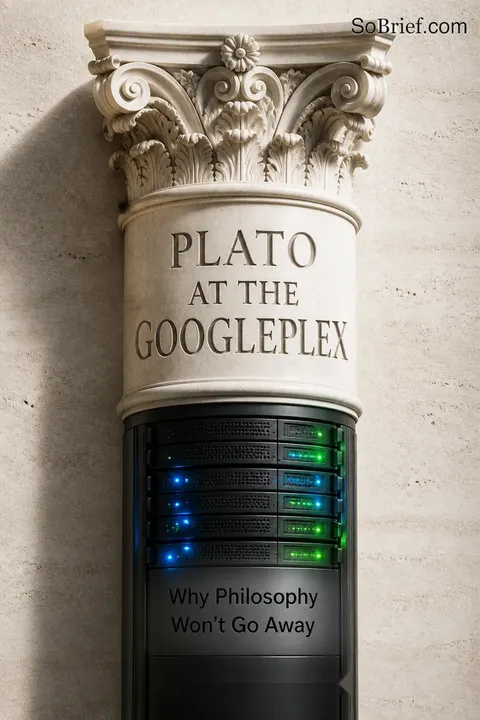


Key Takeaways
Treat Plato as a live questioner, not a museum answer key
Questions outlast answers. Goldstein imagines Plato visiting the Googleplex, appearing on cable news, advising a columnist, and entering a neuroscience lab. He encounters search engines, brain scans, and contemporary arguments, but the point is not to make him sound miraculously up to date. His old questions about justice, knowledge, love, and the mind still trouble people who think new technology has settled them.
The author stays elusive. Plato wrote dialogues rather than straightforward treatises. Socrates often leads the discussion, but he cannot simply be treated as Plato's spokesperson. The imagined conversations echo that uncertainty: their purpose is less to deliver a doctrine than to make readers examine the assumptions beneath their own answers.
What's striking is that relevance here means more than finding ancient parallels to modern disputes. The dialogues model a way of thinking in which a question changes the person asking it. That resembles a scientific research program: its value is not only in current results, but in generating sharper questions and exposing failed assumptions. The comparison has limits. A question's survival does not prove that philosophy has solved it, or that every philosophical question has a determinate answer.
Science can inherit philosophy's questions without making philosophy obsolete
Some questions change homes. Early Greek thinkers such as Thales and Anaximander speculated about the material basis of nature and the laws behind change. Later sciences took up such questions with mathematics, instruments, and experiments that let evidence challenge proposed answers. Goldstein calls the enduring belief that nature has an intelligible order the Ionian Enchantment, a phrase borrowed from historian of science Gerald Holton.
Other questions remain philosophical. Neuroscience can study brain activity, but that alone does not settle what makes an action right. Physics uses mathematical theories, but experiments do not by themselves establish whether those theories describe real, unobservable entities or merely predict observations. Even claims that science alone makes progress rely on philosophical ideas about evidence and explanation.
The boundary between science and philosophy is better understood as a working border than a permanent wall. Scientific practice depends on judgments about what counts as evidence, explanation, and reality, while philosophical analysis can clarify those judgments without replacing experiments. The caution is that philosophy does not own every question that science has not yet answered. The strongest version of Goldstein's case is not that philosophers should retain jurisdiction, but that conceptual scrutiny remains necessary wherever evidence is interpreted.
Stop measuring a life by how many people remember it
Fame once promised survival. Goldstein calls the Greek ideal the Ethos of the Extraordinary: the belief that a life mattered most when it rose above ordinary existence. Its measure, kleos, meant renown carried through other people's stories. Achilles chooses a short, glorious life over a longer, less celebrated one, making the heroic bargain vivid. In Athens, civic pride widened the promise: citizens could share in the city's exceptional achievements, though women, enslaved people, and foreign residents were excluded.
Socrates changes the measure. In Plato's account, a life should be judged not by acclaim but by whether it has been examined and lived virtuously. The Greek term aretē, often translated as virtue, means excellence, but Plato shifts it away from public reputation toward a person's moral character. A life can be worthy even when its society condemns it.
The argument catches a persistent tension in status-driven cultures: recognition can reward real contribution, but it can also become the goal that distorts contribution. Social media makes ancient kleos newly visible by turning attention into a public score. Yet praise is not worthless; communities can identify work that deserves recognition. The useful distinction is between acclaim as evidence that something matters and acclaim as the thing that makes it matter. Plato's shift insists that those standards can come apart.
Use disagreement to expose assumptions your own group cannot see
Reason needs company. Plato's dialogues show arguments tested through objections, examples, and questions about what a speaker means. Goldstein connects this practice to an epistemic democracy: no one gets a special exemption from giving reasons that others could assess. Tradition, confidence, personal feeling, or status may explain a belief, but none automatically proves it.
Discomfort is part of the method. Socratic questioning often ends in aporia, a state of intellectual impasse in which a person's confident definition has collapsed but no replacement is ready. That failure can be productive. It reveals where an assumption was doing hidden work. The Academy Plato founded gave this collective activity an institutional home, while the dialogues made readers participants in arguments rather than passive recipients of conclusions.
This is close to the logic of error correction: independent critics can find mistakes that one thinker misses. But independence matters. A group that shares the same incentives or background assumptions can reinforce a blind spot rather than expose it. A practical test follows: seek disagreement from people who can explain their objections, especially those affected by the conclusion. Argument is most useful when it broadens the evidence and experience under review, not when it merely rewards the cleverest debater.
Never outsource moral judgment to a crowd or an algorithm
A ranking rule contains values. At the Googleplex, software engineer Marcus explains how search results can be ordered using links and user responses. He proposes an ethical search engine, EASE, that would gather people's judgments about good and bad lives and calculate an answer. The proposal sounds democratic, but it immediately raises a problem: which votes count most, and by what standard?
There is no neutral setting. Weighting opinions by satisfaction or social admiration assumes something about a worthwhile life. Counting each opinion equally assumes a principle of fairness. Either choice already makes a moral judgment before the engine produces its verdict. Crowds can correct individual bias, but aggregation alone cannot decide what justice means. The person who designs the system is still responsible for its standards.
The scene anticipates a central problem in algorithmic decision-making: a system can make judgments look mechanical while hiding the values built into its objectives, data, and ranking rules. Collective input can improve decisions when participants contribute diverse information, but popularity is not a substitute for justification. The deeper lesson is not to distrust every algorithm. It is to ask who selected its goal, whose experience its data represent, and who can challenge the result.
Test moral authority with the Euthyphro question
Authority needs an account. In Plato's Euthyphro, Socrates questions a religious expert who is bringing a charge against his own father. He asks whether an act is pious because the gods approve it, or whether they approve it because it is pious. If approval alone makes an act right, morality seems arbitrary. If the gods approve it because it is already right, their approval does not explain what makes it right.
Reason cannot be skipped. The Euthyphro Dilemma does not supply a complete moral theory, but it challenges the claim that divine command by itself settles ethical questions. People still need to explain what makes an action just or unjust. For Goldstein, that is a central reason philosophy matters: moral authority must be examined, not merely invoked.
The dilemma remains powerful because it separates obedience from justification. It also has a limit: some religious philosophers answer that goodness is grounded in God's nature, rather than in arbitrary commands or an external standard. That reply shifts the discussion instead of ending it, since the nature of goodness still needs explanation. The enduring value of Socrates' question is methodological. It forces an authority claim to state what, exactly, makes the authority morally authoritative.
Explain actions at both the brain level and the human level
Mechanism is not the whole account. In an imagined neuroscience lab, Plato challenges a researcher who argues that brain processes eliminate moral responsibility. Plato recalls Socrates in prison, about to die. Describing bones and muscles would explain how Socrates can sit there, but not why he chooses to remain rather than escape. For that, the explanation must include what the choice means to him and the reasons he offers for it.
Levels can complement each other. Brain imaging tracks changes in blood oxygen, not thoughts directly, and the book notes that the signal is slower than neural activity. Libet's readiness-potential experiments also do not, by themselves, prove that conscious choice is an illusion. Brain processes implement decisions; explanations in terms of reasons make actions intelligible. Neither account should be mistaken for the other.
The exchange illustrates a distinction familiar across the sciences: explaining a phenomenon's physical realization is not always the same task as explaining its function or meaning. A river's molecular composition does not replace an account of how rivers shape landscapes; similarly, neural correlates do not automatically replace reasons in accounts of action. Still, personal explanations can be self-serving stories. Treating them as evidence to investigate, rather than final verdicts, preserves both scientific scrutiny and human accountability.
Treat the cave exit as a painful duty, not a private triumph
Familiar beliefs can be a prison. In Plato's Myth of the Cave, people confined from childhood can see only shadows cast on a wall and mistake them for reality. One prisoner is dragged into the light. At first, he is pained and confused; only gradually can he recognize what produced the shadows and see the world outside. The image represents the effort to leave an ideology that makes its own assumptions feel obvious.
Insight brings responsibility. The freed person eventually returns to the cave, despite the risk that the prisoners will reject or attack him. Knowledge is not just private escape. The thinker owes something to people still living within distorted assumptions. Yet the story also carries a danger: those who claim to see clearly may become paternalistic. Their claims, too, require public scrutiny and accountability.
The cave is compelling because it treats learning as a change in orientation, not the addition of one more fact. It also makes the return a political problem: insight matters only if it can enter shared life. A modern safeguard is to pair expertise with accountability to the people affected by policy. The cave image can justify education and criticism, but it cannot certify that the person who claims to have escaped is right.
Let beauty draw attention outward, then make reason answer for it
Desire can become inquiry. Plato links erotic longing with the pursuit of knowledge: attraction to a particular person can lead, if transformed, toward beauty and truth beyond the self. In the Symposium, Socrates describes this ascent, while Alcibiades arrives drunk and tells of loving Socrates without becoming less self-absorbed. The contrast shows how powerful desire can be without making a person wiser.
Beauty and truth are entwined. Goldstein names Plato's connection among truth, beauty, and goodness the Sublime Braid. Mathematical elegance, music, and poetry can draw people toward an order larger than their private interests. But beauty is a guide, not a guarantee. Elegant scientific theories can remain untested, so aesthetic appeal must be challenged by evidence and argument.
Aesthetic judgment can help discovery by making patterns and explanations feel worth pursuing. In science, elegance often serves as a useful heuristic when several models explain the same observations. It becomes dangerous when elegance is mistaken for confirmation. The book's strongest formulation preserves both roles: beauty opens attention to possibilities, while evidence and criticism decide whether those possibilities survive. The same discipline applies to romance, where intensity can reveal value without proving that a beloved is good.
Recognize moral progress by noticing what earlier geniuses could not see
Inheritance can hide progress. Goldstein argues that philosophical advances often become ordinary intuitions, so people forget how difficult they were to establish. Plato framed enduring questions about justice and virtue, yet he lived in a society built on slavery and sharply limited women's lives. His own views did not reach modern commitments to equal rights, but his work helped make moral assumptions available for continued argument.
The story is unfinished. Goldstein treats the distance between Plato's world and ours as evidence that moral understanding can advance, not proof that it advances smoothly. The same questions return under new conditions, and yesterday's common sense can become tomorrow's moral blind spot. Philosophy's contribution is not a final answer delivered by an ancient authority. It is a continuing practice of testing the assumptions that inherited answers leave behind.
This account of progress is persuasive when it describes how arguments become part of common judgment. It is less persuasive if it gives professional philosophers too much credit for changes also driven by protest, law, and the testimony of people harmed by injustice. The movement from moral exclusion toward broader rights is neither automatic nor irreversible. Philosophy contributes tools for examining reasons; social movements can force neglected experiences into the discussion. Both are necessary for inherited certainty to change.
Analysis
Goldstein's book is at once a history of philosophy, an argument about its continuing value, and a literary experiment. Its structure makes that case rather than merely announcing it: historical chapters establish Plato's Athenian setting, while contemporary dialogues test his questions against Google, parenting advice, cable news, and neuroscience. The resulting tension is productive. Plato is made relevant because he is not made infallible. His treatment of reason, ethical inquiry, and intellectual humility remains forceful, while his elitism and the moral limitations of his society make visible how philosophical claims can be outgrown.
The book's strongest argument is that philosophical progress can be real without resembling scientific progress. Science often displays change through improved prediction and technology; ethical and epistemological changes can disappear into what people take for granted. That account explains why an ancient thinker remains worth reading, but it risks treating every surviving question as evidence of philosophy's unique necessity. Some questions migrate into other disciplines, and many answers emerge through institutions and movements beyond philosophy. Goldstein's own most convincing examples, especially the challenge to divine command and the analysis of algorithmic moral judgment, show philosophy as a partner in inquiry rather than a sovereign discipline.
The imagined dialogues supply immediacy and humor, but they are also argumentative models, not neutral transcripts. Contemporary characters sometimes represent positions in simplified form so that assumptions become visible. Readers should take their friction as an invitation to think, not as proof that Plato has won each exchange. The central achievement is to make a difficult distinction memorable: explanations can be incomplete without being useless, and inherited beliefs can be valuable without being immune to revision. Plato persists not because he finished philosophy, but because his work helps expose what a culture has not yet learned to ask.
Review Summary
Plato at the Googleplex receives mixed reviews, with praise for its engaging concept of placing Plato in modern contexts and its accessible introduction to philosophy. Many appreciate Goldstein's well-researched historical context and her ability to make complex ideas understandable. Critics note the book's uneven pacing and occasional dry sections. Some disagree with Goldstein's interpretations of Plato's ideas. Overall, readers find the book thought-provoking, though opinions vary on its execution and appeal to different audiences.
People Also Read







Glossary
Ethos of the Extraordinary
Excellence as life's justificationGoldstein's name for an ancient Greek outlook in which a life gains significance by becoming exceptional and earning lasting recognition. The ideal drew on heroic stories such as Achilles choosing a short, glorious life. Plato redirects the demand for excellence away from public fame and toward examined moral character.
kleos
Renown carried through storiesAn ancient Greek term for glory or fame, closely connected to the telling and hearing of a person's deeds. In the Homeric ideal discussed by Goldstein, a person's life could outlast death through the stories others repeated. Plato's account of virtue challenges the idea that recognition determines moral worth.
aretē
Excellence or virtueA Greek term usually translated as excellence or virtue. Its earlier uses could include the outstanding quality of a person or object and often carried a social dimension, since recognition helped establish distinction. Goldstein explains how Socrates and Plato shift its moral emphasis toward character and right action, whether or not others approve.
Ionian Enchantment
Nature is intelligibly lawfulHistorian Gerald Holton's phrase for the intuition, associated with early Ionian thinkers, that a small number of regular principles can explain the complexity of nature. Goldstein uses it to identify a foundational commitment of science: observations that conflict with a proposed law prompt revision of the law, not abandonment of nature's intelligibility.
Euthyphro Dilemma
Tests divine moral authorityA question raised in Plato's Euthyphro about whether an act is good because the gods approve it, or whether the gods approve it because it is good. If approval alone makes it good, morality appears arbitrary. If goodness is independent, divine approval does not explain the moral standard. The dilemma challenges, but does not settle, how morality is grounded.
Myth of the Cave
Allegory of escaping false beliefPlato's story of prisoners who see shadows on a wall and mistake them for reality. A freed prisoner struggles toward the light, gradually recognizing the sources of the shadows and the world beyond the cave. The story represents education as a painful change in perspective and raises the question of what the newly informed owe those left behind.
Sublime Braid
Truth, beauty, and goodness intertwinedGoldstein's name for Plato's view that truth, beauty, and goodness are deeply connected. Mathematical order can be beautiful because it makes nature intelligible, and knowledge of that order can reshape a person's character. The idea gives beauty a guiding role in inquiry, though aesthetic elegance alone cannot establish that a theory is true.
Ethical Answers Search Engine (EASE)
Crowdsourced moral-answer proposalA fictional system proposed in the Googleplex dialogue. It would gather people's judgments about ethical questions and rank or combine them to produce answers, much as a search engine orders information. Plato points out that the system must choose how opinions are weighted, and those choices already contain ethical assumptions.
abduction
Inference to best explanationReasoning that selects the strongest available explanation for a set of observations or questions. Goldstein connects this process to the ascent in Plato's cave story: each explanatory level reveals limits in the one before it. The method is powerful but provisional, since a later, more adequate explanation may require changing earlier beliefs.
FAQ
What's Plato at the Googleplex about?
- Exploration of Relevance: The book examines how Plato's philosophical ideas remain pertinent in modern society, especially in the context of technology and contemporary issues.
- Imaginary Dialogues: Rebecca Goldstein creates fictional dialogues where Plato interacts with modern thinkers, discussing topics like ethics, love, and reason.
- Philosophical Progress: It argues that philosophy, while seemingly stagnant compared to sciences, has evolved and integrated into our collective knowledge.
Why should I read Plato at the Googleplex?
- Engaging Narrative Style: Goldstein combines philosophical exposition with storytelling, making complex ideas accessible and entertaining.
- Timely Questions: The book addresses pressing contemporary issues, such as morality and technology, through Plato's philosophical lens.
- Deep Insights: Readers gain insights into knowledge, ethics, and the human condition, prompting reflection on personal beliefs.
What are the key takeaways of Plato at the Googleplex?
- Enduring Importance of Philosophy: The book emphasizes that philosophical questions are timeless and continue to challenge our understanding of morality and existence.
- Ethos of the Extraordinary: Goldstein contrasts the Greek concept of extraordinary lives with modern views on individual worth.
- Crowd-Sourcing Knowledge: The idea that collective wisdom can surpass individual expertise is explored, especially in the context of technology and ethics.
What are the best quotes from Plato at the Googleplex and what do they mean?
- "The unexamined life is not worth living.": This Socratic quote underscores the importance of self-reflection and philosophical inquiry for a meaningful life.
- "A person is a person.": Highlights the intrinsic value of every individual, reminding us of our shared humanity.
- "Knowledge is, in itself, a good thing.": Reflects the belief that pursuing knowledge enriches life and contributes to moral understanding.
How does Rebecca Goldstein portray Plato's character in Plato at the Googleplex?
- Complex and Relatable: Plato is shown grappling with his ideas, making him both a historical icon and relatable character.
- Philosophical Curiosity: Depicted as curious about modern society, eager to engage in discussions that challenge and adapt his ideas.
- Moral Integrity: His commitment to philosophical principles, despite societal norms, showcases his integrity and the challenges of being a philosopher.
What is the Socratic method as discussed in Plato at the Googleplex?
- Questioning as a Tool: Involves asking questions to stimulate critical thinking and illuminate ideas, encouraging examination of beliefs.
- Dialogue Over Debate: Fosters collaborative dialogue aimed at uncovering truth, valuing understanding over victory.
- Self-Reflection and Growth: Promotes personal growth by challenging assumptions and biases, leading to deeper self-awareness.
What is the "Alcibiadean Problem" mentioned in Plato at the Googleplex?
- Celebration of Individuality: Refers to challenges posed by celebrating individual extraordinariness, potentially leading to moral instability.
- Consequences of Antinomianism: Discusses how glorifying exceptional individuals can result in behavior disregarding societal norms.
- Need for Social Responsibility: Argues for balancing individual ambition with community responsibility, suggesting true greatness should benefit the common good.
How does Plato at the Googleplex address the concept of aretē?
- Definition of Aretē: Defined as excellence or virtue, particularly in fulfilling one's potential, central to Greek thought.
- Connection to the Polis: Emphasizes that individual excellence should serve society's greater good, highlighting the social dimension of virtue.
- Philosophical Implications: Encourages reflection on moral responsibility and the pursuit of a meaningful life through understanding excellence.
What is the Euthyphro Dilemma discussed in Plato at the Googleplex?
- Divine Command vs. Moral Worth: Questions whether actions are good because God commands them or if they are inherently good.
- Implications for Secular Ethics: Illustrates the need for a secular foundation for morality, suggesting ethical reasoning should be rational.
- Historical Significance: Influenced many thinkers and remains a critical point in moral philosophy and theology.
How does Goldstein connect Plato's ideas to modern society in Plato at the Googleplex?
- Philosophy in Everyday Life: Illustrates how Plato's ideas apply to contemporary issues like ethics and politics.
- Relevance of Socratic Inquiry: Emphasizes Socratic inquiry's importance in fostering critical thinking and self-reflection today.
- Cultural Critique: Critiques modern values, advocating for philosophical principles prioritizing moral integrity and communal responsibility.
How does Plato at the Googleplex address the relationship between knowledge and virtue?
- Knowledge as a Path to Virtue: Asserts that knowledge is essential for understanding virtue, preventing unethical behavior.
- Socratic Methodology: Illustrates how questioning fosters understanding of virtue, crucial for moral development.
- Interconnectedness of Knowledge and Ethics: Emphasizes that knowledge and virtue are intertwined, leading to ethical living.
What role does the concept of the "examined life" play in Plato at the Googleplex?
- Foundation of Socratic Philosophy: Central to Socratic thought, emphasizing self-reflection and critical inquiry for understanding and moral clarity.
- Contrast with Unexamined Existence: Contrasts with complacency and ignorance, leading to unfulfillment.
- Practical Application: Encourages self-examination for personal growth and ethical living, essential for a meaningful existence.
About the Author
Other books by Rebecca Goldstein
Download PDF
Download EPUB
.epub digital book format is ideal for reading ebooks on phones, tablets, and e-readers.








