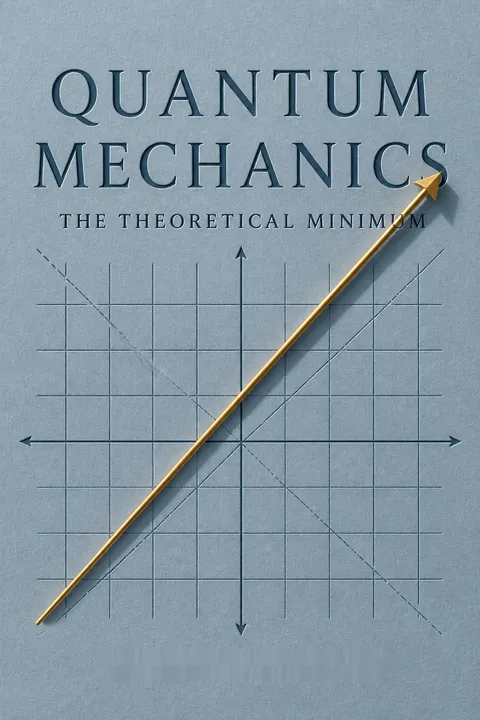


Key Takeaways
Treat quantum states as probability amplitudes, not hidden classical snapshots.
A state is a mathematical description. In classical mechanics, knowing a system's state means knowing the values needed to predict its future. In quantum mechanics, a state-vector instead encodes the possible results of experiments and their probabilities. Its components are probability amplitudes: complex numbers whose squared magnitudes give probabilities. The book adopts this practical account without claiming to settle whether hidden variables could exist in principle.
Measurement adds a new question. A state and a measurement are distinct objects. A spin state can be known exactly, yet a measurement of one component may still have either of two outcomes. The state does not secretly list a single answer for every possible measurement.
What's striking is how the state-vector separates knowledge of a preparation from prediction of a particular observation. This resembles probability models in statistics, but with a crucial difference: amplitudes carry phase information, so combining possibilities can change outcomes through interference. A probability distribution alone cannot capture that structure. The operational stance is powerful because it tells learners what calculations mean without requiring a story about an unseen microscopic mechanism. Its limit is equally important: using the formalism successfully does not, by itself, resolve what a quantum state represents in reality.
A spin returns only ±1, while its average tracks the angle between axes.
One trial is random. The book introduces quantum mechanics through a spin measured by an apparatus that can point in different directions. After the apparatus prepares the spin as positive along one axis, measuring along an axis at angle θ produces only +1 or -1, never an intermediate value. Across many repeated trials, however, the average reading is cos θ. The probabilities are (1 + cos θ)/2 for +1 and (1- cos θ)/2 for -1.
The average is not the outcome. At a right angle, the results are evenly split, so the average is zero. That does not mean any individual measurement returns zero. This contrast shows why quantum predictions concern distributions of outcomes, not merely a modified picture of a tiny classical arrow.
The spin experiment gives an unusually compact demonstration of how a probabilistic law can still have precise structure. Individual outcomes resist prediction, while the average follows a simple geometric rule. This is a useful distinction in many fields: a model may predict population patterns reliably without forecasting each case. The comparison with a classical vector is illuminating, but it must not be taken literally. A spin is not a little arrow whose hidden component is merely revealed by the apparatus; the experiment's discrete outcomes and measurement dependence are the point.
Use Hermitian operators to predict possible readings, not to model measurement itself.
Operators encode observables. A linear operator is a mathematical rule that transforms state-vectors. For a measurable quantity, the relevant operator is Hermitian, meaning it equals its Hermitian conjugate. Its eigenvalues are the possible measurement results; an eigenvector represents a state in which that result is certain. For spin, the three Pauli matrices represent measurements along the three coordinate axes, each with possible readings +1 and -1.
Calculation is not physical contact. Applying an operator to a state-vector is not the same process as measuring the system. For a spin prepared along one direction, the operator for another direction produces a vector used in calculations, not the single post-measurement state. The actual result is one eigenvalue, with probabilities determined by the state's overlaps with the operator's eigenvectors.
This distinction prevents a common category error: confusing a mathematical representation of an observable with the laboratory procedure that reads it. The spectral viewpoint also turns abstract linear algebra into a prediction recipe, connecting possible outcomes to eigenvalues and certainty to eigenstates. The caution matters beyond physics, since models often represent measurements without reproducing the full interaction that generates data. Here, the apparatus is not decorative. Treating measurement as an operator acting on the isolated system erases precisely the disturbance and probabilistic selection the formalism is meant to describe.
Unitary evolution predicts probabilities; measurement selects one outcome unpredictably.
Between observations, change is orderly. A unitary operator preserves inner products, so distinct states remain distinguishable as they evolve. The Hamiltonian is the Hermitian operator associated with a system's energy, and it governs this time development through the Schrödinger equation. Knowing the state at one moment lets physicists calculate the state at another, and therefore the probabilities of future measurement results.
Observation changes the description. In the standard measurement account presented here, measuring an observable leaves the system in the eigenstate corresponding to the result obtained. Which result occurs is probabilistic. The book also shows that an apparatus can be included as part of a larger quantum system: the system and apparatus become entangled through unitary evolution, even as the practical account describes a definite recorded result.
The tension between continuous unitary change and probabilistic measurement is not a loose end in the calculations; it is a central conceptual pressure point. Modeling an apparatus as quantum matter clarifies that measurement does not suspend physical law, while the account of a single registered outcome still raises interpretive questions. This is closely related to the measurement problem: a complete mathematical description of system and instrument does not obviously explain why one result is experienced. The section is strongest when it distinguishes reliable prediction rules from claims about the ultimate nature of observation.
Use noncommuting observables to identify the limits of simultaneous knowledge.
Order can matter. Two observables commute when applying their operators in either order gives the same result. Commuting observables can have a shared basis of states with definite values for both. Noncommuting observables generally cannot be specified simultaneously with certainty. For a particle, position X and momentum P obey [X, P] = iħ, where the commutator [X, P] means XP- PX.
Uncertainty is quantitative. The standard deviation measures how spread out measurement outcomes are around their average. For position and momentum, their uncertainties satisfy ΔX ΔP ≥ ħ/2. This is not simply a warning that instruments are clumsy. The same mathematical structure applies to spin components, whose operators also fail to commute, although the exact uncertainty depends on the state being measured.
The commutator turns a broad claim about incompatible measurements into a testable mathematical relation. It also connects uncertainty to the algebra of observables, rather than treating it as a special mystery attached only to position and momentum. A useful nuance is that noncommutation does not force every state to have the same nonzero uncertainty product: the bound depends on the expectation of the commutator in that state. The general principle identifies a structural limit, while its numerical force must be assessed for the particular preparation.
Entanglement makes a complete two-spin state coexist with ignorance of either spin.
The pair can be known completely. The book's singlet example combines two spins in the state (|up, down>- |down, up>)/√2. This is an entangled state: it cannot be written as a separate state for Alice's spin multiplied by a separate state for Bob's. The pair has a definite combined description, yet each individual spin has equally probable outcomes for any single-component measurement.
Local ignorance hides perfect relations. If both observers measure the same component, their results are always opposite. A density matrix summarizes what can be predicted for one subsystem alone. For either spin in the singlet, it is proportional to the identity matrix, indicating equal probabilities; the full two-spin state remains pure. The whole can therefore contain definite correlations absent from either part's individual description.
Entanglement is more than unusually strong correlation. A classical pair of coins can be correlated because each coin already has a definite face, whether or not anyone looks. The singlet's correlations instead belong to the joint quantum description, while the subsystem density matrices omit the phase-sensitive relationships between the parts. This is a striking information-theoretic lesson: knowing a whole need not mean possessing separate complete descriptions of its pieces. The distinction depends on which measurements count as accessible, so claims of total ignorance should be read as claims about local observations, not every imaginable joint experiment.
Separate correlation from signaling: entangled spins share patterns without sending messages.
Distant outcomes remain linked. The book imagines Alice and Bob measuring entangled spins far apart. Each observer's local results remain random, but when they compare records, matching-axis measurements reveal perfect opposition for a singlet. The shared pattern cannot be used to send a message faster than light: Bob's allowed local changes do not alter Alice's density matrix or her statistical predictions.
Bell's theorem targets classical explanations. The text's computer simulation makes the contrast concrete. A classical simulator can reproduce entangled predictions if its separated parts share an instantaneous connection; disconnecting that connection breaks the simulation. The lesson is not that quantum mechanics supplies a usable faster-than-light signal, but that reproducing its correlations with a classical local model faces a serious constraint.
Popular accounts often collapse two different questions into one: whether distant measurements are correlated, and whether one observer can control what another sees. The density-matrix argument addresses signaling, while Bell's theorem challenges local hidden-variable explanations of the observed correlations. Keeping those claims separate makes the result both stranger and more precise. The book's simulator is a helpful intuition pump, though it is not a full derivation of Bell inequalities. Its central value is showing why ordinary classical bookkeeping struggles to reproduce quantum joint statistics.
Position and momentum are Fourier duals, so sharpening one spreads the other.
One state, two representations. A wave function gives the components of a state-vector in a chosen basis. In the position basis, its squared magnitude gives the probability density for position. In the momentum basis, a different wave function gives the probability density for momentum. These are not two different physical states; they are two descriptions connected by a Fourier transform.
Waves reveal the connection. A momentum eigenstate, when written as a function of position, oscillates with wavelength 2πħ/p. A definite momentum is spread uniformly across position, while a sharply localized position requires a broad range of momenta. The relation between the two representations makes the uncertainty principle visible: narrowing a wave packet in one representation broadens it in the other.
The Fourier connection offers a concrete way to understand why position and momentum cannot both be sharply specified. A localized pulse requires many wave components, just as a short sound burst contains a broad range of frequencies. The analogy is useful because it makes uncertainty a feature of representation and wave structure, not a mysterious flaw in measurement. It also cautions against treating the wave function as necessarily a physical ripple in space. In this setting, it is a basis-dependent mathematical description whose wave-like form carries experimentally meaningful probability information.
Expect classical trajectories only when wave packets stay narrow and potentials stay smooth.
Classical motion is an approximation. Quantizing a familiar classical Hamiltonian replaces position and momentum with operators and turns the Hamiltonian into the generator of quantum evolution. For a free particle, the Schrödinger equation makes a wave packet spread; with forces, its behavior depends on the potential energy landscape. The average position and momentum can follow classical equations when the packet remains sufficiently localized.
Sharp features spoil the shortcut. If a potential changes rapidly across the wave packet, different parts of the packet evolve differently and it can scatter or spread apart. A heavy object in a smooth potential is more likely to behave classically than a light particle encountering a sharp atomic potential. Classical mechanics is thus a useful limit of quantum mechanics, not a separate, more fundamental rulebook.
This account gives the classical limit a physical mechanism: narrow distributions and slowly varying forces allow averages to behave like a trajectory. It also avoids the simplistic idea that large objects are classical merely because they are large. Mass, localization, and the shape of the potential all matter. The argument is pedagogically strong, although real macroscopic classicality also depends on interactions with the environment, a subject beyond this treatment. The practical lesson remains valuable: before replacing quantum dynamics with a path, check whether the wave packet and force landscape justify the approximation.
Understand photons as quanta of field oscillators, spaced by ħω.
The oscillator is a recurring model. A harmonic oscillator describes motion near a stable equilibrium when the potential is approximately quadratic. A weight on a spring is the familiar picture, but similar mathematics describes atomic vibrations, circuits, and individual modes of electromagnetic radiation. Its energy levels are evenly spaced: Eₙ = ħω(n + 1/2), with n taking nonnegative integer values. Even the lowest state retains zero-point energy.
Operators climb the ladder. Creation and annihilation operators raise or lower an oscillator's energy level by one step. For an electromagnetic mode, one step has energy ħω and is called a photon. Thus light in a cavity can be modeled as quantized field oscillators, with the number of photons corresponding to the oscillator's excitation level.
The oscillator's power comes from its reach: many systems look approximately quadratic near equilibrium, so one solvable model travels across mechanics, matter, and radiation. The ladder of discrete energies also gives a clean bridge from wave descriptions of light to particle language. The zero-point term matters conceptually even when a calculation can ignore it, because it signals that the ground state is not classical rest. The model is not a claim that every field mode behaves like a literal spring; it is a shared mathematical structure with distinct physical interpretations.
Analysis
The book's organizing achievement is to make quantum mechanics feel less like a catalogue of paradoxes and more like a disciplined grammar. States are vectors, measurements are represented by operators, probabilities come from amplitudes, and time evolution preserves the geometry of the state space. The reader is repeatedly asked to distinguish mathematical representation from physical procedure. That distinction is the key to avoiding familiar confusions, such as treating an operator as a miniature measurement device or imagining a spin as an ordinary arrow.
The narrative moves from the simplest system, one spin, toward larger structures: incompatible observables, composite systems, continuous variables, particle motion, and oscillators. Each expansion exposes what the earlier model could not show. The spin demonstrates discrete outcomes and angular probabilities; the singlet state makes correlations without local certainty unavoidable; position and momentum turn those structural ideas into Fourier analysis and uncertainty. The harmonic oscillator then shows why this formal machinery matters beyond a single puzzle, since its energy ladder applies to many physical systems. The strongest conceptual distinction is between quantum evolution and quantum observation. Unitary evolution is deterministic, but measurement results are probabilistic. Incorporating an apparatus into the quantum system explains how correlations develop, yet the account of a definite recorded result remains interpretively unsettled. The book is admirably candid about this conceptual pressure, even as its practical treatment uses the standard collapse rule.
The main pedagogical tradeoff is that mathematical derivations are central, while philosophical interpretations remain deliberately restrained. That choice suits readers who want working competence rather than a verdict on reality. The result is not a shortcut around the mathematics. It is a compact route into the mathematics that lets strangeness emerge from explicit rules rather than atmospheric claims.
Review Summary
Quantum Mechanics: The Theoretical Minimum is praised as an excellent introduction to quantum mechanics for readers with some mathematical background. Reviewers appreciate Susskind's clear explanations, focus on spin, and early introduction of entanglement. The book is seen as a bridge between popular science and textbooks, requiring effort but rewarding readers with deep insights. Some find the later chapters more challenging and rushed. Overall, it's highly recommended for those seeking a mathematical understanding of quantum mechanics without oversimplification.
People Also Read






Glossary
Qubit
Two-dimensional quantum systemA qubit is a quantum system with a two-dimensional state space, the quantum counterpart of a classical two-state bit. A spin measured along any chosen axis gives one of two outcomes, but its state can be a superposition of basis states. The probabilities for those outcomes depend on the measurement direction.
Hilbert space
Space of quantum statesA Hilbert space is the vector space used to represent the possible states of a quantum system. Its vectors can be added and multiplied by complex numbers, and it has an inner product that defines orthogonality and probabilities. It may have a finite or infinite number of dimensions.
State-vector
Quantum state representationA state-vector is a vector in a quantum system's Hilbert space that represents how the system was prepared. Its components depend on the basis chosen to describe it. Squared magnitudes of components give probabilities for corresponding measurement outcomes, while the complex phases can affect interference.
Probability amplitude
Complex probability componentA probability amplitude is a complex number associated with a possible measurement outcome. It is not itself a probability. The probability is calculated from the squared magnitude of the amplitude. Amplitudes also retain phase information, allowing different possible contributions to reinforce or cancel when combined.
Hermitian operator
Operator for an observableA Hermitian operator equals its own Hermitian conjugate, which combines matrix transposition with complex conjugation. In quantum mechanics, observable quantities are represented by Hermitian operators. Their eigenvalues are real and correspond to possible measurement results, while their eigenvectors represent states with definite results.
Unitary operator
Inner-product-preserving transformationA unitary operator U satisfies U†U = I, where U† is its Hermitian conjugate and I is the identity operator. It preserves inner products, and therefore preserves lengths, probabilities, and distinguishability among states. Quantum time evolution of an isolated system is unitary.
Hamiltonian
Energy and evolution operatorThe Hamiltonian is the Hermitian operator associated with a system's energy. Its eigenvalues are the possible outcomes of energy measurements. It also determines how a quantum state changes with time through the Schrödinger equation. In classical mechanics, the Hamiltonian represents total energy as a function of coordinates and momenta.
Wave function
State components in a basisA wave function is the collection of components of a state-vector in a chosen basis. In a position basis, its squared magnitude gives the probability density for finding a particle at each position. In another basis, such as momentum, the same state has a different wave function.
Density matrix
Summary of quantum predictionsA density matrix encodes the information needed to calculate measurement probabilities and expectation values for a quantum system. A pure state has a density matrix formed from one state-vector and its dual. A mixed state represents a statistical mixture or, for a subsystem of an entangled whole, incomplete local information.
Entanglement
Nonseparable joint quantum stateEntanglement occurs when a composite system's state cannot be written as a product of separate state-vectors for its parts. The whole may have a precise pure state while measurements on either part alone remain uncertain. Joint measurements can nevertheless reveal strong correlations between the parts.
Creation and annihilation operators
Energy-level raising and loweringFor the harmonic oscillator, creation and annihilation operators transform one energy eigenstate into the next higher or lower state. They are Hermitian conjugates of each other and obey a simple commutation relation. For electromagnetic field modes, raising the excitation by one unit corresponds to adding a photon.
Path integral
Sum over possible historiesThe path integral is a formulation of quantum mechanics in which the amplitude for a particle to travel between two points is built by summing contributions from possible paths. Each path contributes a complex phase determined by its action and Planck's constant. The classical least-action path emerges as a special limit.
About the Author
Other books by Leonard Susskind

Download PDF
Download EPUB
.epub digital book format is ideal for reading ebooks on phones, tablets, and e-readers.








