

Key Takeaways
Ramanujan saw patterns in infinity, but institutions nearly left him unknown.
A narrow escape. Born into a poor Brahmin family in South India, Srinivasa Ramanujan showed extraordinary mathematical ability as a boy. Yet he failed college examinations because he could not make himself study subjects beyond mathematics. Without a degree, he lost scholarships, struggled to find work, and spent years with little contact with professional mathematicians. His talent was real, but talent alone could not secure a livelihood or an audience.
Recognition changed everything. Ramanujan kept approaching people who might understand his work. After local patrons helped him survive, he sent G. H. Hardy a letter filled with original results. Hardy recognized a mind of rare power, helped bring him to Cambridge, and gave his work an international audience. The story is not simply that genius wins. It is that discovery depended on a precarious chain of persistence, help, and recognition.
What's striking is how easily a celebrated biography can make an unlikely outcome look inevitable. Ramanujan's eventual fame encourages the reader to treat his persistence as proof that institutions work, when his repeated near-failures show the opposite. His story is also a case of survivor bias: the unknown people with comparable ability leave no archive and no biographer. The useful question is not only how exceptional talent gets noticed, but how much talent disappears before anyone qualified to notice it gets a chance.
Treat a textbook's omissions as invitations, not merely missing instructions.
A book becomes a workshop. Around age sixteen, Ramanujan encountered George Shoobridge Carr's A Synopsis of Elementary Results in Pure and Applied Mathematics. It compressed roughly five thousand results across subjects such as algebra, calculus, and trigonometry. Carr often stated results without detailed proofs, deliberately leaving students to reconstruct the reasoning. For Ramanujan, each claim became a problem to explore, not a fact to memorize.
Exploration took over. He began by proving Carr's formulas, then followed their patterns into results the book did not contain. He recorded his discoveries in notebooks, testing numerical cases and working through long calculations. Carr supplied a map, not Ramanujan's methods or discoveries. The notebooks eventually held thousands of compressed results, many without proof. This self-directed apprenticeship gave Ramanujan room to invent, though it also left him without the guidance that might have corrected mistakes sooner.
Carr's book illustrates a powerful distinction between receiving knowledge and doing something with it. An incomplete explanation can provoke active reasoning, especially when the learner has both motivation and enough background to experiment. But productive difficulty is not the same as abandonment. Ramanujan's independence generated striking originality, while his isolation also allowed gaps to persist. The broader lesson is to design learning that requires discovery while still providing feedback, context, and access to people who can identify when a promising path has gone wrong.
Talent needs patrons and pathways, not just permission to work.
Credentials blocked access. South India's colleges rewarded broad examination performance, not exceptional skill in one subject. Ramanujan repeatedly failed exams in subjects such as English composition and physiology, and lost the scholarship that let him study. Although teachers admired his mathematics, admiration could not substitute for the degree employers expected.
Patronage bought time. After years of poverty and job hunting, mathematician R. Ramachandra Rao began supporting Ramanujan with twenty-five rupees a month. The University of Madras later gave him a research scholarship of seventy-five rupees a month, despite rules normally reserving such support for degree holders. That money made sustained research possible. Ramanujan's Brahmin background also helped him reach influential networks. His rescue depended on generosity and access, not a system that reliably identified and supported unusual ability.
The biography makes opportunity concrete: a scholar's work requires time, food, and a route into institutions, not just an abstract invitation to flourish. Patronage can protect unconventional work from short-term demands, but it is uneven by nature. Ramanujan's caste and personal connections opened doors that would not have been equally available to everyone. His case therefore supports both the value of flexible funding and the need to build durable pathways, so that a person's prospects do not turn on finding one unusually generous benefactor.
Let intuition propose boldly, then make proof test every boundary.
A brilliant guess can fail. Ramanujan often saw mathematical relationships before he could explain how he found them. In his early work on prime numbers, he tested a formula against manageable examples and believed its error stayed within strict bounds. He had overlooked important features of the Riemann zeta function, so the conclusion did not hold generally. Numerical agreement, however impressive, could not establish the claim.
Proof made discovery durable. Hardy pressed Ramanujan to supply rigorous demonstrations, meaning arguments that establish a result under clearly stated conditions. Their work on partitions, the number of ways to express an integer as a sum, shows the other side: a new approximation calculated the number of partitions of 100 with an error of only 0.004 after six terms. The circle method helped them reach this extraordinary accuracy. Later work made the formula exact.
The contrast is not between creative intuition and dull verification. Intuition helps generate candidates worth investigating; proof checks whether a pattern survives beyond the examples that first made it appealing. This is a useful model far beyond mathematics, where a persuasive anecdote or successful trial can be mistaken for a general rule. The caution is that formal proof is not the source of every insight. Ramanujan's work shows why exploration and verification need different habits, and why both are essential to reliable knowledge.
The best mentor protects originality while supplying missing tools.
Hardy recognized difference. When Ramanujan's letter arrived, Hardy and his collaborator J. E. Littlewood spent hours trying to understand its unfamiliar results. Other eminent mathematicians had not offered comparable help. Hardy did more than praise him: he arranged his journey to Cambridge, helped secure funding, edited his work for publication, and taught him mathematical methods he had never encountered.
Teaching required restraint. Ramanujan had spent years developing his own style, and Hardy feared that forcing him through a standard course might weaken the source of his originality. Instead, he tried to add what Ramanujan needed, especially modern ideas about proof, without replacing his distinctive way of seeing problems. Their collaboration on partitions joined Ramanujan's unusual insights to Hardy's technical command. Each brought something the other lacked, though their closeness in mathematics did not mean deep personal understanding.
This is mentorship as translation rather than conversion. Hardy helped make Ramanujan's work legible to mathematical institutions while recognizing that standard training could not manufacture the central gift. That balance is difficult: too little structure leaves errors uncorrected, while too much can reward conformity over discovery. The relationship also has limits. A mentor can champion someone's work without understanding every dimension of that person's life. Intellectual support matters enormously, but it should not be mistaken for complete emotional care.
A mathematician's culture is part of the mind doing the mathematics.
Faith shaped his world. Ramanujan grew up in a devout Vaishnavite Brahmin family and credited the goddess Namagiri with some of his mathematical insights. In late 1913, after religious objections to crossing the sea threatened his journey to England, he went to Namakkal with a friend. Accounts differ on exactly who dreamed of the goddess's approval, but Ramanujan understood the decision through his faith.
Difference followed him abroad. In Cambridge, he kept strict vegetarian practices, struggled to find familiar food, and lived among people whose customs and reserve felt foreign. Hardy, an atheist, tended to interpret Ramanujan's religion as outward observance rather than a deep part of his thinking. The biography does not establish that religious belief caused mathematical discoveries. It does show that dismissing or exoticizing Ramanujan's faith obscures the culture through which he understood himself and his work.
The section resists two easy explanations: that divine intervention accounts for mathematical genius, or that religion is merely decorative belief around a purely Western-style intellect. Both flatten the person. A more careful view lets Ramanujan's own account matter without treating it as scientific proof. Cultural context can shape what questions feel meaningful, which metaphors seem natural, and how a person makes sense of creative experience. Respecting that context does not require accepting every metaphysical claim as fact.
Cambridge gave Ramanujan peers, but war and loneliness stripped away his supports.
The conditions deteriorated. In England, Ramanujan was separated from his family and struggled to maintain his diet. His mother intercepted letters between him and his young wife, Janaki, deepening the distance between them. Wartime food shortages made suitable ingredients harder to find. Ramanujan worked intensely, often at night, and had little social life outside mathematics.
Illness had many possible causes. He became seriously ill in 1917 and received conflicting diagnoses. Tuberculosis is the most likely explanation in the book, but it is not certain. The biography considers how undernourishment, limited sunlight, stress, and isolation may have weakened his health, without establishing any one cause. His distress became severe enough that he attempted suicide. The episode complicates the image of Cambridge as a simple rescue: professional recognition brought opportunity, but did not provide adequate care for the whole person.
This account places intellectual work inside a body and a social life. Concentration depends on conditions that achievement narratives often treat as incidental: nourishment, rest, companionship, and competent care. Still, the causes of Ramanujan's illness cannot be reduced confidently to diet or loneliness; the evidence is incomplete, and his doctors disagreed. That uncertainty matters. The strongest claim is not that one factor made him sick, but that severe illness met a person with too few reliable supports.
Keep unfinished work alive; Ramanujan's final formulas still invite proof.
The work continued near the end. In January 1920, while gravely ill in India, Ramanujan wrote Hardy about a new family of formulas he called mock theta functions. He died that April, aged thirty-two, leaving many results unexplained. His final mathematical pages were not a tidy conclusion but a set of difficult questions for others to pursue.
Discovery outlasted the discoverer. In 1976, mathematician George Andrews recognized a cache of roughly 140 pages among papers associated with G. N. Watson at Cambridge. The pages, now known as the Lost Notebook, contained further results that mathematicians continued to study. Ramanujan's notebooks also inspired generations of researchers. Their afterlife is remarkable, but it does not erase the cost of his early educational exclusion, poor health, or short life.
A mathematical legacy is not simply a monument to a finished achievement. It can be a working inheritance, with later scholars testing, extending, and sometimes finding unexpected meaning in unfinished ideas. That process depends on preservation and on someone recognizing what a document contains. The Lost Notebook makes that dependence vivid: intellectual value can sit unnoticed in an archive until a knowledgeable reader sees it. Its rediscovery is inspiring, but should not be mistaken for compensation for the conditions that limited Ramanujan's life.
Analysis
Kanigel's biography works on two tracks at once. It follows an extraordinary mathematical life, and it asks what social conditions make that life visible. Ramanujan's notebooks establish that his creativity was not a legend invented by sympathetic Europeans. Yet the path from Kumbakonam to Cambridge depended on a chain of fragile events: a book that invited independent work, friends who supplied food and introductions, Indian patrons willing to finance leisure, and Hardy's willingness to stake his judgment on unfamiliar work. The story therefore complicates the familiar triumph narrative. Ramanujan's persistence mattered, but it did not make institutional barriers harmless.
The book also refuses to separate mathematical intelligence from the person who carried it. Ramanujan's Brahmin upbringing shaped his religious commitments and food practices; his family ties shaped his choices; Cambridge's climate, wartime scarcity, and social reserve shaped his daily life. These details are not colorful scenery around a disembodied genius. They help explain what opportunity and recognition cost him. At the same time, the biography must speculate where records are thin, particularly about the origins of his insights, the precise course of his illness, and the emotional distance between Ramanujan and Hardy. Its strongest interpretations remain those that distinguish evidence from conjecture.
The enduring lesson is not that every struggling prodigy will become famous if someone discovers them. Ramanujan's exceptional outcome cannot tell us how many others were missed. Rather, his life demonstrates that institutions are not neutral sorting machines: their rules privilege particular forms of preparation, communication, and credential. A humane response to exceptional ability requires more than admiration after the fact. It requires flexible routes into learning, material support, rigorous intellectual exchange, and attention to the whole human being. Ramanujan's achievement is astonishing. The near-loss of it is the warning.
Review Summary
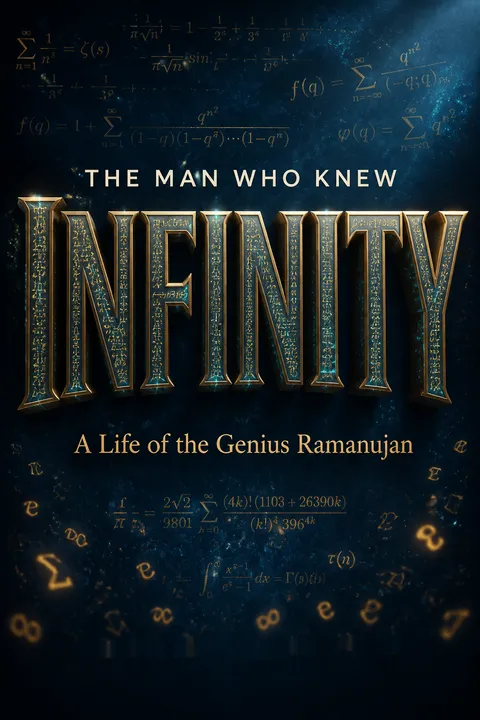
The Man Who Knew Infinity is a compelling biography of Indian mathematician Srinivasa Ramanujan. Readers praise Kanigel's thorough research and vivid portrayal of Ramanujan's life, from his humble beginnings to his collaboration with G.H. Hardy at Cambridge. The book explores Ramanujan's genius, cultural challenges, and tragic early death. While some criticize the writing style and organization, most find it a fascinating account of a mathematical prodigy. The biography also touches on broader themes of colonialism, racism, and the nature of genius.
People Also Read


Glossary
A Synopsis of Elementary Results in Pure and Applied Mathematics
A compact mathematics compendiumGeorge Shoobridge Carr's book gathered thousands of mathematical results across subjects including algebra, calculus, trigonometry, and geometry. It often stated results without giving full proofs, inviting readers to work out the reasoning. Ramanujan used it as a launchpad for independent study, extending its formulas and recording his own discoveries in notebooks.
Partition function
Counts integer sumsThe partition function, written p(n), gives the number of distinct ways to express a positive integer n as a sum of positive integers, ignoring rearrangements. For example, 4 has five partitions: 4, 3+1, 2+2, 2+1+1, and 1+1+1+1. The count grows rapidly, making general formulas valuable.
Circle method
An analytic counting techniqueThe circle method is a technique developed by Hardy and Ramanujan to estimate the number of partitions of an integer. It uses complex analysis and carefully chosen approximations near a circular path to extract information from a generating function. Their formula was extraordinarily accurate, and later work by Hans Rademacher made the calculation exact.
Formalism
Reasoning through formulasIn this biography, formalism describes a mathematical style centered on manipulating formulas and recognizing relationships among them, sometimes before their broader meaning is clear. Ramanujan excelled at producing unexpected identities, series, and transformations. His work could be insightful and correct while remaining difficult for other mathematicians to follow without explanation or proof.
Riemann hypothesis
A conjecture about zeta zerosThe Riemann hypothesis is an unproved conjecture about the locations of certain zeros of the Riemann zeta function, a function closely connected to prime numbers. Its truth would imply important conclusions about how primes are distributed. Ramanujan's early attempt to give an exact formula for prime counts went wrong partly because he did not account for the relevant complex zeros.
Mock theta functions
Theta-like infinite seriesMock theta functions are a family of functions Ramanujan described in a letter to Hardy shortly before his death. They resemble classical theta functions in important ways but do not share all their defining properties. Ramanujan supplied examples and partial explanations, leaving a deep and influential body of work that mathematicians continued to investigate.
Rogers-Ramanujan identities
Equal counts of distinct partitionsThe Rogers-Ramanujan identities connect two apparently different ways of counting partitions of integers. One counts sums whose parts meet a minimum separation rule; the other restricts the allowable parts to specified arithmetic patterns. Leonard James Rogers had published these identities earlier, and Ramanujan independently rediscovered them.
Ramanujan's Master Theorem
A method for evaluating integralsRamanujan's Master Theorem is a result he presented in a research report to the University of Madras. It provides a way to evaluate a broad class of definite integrals that resist familiar methods. Ramanujan described it as a general tool and developed particular results from it, although some of his proofs needed refinement.
FAQ
What is The Man Who Knew Infinity by Robert Kanigel about?
- Biography of Ramanujan: The book is a detailed biography of Srinivasa Ramanujan, a self-taught mathematical genius from South India who made groundbreaking contributions to mathematics despite limited formal education.
- Cultural and historical context: It explores the social, cultural, and political backdrop of early 20th-century India and England, including caste systems, colonialism, and World War I.
- Mathematical journey: The narrative follows Ramanujan’s journey from his humble beginnings in Kumbakonam to his collaboration with G. H. Hardy at Cambridge, highlighting both his personal struggles and mathematical achievements.
- Clash of worlds: The book delves into the cultural and intellectual clash between Ramanujan’s intuitive, spiritual approach and the rigorous, formal traditions of Western mathematics.
Why should I read The Man Who Knew Infinity by Robert Kanigel?
- Inspiration from adversity: Ramanujan’s story is a testament to human creativity and perseverance, showing how genius can flourish even in the face of poverty, illness, and cultural isolation.
- Insight into mathematical creativity: The book offers a rare glimpse into the mind of a prodigy, making complex mathematical ideas accessible and engaging for general readers.
- Rich historical and cultural detail: Kanigel provides a vivid portrait of colonial India, Cambridge academia, and the personal and societal challenges Ramanujan faced.
- Compelling storytelling: Praised for its meticulous research and narrative style, the biography humanizes Ramanujan and brings his world to life.
What are the key takeaways from The Man Who Knew Infinity by Robert Kanigel?
- Genius transcends boundaries: Ramanujan’s life demonstrates that extraordinary talent can emerge from the most unlikely circumstances and environments.
- Cultural and intellectual exchange: The collaboration between Ramanujan and Hardy highlights the value and challenges of cross-cultural partnerships in advancing knowledge.
- Importance of intuition and rigor: The book contrasts Ramanujan’s intuitive approach with the Western emphasis on formal proof, showing how both are essential in mathematics.
- Legacy of perseverance: Despite immense obstacles, Ramanujan’s work continues to inspire mathematicians and scientists, illustrating the enduring impact of individual brilliance.
Who was Srinivasa Ramanujan, as portrayed in The Man Who Knew Infinity by Robert Kanigel?
- Early life and background: Born in 1887 in Kumbakonam, India, Ramanujan grew up in a poor Brahmin family, deeply influenced by Hindu spirituality and tradition.
- Mathematical prodigy: He mastered advanced mathematics at a young age, largely self-taught through Carr’s Synopsis of Elementary Results in Pure and Applied Mathematics.
- Personal traits: Ramanujan was intensely focused on mathematics, sensitive, stubborn, and socially naive, with a profound belief that his insights were divinely inspired.
- Struggles and achievements: Despite academic failures and social isolation, he produced original theorems and formulas that continue to baffle and inspire mathematicians.
How did G. H. Hardy influence Ramanujan’s career, according to The Man Who Knew Infinity by Robert Kanigel?
- Discoverer and mentor: Hardy recognized Ramanujan’s genius from his initial letter and facilitated his move to Cambridge, providing crucial academic support.
- Collaborative partnership: Their relationship was mutually enriching, with Hardy bringing rigor and proof to Ramanujan’s intuitive discoveries, resulting in significant joint publications.
- Cultural bridge: Hardy helped Ramanujan navigate the unfamiliar world of British academia, balancing respect for his unique methods with the demands of Western mathematics.
- Personal impact: Hardy described their collaboration as “the one romantic incident in my life,” underscoring its deep professional and emotional significance.
What was the state of British mathematics before Ramanujan’s arrival, as described in The Man Who Knew Infinity by Robert Kanigel?
- Newton’s legacy and isolation: British mathematics was dominated by Newton’s notation and a reluctance to adopt Continental rigor, leading to stagnation and isolation from European advances.
- Lack of rigor: Cambridge students learned calculus without valid proofs, relying on tradition rather than modern mathematical standards.
- Hardy’s reforms: Hardy played a key role in introducing rigor to English mathematics, challenging the outdated Tripos system and preparing the ground for Ramanujan’s contributions.
- Transition period: Ramanujan’s arrival coincided with a pivotal moment in British mathematics, as it shifted toward greater rigor and openness to new ideas.
How did Ramanujan and Hardy collaborate mathematically, according to The Man Who Knew Infinity by Robert Kanigel?
- Complementary strengths: Hardy contributed rigorous proof techniques and modern mathematical knowledge, while Ramanujan brought extraordinary intuition and original formulas.
- Key achievements: Their collaboration led to breakthroughs such as the circle method for partition functions and significant advances in number theory.
- Mutual learning: Hardy taught Ramanujan the importance of formal proof, while Ramanujan’s creativity challenged Hardy’s views on mathematical discovery.
- Enduring legacy: Their partnership produced influential papers and set new directions in analytic number theory.
What challenges did Ramanujan face in his education and career, as depicted in The Man Who Knew Infinity by Robert Kanigel?
- Academic obstacles: Ramanujan struggled with formal education, often failing exams in non-mathematical subjects, which limited his academic and career opportunities.
- Financial hardship: His family’s poverty and lack of a degree made it difficult to secure stable employment, forcing him to rely on tutoring and patronage.
- Cultural and social isolation: In England, he faced racial prejudice, loneliness, and difficulty maintaining his strict vegetarian diet, especially during wartime rationing.
- Health and emotional struggles: Ramanujan suffered from tuberculosis, depression, and family conflicts, all of which affected his productivity and well-being.
What is the significance of Carr’s Synopsis of Elementary Results in Pure and Applied Mathematics in Ramanujan’s development, according to The Man Who Knew Infinity by Robert Kanigel?
- Primary mathematical resource: Carr’s book, a compilation of thousands of formulas and theorems, was Ramanujan’s main source of mathematical knowledge during his formative years.
- Encouragement of independent work: The lack of detailed proofs in the book encouraged Ramanujan to develop his own methods and original discoveries.
- Limitations and challenges: While influential, the book was not a great mathematical work and lacked the depth of contemporary mathematics, forcing Ramanujan to go beyond it.
- Foundation for genius: Despite its shortcomings, Carr’s Synopsis played a crucial role in shaping Ramanujan’s unique approach to mathematics.
What are mock theta functions, and why are they important in The Man Who Knew Infinity by Robert Kanigel?
- Definition and discovery: Mock theta functions are a class of functions discovered by Ramanujan late in his life, resembling classical theta functions but with mysterious and distinct properties.
- Mathematical significance: These functions have profound implications in number theory and mathematical physics, influencing areas such as modular forms and string theory.
- Enduring mystery: For decades, mathematicians struggled to fully understand mock theta functions, highlighting the depth and originality of Ramanujan’s intuition.
- Legacy in mathematics: Mock theta functions remain a central topic in modern mathematics, illustrating Ramanujan’s lasting impact on the field.
How did cultural and social factors shape Ramanujan’s life and work, according to The Man Who Knew Infinity by Robert Kanigel?
- Brahmin upbringing: Ramanujan’s strict Brahmin background imposed dietary and social customs that affected his daily life and interactions, both in India and England.
- Colonial context: The British Raj’s educational and institutional systems were often rigid and unsupportive, delaying Ramanujan’s recognition and complicating his career.
- Family dynamics: Conflicts within his family, especially involving his mother and wife, added emotional strain during his illness and final years.
- Cultural isolation: Ramanujan’s spiritual worldview and traditional practices often clashed with the secular, rationalist environment of Cambridge.
What are the best quotes from The Man Who Knew Infinity by Robert Kanigel, and what do they mean?
- “An equation for me has no meaning unless it expresses a thought of God.” This quote reflects Ramanujan’s deep spirituality and belief that his mathematical insights were divinely inspired.
- “They must be true because, if they were not true, no one would have the imagination to invent them.” Hardy’s remark expresses awe at the originality and intuition behind Ramanujan’s theorems.
- “One gift [Ramanujan’s work] has which no one can deny, profound and invincible originality.” Hardy highlights Ramanujan’s unparalleled creative genius.
- “He would probably have been a greater mathematician if he had been caught and tamed a little in his youth... But he would have been less of a Ramanujan.” This quote captures the bittersweet nature of Ramanujan’s unconventional path and the unique qualities that made him extraordinary.
About the Author
Other books by Robert Kanigel
Download PDF
Download EPUB
.epub digital book format is ideal for reading ebooks on phones, tablets, and e-readers.








