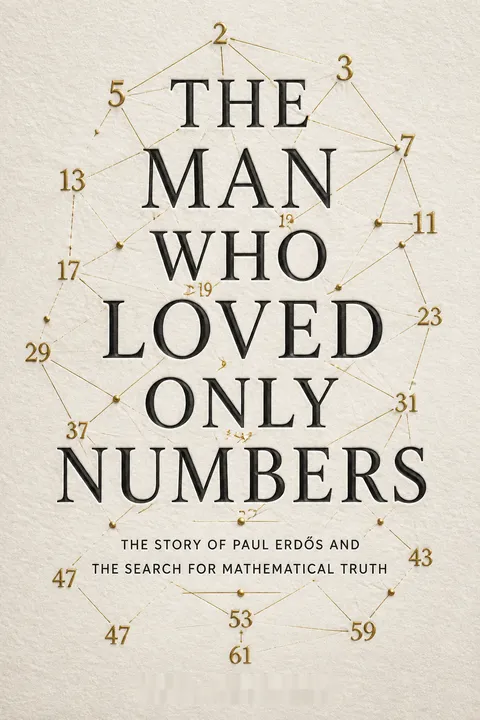


Summary Unavailable
This book is not suitable for a summary (it may be a textbook, workbook, cookbook, reference book, or collection). However, you can still explore the FAQs, about author, and other metadata below!
Key Takeaways
Let a consuming pursuit organize life, but notice what it excludes
A life without ballast. Paul Erdős arranged almost everything around mathematics. He had no home, job, spouse, or children, and traveled constantly in search of problems and collaborators. By his death in 1996, he had written or co-written 1,475 papers with 485 mathematicians. After his mother died, he often worked nineteen-hour days, using stimulants to keep going. He gave away much of his earnings because money and possessions held little interest for him.
A costly example. This was not solitary genius in an attic. Erdős depended on friends to manage his money, travel, clothes, and daily needs. His life shows the power of relentless focus, but also how much support and personal compromise that focus can require.
What's striking is that Erdős's apparent independence rested on an extensive network of people who accommodated and cared for him. His example therefore complicates the familiar story of genius as self-sufficiency: a person may concentrate intensely because others absorb the ordinary burdens. That does not diminish his achievement. It does make his life a poor template for anyone seeking a balanced routine. The useful lesson is to examine what a commitment costs, and who quietly pays those costs, before treating extreme devotion as a universal ideal.
Treat mathematics as discovery of structure, not arithmetic done faster
Beyond calculation. Erdős saw mathematics as the search for truths that do not depend on human convenience or physical conditions. He described an imagined Book containing the most elegant proof of every mathematical result. A proof judged especially clear or beautiful could be called a page from that Book. The metaphor expressed a belief that mathematicians uncover patterns rather than invent them at will.
Primes as a case. Prime numbers, such as 2, 3, 5, and 7, remain prime in any number system, even if a society counts in a base other than ten. Euclid proved that there cannot be a largest prime: any supposed finite list leads to a construction that produces a number with a prime factor beyond the list. The result is not faster arithmetic. It is a fact about the structure of numbers.
The Book gives a memorable picture of mathematical Platonism, the view that mathematical truths exist independently of human minds. It also explains why mathematicians care about elegance: a short proof can reveal the mechanism behind a result, not merely establish that the result holds. The metaphor is powerful, but it should not be mistaken for evidence that mathematical objects inhabit a literal realm. The book presents a mathematician's working faith, one that makes abstraction feel like exploration while leaving the underlying philosophy open to debate.
Ask the solvable question that opens the next door
Problems at the edge. Erdős was famous for posing questions that were neither trivial nor hopeless. He could recognize what a mathematician might be ready to solve, sometimes before that person recognized it. His modest cash prizes for solutions, which ranged from small sums to thousands of dollars, made the difficulty of a problem visible and gave young researchers a concrete invitation to begin.
A first breakthrough. In Budapest, twelve-year-old Louis Pósa quickly solved a question Erdős posed over lunch: choose six integers from 1 to 10, and two must be relatively prime, meaning they share no divisor greater than 1. Pósa noticed that two chosen numbers must be neighbors, and neighboring integers cannot share a divisor. Erdős's questions helped launch careers because they offered a foothold into larger mathematics.
A well-chosen problem does more than test ability. It teaches a newcomer what counts as a mathematical move, where a useful simplification might lie, and how proof differs from a hunch. Erdős's talent for matching questions to people resembles good mentorship in other fields: stretch someone without making the task feel meaningless. There is a limit, however. A problem that is perfectly calibrated for one person may discourage another. The enduring principle is not to romanticize difficulty, but to make the next intellectual step demanding and reachable.
Use randomness to establish hidden structure when explicit construction fails
Order in large groups. Ramsey theory studies how sufficiently large collections inevitably contain a chosen pattern, even when their parts are arranged unpredictably. For example, among six people, there must be either three who all know one another or three who are mutual strangers. Erdős helped develop this field from simple questions whose answers can be surprisingly hard to calculate. For larger groups, mathematicians often know bounds without knowing the exact minimum size required.
Existence by chance. Erdős also used the probabilistic method: prove that an object must exist by showing that a random choice has a positive chance of producing it. This can establish that a pattern-free arrangement is possible without giving a recipe for building one. The approach was startling in a subject devoted to exact proof, and it later became useful in computer science and other mathematical work.
The probabilistic method separates two questions that are often conflated: whether a solution exists, and how to find one. That distinction matters in computation, where a proof of existence may not supply an efficient procedure. Randomness here is not an escape from rigor; it is the object being analyzed with rigor. The method's weakness is equally instructive: an existence proof can leave practitioners with no practical construction. Its value depends on whether the goal is understanding possibility, producing an example, or building a usable algorithm.
Accept that mathematical truth can outrun what humans can prove
Infinities have sizes. Georg Cantor showed that the counting numbers and rational numbers can each be matched with the counting numbers, despite the apparent crowding of fractions between zero and one. The real numbers, which include nonrepeating decimals, cannot be matched in this way. Cantor's diagonal argument constructs a real number missing from any proposed complete list, demonstrating a larger infinity.
Proof has limits. The Continuum Hypothesis asks whether an infinity lies between the size of the counting numbers and the size of the real numbers. Paul Cohen showed that the standard axioms used in mathematics could not settle it: the hypothesis or its opposite could be added without contradiction. This does not mean every hard question is unanswerable. It means that even mathematical truth and what a chosen formal system can prove are not always the same thing.
This is the book's sharpest challenge to the idea that enough intelligence can answer every well-formed question. Mathematical reasoning is powerful partly because it makes assumptions explicit, but those assumptions also define the reach of a proof. The result invites humility without collapsing into relativism: the Continuum Hypothesis is not simply a matter of taste, yet its status depends on the axioms being used. Erdős resisted treating such limits as the end of inquiry, preserving a productive tension between formal boundaries and the possibility of new ways to reason.
Protect intellectual freedom when governments turn curiosity into suspicion
A mathematician in history. Erdős left Hungary in 1934 because he was Jewish and the country was becoming increasingly hostile. During World War II, Nazi persecution killed his father and four of his mother's five siblings. His mother survived the Budapest ghetto. For Erdős, mathematics offered an anchor amid political upheaval, but it could not keep politics out of his life.
Suspicion crosses borders. During the McCarthy era, the United States denied him permission to return after a European trip. Authorities questioned his interest in visiting Hungary and scrutinized his correspondence with a Chinese mathematician. His mathematical letters were full of symbols, but officials wondered whether they concealed messages. He spent years petitioning to return, and was finally readmitted in 1963 after mathematicians and public figures advocated for him.
The political history matters because it prevents Erdős's itinerancy from being reduced to eccentric preference. His freedom to collaborate depended on passports, immigration decisions, and the changing treatment of Jews and suspected Communists. At the same time, his experience should not be treated as a generic story of science transcending politics: mathematics gave him a vocation, not immunity. The episode also shows how expertise can become opaque to outsiders. When authorities cannot understand technical communication, suspicion can fill the gap unless institutions protect inquiry and due process.
Demand proofs that explain a result, not merely certify it
Proof and insight. In mathematics, a proof is a logical argument showing that a conclusion follows from stated assumptions. But mathematicians also judge proofs by whether they reveal why the conclusion is true. The Four Color Map Theorem says that four colors suffice to color any map so neighboring regions differ. In 1976, Kenneth Appel and Wolfgang Haken proved it by reducing the possibilities to more than 1,500 cases and checking them with computers.
Validity versus beauty. The proof became generally accepted, yet some mathematicians found it unsatisfying because it did not offer a simple conceptual explanation. Erdős assumed it was correct but wished for a proof that made the result feel inevitable. The distinction is important: checking every case can establish truth, while a more revealing argument can also deepen understanding.
The Four Color example exposes two standards of mathematical success: certainty and explanation. A computer-assisted proof can be logically valid even when no person can conveniently verify every step by hand. Yet a proof that exposes a compact principle may travel more easily through a field and inspire new results. These standards need not be enemies. Modern mathematics can accept computational verification while continuing to search for conceptual structure. The key is to say clearly what a proof accomplishes, rather than treating elegance as either a luxury or a substitute for correctness.
Make mathematical collaboration a practice of generosity, not just productivity
A shared profession. Erdős coauthored papers with 485 people, a record that gave rise to the Erdos number. A mathematician who published with him had number 1; someone who published with a coauthor of his had number 2, and so on. The playful measure reflected a serious fact: Erdős made collaboration central to mathematical life, sharing conjectures rather than guarding every idea for himself.
Help beyond the page. He gave away much of his prize money and lecture income. When he lent promising student Glen Whitney $1,000 for tuition, he asked for repayment only when it would not cause hardship. Years later, when Whitney asked what to do with the returned money, Erdős told him to use it to help someone else. Mathematical achievement, in this account, includes opening doors for people who may continue the work.
Erdős's collaborations show how intellectual generosity can multiply a person's influence beyond their own publications. A shared question lets several minds contribute different strengths, while recognition of coauthors makes that contribution visible. His tuition loan extends the same ethic from ideas to opportunity: help is most powerful when it enables another person to act independently. Still, collaboration is not automatically equitable. The story invites attention to credit, labor, and access, not merely to the romance of a large network. Generosity works best when it expands participation without erasing individual contributions.
Check the rules behind a probability before trusting your first intuition
The door problem. In the Monty Hall dilemma, a contestant chooses one of three doors, one hiding a car and two hiding goats. The host knows what is behind each door and opens a different door to reveal a goat, then offers the contestant a chance to switch. Switching wins two-thirds of the time, provided the host always reveals a goat and always offers the switch. The host's behavior is part of the information, not a neutral detail.
Erdős changes his mind. When Andrew Vázsonyi explained the puzzle, Erdős initially insisted that switching could make no difference. A decision tree and a computer simulation eventually persuaded him. The simulation demonstrated the pattern by repeating the game, while the decision tree clarified why it occurred. The episode shows that even exceptional mathematical intuition can be wrong when probability is framed in a misleading way.
The puzzle is a lesson in conditional probability: the odds change because the host's action depends on knowing where the car is. Treating the two unopened doors as automatically equivalent erases that selection process. This is a useful habit outside game shows, wherever evidence is produced by an informed person or system. Simulations can reveal a result, but they do not always explain it; the tree of possible cases makes the assumptions visible. Erdős's willingness to revise his view is as instructive as the calculation itself.
Analysis
Paul Hoffman's book is at once a biography, a guided tour of mathematical ideas, and a portrait assembled from recollections. Its central character is unusual enough to tempt a merely comic account: a homeless professor who arrived without warning, forgot how to use ordinary household objects, and spent nearly every waking hour on mathematics. Hoffman avoids making eccentricity the whole story. Erdős's habits illuminate a more serious question: what kind of life might a person build around a vocation believed to reveal truths independent of everyday affairs?
The answer is both inspiring and unsettling. Erdős produced work at astonishing scale, but that scale depended on collaborators, hosts, and friends who supplied the practical infrastructure he refused to build for himself. The biography therefore quietly disputes the lone-genius myth. His mathematics was social: problems moved between people, ideas were developed in conversation, and young researchers were invited into the work. His generosity with money and conjectures extended that social ethic beyond formal coauthorship.
The mathematical explanations serve the biography rather than forming a complete textbook. Primes, infinity, Ramsey theory, and proof are introduced through episodes that make abstraction graspable. This selection is effective because it links technical ideas to human motives: beauty, certainty, curiosity, and the desire to find a pattern that survives its discoverer. It also preserves a tension that matters. Mathematics can offer rigorous certainty within a system, but the limits of proof and the difficulty of explaining computer-assisted results complicate any claim that it supplies total certainty.
The political history keeps the story grounded. Antisemitism and Cold War suspicion shaped where Erdős could live and whom he could visit. His devotion did not float above history. The result is not a prescription to imitate an extreme life, but an account of how commitment, intellectual community, historical vulnerability, and personal cost became entangled in one remarkable career.
Last updated:
Report IssueReview Summary
The Man Who Loved Only Numbers is a captivating biography of Paul Erdős, a prolific Hungarian mathematician. Readers praise Hoffman's engaging writing style, which makes complex mathematical concepts accessible to non-experts. The book explores Erdős' eccentric lifestyle, his profound impact on mathematics, and his collaborative approach. Many reviewers appreciate the balance between mathematical explanations and personal anecdotes. Some criticize the tangential stories about other mathematicians, while others find these additions enriching. Overall, the book is lauded for its insight into the world of mathematics and the unique character of Erdős.
People Also Read




Glossary
the Book
Ideal proofs imagined togetherErdős's metaphor for a hypothetical collection containing the most elegant proof of every mathematical theorem. A result described as coming from the Book was considered especially beautiful and concise. The metaphor reflected his belief that mathematical truths are discovered rather than invented, while remaining a playful way to talk about aesthetic standards in proof.
Erdos number
Distance through coauthorshipA measure of how many coauthorship steps separate a mathematician from Paul Erdős. A person who wrote a paper with Erdős has number 1. Someone who published with a number 1 mathematician has number 2, and the chain continues in the same way. The idea began as a joke about Erdős's unusually large network of collaborators and became a widely recognized mathematical curiosity.
Ramsey theory
Unavoidable patterns in groupsA branch of combinatorics concerned with conditions under which sufficiently large structures must contain a particular pattern. A basic example asks how many people are needed to guarantee either a group of mutual acquaintances or a group of mutual strangers. Erdős helped develop the subject, where simple questions can have difficult answers and exact minimum sizes may remain unknown.
probabilistic method
Proving existence through chanceA proof technique that establishes an object exists by showing that a random selection has a positive probability of producing an object with the desired properties. The method may demonstrate that a structure is possible without providing a direct construction of one. Erdős used this approach in combinatorics, and it later became important in areas such as computer science.
Ruth-Aaron pairs
Neighbors with matching prime sumsPairs of consecutive integers whose prime factors have equal sums when counted with multiplicity. The name comes from baseball records 714 and 715, associated with Babe Ruth and Hank Aaron. Their prime factorizations are 2 × 3 × 7 × 17 and 5 × 11 × 13, and each list sums to 29. Erdős proved that infinitely many such pairs exist.
Carmichael numbers
Composite numbers fooling Fermat testsComposite numbers that satisfy the divisibility pattern in Fermat's Little Theorem for every integer used in the test. They can therefore imitate prime numbers under a basic primality test. The smallest is 561. Their existence shows why passing a single mathematical test is not always enough to establish that a number is prime.
Monty Hall dilemma
A probability puzzle about switchingA puzzle in which a contestant chooses one of three doors, then an informed host reveals a goat behind another door and offers the contestant a chance to switch. If the host always reveals a goat and always offers the switch, changing doors wins two-thirds of the time. The result depends on the host's rules, which shape the information conveyed by the reveal.
FAQ
What is The Man Who Loved Only Numbers by Paul Hoffman about?
- Biography of Paul Erdős: The book is a biography of Paul Erdős, a legendary and eccentric mathematician who devoted his life to mathematics, traveling the world to collaborate with others.
- Mathematics as a quest: It explores Erdős’s belief in the transcendence and beauty of mathematical truth, portraying mathematics as a creative and communal pursuit.
- Historical and cultural context: The narrative situates Erdős’s life within the political and social upheavals of 20th-century Hungary and the broader world, showing how these events shaped his career and worldview.
Why should I read The Man Who Loved Only Numbers by Paul Hoffman?
- Insight into mathematical genius: The book offers a rare, intimate look at Erdős’s mind, revealing how his passion and personality influenced modern mathematics.
- Human side of mathematics: It dispels the myth that mathematics is purely abstract or computational, showing its emotional, social, and philosophical dimensions.
- Inspiration and creativity: Erdős’s relentless pursuit of knowledge, generosity, and unique worldview provide inspiration for anyone interested in passion, creativity, and intellectual curiosity.
What are the key takeaways from The Man Who Loved Only Numbers by Paul Hoffman?
- Nomadic and ascetic lifestyle: Erdős lived without a permanent home or possessions, traveling constantly to collaborate and solve problems.
- Collaborative spirit: He worked with over 500 mathematicians, fostering a global community and encouraging young talent.
- Mathematics as discovery: The book emphasizes that mathematics is about uncovering eternal truths, not just computation or application.
What are the most memorable quotes from The Man Who Loved Only Numbers by Paul Hoffman and what do they mean?
- "Mathematical truth is immutable; it lies outside physical reality..." — Highlights the belief in the transcendence and permanence of mathematical truths.
- "There'll be plenty of time to rest in the grave." — Reflects Erdős’s tireless work ethic and dedication to mathematics.
- "Mathematics is not a spectator sport." — Emphasizes the importance of active participation and collaboration in mathematical discovery.
- "Problems worthy of attack prove their worth by fighting back." — Suggests that the most valuable problems are those that challenge and resist easy solutions.
How does Paul Hoffman portray Paul Erdős’s personality and lifestyle in The Man Who Loved Only Numbers?
- Eccentric and nomadic: Erdős had no permanent home, lived out of a suitcase, and relied on friends for lodging, focusing almost exclusively on mathematics.
- Unique worldview and language: He developed a personal vocabulary and saw mathematics as a religious quest, maintaining a childlike curiosity and trust in others.
- Generosity and kindness: Erdős was known for his generosity, often giving away his money and supporting colleagues and their families.
What is the significance of the "Erdős number" in The Man Who Loved Only Numbers by Paul Hoffman?
- Definition and meaning: The Erdős number measures the collaborative distance between a mathematician and Erdős, with Erdős himself as 0, his direct co-authors as 1, and so on.
- Symbol of collaboration: It represents Erdős’s central role in the mathematical community and the importance of joint problem-solving.
- Cultural impact: The concept has become a playful badge of honor, symbolizing the interconnectedness of mathematicians worldwide.
What are the key mathematical concepts and problems explained in The Man Who Loved Only Numbers by Paul Hoffman?
- Prime numbers and number theory: The book discusses the mysteries of prime numbers, the Riemann Hypothesis, Goldbach’s conjecture, and the distribution of primes.
- Ramsey theory and combinatorics: It covers Ramsey theory’s assertion that complete disorder is impossible, and Erdős’s pioneering work in this field.
- Unit fractions and Egyptian fractions: The book explains how ancient Egyptians represented fractions, a topic that fascinated Erdős and influenced his early work.
- Complexity and worst-case analysis: It explores computational problems like the traveling salesman problem and the difficulty of finding optimal algorithms.
How does The Man Who Loved Only Numbers by Paul Hoffman explain the beauty and nature of mathematics?
- Mathematics as discovery: Erdős and others believed mathematical truths exist independently, waiting to be discovered, akin to a divine "Book" of perfect proofs.
- Emphasis on elegance: The book highlights the importance of beauty, elegance, and surprise in mathematical proofs, quoting G. H. Hardy’s view on mathematical aesthetics.
- Beyond computation: It clarifies that mathematics is a creative, abstract, and aesthetic discipline, not just about numbers or calculations.
How did Paul Erdős influence mathematical collaboration and the global mathematics community, according to Paul Hoffman?
- Prolific collaborator: Erdős co-authored over 1,500 papers with more than 500 collaborators, fostering a culture of joint problem-solving.
- Mentorship and encouragement: He actively sought out young talent, posed problems tailored to their abilities, and shared credit generously.
- Mathematics as a social activity: Erdős’s constant travel and spontaneous visits turned mathematics into a communal and dynamic pursuit.
What is the Monty Hall problem, and how is it discussed in The Man Who Loved Only Numbers by Paul Hoffman?
- Probability puzzle: The Monty Hall problem is a brain teaser about probability and decision-making that even Erdős initially found counterintuitive.
- Erdős’s skepticism: He doubted the solution that switching doors improves winning odds, illustrating the challenge of probabilistic reasoning.
- Monte Carlo simulation: The book describes how a friend used random simulation to convince Erdős, highlighting the role of experimentation in mathematics.
How does The Man Who Loved Only Numbers by Paul Hoffman address the concept of infinity and set theory?
- Different sizes of infinity: The book explains Cantor’s discovery of countable and uncountable infinities, such as aleph-null and aleph-one.
- Paradoxes and hypotheses: It discusses paradoxes like Hotel Hilbert and the Continuum Hypothesis, showing the complexity of infinite sets.
- Erdős’s contributions: Erdős extended combinatorial problems into the infinite realm, contributing to the theory of infinite sets and cardinals.
How does Paul Hoffman describe the relationship between pure and applied mathematics in The Man Who Loved Only Numbers?
- Erdős’s preference for pure math: Erdős focused on pure mathematics and was skeptical of applied work, often warning colleagues against it.
- Unexpected applications: The book shows how pure mathematical discoveries found critical uses in cryptography, computer science, and physics.
- Real-world impact: Erdős and collaborators applied combinatorial and number theory techniques to practical problems in industry and technology.
About the Author
Paul Hoffman is a distinguished author and television host known for his work in science communication. Born in 1956, he has held prominent positions in the publishing industry, including president and editor-in-chief of Discover magazine and president and publisher of Encyclopaedia Britannica. Hoffman has authored at least ten books and appeared as a correspondent on major television networks. He is also a puzzlemaster, designing puzzles for books and films under the pseudonym Dr. Crypton. A Harvard graduate, Hoffman has received recognition for his writing, including the National Magazine Award for Feature Writing. He is a member of the American Academy of Arts and Sciences and resides in Woodstock, New York.
Download PDF
Download EPUB
.epub digital book format is ideal for reading ebooks on phones, tablets, and e-readers.








