

Key Takeaways
Treat mathematics as a language we invent and a world we discover
Abstraction gives power. In the book’s opening scene, a hotel worker tries to order fish by repeating the word for each penguin. Counting lets him replace that cumbersome chant with a number, a compact idea that applies to fish, guests, or anything else. The gain comes with a tradeoff: the number is more abstract than the things counted. It names what separate objects have in common while leaving their differences behind.
Ideas have consequences. People invent concepts and symbols, but they do not get to choose what follows once the definitions are set. Arithmetic is both human-made and constrained: we create the idea of addition, then discover that six plus six must equal twelve. That mix of freedom and necessity is part of mathematics’ appeal.
What's striking is that abstraction is not merely a shortcut. It is a decision about what matters. Counting penguins preserves quantity and discards color, appetite, and individuality, which is precisely why it works across situations. The same move underlies maps, scientific models, and categories in law: each becomes useful by simplifying reality. The danger is mistaking the simplified representation for the whole world. Mathematical confidence is strongest when paired with the question, “What did this abstraction leave out?”
Choose notation that makes hard calculations repeatable
Place matters. Roman numerals assign special symbols to favored quantities, so large numbers become cumbersome and arithmetic difficult. The Hindu-Arabic system instead uses ten digits, including zero, and gives a digit its value through its position. Zero is essential: it distinguishes 1, 10, and 100 by holding an otherwise empty place. Once this system is in place, the same simple addition and multiplication facts can be reused for numbers of any size.
Notation enables machines. The Babylonians’ base-60 system survives in our minutes, seconds, and circle measurements partly because 60 divides neatly into many factors. Computers favor base 2, which represents information with just 0 and 1, matching electronic switches that have two states. A good notation does not just record thought. It makes new kinds of calculation practical.
Notation is often treated as packaging around mathematical ideas, but it can determine which ideas are usable. Place value turns arithmetic into a procedure that can be taught, repeated, and automated. Binary makes a similar exchange: it is less comfortable for people, but well suited to devices built from on-off states. This is a useful design principle beyond mathematics. Representations should be judged not only by elegance, but by the operations they make easy and the errors they invite.
Expand the number system when a useful question outgrows it
New questions demand new numbers. Counting works with whole quantities, but subtraction creates debts and temperatures below zero, so negative numbers become useful. Division asks how to share a whole into parts, leading to fractions and decimals. Some decimals never end or repeat, so they cannot be written as ratios of whole numbers. These are irrational numbers, and they are not rare curiosities: the book notes that almost all decimals are irrational.
Even the strange can be practical. The square root of negative one, written i, extends numbers into a plane rather than a line. Numbers combining real and imaginary parts are called complex numbers. Multiplying by i corresponds to a quarter-turn, a compact way to describe rotations that helps engineers analyze alternating currents and vibrations. The history of numbers is a sequence of useful expansions, not a march toward ever more familiar answers.
This progression offers a strong antidote to the idea that mathematics is a fixed list of facts. A number system earns its keep when it makes a problem coherent and preserves workable rules. Complex numbers are especially revealing: a symbol first dismissed as fictitious becomes a natural language for rotation and oscillation. Still, expansion is not permission to treat every formal object as an ordinary quantity. Each extension needs precise definitions, and its usefulness depends on the structure those definitions preserve.
Model relationships, and state the assumptions that make them solvable
Algebra tracks dependence. Arithmetic asks for an answer; algebra can describe how one quantity changes with another. A formula relating a hallway’s length in yards and feet is easy to reverse by mistake. Checking units exposes the error: three feet per yard multiplied by yards must produce feet. Units are not decoration. They are a safeguard against plausible-looking nonsense.
Word problems are models. If one faucet fills a tub in 30 minutes and another in 60, their rates add, giving a total fill time of 20 minutes, not 45. The faucets work independently, so averaging their times is the wrong analogy. Likewise, a problem about three workers painting three fences in three hours assumes steady, equal work rates. Such assumptions simplify reality enough to calculate, but they should be made explicit.
The deepest lesson in the bathtub puzzle is not the fraction arithmetic. It is the distinction between averaging outcomes and combining rates. Similar mistakes appear whenever people compare processes, from production capacity to travel time. The book’s emphasis on modeling assumptions is equally valuable: a clean answer can be mathematically correct inside a simplified world and still fail in practice. Strong quantitative reasoning therefore has two stages, solving the model and deciding whether the model deserves to be trusted.
Let a picture suggest the proof, then let logic certify it
Geometry joins sight and reason. The Pythagorean theorem says that the square built on a right triangle’s longest side has the same area as the two squares built on its shorter sides combined. One proof places four copies of the triangle inside a larger square, then rearranges them to reveal the two smaller squares. The rearrangement makes the relationship visible instead of burying it in algebra.
Discovery is not deduction. To construct an equilateral triangle with only a compass and an unmarked straightedge, draw equal-radius circles around the endpoints of the given side. Their intersection supplies the third corner. The picture suggests the construction; the proof confirms that all three sides are equal. Geometry’s lesson is that intuition can find a route, while logic checks that the route actually works.
The distinction between finding a proof and verifying one matters well beyond geometry. In research, a diagram, analogy, or computational experiment can reveal a promising conjecture, but it cannot by itself establish that the claim holds in every case. Conversely, a formally valid argument can be so opaque that it teaches little about why the result is true. The best mathematical explanations do both jobs: they make the conclusion feel inevitable and show exactly which assumptions carry the weight.
Use mathematical forms to spot patterns hidden in motion and matter
Circles generate waves. Track a rider’s height on a Ferris wheel as the wheel turns, and the measurements rise and fall in a repeating sine wave. The sine function began as a way to relate angles and triangle sides, but it also describes recurring motion, from daylight through the seasons to vibrations in sound. Patterns that look unrelated can share a mathematical shape.
Equations can reveal unseen structure. Maxwell used equations for electric and magnetic fields to show that they could sustain one another as waves. Calculating their predicted speed, he found it matched the measured speed of light. This connected light, electricity, and magnetism. Complex numbers likewise make rotations and oscillations easier to calculate, while computer images of root-finding show fractal boundaries where tiny changes in a starting point can alter the result.
Mathematics is unusually good at finding a common structure beneath different physical appearances. A wave in a field, a seasonal cycle, and a vibrating string may be modeled with related tools because each involves changing quantities with recurring patterns. That unity is powerful, but a shared equation does not prove that two systems are identical in every important respect. Mathematical resemblance identifies a useful connection; experiments and context determine how far the analogy can be trusted.
Calculus turns changing rates into predictions of accumulated change
Two ideas organize calculus. A derivative measures how fast something changes at a particular moment; an integral adds many small contributions to measure accumulated change. A basketball player’s upward velocity becomes zero at the top of a jump, while an integral can total the changing forces acting across space or time. The concepts first developed separately, but the fundamental theorem of calculus links them: integrating a rate of change gives the net change between two points.
Limits make curves manageable. Archimedes approximated a circle with polygons, tightening the bounds around pi as the number of sides increased. A related slicing idea rearranges many thin sectors of a circle toward a rectangle, yielding its area formula. Calculus takes these approximations to a limit, where curved objects can be analyzed through infinitely many tiny pieces.
Calculus is powerful because it connects local information to global consequences. A rate measured at each instant can explain total distance, and tiny forces can combine into a large-scale effect. This bridge appears in fields as different as mechanics and population modeling. The limiting process should not be read as a claim that infinitely small pieces are physically present. It is a disciplined way to make approximations converge, replacing an impossible direct calculation with a sequence whose error can be controlled.
Exponential growth hides in small repeated changes; logarithms tame its scale
Repeated multiplication accelerates. With a 100 percent annual interest rate, $1,000 becomes $2,000 after a year. If interest is compounded more frequently, each increase is smaller but occurs more often. Continuous compounding approaches a growth factor of e, about 2.718, making the balance roughly $2,718. This same constant appears when many small, cumulative events produce smooth growth or decay.
Logarithms reverse the scale. A logarithm undoes exponentiation and compresses huge ranges: on a base-10 scale, 100 and 100 million become 2 and 8. That makes logarithms useful for measures such as acidity and earthquake magnitude. The book also applies e to a simplified dating problem: if potential partners arrive in random order and the best must be chosen, the optimal strategy is to spend about 37 percent of the available time observing before choosing.
Exponential processes are difficult to intuit because human attention tends to track absolute increments, while these processes grow by proportions. A small repeated percentage can therefore become consequential without any single dramatic step. Logarithmic scales restore perspective when quantities span many orders of magnitude. The dating calculation is memorable, but its assumptions are severe: candidates must be rankable, the total pool known, and rejected options unavailable. It is a model of optimal stopping, not a literal romance manual.
Count actual cases before trusting a conditional probability
Base rates change the answer. In the book’s mammogram example, 0.8 percent of a low-risk group has breast cancer, the test detects 90 percent of those cases, and 7 percent of people without cancer still test positive. Imagine 1,000 women: about 8 have cancer, with roughly 7 positive tests; about 70 of the 992 without cancer also test positive. Only 7 of 77 positive results indicate cancer, about 9 percent.
The shape of the data matters too. Many independent, small influences produce bell-shaped normal distributions, as with the Galton board’s bouncing balls. But market crashes and earthquakes have heavier tails, so extreme events occur more often than a bell curve predicts. The Dow’s 22 percent drop on Black Monday in 1987 was an example of a risk that normal assumptions badly understate.
Natural frequencies make conditional probability legible because they keep the reference group in view. The mammogram result is not just about how accurate a test is; it is also about how uncommon the condition is before testing. This is a practical defense against false alarms and false reassurance. Distribution choice is another modeling decision with consequences: a familiar bell curve can create an illusion of safety when the real process has heavy tails. Simple models are useful, but their tails deserve scrutiny.
Rank networks by the quality of their connections, not raw popularity
A link is a vote with context. Early search engines struggled to identify useful pages from a rapidly growing Web. PageRank addressed the problem with a recursive idea: a page matters when important pages link to it. In a small example, one page receives two incoming links, but its score depends on the value of the pages giving those endorsements, not merely the count.
Iteration resolves the circle. The algorithm treats a hypothetical surfer as moving randomly from link to link. A page’s rank is the share of time the surfer spends there. Starting with equal scores, the system repeatedly redistributes each page’s score across its outgoing links until the scores stabilize. The self-reference is not a flaw to avoid; it becomes a set of equations whose steady state can be calculated.
PageRank illustrates how a circular definition can become a workable measurement once its feedback rules are specified. Similar logic appears wherever influence is networked: citations depend on cited work, and reputation depends partly on who recognizes it. Such scores are not neutral measures of intrinsic worth. They encode choices about links, attention, and the imagined surfer’s behavior. A ranking is best understood as an answer to a defined question, not as a final verdict on quality.
Study what stays invariant when a shape is transformed
Symmetry is about permitted moves. Group theory studies transformations that leave chosen features unchanged. A rectangular mattress has four orientations that still fit its frame: leave it alone, flip it on either axis, or rotate it half a turn. Cycling through these states spreads wear more evenly. The same abstract pattern can describe other systems, including the states of switches.
Topology ignores superficial shape. It treats forms as equivalent when one can be bent or stretched into another without tearing or puncturing. A paper strip joined with a half twist becomes a Möbius strip, with one continuous side and one edge. On curved surfaces, geodesics generalize straight lines: they are locally straight paths constrained to follow the surface, such as great-circle routes across Earth.
Invariants let mathematicians compare objects without being distracted by features irrelevant to the question. A square and a circle differ visibly, yet both are loops; a mattress’s exact fabric does not change the algebra of its flips. This way of seeing supports useful simplification in design, navigation, and physics. The choice of what counts as invariant remains crucial. Stretching may preserve topology but destroy measurements such as length, so no single description captures every property that matters.
Infinity has sizes, but infinite processes need rules
Not all infinities match. In the Hilbert Hotel thought experiment, shifting every guest from room n to room 2n frees infinitely many odd-numbered rooms. A diagonal assignment can even make room for infinitely many buses, each carrying infinitely many passengers. Yet Cantor showed that the real numbers between zero and one cannot be listed in a one-to-one pairing with the whole numbers: there are more of them than rooms in this countable hotel.
Infinite sums need discipline. The repeating sum 1 minus 1 plus 1 minus 1 never settles toward a single value, so it does not converge. Other infinite series do converge, but rearranging their terms can change the result when convergence is conditional. Meanwhile primes continue forever while thinning out; the average gap near a large number N is approximately the natural logarithm of N, and whether infinitely many twin primes exist remains open.
Infinity is not simply an enormous number. It raises distinct questions about how sets can be paired and whether a process approaches a stable result. The hotel makes the first question concrete; convergence makes the second precise. Together they show why intuition built from finite collections can mislead. A useful habit is to ask what kind of infinity is involved and what rule controls the limiting process. Without those distinctions, apparently clever manipulations can produce contradictions rather than insight.
Analysis
The book’s central achievement is not a catalog of mathematical facts. It is a change in the reader’s posture toward the subject. School often presents mathematics as a sequence of procedures to execute correctly. Strogatz instead presents it as a practice of choosing representations, noticing structure, and asking what follows. The stories make that shift tangible: a bathtub puzzle exposes faulty analogy, a geometric diagram suggests a proof, and a toy Web turns circular ranking into a solvable system.
The organizing journey from counting to infinity also makes a useful philosophical argument. Mathematics grows by extending its language when familiar tools fail: subtraction motivates negative numbers, division motivates fractions, and equations involving negative square roots motivate complex numbers. The expansion is neither arbitrary nor purely discovered. Definitions are human choices, but their consequences are constrained. That tension explains both the creativity and the authority of mathematical reasoning.
A second theme is that the same mathematical structure can cross domains. Sine waves connect circular motion with sound and seasonal cycles. Calculus links local rates to accumulated effects. Network ranking turns mutual endorsement into an iterative calculation. These connections help explain why mathematics describes so much of the physical and digital world, while also requiring caution: a model captures selected features, not reality in its entirety.
The book’s broad sweep necessarily favors intuition over complete rigor. That is a strength for re-entry into mathematics, but it can make difficult ideas seem more settled or universal than they are. The text itself offers reminders: word problems depend on assumptions, probability depends on base rates, and infinite operations can violate rules that work for finite sums. The most durable lesson is therefore not simply that mathematics is everywhere. It is that mathematical understanding comes from seeing what a representation preserves, what it ignores, and why its conclusions follow.
Review Summary
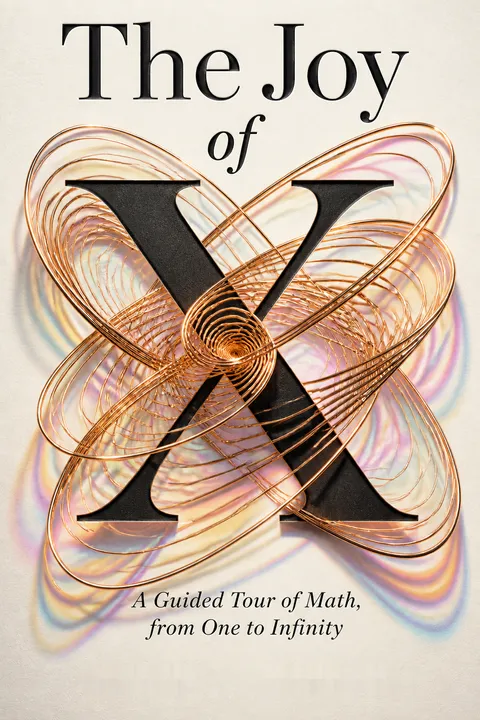
The Joy of X receives mostly positive reviews for making mathematics accessible and engaging. Readers praise Strogatz's clear explanations, real-world examples, and ability to spark interest in math. Many find it enjoyable and insightful, appreciating the historical context and connections to everyday life. Some reviewers note that certain sections become more challenging, potentially losing readers without strong math backgrounds. Overall, the book is recommended for those seeking to rediscover the beauty and relevance of mathematics, though opinions vary on its effectiveness for complete math novices.
People Also Read




Glossary
Complex numbers
Numbers with real and imaginary partsNumbers of the form a + bi, where a and b are real numbers and i is defined by i² = -1. They can be represented as points in a plane, with real and imaginary axes. Multiplication by i acts like a quarter-turn, making complex numbers useful for describing rotations, alternating currents, waves, and other oscillations.
Fundamental theorem of calculus
Connects rates and totalsA central result linking differentiation and integration. It says that accumulating a function’s rate of change over an interval gives the function’s net change across that interval. This connection allows many integrals, which represent sums of continuously varying quantities, to be calculated using antiderivatives.
Natural frequencies
Counts instead of probabilitiesA way to express uncertainty using counts of cases rather than abstract percentages. For instance, instead of saying a test has a particular false-positive rate, one can describe how many people in a group of 1,000 will test positive without having the condition. The method often makes conditional probabilities easier to reason about.
Normal distribution
The familiar bell-shaped distributionA symmetric, bell-shaped probability distribution that commonly arises when many small, independent effects of similar size are added together. Most observations cluster near the mean, with progressively fewer at greater distances. It is useful for many phenomena, but it does not describe every kind of data, especially processes with unusually frequent extreme events.
PageRank
A recursive measure of page importanceA method for estimating the importance of webpages from their links. A page receives value from pages that link to it, with more influential pages contributing more. The scores are repeatedly redistributed across outgoing links until they stabilize. The method can also be interpreted as the long-run share of time a hypothetical random Web surfer spends on each page.
Power-law distribution
A distribution with a heavy tailA distribution in which the frequency of an event declines as a power of its size. Many observations may be small, while exceptionally large observations remain more common than they would be under a normal distribution. City sizes, wealth, earthquakes, and market movements are among the examples discussed in the book.
Method of exhaustion
Bounds an unknown by approximationAn ancient method for estimating a quantity by trapping it between inner and outer approximations whose bounds grow progressively closer. Archimedes used polygons inside and outside a circle to narrow the possible value of pi. The approach anticipates the use of limits in calculus and modern numerical methods.
Hilbert Hotel
A thought experiment about infinityA hypothetical hotel with one room for every positive whole number, all occupied. Moving each guest from room n to room 2n creates infinitely many vacant odd-numbered rooms, showing that an infinite set can be matched with a proper part of itself. Variations illustrate how countable infinite collections can be reorganized and compared.
Möbius strip
A one-sided twisted surfaceA surface made by giving a strip of paper a half twist and joining its ends. It has one continuous side and one continuous edge: tracing along the surface returns to the starting point only after passing across what seemed to be both sides. It is a familiar object for exploring topology, the study of properties preserved under continuous deformation.
FAQ
What's "The Joy of X" by Steven H. Strogatz about?
- Guided tour of math: The book is a guided tour through the elements of mathematics, from basic arithmetic to advanced concepts like calculus and complex numbers.
- Math's beauty and utility: It aims to show the beauty and utility of math, explaining why it is so enthralling to those who understand it.
- Real-world applications: The book connects mathematical concepts to real-world scenarios, such as Michael Jordan's dunks explaining calculus fundamentals.
- Accessible to all: It is designed for anyone who wants a second chance at understanding math, from an adult perspective.
Why should I read "The Joy of X"?
- Rekindle interest in math: It offers a chance to rediscover math in a more engaging and less intimidating way than traditional education.
- Understand math's relevance: The book demonstrates how math is relevant in everyday life, from flipping mattresses to understanding stock market swings.
- Enjoyable learning experience: Strogatz uses humor and storytelling to make complex mathematical ideas accessible and enjoyable.
- Broaden your perspective: It provides insights into how math shapes our understanding of the world, from the smallest particles to the vastness of the universe.
What are the key takeaways of "The Joy of X"?
- Math is everywhere: Math is present in various aspects of life, from nature to technology, and understanding it can enhance our perception of the world.
- Conceptual understanding: The book emphasizes understanding mathematical concepts rather than just memorizing formulas.
- Interconnectedness of math: It shows how different areas of math, like algebra and geometry, are interconnected and build upon each other.
- Math's creative side: Strogatz highlights the creativity involved in solving mathematical problems and constructing proofs.
How does Steven H. Strogatz explain complex numbers in "The Joy of X"?
- Imaginary numbers introduction: Complex numbers are introduced through the concept of imaginary numbers, defined by the square root of -1, denoted as 'i'.
- Visual representation: Strogatz explains complex numbers using a two-dimensional plane, with real numbers on one axis and imaginary numbers on the other.
- Applications in engineering: The book discusses how complex numbers are used in engineering fields, such as electrical engineering, to simplify calculations involving rotations.
- Fundamental theorem of algebra: Complex numbers are shown to be the culmination of the number system, as they allow for the solution of all polynomial equations.
What is the significance of the Pythagorean theorem in "The Joy of X"?
- Foundation of geometry: The Pythagorean theorem is presented as a fundamental concept in geometry, relating the sides of a right triangle.
- Proofs and elegance: Strogatz provides multiple proofs of the theorem, highlighting the elegance and creativity involved in mathematical reasoning.
- Real-world applications: The theorem's applications are discussed, such as in surveying and construction, where it helps calculate distances.
- Insight into space: It reveals fundamental truths about the nature of space, indicating that space is flat in Euclidean geometry.
How does "The Joy of X" approach the concept of infinity?
- Infinity in calculus: Infinity is explored through its role in calculus, particularly in understanding limits, derivatives, and integrals.
- Paradoxes and challenges: The book discusses historical challenges and paradoxes associated with infinity, such as Zeno's paradoxes.
- Archimedes' method: Strogatz explains how Archimedes used the concept of infinity to approximate pi through the method of exhaustion.
- Infinity's impact: The book illustrates how embracing infinity has led to significant advancements in mathematics and science.
What are some of the best quotes from "The Joy of X" and what do they mean?
- "Math is everywhere, if you know where to look." This quote emphasizes the omnipresence of mathematics in daily life and the importance of recognizing its applications.
- "The right abstraction leads to new insight, and new power." It highlights the power of abstraction in mathematics to simplify complex problems and reveal deeper truths.
- "Math always involves both invention and discovery." This quote reflects the dual nature of mathematics as both a creative and exploratory discipline.
- "The domestication of infinity was the breakthrough that made calculus work." It underscores the pivotal role of infinity in the development of calculus and its applications.
How does "The Joy of X" explain the concept of derivatives?
- Rate of change: Derivatives are introduced as a measure of how fast something is changing, akin to the slope of a curve.
- Real-world examples: Strogatz uses examples like the slope of a ramp and Michael Jordan's jump to illustrate the concept of derivatives.
- Applications in optimization: The book discusses how derivatives are used to find maximum and minimum values in various contexts, such as optimizing travel paths.
- Connection to calculus: Derivatives are presented as one of the two central ideas in calculus, alongside integrals.
What is the role of integrals in "The Joy of X"?
- Summation of parts: Integrals are explained as a way to sum up small parts to find a whole, such as calculating areas under curves.
- Applications in physics: The book discusses how integrals are used in physics to calculate quantities like gravitational pull and tumor growth.
- Fundamental theorem of calculus: Strogatz highlights the connection between derivatives and integrals through the fundamental theorem of calculus.
- Real-world relevance: Integrals are shown to be crucial in understanding and predicting changes in various scientific and engineering fields.
How does "The Joy of X" address the concept of probability?
- Conditional probability: The book explains conditional probability and its importance in understanding events given certain conditions.
- Real-life scenarios: Strogatz uses examples like plant watering and medical tests to illustrate how conditional probability works.
- Misconceptions and clarity: The book addresses common misconceptions about probability and offers clearer ways to think about it using natural frequencies.
- Applications in decision-making: Probability is shown to be a valuable tool in making informed decisions in uncertain situations.
What insights does "The Joy of X" provide on the use of logarithms?
- Compressing information: Logarithms are explained as tools for compressing large ranges of numbers into more manageable scales.
- Applications in music and science: The book discusses how logarithms are used in music perception and scientific measurements like the Richter scale.
- Inverse of exponentials: Logarithms are presented as the inverse of exponential functions, crucial for solving equations involving growth and decay.
- Simplifying calculations: Strogatz highlights how logarithms simplify complex calculations, making them essential in various fields.
How does "The Joy of X" explore the concept of symmetry through group theory?
- Symmetry in transformations: Group theory is introduced as the study of transformations that leave certain properties unchanged, such as symmetry.
- Applications in art and science: The book discusses how group theory applies to areas like art, physics, and even mattress flipping.
- Understanding structure: Group theory is shown to reveal the underlying structure and relationships within mathematical systems.
- Versatility of group theory: Strogatz emphasizes the wide-ranging applications of group theory, from particle physics to everyday problems.
About the Author
Other books by Steven H. Strogatz



Download PDF
Download EPUB
.epub digital book format is ideal for reading ebooks on phones, tablets, and e-readers.








