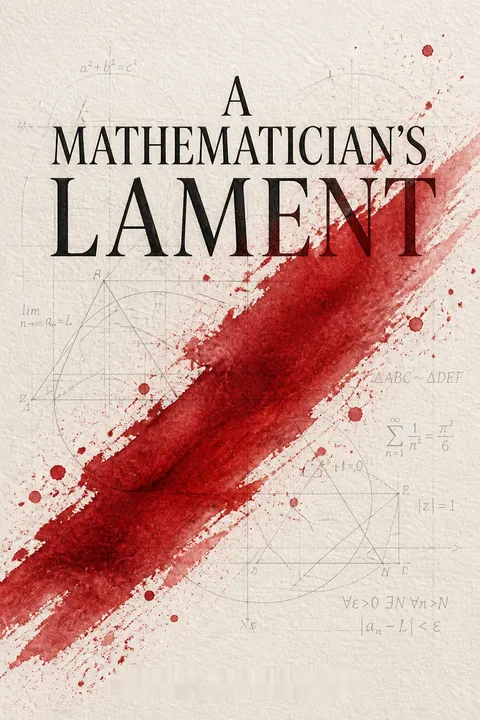


Key Takeaways
Treat math as an art of explanation, not a warehouse of formulas.
The discovery matters. Lockhart argues that mathematics belongs with painting and music: it is a creative practice, not merely a collection of facts with practical uses. A mathematician imagines a triangle inside a rectangle and asks how much of the rectangle it occupies. A clever cut shows that the triangle covers half. The important learning is not just the result, but the act of finding and understanding the argument. Handing students the area formula before they can wonder about the shape is like displaying a painting's label while hiding the painting itself.
Results need a story. Formulas and techniques still matter, but they gain meaning when students see the questions and reasoning that produced them. Lockhart's complaint is not that school teaches facts, but that it too often teaches the answers while removing the mathematics that makes them intelligible.
What's powerful here is the shift from mathematics as stored information to mathematics as a way of making sense. That aligns with the broader idea that expertise involves not only knowing conclusions but understanding why they hold and when they apply. The art analogy also restores pleasure as a legitimate educational aim, rather than treating it as decoration. Still, art and utility need not compete. A mathematical idea can be beautiful, useful, and culturally important at once. The strongest version of Lockhart's case is that utility cannot substitute for explanation, not that practical applications have no place.
Give students questions whose answers are not already printed.
A real problem is unknown. Lockhart distinguishes an open question from a textbook exercise that announces the method and asks students to repeat it. A question such as whether prime numbers continue forever, or how to find a cube's diagonal, gives learners something to investigate without telling them what tool to use. The uncertainty is not a flaw in the lesson. It is the reason there is something to think about.
Questions generate more questions. A good problem can lead into new patterns, examples, and arguments. In Lockhart's approach, the teacher chooses a question suited to the students, then allows time for conjectures and attempts. Technique enters when it helps resolve a genuine difficulty, not simply because a chapter has reached the relevant page.
An unsolved question gives students a reason to attend to method, evidence, and one another's ideas. This resembles inquiry in science and interpretation in literature, where the task is not simply to reproduce an answer but to build a defensible account. The approach also makes uncertainty intellectually productive rather than embarrassing. Its practical challenge is that open problems can overwhelm students if they lack any foothold. A carefully chosen prompt, examples to explore, or a modest hint can provide support without spoiling the discovery.
Let conjecture, failure, and revision precede technique.
Struggle is part of the work. In one classroom example, a student notices that a triangle's area argument seems to fail when the triangle is tilted. Rather than correcting the student with a formula, the teacher treats the objection as a clue: the earlier reasoning depended on a condition that had not been stated. The student is invited to test new ways of cutting the shape.
Guidance follows curiosity. Students can make guesses, find counterexamples, and improve their reasoning before receiving a polished method. Lockhart does not expect children to rediscover all of mathematics unaided. He argues that techniques should arise within meaningful work, with a teacher offering help when it becomes useful. The aim is not struggle for its own sake, but ownership of the reasoning.
This model treats errors as information about a learner's current theory, rather than as evidence of incapacity. That perspective can make classroom discussion more intellectually honest: a student's objection may reveal a hidden assumption that a polished solution conceals. The teacher's restraint is important, but it is not passivity. Good facilitation requires noticing which hint opens the next step and which one takes the problem away. The approach is most compelling when challenge and support are calibrated, so students retain agency without being left to mistake confusion for progress.
Judge proofs by airtight logic and the understanding they create.
A proof should explain. Lockhart's example is the pattern that adding the first few odd numbers produces square numbers: 1, then 1 plus 3, then 1 plus 3 plus 5, and so on. A drawing reveals why: each new odd number forms an L-shaped layer around the previous square. The picture suggests the rule, while an argument about how each layer grows shows that it continues for every square size.
Two standards apply. Lockhart describes proof criticism as having two demands: every logical step must hold, and the reasoning should make the result clearer. A proof that merely verifies a claim can be valid yet unilluminating. A beautiful explanation does more: it exposes the pattern that made the claim true and helps readers see what to investigate next.
The distinction between verification and explanation is central to how mathematical knowledge becomes shareable. The L-shaped argument compresses infinitely many cases into a general reason, while also giving the learner a mental image of the relationship. This makes proof more than a gatekeeping ritual. At the same time, visual insight can hide assumptions, so intuition and formal checking are complements, not rivals. Lockhart's standard is demanding in a useful way: reasoning should survive scrutiny and leave the audience with a better model of the subject.
Teach notation as a tool for ideas, not the subject itself.
Symbols are representations. Lockhart separates a mathematical object from the notation used to name it. The written numeral for twelve is not the number itself, just as a word is not the thing it refers to. A learner can reason about quantity with objects or diagrams before mastering compact symbolic forms; the notation is useful because it lets ideas be expressed efficiently.
Systems can be extended. Lockhart calls the imagined domain of mathematical objects and relationships Mathematical Reality. In it, numbers are understood through their behavior. Negative numbers, for example, extend ordinary counting by giving each positive number an additive opposite. Fractions extend the system again, allowing quantities that do not fit whole-number multiplication. Once definitions and operations are chosen, their consequences must be discovered rather than simply declared.
Separating concept from notation helps explain why symbolic fluency should serve understanding rather than stand in for it. It also makes room for multiple representations, such as diagrams, words, and equations, each of which can reveal different features of a problem. Lockhart's account leans toward mathematical invention: people choose the structures they want to study. Yet invention is not arbitrary freedom. Definitions must work together consistently, and their implications can surprise their creators. That tension between human choice and impersonal consequence is one of the book's most fertile ideas.
Let definitions arise when a problem makes a distinction matter.
Vocabulary should earn its place. Lockhart objects to teaching terms before students have a reason to use them. Calling one form a proper fraction and another an improper fraction may create a distinction without explaining why it matters, since the two forms can represent the same number. Similarly, a term is more useful when students encounter the idea it names while solving a problem.
Definitions shape the inquiry. A definition is not merely a label pasted onto a finished idea. It identifies a feature that matters for a particular question. Lockhart points to the historical discovery of numbers that cannot be written as ratios: the need to describe that unexpected phenomenon gives the relevant distinction its purpose. Starting with a problem can make technical language feel like a tool students helped create, rather than a list of rules imposed from outside.
This principle connects mathematical vocabulary to the larger question of what learners are being asked to notice. A definition directs attention, and its timing can determine whether a term clarifies an idea or becomes one more item to memorize. The argument is especially persuasive when a distinction is conventional or not needed for the current task. However, shared terminology also lets students communicate across classrooms and years. The choice is not between jargon and plain speech, but between vocabulary introduced as an answer key and vocabulary introduced as a useful instrument.
Replace the curriculum ladder with connected problems, not topic races.
The ladder myth misrepresents mathematics. Lockhart uses this term for the belief that school mathematics is a fixed staircase of subjects, each objectively higher than the last. Students are ranked as ahead or behind, while courses such as Algebra I, geometry, and Algebra II appear to form a natural sequence. He argues that this structure often reflects school organization more than the way mathematical ideas actually develop.
Ideas connect through questions. A problem may lead into several areas at once, while a technique from one area can illuminate another. Lockhart criticizes curricula that present disconnected topics and notations without their history or motivation. He favors coherence built from investigation: students follow relationships among ideas, learn methods when needed, and see why a new concept belongs in the story.
The ladder metaphor makes educational progress look like a race with a single route and a clear ranking of learners. Lockhart usefully challenges that picture by emphasizing that mathematical ideas often cross course boundaries. A connected curriculum can help students recognize recurring structures instead of treating each unit as disposable content. But sequence is not meaningless: some techniques do depend on earlier ones, and schools must coordinate instruction. The deeper question is whether a sequence serves conceptual growth or merely organizes material for coverage and testing.
Protect intuition before requiring formal proof rituals.
Formalism can arrive too soon. Lockhart criticizes school geometry's rigid proof templates, where statements are paired with approved reasons even when the central idea is simple. He describes a student exploring why a triangle inscribed in a semicircle has a right angle. Instead of copying a prescribed sequence, the student imagines rotating the triangle to form a rectangle and then works to explain why the construction supports the claim.
Rigor should clarify. Lockhart is not opposed to proof or precision. He argues that students should first become familiar with the shapes, patterns, and questions, then make their reasoning clearer and more complete. Formal language has a role when it resolves genuine uncertainty. Used as the first and only acceptable form of argument, it can teach students to imitate proof without understanding what their own statements mean.
The example distinguishes mathematical rigor from a rigid presentation format. A learner's informal explanation can reveal the structure of an idea before its gaps are fully resolved, giving the teacher something concrete to refine. This resembles the way drafts work in writing: revision is possible because an initial meaning exists. Still, intuition is not self-validating, and formal conventions can make arguments easier to inspect and share. The educational opportunity lies in moving from a student's insight toward precision, rather than demanding polished form before the insight has a chance to appear.
Look for structure-preserving moves that expose a problem's hidden shape.
Transform the problem, not the goal. Lockhart illustrates structural thinking with two points on the same side of a line and the question of the shortest route between them that touches the line. Reflecting one point across the line converts the constrained path into an ordinary straight-line distance between the first point and the reflected point. Because reflection preserves length, the shortest route can be found by drawing that straight line and reflecting its path back.
Structure guides invention. A structure is the setting of relationships that matters to a problem, such as points, distances, and transformations. Once those features are clear, certain moves become natural and others are likely to distort the information. The proof also applies beyond the original picture wherever the relevant notions of reflection and distance behave in the same way.
This example shows how mathematical creativity often works through a change of representation. The solution does not calculate every possible route; it recasts the problem so a familiar principle can do the work. That is a powerful general habit of thought across fields: identify what must remain unchanged, then transform the situation around it. The caution is that an elegant analogy only transfers when the underlying relationships really match. Students need to check what the transformation preserves, rather than treating resemblance between pictures as proof.
Stop defending math with fake utility; let its ideas make the case.
Meaning need not be practical. Lockhart argues that teachers often try to sell mathematics through contrived everyday scenarios, such as using algebra to infer someone's age from oddly specific clues. Such examples can make a subject feel less relevant, not more, because the situation exists only to justify a calculation. He sees mathematics as valuable in its own right, much as music or painting can matter without serving an immediate practical purpose.
Applications are not the whole story. Lockhart does not deny that mathematics supports science, engineering, and other work. His point is that usefulness does not explain what mathematics is, or why every student should encounter it. A mathematical problem can offer pleasure, surprise, and a chance to reason even when it has no direct application. Teaching should not make those experiences wait behind promises of future utility.
The critique challenges a narrow account of education in which every subject must justify itself as job training. It also points to a durable feature of the arts: intrinsic value can be a sufficient reason for learning. This reframing may invite students who feel alienated by forced real-world examples. Yet practical contexts can be intellectually rich when they are genuine, and applied mathematics has its own forms of creativity. The useful distinction is between exploring a real application and attaching an artificial story to a procedure students are expected to repeat.
Teach from active mathematical curiosity, not a script.
Teachers should do mathematics. Lockhart argues that educators need more than the ability to present a textbook sequence. They should understand and enjoy exploring mathematical ideas, so they can respond to students' questions and recognize promising lines of thought. He does not require every teacher to be a professional researcher; he asks for a genuine relationship with the subject.
Play is a starting point. For younger students, he suggests games, puzzles, and invented challenges that invite reasoning without demanding advanced notation. Games such as chess, Go, and Nim can create situations in which players must plan, test ideas, and adapt. The closing invitation is simple: explore a pattern, make a guess, and see where curiosity leads. But Lockhart also recognizes that rigid curricula and tests can limit what teachers are able to do.
The teacher in this vision is neither a performer reading instructions nor an answer machine, but a participant who can guide inquiry because the subject matters to them. Games make the point vividly: strategic thought can develop before students encounter a formal vocabulary for it. The institutional constraint is real within the book's account. Expecting deep individual exploration while imposing tight pacing and standardized measures can put teachers in conflict with their working conditions. Supporting this model therefore requires attention to teacher knowledge, time, and professional autonomy, not simply exhortations to be inspiring.
Analysis
Lockhart's book moves from satire to reconstruction. First, it asks readers to imagine music or painting taught as lists of symbols and procedures. The absurdity exposes how easily school mathematics can be mistaken for mathematics itself. The second half then makes the alternative tangible through small investigations: a triangle's area, odd numbers building squares, a reflected shortest path, and patterns in primes. These examples do more than illustrate a thesis. They let readers experience the difference between receiving a result and discovering why it holds.
The book's strongest claim is that mathematical education should make room for invention, explanation, and aesthetic judgment. Its distinctive contribution is not simply a call for engaging lessons, but a demand to change what counts as mathematical activity. A student's conjecture or imperfect proof is not preliminary noise around the real subject. It is part of the subject. That argument also reframes teachers as guides who need a living relationship with mathematics, not only procedural competence.
The polemic sometimes outruns its evidence. Lockhart's dismissal of curricula, formal proof formats, and teacher education is rhetorically effective but does not establish that structure or shared standards are inherently harmful. Students need reliable fluency, and teachers need ways to develop both subject knowledge and pedagogical judgment. Nor does celebrating pure mathematics require rejecting applications. The more defensible conclusion is that utility and technique should be integrated with meaning, rather than used to replace it.
A practical synthesis would preserve a coherent progression of ideas while organizing learning around problems that make those ideas necessary. Students could explore, argue, and revise, then acquire notation and formal methods as tools for expressing and checking what they have found. Assessment could value reasoning alongside correct answers. This approach retains Lockhart's central insight without requiring every lesson to be unstructured discovery: mathematics is not merely what students know, but what they learn to do with an idea.
Review Summary
A Mathematician's Lament is a passionate critique of math education, arguing that math should be taught as an art form rather than a set of rote procedures. Many readers found it eye-opening and inspiring, praising Lockhart's argument that math is creative and beautiful. Some appreciated his humor and engaging writing style. Critics felt he offered few practical solutions and was dismissive of real-world applications. Overall, the book sparked reflection on how math is taught and understood, with many wishing they had been exposed to this perspective earlier.
People Also Read

Glossary
Mathematical Reality
Imagined mathematical domainLockhart's name for the imagined domain of mathematical objects, relationships, and structures. Numbers, shapes, and other objects are considered through their properties and behavior, not through the symbols used to represent them. People choose definitions and structures to investigate, but the consequences of those choices must then be worked out.
ladder myth
Fixed hierarchy of topicsThe mistaken picture of mathematics as a single ascending sequence of school subjects, with each course objectively higher than the one before it. Lockhart argues that this view turns learning into a race, encourages ranking students as ahead or behind, and hides the connections and overlapping development of mathematical ideas.
pseudo-mathematics
Symbol manipulation without discoveryLockhart's term for schoolwork that resembles mathematics because it involves formulas, notation, and procedures, but removes the questioning and reasoning that give those tools meaning. Students may learn to manipulate symbols accurately while missing the creative activity of posing problems, finding patterns, and explaining why a result holds.
Two-Headed Monster
Logic and explanatory beautyLockhart's image for the two demands placed on a mathematical proof. One demand is strict logical validity, with no gaps in the reasoning. The other is explanatory power: the proof should be clear, elegant, and illuminating, helping the reader understand why the result is true rather than merely confirming it.
structure-preserving transformations
Moves that keep key relationsTransformations that change how a mathematical situation is represented while preserving the features relevant to the problem. In Lockhart's shortest-path example, reflection changes the setup but preserves length, allowing a constrained route to be solved as a straight-line problem. Recognizing what remains unchanged can suggest useful strategies and reveal connections between problems.
FAQ
1. What is "A Mathematician’s Lament" by Paul Lockhart about?
- Critique of Math Education: The book is a passionate critique of how mathematics is taught in schools, arguing that the current system destroys creativity and curiosity.
- Mathematics as Art: Lockhart asserts that mathematics is an imaginative and creative art form, not just a set of rules or formulas.
- Contrast with Other Arts: He draws analogies to music and painting, showing how math is stripped of its artistic essence in education.
- Call for Reform: The book advocates for a radical rethinking of math education, focusing on discovery, play, and genuine problem-solving.
2. Why should I read "A Mathematician’s Lament" by Paul Lockhart?
- Fresh Perspective: It offers a unique, insider’s view from a mathematician who became a K-12 teacher, blending expertise with classroom experience.
- Inspiration for Educators and Parents: The book is recommended for anyone involved in education, especially those frustrated with traditional math teaching.
- Rekindling Curiosity: Readers gain insight into the beauty and joy of mathematics, potentially transforming their own or their children’s relationship with the subject.
- Provocative and Eloquent: Lockhart’s writing is passionate, witty, and thought-provoking, making it engaging even for those who disliked math in school.
3. What are the key takeaways from "A Mathematician’s Lament" by Paul Lockhart?
- Math is an Art: Mathematics should be seen and taught as a creative, imaginative pursuit, not as rote memorization or mechanical procedures.
- Current Curriculum is Harmful: The standard math curriculum is rigid, uninspired, and often counterproductive, stifling genuine mathematical thinking.
- Discovery Over Drills: True mathematical understanding comes from exploring problems, making conjectures, and crafting explanations, not from repetitive exercises.
- Teachers as Artists: Effective math teaching requires teachers who appreciate and practice mathematics as an art, guiding students through exploration rather than dictation.
4. How does Paul Lockhart define mathematics in "A Mathematician’s Lament"?
- Art of Pattern-Making: Lockhart defines mathematics as the art of making patterns with ideas, akin to composing music or painting.
- Imagination and Play: He emphasizes that mathematics is about playing with imaginary objects and asking questions about them.
- Beauty and Explanation: The essence of mathematics lies in crafting beautiful explanations and arguments, not in memorizing facts.
- Freedom of Creation: Mathematicians are free to invent and explore within their own imaginative worlds, constrained only by logical consistency.
5. What are the main problems with the way mathematics is taught in schools, according to "A Mathematician’s Lament"?
- Lack of Creativity: The current system removes the creative process, reducing math to memorization and symbol manipulation.
- Absence of Real Problems: Students rarely encounter genuine mathematical problems; instead, they are given repetitive exercises with predetermined solutions.
- Overemphasis on Rigor and Notation: Formalism and jargon are introduced too early, stifling intuition and curiosity.
- Teacher Preparation: Many teachers lack a true understanding or appreciation of mathematics as an art, perpetuating a cycle of uninspired teaching.
6. How does "A Mathematician’s Lament" by Paul Lockhart compare mathematics to other art forms?
- Analogies to Music and Painting: Lockhart uses vivid analogies, imagining a world where music and painting are taught as mindless symbol manipulation, paralleling math education.
- Loss of Expression: Just as it would be absurd to teach music without playing or painting without painting, teaching math without creative exploration is equally misguided.
- Cultural Misunderstanding: Society recognizes the artistic value of music and painting but fails to see mathematics in the same light.
- Artistic Process: He argues that, like other arts, mathematics involves inspiration, experimentation, and personal expression.
7. What specific advice does Paul Lockhart give for improving math education in "A Mathematician’s Lament"?
- Focus on Problems and Play: Teachers should present students with engaging, open-ended problems and encourage playful exploration.
- Encourage Discovery: Allow students to make conjectures, struggle, and find their own explanations, rather than providing answers upfront.
- De-emphasize Rote Learning: Reduce emphasis on memorization, drills, and standardized testing in favor of creative thinking.
- Teacher Engagement: Teachers should be active mathematical thinkers themselves, sharing their excitement and curiosity with students.
8. What is the "ladder myth" in mathematics education, as discussed in "A Mathematician’s Lament"?
- Sequential Misconception: The "ladder myth" is the belief that mathematics consists of a strict sequence of subjects, each more advanced than the last.
- Race to Nowhere: This myth turns math education into a competitive race, with students worried about being "ahead" or "behind."
- Fragmented Curriculum: It leads to a fragmented, rigid curriculum lacking thematic unity or historical context.
- Art is Not a Race: Lockhart argues that real mathematics is organic and interconnected, not a linear progression of topics.
9. How does "A Mathematician’s Lament" critique the teaching of high school geometry?
- False Promise of Proof: While geometry is supposed to introduce students to mathematical reasoning, it often devolves into rigid, bureaucratic proof formats.
- Stifling Intuition: The focus on formalism and notation undermines students’ natural intuition and curiosity about shapes and patterns.
- Lack of Creativity: Students are trained to mimic proofs rather than create their own arguments or explore geometric ideas.
- Missed Opportunities: Lockhart provides examples of how genuine exploration and student-generated proofs can be far more meaningful and satisfying.
10. What does Paul Lockhart mean by "mathematics is about problems," and how should this shape teaching?
- Centrality of Problems: Mathematics is fundamentally about engaging with interesting, challenging problems, not about memorizing solutions.
- Process Over Product: The journey of exploring, conjecturing, and explaining is more important than the final answer.
- Historical Context: Many mathematical concepts arose from real problems, and teaching should reflect this context.
- Student Involvement: Students should be active participants in problem-solving, developing their own definitions, conjectures, and proofs.
11. What are some examples of mathematical beauty and creativity highlighted in "A Mathematician’s Lament"?
- Odd Numbers and Squares: Lockhart explores the pattern that the sum of consecutive odd numbers forms perfect squares, illustrating the joy of discovery and explanation.
- Shortest Path Problem: He presents the geometric problem of finding the shortest path touching a line, showcasing elegant reasoning through reflection.
- Prime Numbers: The book discusses the mystery and intrigue of prime numbers, including unsolved problems like the twin prime conjecture.
- Student Discoveries: Lockhart shares examples of student-generated proofs and insights, emphasizing the value of personal mathematical creation.
12. What are the best quotes from "A Mathematician’s Lament" by Paul Lockhart, and what do they mean?
- "Mathematics is the music of reason." – This encapsulates Lockhart’s view of math as an expressive, creative art form, akin to music.
- "Mathematics is the art of explanation." – The heart of math lies in crafting beautiful, satisfying explanations, not in memorizing facts.
- "If you deny students the opportunity to engage in this activity... you deny them mathematics itself." – Lockhart stresses that without creative engagement, students are deprived of true mathematics.
- "You don’t need to make math interesting—it’s already more interesting than we can handle!" – He argues that math’s inherent beauty and intrigue are enough, if only teaching would allow it to shine.
- "Just play! You don’t need a license to do math." – Lockhart encourages everyone to explore mathematics freely, emphasizing its accessibility and joy.
Download PDF
Download EPUB
.epub digital book format is ideal for reading ebooks on phones, tablets, and e-readers.








