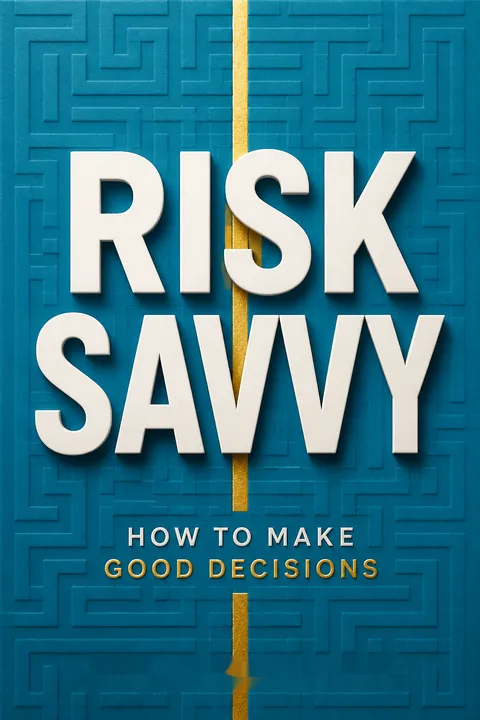


Key Takeaways
Treat risk literacy as a civic skill, not a reason to surrender judgment
Citizens need usable tools. Risk literacy is the ability to understand statistical information well enough to make decisions about health, money, and safety. Risk savvy goes further: it includes handling situations where probabilities are unknown, recognizing emotional pressures, and having the courage to question authority. Gigerenzer argues that people are not inherently incapable of sound decisions. They are rarely taught how to interpret the numbers and uncertainty that now shape daily life.
Expertise is not a guarantee. Doctors may misunderstand test results, advisers may not understand the products they sell, and both may face incentives that conflict with a client’s interests. More technology and regulation cannot replace informed citizens who know what questions to ask. The book’s central proposal is to teach people to judge evidence rather than expect experts to make every choice for them.
The argument connects individual competence to democratic accountability. Informed consent, for example, is hollow if a patient receives statistics that are technically accurate but practically unintelligible. The same problem appears in public policy: access to information matters less when citizens cannot evaluate its framing. Still, literacy cannot repair every imbalance. A patient may understand a treatment’s risks yet have little power to challenge a rushed clinician or an insurer’s limits. The strongest version of the book’s case is therefore not education instead of institutions, but education as a condition for making institutions answerable.
Match each decision to its world: calculate known risks, use rules for uncertainty
Risk is not uncertainty. A known risk has identifiable options and probabilities, as in a lottery. Uncertainty means that possible outcomes, their odds, or even the relevant alternatives are not fully known. Probability calculations can help with the first; a heuristic, or rule of thumb, can help with the second by focusing on a few useful cues and ignoring the rest.
The setting changes the answer. In the standard Monty Hall puzzle, a host always reveals a goat and offers a switch, so switching wins two times out of three. On the actual television show, host Monty Hall could choose whether to offer a switch and could use the offer to manipulate a contestant. The puzzle’s calculation no longer settles the real decision. Similarly, the pilots of the Hudson River landing used a visual rule to judge whether they could reach an airport, rather than attempting a complex calculation in seconds.
This distinction resembles a basic principle in engineering: a model is useful only within the conditions for which it was built. Gigerenzer’s contribution is to treat simple judgment not as defective calculation, but as a separate competence suited to environments with missing information. That is a valuable correction to the reflex that more data must improve every decision. The caution is that intuition can also preserve obsolete habits. A heuristic deserves trust when its cues remain connected to outcomes, not merely because it feels quick or experienced.
Ask "percent of what?" and compare absolute numbers, not alarming percentages
Numbers need a denominator. A 30 percent chance of rain could mean rain on 30 percent of forecast days, in 30 percent of a region, or for 30 percent of the day. Forecasters intend the first, but listeners may reasonably infer another. Ask for the reference class, meaning the group or set of events that the percentage describes.
Relative risk can magnify fear. During a British contraceptive-pill scare, officials reported that a newer pill doubled the risk of thrombosis. The underlying figures were about one case per 7,000 users for the older pill and two per 7,000 for the newer one. That is a 100 percent relative increase, but an absolute increase of one case per 7,000. The warning contributed to an estimated 13,000 additional abortions the following year. Natural frequencies, such as “two cases among 14,000 women,” make the scale easier to grasp.
This is a lesson in how presentation shapes judgment without changing the underlying facts. The distinction parallels work in behavioral economics on framing: people react differently to equivalent descriptions, especially when one makes a small effect sound dramatic. Transparent denominators help patients and readers resist that effect. Yet absolute numbers are not a complete ethical answer. A rare harm may matter greatly to someone facing it, and personal values shape choices. Good communication clarifies the trade-off; it should not dictate which side a person must value more.
Do not let spectacular fear push you toward quieter, deadlier risks
Dread-risk fear follows vivid events. Gigerenzer uses this term for fear triggered when many people die suddenly and together. After the September 11 attacks, many Americans avoided flying and drove instead. Long-distance road travel increased, and an analysis estimated about 1,600 additional traffic deaths during the following year, roughly six times the passengers killed on the four hijacked flights.
Fear travels socially. Social imitation means learning to fear what one’s group fears, without testing the danger personally. This protects people from hazards where trial and error could be fatal. Biological preparedness, the rapid acquisition of fear around historically dangerous cues such as snakes and spiders, can also help. But these mechanisms can misdirect attention: some people fear culturally salient hazards while overlooking more routine dangers. The book’s point is not that fear is foolish, but that its intensity is not a reliable measure of risk.
The example demonstrates how threat perception can produce a second wave of harm through changed behavior. Public-health communication therefore needs to address both the original danger and the risks created by reactions to it. This resembles the distinction between hazard and risk in safety engineering: a threat does not exist in isolation from how people respond. At the same time, fear is not merely a statistical error. It registers vulnerability, uncertainty, and loss of control, dimensions that a death count alone cannot capture. Better decisions combine emotional recognition with comparison to relevant alternatives.
Make mistakes discussable, so organizations can learn instead of hide
An error culture determines what gets learned. A positive error culture makes mistakes visible and studies their causes; a negative one emphasizes blame and concealment. Aviation offers Gigerenzer’s model: pilots report serious errors so colleagues can learn from them, and checklists guard against predictable omissions.
Medicine shows the cost of silence. In one intensive-care unit, Peter Pronovost introduced a five-step checklist for central-line procedures and allowed nurses to stop doctors who skipped a step. The infection rate, initially 11 percent, fell to zero after a year; only two infections occurred over the next fifteen months. A wider Michigan project involving more than 100 ICUs also sharply reduced infections. By contrast, fear of lawsuits can encourage defensive decision making, meaning choosing a less suitable option mainly to protect oneself from blame.
The comparison is about system design, not whether pilots are morally better than doctors. Aviation makes failures difficult to hide and gives crews shared procedures; medicine often combines hierarchy, litigation risk, and uneven reporting. This resembles the logic of high-reliability organizations, which treat near misses as valuable information rather than personal embarrassments. Checklists are not magic, however. They work best when teams can speak up, adapt the process to local conditions, and address causes rather than merely document compliance. A checklist without psychological safety can become paperwork.
Distrust precise market forecasts; use simple, transparent financial rules
Precision can disguise guesswork. Gigerenzer compares bank forecasts of dollar-euro exchange rates over a decade: analysts usually projected that the previous year’s trend would continue, and large turns repeatedly surprised them. Impressive credentials and elaborate models did not make the future reliably predictable.
Simple rules can be sturdier. The 1/N rule divides money equally among N investment options. In a comparison of seven investment settings, it outperformed the complex mean-variance method in six, though the book stresses that the complex method can work when risks and estimates are unusually well known. For banks, former Bank of England governor Mervyn King proposed limiting leverage to 10:1. Borrowing magnifies gains and losses; before the 2008 crisis, some banks reached about 50:1. A practical safeguard for individuals is simpler still: do not buy a product you cannot explain.
The financial lesson is not that models are useless, but that their confidence should match the data and the stability of the world they describe. This is closely related to overfitting: a model can explain historical patterns while failing on new conditions. Simplicity can reduce that fragility, though equal allocation is not automatically right for every investor, time horizon, or portfolio. The deeper test is transparency. Can the decision maker explain the assumptions, incentives, and failure modes, rather than hiding behind a forecast’s decimal places?
Demand test results in frequencies, with benefits and harms side by side
A positive result is not a diagnosis. For a hypothetical group of 1,000 women with a 1 percent prevalence of breast cancer, a test that detects 90 percent of cancers and has a 9 percent false-positive rate produces about 98 positive results. Only about nine of those women have cancer, roughly one in ten. Natural frequencies make the base rate and false alarms visible.
Screening needs balanced evidence. A fact box or icon box places the tested and untreated groups side by side, showing outcomes in simple counts. The book uses prostate screening to explain lead-time bias, when earlier diagnosis makes survival after diagnosis look longer without delaying death, and overdiagnosis, when a test detects a condition that would never cause symptoms. Its broader warning is the SIC syndrome: self-protective care, statistical innumeracy, and conflicts of interest can combine to produce unnecessary testing and treatment.
The strongest insight is procedural: patients need comparable denominators, a clear account of false alarms, and both benefits and harms before choosing. This aligns with shared decision-making, where evidence informs rather than replaces a patient’s priorities. The medical evidence cited in the book reflects the studies it reviews and screening guidance can change as evidence and individual risk change. A fact box should therefore be current, tailored to the person, and explicit about uncertainty. Transparent numbers improve a conversation, but they cannot make a complex clinical decision automatic.
Use experienced intuition and good-enough rules when optimization is fiction
Intuition is trained judgment, not magic. The book defines a gut feeling as a quick judgment whose reasons are not fully conscious but are strong enough to guide action. In interviews, executives reported relying on such judgments in about half of important decisions, even though many felt pressured to invent rational explanations afterward. A useful check is whether the decision maker has relevant experience and a reliable record in that domain.
Stop searching when the choice is good enough. Satisficing means setting an acceptable threshold, then choosing the first option that meets it rather than trying to find an unknowable best. The book applies this to meals, shopping, and partner choice. A formal partner-selection puzzle suggests waiting through 37 percent of candidates, but in the less predictable real world of relationships, a shorter search can be more sensible. No single rule fits every setting.
This section makes an important distinction between expertise and mere confidence. Research on skilled performance often finds that conscious self-monitoring can disrupt actions that have become well practiced, while beginners benefit from deliberate instruction. But a leader’s private hunch is not self-validating. Experience can be narrow, biased, or outdated, and group decisions need ways to hear dissent. The best use of intuition is as evidence about a situation, especially when the expert can recognize patterns, not as an exemption from accountability.
Teach risk skills before adulthood, while habits and peer influence are still forming
Start with real decisions. Gigerenzer proposes teaching children health literacy, financial literacy, and digital risk competence. Each draws on statistical thinking, practical rules of thumb, and an understanding of how emotions and social influence shape choices. Lessons should use stories, experiments, and everyday problems rather than formulas divorced from life.
Children can learn sophisticated ideas. In one study, fourth graders given natural-frequency problems with visual icons solved 60 percent correctly, although they had not yet studied percentages. The book also tells of ten-year-old Tilly Smith, who recognized tsunami warning signs from a school lesson and helped prompt an evacuation in Phuket. Technology alone did not save every beach; someone had to understand what the warning meant. The goal is adults who can use digital tools without being ruled by them, and question financial or health claims before harm is done.
The educational proposal treats agency as a skill that can be practiced, not a trait reserved for unusually gifted adults. That fits evidence from learning science: concrete representations and familiar contexts can make abstract reasoning more accessible. It also reframes peer influence. Since social norms shape behavior, a classroom can teach useful habits before adolescent pressures intensify. Still, curricula require trained teachers and institutional support, not just attractive lesson plans. Risk education is most effective when the surrounding systems also communicate honestly and make safer choices feasible.
Analysis
Risk Savvy is both a practical guide and an argument about who should hold power when decisions are uncertain. Its most useful distinction is between measurable risk and uncertainty, where important possibilities or probabilities remain unknown. Once those are separated, the book’s advice coheres: calculate when the situation supports calculation, use transparent frequencies to interpret evidence, and rely on tested heuristics when exhaustive optimization pretends to know more than it can.
The recurring stories make the case memorable because the errors are not confined to individuals. A frightening risk can redirect travel toward a more dangerous activity. A screening statistic can turn a false alarm into a crisis. A hospital hierarchy can prevent a simple checklist from being used. A bank can reward models that conceal fragility. Gigerenzer’s focus on incentives and communication challenges the idea that poor decisions mainly reveal defective minds. It also makes risk literacy a public responsibility, not merely a consumer skill.
The argument is strongest where it shows how changing a representation changes understanding, as in natural-frequency explanations of medical tests. Its advocacy for simple rules is more conditional than a slogan such as less is more might suggest. A heuristic only works when its cues fit the environment, and familiar patterns can break when technology, incentives, or social conditions change. Likewise, evidence about cancer screening is not timeless; recommendations need current research and individual context.
The book’s central tension is productive: people should think for themselves, yet many decisions are shaped by organizations that control information and options. Teaching citizens to ask better questions is necessary, but not sufficient. Trustworthy systems must also disclose uncertainty, conflicts, and errors. The most durable version of risk savvy is therefore shared: citizens learn to reason, experts learn to communicate, and institutions make it possible to challenge them.
Review Summary
Risk Savvy explores decision-making under uncertainty, advocating for simple heuristics over complex models. Gigerenzer critiques medical screening practices and financial advice, emphasizing the importance of understanding statistics and probabilities. Readers find the book insightful, praising its accessible explanations of risk assessment and decision-making strategies. Some criticize its structure and repetitiveness, while others appreciate its challenge to conventional wisdom. The book's emphasis on empowering individuals to make informed decisions resonates with many, though some find certain sections less compelling or biased against specific industries.
People Also Read





Glossary
Risk savvy
Judgment under riskThe capacity to understand statistical evidence and make decisions when outcomes are uncertain. It combines risk literacy, awareness of how fear and social influence shape choices, and the courage to question experts or institutions. It does not mean avoiding every danger, nor does it assume that every uncertainty can be reduced to a precise probability.
Natural frequencies
Counts that clarify probabilitiesCounts that preserve the number of people or events under consideration instead of expressing information only as normalized percentages or conditional probabilities. For example, saying that 9 of 98 positive tests indicate disease makes false positives and prevalence easier to see. Natural frequencies can help people reason about the chance of a condition given a test result.
Heuristic
A focused rule of thumbA conscious or unconscious strategy that uses a limited amount of information to make a judgment or choice. A heuristic can be fast and accurate when its selected cues fit the environment. It is not universally reliable, but neither is complex calculation. The appropriate tool depends on what is known and what remains uncertain.
Adaptive toolbox
A repertoire of decision rulesThe collection of heuristics available to a person, organization, or culture for making judgments under uncertainty. Different tools suit different problems, much as different hand tools suit different repairs. Intelligent decision making involves not only possessing rules, but recognizing which rule is likely to work in a particular environment.
Turkey illusion
Mistaking uncertainty for calculable riskThe mistaken belief that a situation can be assigned reliable probabilities when important possibilities are unknown. The image comes from a turkey whose daily experience of being fed makes tomorrow seem increasingly predictable, until an unseen change in circumstances overturns the pattern. In finance and other changing environments, precise models can create confidence without genuine predictability.
Dread-risk fear
Fear of sudden mass deathA strong reaction to events in which many people die together or within a short period, such as a terrorist attack. The book contrasts this response with weaker concern about deaths spread across ordinary activities, such as road travel. Such fear can protect people from threats, but it can also redirect attention and behavior toward risks that are not comparatively larger.
Error culture
How a group handles mistakesThe practices and expectations that determine whether an organization admits, reports, and learns from errors or hides them to avoid blame. A positive error culture investigates causes and shares lessons. A negative one encourages concealment and self-protection, making repeated failures more likely. Aviation reporting and hospital safety are used to illustrate the contrast.
Defensive decision making
Choosing to avoid personal blameA decision process in which a person or group believes one option is best but chooses an inferior alternative to protect itself if something goes wrong. It can lead to unnecessary tests or treatments, preference for recognizable brands, or delay while more information is requested. The decision protects the decision maker at a cost to patients, clients, or the organization.
Satisficing
Choose the first acceptable optionA decision strategy in which a person sets an aspiration level, searches among alternatives, and stops when an option meets the threshold. It contrasts with maximizing, which seeks the best possible option. Satisficing is useful when there are many choices and the true best option cannot be known or is not worth the cost of continued search.
SIC syndrome
Three systemic health-care failuresA label for three problems that can undermine medical care: self-protective decisions, inability to understand health statistics, and conflicts of interest. The book argues that these pressures can reinforce one another, encouraging unnecessary testing or treatment. The term is a diagnostic framework for examining incentives and competence, not a claim that every clinician behaves this way.
Fact box
A balanced treatment summaryA table that presents the benefits and harms of a treatment or screening option using clear frequencies and comparable groups. By showing outcomes for people who receive an intervention and those who do not, it avoids relying on relative-risk figures or misleading survival statistics alone. It is meant to support informed choices rather than prescribe a single decision.
FAQ
What's Risk Savvy: How to Make Good Decisions about?
- Focus on Decision Making: The book explores how individuals can make better decisions in uncertain situations by understanding risk and probability.
- Critique of Expert Reliance: Gerd Gigerenzer argues against sole reliance on experts, advocating for personal risk understanding and intuition.
- Practical Applications: It provides tools and rules of thumb for decision-making in contexts like finance and healthcare.
Why should I read Risk Savvy: How to Make Good Decisions?
- Enhance Decision-Making Skills: The book equips you with knowledge to make informed decisions, especially in uncertain situations.
- Understand Risk Literacy: It highlights the importance of risk literacy in navigating complex information and potential pitfalls.
- Real-World Examples: Engaging anecdotes and case studies make complex concepts relatable and applicable.
What are the key takeaways of Risk Savvy: How to Make Good Decisions?
- Risk Literacy is Essential: Understanding risks is as crucial as traditional literacy in today’s society.
- Simple Rules Over Complex Models: Simple rules of thumb can often outperform complex models in uncertain environments.
- Intuition Matters: Trusting informed gut feelings can play a significant role in decision-making.
What are the best quotes from Risk Savvy: How to Make Good Decisions and what do they mean?
- “Knowledge is the antidote to fear.”: Understanding risks can alleviate anxiety and lead to better decision-making.
- “Always ask for the reference class: Percent of what?”: Highlights the importance of context in interpreting probabilities.
- “If you can get me to offer you $5,000 not to open the door, take the money and go home.”: Emphasizes minimizing potential losses in uncertain situations.
What is risk literacy as defined in Risk Savvy: How to Make Good Decisions?
- Basic Knowledge Requirement: It involves understanding probabilities, risks, and decision implications.
- Avoiding Manipulation: Educated citizens can protect themselves from misleading statistics and poor choices.
- Educational Gaps: The book points out the lack of risk literacy education in schools.
How does Gerd Gigerenzer suggest we communicate risks effectively in Risk Savvy: How to Make Good Decisions?
- Use Natural Frequencies: Present risks in natural frequencies rather than conditional probabilities for better understanding.
- Clarify Reference Classes: Specify the reference class when discussing probabilities to avoid confusion.
- Simplify Information: Clear communication enhances understanding and decision-making.
What is the Monty Hall problem and its significance in Risk Savvy: How to Make Good Decisions?
- Game Show Scenario: Involves choosing between three doors, illustrating probability misunderstandings.
- Probability Confusion: Many mistakenly believe switching doors offers no advantage, though it increases winning chances.
- Teaching Tool: Highlights the importance of understanding risk in uncertain situations.
How does Risk Savvy: How to Make Good Decisions address the concept of defensive decision-making?
- Fear of Responsibility: Defensive decisions are made to avoid blame, leading to suboptimal choices.
- Cultural Implications: A culture of fear stifles innovation and risk-taking.
- Real-World Examples: Examples from industries like medicine illustrate how defensive decision-making hinders progress.
What role does intuition play in decision-making according to Risk Savvy: How to Make Good Decisions?
- Unconscious Intelligence: Intuition is based on experience and rules of thumb, allowing quick decisions.
- Trusting Gut Feelings: Encourages trusting instincts informed by past experiences.
- Balancing Intuition and Reasoning: Both intuition and rational thought are necessary for effective decision-making.
What is the SIC syndrome mentioned in Risk Savvy: How to Make Good Decisions?
- Definition of SIC Syndrome: Combines defensive medicine, innumeracy, and conflicts of interest in healthcare.
- Impact on Patients: Leads to overtreatment and misinformed patients due to unnecessary procedures.
- Call for Change: Advocates for training medical professionals in risk communication and statistical reasoning.
What is the Turkey Illusion as described in Risk Savvy: How to Make Good Decisions?
- Definition of Turkey Illusion: Misconception that risks can be precisely calculated, leading to false certainty.
- Historical Context: Uses a turkey's fate as a metaphor for perceived safety being misleading.
- Implications for Decision-Making: Encourages skepticism of complex models and simpler decision-making strategies.
How can I apply the principles from Risk Savvy: How to Make Good Decisions in my daily life?
- Practice Risk Literacy: Question statistics and probabilities, seeking context and clarification.
- Use Simple Rules: Implement rules of thumb like the 1/N rule for investments to streamline decisions.
- Trust Your Intuition: Recognize when gut feelings are based on experience and balance them with rational analysis.
About the Author
Download PDF
Download EPUB
.epub digital book format is ideal for reading ebooks on phones, tablets, and e-readers.








