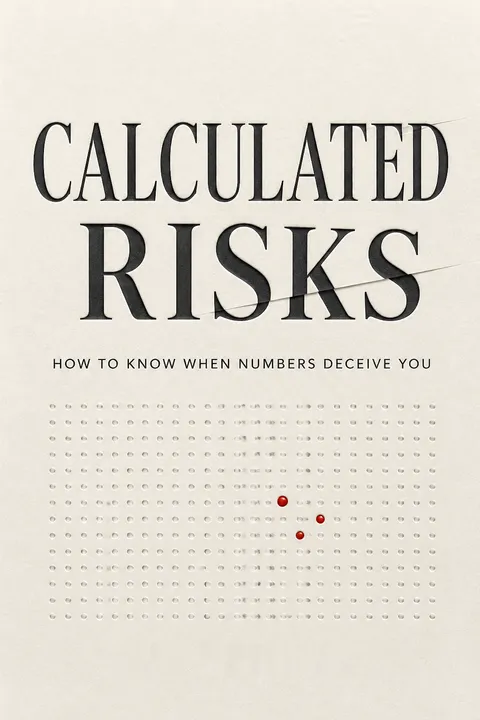


Key Takeaways
Treat every test as evidence, never as an oracle
A diagnosis can fail. Susan, a 26-year-old mother, was told she had HIV after a hospital accidentally switched her result with another patient’s. For nine months, she lived with a terminal diagnosis, feared infecting her son, and lost her job. A retest showed she was not infected. Her doctors had presented the result as certain, leaving her no reason to question it or seek another test. The book calls this the illusion of certainty: believing an outcome is guaranteed when errors or limits remain possible. It can attach itself to sophisticated technologies as easily as to old-fashioned folk beliefs.
Doubt is not denial. A test can be highly useful without being flawless. Asking how errors happen, how often they occur, and whether a second sample is appropriate turns blind trust into informed caution. The book’s point is not that every result is suspect, but that certainty should be earned, not assumed.
What's striking is that the harm came not only from a faulty test, but from certainty in the conversation around it. In safety engineering, near misses and disclosed errors help organizations improve because they make failure visible before it becomes routine. Medicine and law benefit from the same principle: explain what a tool can establish, what it cannot, and what happens when it is wrong. Still, uncertainty should not be used to imply that all outcomes are equally likely. Good communication distinguishes a small residual chance of error from genuine ignorance, while preserving a practical path to verification.
State risks as counts of people in a clearly named group
Give the denominator. Natural frequencies are counts of cases in a defined group, such as the number of patients who experience a side effect among ten who take a drug. They make both the event and its reference group visible. In the book’s mammogram example, imagine 100 women, one with breast cancer. That woman is likely to test positive. Of the 99 without cancer, nine also test positive. Ten women receive positive results, but only one has cancer.
Percentages can mislead. A psychiatrist told patients that 30 to 50 percent taking Prozac might develop sexual problems. Some patients thought the percentage described the share of their own sexual encounters that would go wrong. Rephrasing it as three to five patients out of ten made the intended group clear and encouraged useful questions. The number had not changed; the picture had.
This is a design insight as much as a mathematics lesson. A denominator works like a label on a chart: it tells readers what population the number describes and prevents them from silently substituting a different one. The same principle matters in polls, product claims, and public dashboards. Counts are not automatically honest, though. A carefully chosen group can still exclude relevant people, and a count without a time period can obscure changing risk. The useful habit is to ask for the group, the duration, and the comparison, not simply to demand a more intuitive-looking number.
When a test is positive, start with how common the condition is
Start with prevalence. The base rate is the proportion of a defined population that has a condition before a new test result is considered. A test’s sensitivity describes how often it detects the condition when present. Neither number alone tells a patient the chance of having the condition after a positive result. That updated chance is the positive predictive value.
The same test changes meaning. In the book’s example of low-risk men, about one in 10,000 is infected with HIV. If that man tests positive, he almost certainly appears among the positives. But about one uninfected man in 10,000 may also test positive. So roughly two men test positive, and only one is infected. The positive result means about a one-in-two chance in this example, not near certainty. In a higher-risk group, the same result means something different because the base rate is higher.
The key intellectual move is to reverse the question. Test accuracy asks how results behave among people whose condition is already known; patients usually ask what their result implies about them. Those are different conditional probabilities. This distinction is central to diagnosis, screening, and forensic evidence. A high-performing test can still produce many false alarms when the condition is rare. Conversely, a less dramatic test can be informative when the prior likelihood is substantial. The lesson is not to distrust tests, but to interpret them alongside the population and circumstances that generated the result.
Compare mammography's one-in-1,000 benefit with its false alarms and overtreatment
Small benefits need scale. In the trials cited by the book, four Swedish studies found that over ten years breast cancer deaths fell from about four to three per 1,000 women screened. That is a 25 percent relative reduction, but an absolute reduction of one death per 1,000. The book also reports that screening women from 50 to 69 every other year for 20 years was associated with one life saved per 270 women. These are findings discussed in a 2002 book, not current medical advice.
Screening has costs. A positive result can lead to additional imaging, biopsy, anxiety, or surgery, even when there is no cancer. Screening can also detect slow-growing abnormalities that might never have caused illness, a problem called overdiagnosis. The author argues that people need both benefits and harms in comparable terms before deciding whether screening fits their priorities.
This example shows why relative benefit alone is an incomplete guide to action. A treatment’s value depends on baseline risk, the size and seriousness of possible harms, and the patient’s preferences. It also exposes a communication challenge: absolute numbers may look modest while averted deaths remain profoundly important to the people affected. The book’s figures reflect the evidence it reviewed at publication, so they should not be carried forward as present-day guidance. More broadly, screening decisions deserve updated evidence and transparent denominators, rather than slogans that promise either rescue or danger.
Medical choices compare risks, not certainty against danger
No option is risk-free. A team treating a 21-month-old boy pursued certainty through repeated invasive tests. After six weeks of procedures, including several spinal taps, he died without a clear diagnosis. The case illustrates how the desire to eliminate uncertainty can itself cause harm. A test, treatment, or decision to wait each carries possible consequences.
Patients own the values. Informed consent means more than signing a form. It means understanding the relevant benefits, harms, and alternatives well enough to choose according to one’s priorities. One young woman, called Iphigenia in the book, chose a lumpectomy and radiation after her surgeon explained alternatives to mastectomy. Nancy Reagan made a different choice when facing early breast cancer. Their decisions differed because personal circumstances and values differed. A physician can explain medical options, but cannot decide how a patient should value them.
The distinction between technical expertise and value judgment reaches beyond medicine. Engineers can estimate how a bridge may fail; a community still decides what level of risk is acceptable and who bears it. Shared decision-making is strongest when the professional explains evidence while acknowledging the patient’s goals and the limits of knowledge. The ideal is not to transfer every burden to the patient. Too much information, delivered quickly or without support, can overwhelm rather than empower. The practical standard is usable disclosure, space for questions, and recognition that professional incentives may not perfectly match a patient’s interests.
A rare DNA match does not equal a guilty defendant
Separate the probabilities. In the 1968 Collins robbery case, the prosecution multiplied estimated chances for six traits and claimed that only one couple in 12 million would match. It then treated that figure as the chance the defendants were innocent. But if the relevant population held about 24 million couples, the calculation suggested that roughly two couples might match. The California Supreme Court overturned the conviction, citing unsupported estimates, questionable assumptions, and this basic inferential error.
A match is one link. The prosecutor’s fallacy is confusing the chance of a match in a population with the chance that a matched defendant is innocent. DNA evidence also requires reasoning through possible lab error, coincidental matches, transfer of biological material, and whether the person was present at the relevant time. In an experiment described in the book, legal students and professionals gave more guilty verdicts when DNA evidence was presented as probabilities rather than natural frequencies.
Forensic evidence is powerful precisely because it narrows possibilities, but its force depends on the question being answered. A match statistic is not a verdict, and even a correct match does not establish when or why biological material arrived at a scene. Courts need a clear account of the suspect population, laboratory error, and the relationship between the trace and the alleged act. Natural frequencies can make one part of the reasoning easier to see, but they do not replace careful evidence handling or independent corroboration.
Inspect how numbers are framed before trusting the conclusion
Large percentages impress. A cholesterol drug study reported deaths falling from 41 to 32 per 1,000 over five years. That is a 22 percent relative risk reduction, an absolute reduction of nine per 1,000, and a number needed to treat of 111 to prevent one death. Each description is mathematically compatible, but each creates a different impression. The number needed to treat states how many people receive treatment for one additional life to be saved.
Framing can serve interests. The book describes health agencies and researchers emphasizing relative reductions because they sound substantial, and a leaflet that presented a possible cancer harm as a small absolute number while describing a benefit with a large relative percentage. It also traces how the tobacco industry shifted from claiming cigarettes were safe to emphasizing scientific doubt. Numerical presentation can be accurate while steering attention away from the whole comparison.
Framing is unavoidable because every summary selects a unit, denominator, and comparison. The ethical distinction is whether those choices illuminate the decision or strategically hide important context. Relative risks are useful for comparing proportional changes, but they need baseline rates to show how many people are affected. Absolute risks are clearer about scale, yet they do not express how people value different outcomes. Readers should look for matched formats, a fair comparator, and missing costs. A mismatch is a warning sign, not proof of deception.
Make forecasts specify both their reference group and their time window
The question changes the estimate. More than 400 mental health experts in one study judged whether patients would commit a violent act within six months. Experts asked for a probability gave estimates about 50 percent higher than experts asked how many out of 100 similar patients would act violently. A single-person probability leaves the comparison group unclear. The count format makes the reference class explicit.
Answer choices are cues. The category effect is the influence that offered response categories can have on judgments made under uncertainty. Experts given response scales with larger probability intervals predicted more violence than those given finer intervals at the low end. The order in which patients were ranked stayed more stable than the numerical estimates. To make forecasts interpretable, specify who is being compared, over what period, and how the outcome is defined. Open-ended frequency estimates can reduce the pull of arbitrary categories.
Forecasting is not just a matter of asking experts for a number. The question, response scale, and institutional consequences shape the number that emerges. This matters in parole, clinical care, and any setting where a risk estimate can restrict someone’s freedom. A forecast should also be tested against later outcomes, since consistency between experts does not establish accuracy. When estimates guide high-stakes decisions, the relevant standard is calibrated performance across comparable cases, paired with safeguards against treating an uncertain prediction as a permanent label.
Train with frequency trees, not formulas alone
Make the structure visible. Representation training teaches people to translate probability information into natural frequencies and arrange the counts in a tree. In studies described by the book, a one-to-two-hour tutorial raised American students’ correct answers from 10 percent to 90 percent. Their performance remained near 90 percent after five weeks. A German student group using the same approach reached 100 percent correct after three months, while rule-based training showed more forgetting.
Practice reveals assumptions. In the Monty Hall puzzle, a contestant chooses one of three doors; a host who knows the locations opens a door showing a goat and offers a switch. If the host always offers the switch and always reveals a goat, switching wins two times out of three. Counting the possible cases makes this easier to see than treating the two closed doors as equal. The puzzle teaches both a reasoning method and the need to state assumptions.
The teaching result supports a wider principle: a good representation can function as part of the reasoning, not merely as decoration. Trees and counts externalize steps that working memory might otherwise have to juggle. That is valuable in classrooms and professional interfaces, especially when decisions are made under time pressure. The reported training gains are impressive, but they come from particular tasks and studies, not proof that one format solves every statistical problem. Durable statistical literacy also requires practice with messy data, uncertain definitions, and competing values.
Analysis
Calculated Risks is both a practical guide to statistical reasoning and an argument about who controls the presentation of evidence. Its recurring stories move from a woman harmed by a mistaken HIV diagnosis to physicians misreading screening data, lawyers misusing forensic statistics, and institutions choosing persuasive formats over transparent ones. The through-line is that error is not located only in a person’s mind. It can be built into a test, hidden by a missing denominator, amplified by professional incentives, or induced by the question itself.
The book’s method has three distinct jobs. First, acknowledge that technologies and experts can err. Second, find empirical information about the relevant risk. Third, represent the information so that people can reason from it. Natural frequencies are especially effective when the task involves a test result and a base rate, because they preserve the counts needed to understand how many positives are false alarms. Absolute risks and numbers needed to treat help describe scale, while explicit reference classes make probability statements less ambiguous. These tools solve different problems and should not be collapsed into one universal format.
The strongest contribution is its insistence that numerical literacy is partly a design responsibility. A patient or juror should not need advanced probability training to understand evidence that may alter a life. Yet clear presentation cannot settle what risks are acceptable, whose interests deserve priority, or how much weight to give a rare but severe outcome. Those remain ethical and political questions. Nor does a vivid count guarantee fairness if the population or time horizon has been selected badly.
The book’s medical examples and recommendations reflect evidence available around 2002, and should be read as historical cases rather than current clinical guidance. Its lasting value is methodological: ask what the number counts, which group it describes, what comparison is being made, and which uncertainties remain. Statistical clarity does not abolish uncertainty. It makes uncertainty visible enough for people to reason, question authority, and choose with their eyes open.
Review Summary
Calculated Risks receives mostly positive reviews for its insightful exploration of statistical reasoning and risk communication. Readers appreciate Gigerenzer's clear explanations of complex concepts and the book's real-world examples from medicine and law. Many find it eye-opening and valuable for understanding probability and uncertainty. Some criticize the book for being repetitive or dense, but overall, reviewers praise its importance in helping people interpret statistics and make informed decisions. The book's emphasis on using natural frequencies to explain risks is highlighted as particularly useful.
People Also Read








Glossary
Illusion of certainty
Mistaking confidence for certaintyThe belief that an outcome or technology is error-free when uncertainty remains. The illusion may arise from perception, trust in authority, or a desire for reassurance. It can make people treat a positive test, an expert judgment, or a familiar cultural belief as conclusive, even when errors or limitations are possible.
Innumeracy
Difficulty reasoning with numbersThe inability to reason effectively with numbers, especially numbers describing uncertainty and risk. In the book, statistical innumeracy includes not knowing relevant risks, communicating them ambiguously, or drawing incorrect conclusions from available data. The author argues that it is not simply an individual defect: confusing representations and institutional practices can create or sustain it.
Natural frequencies
Counts in a defined groupCounts of events in a specified population that retain the underlying base-rate information. For example, instead of saying a test is positive for 90 percent of people with a disease, one might describe how many people in a group have the disease and how many of them test positive. These counts often make diagnostic reasoning easier than conditional probabilities do.
Base rate
Condition frequency before testingThe proportion of people in a defined population who have an attribute or condition before considering new evidence, such as a test result. It is also called prevalence. Base rates matter because the meaning of a positive test depends partly on how common the condition is in the population being tested.
Reference class
The group a risk describesThe population or set of events to which a probability or frequency refers. A statement about a 30 percent chance can be unclear if it does not specify whether the group consists of patients taking a drug, events experienced by one patient, or some other set. Naming the reference class reduces ambiguity and makes comparisons interpretable.
Relative risk reduction
Proportional decrease in riskThe reduction in risk expressed as a fraction of the original risk. If deaths fall from 41 to 32 per 1,000, the reduction of nine is divided by the original 41 to produce a relative reduction of about 22 percent. This measure does not show the absolute number of people who benefit without also knowing the baseline risk.
Number needed to treat (NNT)
People treated per added benefitThe number of people who must receive a treatment for one additional person to experience a specified benefit, compared with an alternative such as a placebo. It is calculated from the absolute risk reduction. In the book’s example, treating 111 people with a cholesterol-lowering drug for five years prevented one additional death relative to placebo.
Prosecutor’s fallacy
Confusing a match with guiltThe error of treating the probability that a random person would match evidence as the probability that a defendant is innocent given a match. These are different probabilities. A rare match can still occur in more than one person when the potential population is large, and a match alone does not establish that the defendant committed the crime.
Category effect
Answer scales shift judgmentsThe influence of response categories on numerical judgments made under uncertainty. When experts were given different probability scales for estimating violence, their estimates shifted with the scale, even though the cases were the same. The categories appeared to act as cues about the likely range of answers rather than as neutral recording devices.
FAQ
What's Calculated Risks: How to Know When Numbers Deceive You about?
- Exploration of Uncertainty: The book delves into how humans perceive and handle uncertainty and risk, especially in medical and legal contexts. It stresses the need to understand statistical information for informed decision-making.
- Real-Life Illustrations: Gerd Gigerenzer uses examples like HIV testing and breast cancer screening to show how miscommunication of risks can have serious consequences, highlighting the gap between statistical data and public understanding.
- Practical Tools: The author introduces tools such as using natural frequencies instead of probabilities to help individuals better comprehend risks and make informed choices.
Why should I read Calculated Risks by Gerd Gigerenzer?
- Improve Decision-Making: The book enhances your ability to understand and communicate risks, crucial in today's data-driven world, equipping you to navigate uncertainties effectively.
- Awareness of Miscommunication: It highlights how professionals often miscommunicate risks, leading to unnecessary fear and anxiety, and helps you advocate for clearer communication in healthcare and legal contexts.
- Empowerment Through Knowledge: By learning about statistical principles, readers can feel more empowered to question and understand information presented to them in various settings.
What are the key takeaways of Calculated Risks?
- Understanding Uncertainty: Recognizing uncertainty as a fundamental aspect of life can help individuals make better decisions, as emphasized by Gigerenzer.
- Natural Frequencies vs. Probabilities: The book advocates using natural frequencies to communicate risks more effectively, clarifying actual risks involved.
- Illusion of Certainty: Gigerenzer discusses how the illusion of certainty can lead to poor decision-making, encouraging readers to embrace uncertainty.
What are the best quotes from Calculated Risks and what do they mean?
- “Dare to know!”: This quote encourages individuals to seek knowledge and understanding of risks, promoting critical thinking and informed decision-making.
- “Nothing is certain but death and taxes.”: It serves as a reminder of life's inherent uncertainty, setting the tone for discussions on navigating uncertainties.
- “The best technology is of little value if people do not comprehend it.”: This highlights the importance of understanding tools and technologies, especially in healthcare, underscoring the need for clear communication of risks.
How does Gerd Gigerenzer define "innumeracy" in Calculated Risks?
- Definition of Innumeracy: Gigerenzer defines it as the inability to reason appropriately about uncertainties and risks, particularly in statistical contexts, reflecting a lack of understanding of basic mathematical concepts.
- Forms of Innumeracy: The book identifies forms like ignorance of risk, miscommunication of risk, and clouded thinking, each contributing to poor decision-making.
- Impact on Decision-Making: Innumeracy can lead to significant consequences, such as unnecessary medical procedures or flawed legal judgments, emphasizing the need for education and tools to combat this issue.
What is the significance of using natural frequencies instead of probabilities in Calculated Risks?
- Clarity in Communication: Natural frequencies provide a clearer representation of risks, making it easier for individuals to understand statistical data's actual implications.
- Reduction of Miscommunication: Using natural frequencies minimizes potential miscommunication by specifying the reference class clearly, as illustrated in the Prozac example.
- Facilitating Better Inferences: Gigerenzer argues that natural frequencies help individuals make better inferences about risks, aligning more closely with how humans naturally process information.
How does Calculated Risks address the issue of informed consent?
- Importance of Informed Consent: The book emphasizes that informed consent is crucial in medical and legal contexts, requiring clear communication of uncertainties.
- Challenges in Achieving Informed Consent: Gigerenzer discusses barriers like the illusion of certainty and professionals withholding information, highlighting the need for transparency.
- Recommendations for Improvement: The author suggests educating both patients and professionals about risks and decision-making processes, using natural frequencies and comprehensive information.
What role do experts play in the miscommunication of risks, according to Calculated Risks?
- Expert Misunderstanding: Gigerenzer points out that even experts can misinterpret statistical information, leading to miscommunication of risks.
- Influence on Public Perception: Experts' miscommunication can significantly impact public perception and decision-making, as seen in HIV testing and breast cancer screening cases.
- Need for Better Training: The book advocates for better training of experts in statistical reasoning and communication to foster clearer communication and better decision-making.
How does Gerd Gigerenzer illustrate the concept of the "prosecutor's fallacy" in Calculated Risks?
- Definition of Prosecutor's Fallacy: It occurs when the probability of a match is incorrectly equated with the probability of guilt, leading to wrongful convictions.
- Case Examples: Gigerenzer uses the case of People v. Collins to illustrate this fallacy, where statistical probabilities were misapplied, leading to a reversed conviction.
- Implications for Justice: The book highlights the dangers of this fallacy in the legal system, emphasizing the need for clearer statistical communication to prevent similar errors.
What are the psychological impacts of miscommunication of risks as discussed in Calculated Risks?
- Fear and Anxiety: Miscommunication of risks can lead to heightened fear and anxiety, as seen in false HIV test results, causing significant emotional distress.
- Impact on Decision-Making: The psychological toll can affect decision-making processes, leading to choices based on fear rather than informed understanding.
- Need for Supportive Counseling: Gigerenzer emphasizes supportive counseling that addresses both emotional and informational needs, helping mitigate anxiety and empower informed decisions.
What are the common misconceptions about breast cancer screening discussed in Calculated Risks?
- False Positives: Many women experience false positive results in mammography screening, leading to unnecessary anxiety and procedures.
- Relative vs. Absolute Risk: The book explains the difference, emphasizing that absolute risk reduction provides a clearer picture of screening benefits.
- Mortality Reduction: Gigerenzer discusses the misconception that early detection always reduces mortality, pointing out that total mortality was the same in screening and control groups.
What role does the media play in shaping public perception of risks according to Calculated Risks?
- Influence of Reporting: Media coverage can significantly impact public understanding of risks, often emphasizing sensational stories over statistical realities.
- Miscommunication of Statistics: The media often presents statistics in misleading ways, such as focusing on relative risks without context, creating an illusion of certainty.
- Responsibility of Journalists: Gigerenzer calls for greater responsibility among journalists to report risks accurately and clearly, fostering a more informed public.
About the Author
Download PDF
Download EPUB
.epub digital book format is ideal for reading ebooks on phones, tablets, and e-readers.








