

Key Takeaways
Treat intuition as a tool selected for the situation, not a rival to reason.
A feeling has a method. Gigerenzer defines a gut feeling as a quick judgment whose reasons are not fully conscious, but which is strong enough to guide action. Its hidden logic is often not a miniature calculation of every pro and con. Instead, a simple rule uses a particular ability of the brain, such as recognizing a name or tracking a moving object, and works well when the surroundings suit it.
Harry, torn between two women he loved, wrote out a careful balance sheet. The calculation favored one; his immediate sense of its wrongness revealed that he had already chosen the other. In a poster experiment, people who explained their preferences before choosing were less satisfied with their choices weeks later than those who chose without analyzing their reasons.
What's striking is that intuition is presented as a process to investigate, not a mystical faculty to obey. This resembles modern work on skilled expertise: rapid judgment can encode patterns learned through practice, even when the practitioner cannot explain each cue. But the same speed can preserve prejudice or a bad habit. The useful question is therefore not whether a feeling is sincere, but whether the person has relevant experience and whether this kind of situation rewards that experience. Introspection can disrupt a fluent judgment, yet reflection remains essential when the stakes are high and feedback is available.
Use partial recognition only when familiarity tracks what you want to predict.
Ignorance can inform. The recognition heuristic says that when choosing between two things, if one name is familiar and the other is not, infer that the familiar one ranks higher on the quality being judged. It can work when recognition and quality are correlated. In one quiz, German students who knew little about American cities correctly judged Detroit larger than Milwaukee, while many American students knew both names and were distracted by other associations.
For the 2003 Wimbledon tournament, predictions based on which players ordinary people recognized performed about as well as, or better than, official rankings. The rule has limits: it needs partial knowledge and a useful link between recognition and the target. A heavily advertised brand may be familiar because of publicity, not because its product is better.
This is a sharp corrective to the assumption that more knowledge always improves judgment. In machine learning, a model can overfit by treating accidental details as meaningful; recognition can avoid that trap by using one robust signal. Yet recognition is not inherently reliable. Advertising can manufacture familiarity, and historical visibility can reflect power rather than merit. The heuristic is best treated as a conditional instrument: first ask what made a name known, then ask whether that cause plausibly tracks the outcome. Its real lesson is not to cultivate ignorance, but to notice when extra information is noise.
Judge a shortcut by its environment, not by how little it computes.
The world completes the rule. A heuristic is a simple rule of thumb that uses limited information. Gigerenzer's gaze heuristic shows how a player catches a high fly ball: keep looking at it, run, and adjust speed so its angle against the ground stays roughly constant. The player need not calculate a trajectory through wind, spin, and air resistance. The rule works because human vision and movement already handle those complexities.
This is the book's adaptive toolbox: a collection of rules built from evolved capacities and suited to different surroundings. A rat that chooses a food patch less often than its payoff rate seems inefficient when tested alone. In a crowded natural setting, however, occasional switching can reduce competition. The same behavior can be sensible or mistaken depending on the environment.
The key move is to evaluate a decision rule together with the world it inhabits. This parallels ecological approaches in biology, where an organism's behavior cannot be understood from its anatomy alone; resources and competitors matter too. It also challenges the habit of ranking strategies by computational sophistication. A simple controller can outperform a detailed model when it exploits a stable relationship directly. Still, environments change. A shortcut that was well matched to yesterday's conditions can become dangerous when incentives, technology, or competition shift. Good judgment includes monitoring whether the rule's setting still holds.
Limit choices when extra options create paralysis instead of better decisions.
More can obstruct. In a supermarket tasting experiment, 60 percent of shoppers stopped at a display of 24 jams, compared with 40 percent at a display of six. Yet only 3 percent of all shoppers bought jam from the larger display, versus 30 percent from the smaller one. More options attracted attention but made choosing less likely. A shampoo maker likewise increased sales after reducing its range from 26 versions to 15.
Cognitive limits can help in other ways. The Russian mnemonist Shereshevsky could remember extraordinary quantities of detail, but struggled to summarize a story or grasp its general meaning. Forgetting can clear space for abstraction. These examples do not mean fewer choices or less memory are always better. They show that limits can protect attention when detail overwhelms the task.
The jam result anticipates a broad finding in behavioral science: choice has both an informational benefit and a comparison cost. More alternatives raise the chance of finding a close match, but also increase the effort of evaluating and the possibility of regret. The practical implication is to design menus, plans, and personal routines around meaningful distinctions rather than sheer variety. The boundary matters, though. A small selection can conceal poor options or restrict autonomy. Simplification helps when it removes redundant comparison, not when it removes choices people genuinely value.
In uncertain predictions, one strong clue can beat a spreadsheet.
Prediction is not explanation. Take the Best is a sequential rule: rank clues by importance, check them in order, and stop at the first clue that distinguishes the options. In a study of 57 Chicago high schools, researchers compared this rule using 18 indicators with multiple regression. For predicting dropout rates in schools whose outcomes were not yet known, Take the Best considered about three clues on average and predicted more accurately. Regression did better when explaining data already observed.
The distinction is overfitting: a complex model can fit past details, including accidental ones, and then predict poorly. In basketball studies, a simple rule using season wins and halftime lead matched the accuracy of a more elaborate probability calculation. The point is not that spreadsheets are useless, but that complexity does not guarantee foresight.
This is a valuable distinction between fitting known data and forecasting unseen cases. Statistical learning now formalizes the same risk as overfitting, and uses held-out data to test whether a model generalizes. A sparse heuristic can be robust when evidence is limited, while a richer model can win when the data are abundant and stable. The book's results therefore support disciplined comparison, not a universal preference for simplicity. Before trusting either a gut rule or a complex model, decision-makers should test it on cases that were not used to build it.
Do not mistake conversational intelligence for a failure of logic.
Words carry context. The Linda problem asks whether Linda, described as politically engaged, is more likely to be a bank teller or a bank teller active in feminism. Many people choose the second option, which violates the formal rule that a combined category cannot be more probable than one of its parts. Gigerenzer argues that people may hear probable as plausible or typical, rather than as mathematical probability, because otherwise Linda's description would be irrelevant.
When the question instead asks how many people in a group fit each description, the apparent error largely disappears. Everyday language also gives and meanings beyond logical AND: it can imply sequence, cause, or a combined group. Formal logic is useful for proofs, but it does not capture every intelligent inference made in conversation.
The example exposes a methodological danger: a response can look irrational under a researcher's interpretation while making sense under the participant's. Linguistics and pragmatics study precisely this gap between literal form and intended meaning. That does not make every apparent reasoning error disappear; people do make probability mistakes, and ambiguous wording can produce several interpretations. The stronger lesson is to test what a question means to its audience before diagnosing their thinking. A good experiment distinguishes failures of logic from failures of communication.
Train medical judgment on relevant cues, not on defensive testing.
More testing can harm. Kevin, a severely neglected toddler, initially improved when a young doctor minimized invasive tests and focused on care. Specialists later subjected him to weeks of procedures that found no decisive cause. He stopped eating again and died. The case shows that diagnostic activity is not automatically beneficial, especially when procedures themselves burden a patient.
In a Michigan hospital, physicians sent about 90 percent of severe-chest-pain patients to intensive coronary care, yet their decisions barely distinguished those who had heart attacks from those who did not. A complex prediction instrument improved performance, but a simple decision tree based on key ECG and symptom cues did better. The lesson is to identify useful signals, assess outcomes, and resist testing driven mainly by fear of lawsuits.
The chapter's strongest contribution is to treat medical overuse as a problem of incentives and measurement, not simply individual incompetence. Defensive practice can make clinicians safer from blame while exposing patients to real harms. This connects to quality-improvement methods that audit decisions against outcomes and make evidence usable at the point of care. Still, a brief decision tree cannot replace clinical judgment across all patients. Its value depends on validation in the population where it is used, plus a system that gives clinicians honest feedback about both missed illness and unnecessary intervention.
Change the default when passive habits are costing people their lives.
Settings shape moral action. In countries where people had to register to donate organs, donor eligibility was far lower than in countries where donation was the default unless citizens opted out. The book reports rates of 28 percent in the United States and 99.9 percent in France. An experiment found that the default influenced choices even when participants could change it easily. Many people follow the path already set rather than actively decide.
Social pressure can also redirect behavior. During a 1942 massacre in Poland, a commander told his police battalion that older men could step aside. Only a small number did. Historian Christopher Browning argues that many feared separating themselves from their comrades. A rule about staying with the group could overpower individual moral resistance.
Defaults reveal that public policy is never psychologically neutral. A setting can save lives without requiring every person to make a fresh, effortful choice, which is useful when inaction has predictable costs. But the same mechanism can be used to steer people toward choices they would reject if fully informed. Legitimate defaults therefore need transparency, easy reversibility, and public accountability. The battalion example adds a darker lesson: group belonging can support courage and care, but it can also make refusal feel like betrayal. Institutions should make principled dissent socially possible.
Build cooperation on visible trust, reciprocity, and rules people can follow.
Social life has instincts. Gigerenzer distinguishes a family instinct to care for kin from a community instinct to identify with a wider symbolic group. Humans cooperate with strangers through trust and reciprocity: help now, with an expectation that help will be returned. Imitation also carries culture forward. People copy what most peers do or what a successful person does, especially when individual trial and error is risky or feedback is scarce.
Institutions shape these habits. The Bank of England's governor Mervyn King favored explaining policy decisions and uncertainty publicly rather than cultivating mystery. Gigerenzer presents transparency as a way to strengthen trust and make policy intelligible. Imitation and trust are not automatically virtuous, however. People can copy harmful norms, and loyalty to an ingroup can turn into hostility toward outsiders.
The section connects individual cognition to institutional design: people do not cooperate through private calculation alone, but through learned expectations about whether others will reciprocate. In organizational research, psychological safety describes conditions in which people can question mistakes without fearing humiliation, a useful complement to trust and transparency. Yet transparency is not just the release of more data; information must be understandable and credible. Nor should imitation be romanticized. A stable norm can preserve expertise, but it can also preserve exclusion. Healthy institutions make cooperative behavior observable while leaving room to challenge the group.
Treat rumors as social accelerants, not merely errors to suppress.
Shared belief can move history. On November 9, 1989, an East German official struggled through a press conference about new travel rules and said they applied immediately. Reporters and broadcasters mistakenly interpreted the announcement as opening the Berlin Wall. Thousands of East Berliners went to border crossings. Guards, facing an overwhelming crowd without clear orders, eventually opened the barriers. No one had predicted that the Wall would fall that night.
Gigerenzer uses the episode to show that a mistaken report can become socially powerful when it fits a widely shared hope. The rumor did not simply describe reality; it helped create pressure that changed what officials did. That does not make misinformation harmless. It shows that in uncertain situations, people act on what others appear to believe, and those actions can rapidly alter the facts.
The story resembles a self-fulfilling expectation: once enough people behave as if a condition is true, institutions may have to respond as though it is true. This dynamic appears in financial panics, protests, and networked media, where information spreads alongside visible evidence of other people's reactions. The distinction between creative collective action and dangerous misinformation is morally crucial. Shared hope can break an oppressive stalemate, but false claims can also provoke violence or panic. The relevant question is not only whether a report is accurate, but what social feedback loop it starts.
Analysis
The book's central achievement is to replace a single ideal of rationality with a context-sensitive one. Gigerenzer asks not whether a heuristic contains all relevant information, but whether it uses a small set of cues that fit the environment. That reframing unites examples as varied as catching a ball, choosing a city, predicting school dropout rates, and allocating patients to intensive care. The mind is not merely a weak calculator. It is a collection of specialized capacities that can exploit structure in the world.
The approach is especially persuasive when a task is uncertain, data are scarce, or action must be quick. It also offers a practical standard: evaluate a rule by predictive performance in the setting where it will actually be used, rather than by elegance or completeness. However, a heuristic's simplicity does not validate it. Recognition can be manufactured by advertising, social imitation can spread bad norms, and a medical shortcut can fail when transferred to a different patient population. The book's own framework implies the remedy: test the match between rule and environment, and update when the environment changes.
A second strength is the movement from individual psychology to institutional design. Defaults, professional incentives, and group norms influence which rules people follow, often without conscious choice. This helps explain why moral behavior cannot be understood only by inspecting private values. At the same time, behavioral design raises questions of power. Whoever selects a default or defines the relevant cue shapes other people's actions. Transparency, feedback, and meaningful opportunities to dissent are therefore not add-ons to good judgment. They are safeguards that keep fast decisions accountable. The book's lasting message is not to trust every gut feeling, but to understand the conditions that make some intuitions intelligent and others dangerous.
Review Summary
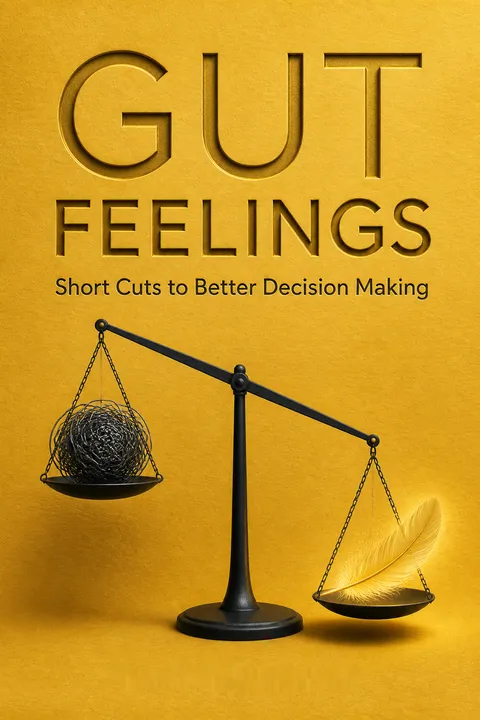
Gut Feelings explores how intuition often outperforms complex analysis in decision-making. Gigerenzer argues that evolved heuristics and unconscious intelligence guide our choices effectively. Readers appreciate the book's insights on human behavior and decision-making processes, though some find it repetitive or overreaching. The book challenges conventional wisdom about rationality and offers practical applications in various fields. While some reviewers found it less engaging than similar works, many valued its scientific approach and thought-provoking ideas about the power of gut instincts in everyday life.
People Also Read








Glossary
gut feeling
Quick, partly unconscious judgmentA judgment that appears rapidly in awareness, whose underlying reasons are not fully known to the person, and that is strong enough to guide action. In Gigerenzer's account, a gut feeling is not necessarily an impulse or a mysterious sixth sense. It can result from a simple rule that draws on learned or evolved capacities and fits a particular environment.
adaptive toolbox
Collection of useful heuristicsGigerenzer's metaphor for the mind's collection of rules of thumb. The tools are built from evolved capacities, such as recognition memory or tracking moving objects, and are used in different environments. The toolbox has no single universally best tool: a heuristic's value depends on whether its assumptions fit the task and surroundings.
evolved capacities
Abilities shaped by genes and learningCapabilities of the brain shaped through natural selection, cultural transmission, individual learning, or combinations of these. Examples include recognizing faces, tracking objects, imitating others, and experiencing emotions. The term does not mean that a capacity is purely genetic. Its development depends on both inherited potential and the environment in which a person learns.
recognition heuristic
Use recognition to infer rankA rule for comparing two alternatives: if one is recognized and the other is not, infer that the recognized alternative has the higher value on the criterion being judged. It can work when recognition is meaningfully correlated with that criterion. It cannot be used when both alternatives, or neither, are recognized, and it can mislead when publicity creates familiarity without quality.
gaze heuristic
Track an object by its angleA rule for intercepting a moving object, such as a high fly ball. The observer keeps looking at the object, moves toward it, and adjusts speed so its angle against the ground remains roughly constant. This avoids calculating its trajectory and instead uses the brain's capacity to track objects and coordinate vision with movement.
less-is-more effect
Less information can improve accuracyA pattern in which someone with less knowledge or information makes more accurate judgments than someone with more. It can occur when partial recognition provides a useful cue, while additional knowledge introduces unreliable details. The effect is conditional, not a claim that less information is always better; it depends on how recognition and knowledge relate to the target.
Take the Best
Decide using the top distinguishing clueA sequential decision heuristic for comparing alternatives. It ranks cues by importance, checks them in order, and stops as soon as one cue distinguishes the options. The decision follows that cue, while lower-ranked information is ignored. Research described in the book finds that it can predict well in uncertain settings, particularly when complex models overfit past data.
fast and frugal tree
Few questions, early decisionsA decision structure that asks a small number of yes-or-no questions in sequence and can reach a decision after each answer. It uses an ordered set of cues and stops once one provides enough information to classify the case. Unlike a full decision tree, it has relatively few paths, making it simpler to understand, teach, and use.
default rule
Follow the preset optionA rule of thumb in which people tend to accept the option already set for them rather than actively change it. The book uses organ donation policies to show how opt-in and opt-out defaults can produce sharply different donor eligibility rates. Because defaults influence behavior, changing them can help, but their use should be transparent and easy to reverse.
split-brain institution
System that hides decision feedbackAn institution that expects people to make consequential judgments but fails to provide systematic feedback about errors and outcomes. Workers may then protect themselves from blame rather than serve the people affected by their decisions. The name compares this gap between action and explanation to split-brain patients who confabulate reasons for behavior they cannot consciously access.
FAQ
What's Gut Feelings: Short Cuts to Better Decision Making about?
- Focus on Intuition: The book explores the role of intuition in decision-making, highlighting how unconscious processes often guide our choices.
- Heuristics and Adaptation: It introduces heuristics, simple rules of thumb that help navigate complex decisions using evolved capacities and environmental cues.
- Unconscious Intelligence: Gigerenzer argues that gut feelings can lead to effective decisions, especially in uncertain environments where analytical methods may fail.
Why should I read Gut Feelings: Short Cuts to Better Decision Making?
- Challenge Conventional Wisdom: The book questions the belief that more information and analysis always lead to better decisions, advocating for intuition.
- Practical Insights: Readers gain insights into effectively harnessing gut feelings in personal and professional life.
- Scientific Backing: Gigerenzer supports his arguments with empirical research, making it informative for those interested in psychology and decision-making.
What are the key takeaways of Gut Feelings: Short Cuts to Better Decision Making?
- Intuition is Valuable: Intuition can be a reliable guide, especially when based on experience and recognition.
- Less is More: The "less-is-more" effect shows that less information can sometimes lead to better decision-making outcomes.
- Recognition Heuristic: Recognizing one option over another often indicates a better choice, especially with partial knowledge.
What is the recognition heuristic in Gut Feelings: Short Cuts to Better Decision Making?
- Definition: It's a mental shortcut suggesting that if you recognize one option but not another, the recognized option likely has higher value.
- Application: Useful in situations with partial knowledge, allowing informed decisions without exhaustive analysis.
- Empirical Evidence: Examples like predicting sports outcomes show that recognition validity often correlates with success.
How does Gerd Gigerenzer define gut feelings in Gut Feelings: Short Cuts to Better Decision Making?
- Quick Judgments: Gut feelings are judgments appearing quickly in consciousness, often without full awareness of reasons.
- Strong Enough to Act: These feelings prompt action, even if the individual can't articulate why.
- Intuitive Decision-Making: Gigerenzer argues they lead to effective decision-making, especially in complex or uncertain situations.
What is the "less-is-more" effect discussed in Gut Feelings: Short Cuts to Better Decision Making?
- Concept Overview: It refers to the phenomenon where less information can lead to better decision-making outcomes.
- Examples in Decision-Making: Studies show individuals often perform better with simple heuristics than exhaustive analysis.
- Implications for Choices: In uncertain situations, simpler strategies can be more effective.
How does Gut Feelings: Short Cuts to Better Decision Making relate to decision-making in healthcare?
- Healthcare Decisions: Intuition and heuristics can be applied to healthcare, where complex choices are common.
- Less Information Can Help: Too much information can overwhelm patients, while simple heuristics guide better choices.
- Practical Applications: Insights into improving patient outcomes by simplifying choices and focusing on key information.
What is the "Take the Best" heuristic in Gut Feelings: Short Cuts to Better Decision Making?
- Definition of the Heuristic: A strategy where individuals rely on the most important cue to make a choice, stopping the search for information once a clear decision is possible.
- Application in Sports: Proven effective in predicting NBA game outcomes, as accurate as more complex methods.
- Efficiency and Speed: Allows quicker decisions with less information, useful in fast-paced environments.
How does Gerd Gigerenzer define "fast and frugal heuristics" in Gut Feelings: Short Cuts to Better Decision Making?
- Definition: Simple decision-making rules for quick, effective choices with minimal information, suited for uncertain environments.
- Examples of Heuristics: Includes methods like "Take the Best," relying on the most important cue.
- Effectiveness in Real Life: Often lead to better outcomes than complex analytical methods.
What role does social environment play in decision-making according to Gut Feelings: Short Cuts to Better Decision Making?
- Influence of Social Norms: Social norms and peer pressure shape decision-making processes.
- Community Instinct: Emphasizes community instincts in guiding behavior and decisions.
- Trust and Reciprocity: Trust in social interactions significantly impacts decision-making.
How does Gut Feelings: Short Cuts to Better Decision Making address the concept of overdiagnosis in healthcare?
- Critique of Screening Practices: Critiques widespread screening tests leading to overdiagnosis and unnecessary treatments.
- Patient Autonomy: Advocates for patient involvement in healthcare decisions, emphasizing informed consent.
- Real-World Implications: Provides examples of overdiagnosis leading to harm, advocating for cautious medical testing.
What is the significance of the "default rule" in Gut Feelings: Short Cuts to Better Decision Making?
- Definition of the Default Rule: Tendency to stick with pre-set options rather than actively making choices.
- Impact on Organ Donation: Illustrates how default settings influence behaviors, like organ donation rates.
- Behavioral Economics Insight: Shows how small policy changes can lead to substantial differences in outcomes.
About the Author

Download PDF
Download EPUB
.epub digital book format is ideal for reading ebooks on phones, tablets, and e-readers.








