

Key Takeaways
Turn your first blame reflex into a question about your next move
A tool for redirection. The Question Behind the Question, or QBQ, is a way to practice personal accountability by replacing a first, unhelpful reaction with a question that points toward useful action. The author calls blame-focused, waiting-focused, or victim-minded questions Incorrect Questions, or IQs. A QBQ follows three tests: it begins with what or how, refers to the person asking, and focuses on action.
A server shows the idea. At a busy restaurant, Jacob noticed a customer outside his section needed help. The restaurant did not sell the customer’s preferred drink, so Jacob arranged to get one from a nearby store, with help from his manager. Instead of treating the gap as someone else’s problem, he found a way to serve. The book’s central claim is that the question a person chooses can redirect what happens next.
The framework works like a brief attention reset: instead of scanning for fault, the person scans for a controllable next step. That resembles cognitive reappraisal, the practice of changing how a situation is interpreted before choosing a response. The strength is its portability: a short question can be used during a tense customer interaction or an ordinary family frustration. Its limit is equally important: individual initiative cannot repair every broken policy or under-resourced team. Personal agency is most useful when paired with a willingness to raise systemic problems.
Treat agency as a choice, not a claim that hardship is imaginary
Notice the response. The book argues that external events do not dictate every reaction. A person may answer a setback with anger, silence, worry, or a search for a next step. Asking why a problem is happening to me can reinforce helplessness, while asking what can be done redirects attention toward available choices.
A provocative claim. Miller calls stress a choice because people respond differently to the same circumstances. A conference attendee challenged that idea, then wrote a month later that she had found her own reactions were contributing to her tension. The lesson is not that difficult events are harmless or chosen. It is that some part of the response may remain open to influence, even when the event itself is not.
This idea connects to perceived control, a well-established psychological distinction between what a person can influence and what lies beyond reach. The distinction can protect attention from being consumed by imagined control over other people. Still, saying stress is a choice can overstate voluntary control: grief, trauma, illness, and unsafe conditions can produce reactions that are not switched off by better wording. The more durable interpretation is narrower and kinder. A person may not choose the first feeling, but can sometimes choose what action follows.
Act while the problem is small; waiting quietly makes it expensive
Delay compounds risk. Miller’s family left a large sheet of glass propped near their driveway after giving away a desk. He repeatedly intended to put it somewhere safe, but postponed the task. Later, when his young son went to retrieve garden clippers, the child ran into the glass as it fell and shattered. He escaped without injury, but the incident could have ended much worse.
A small task became urgent. The point is not that every postponed chore turns dangerous. It is that delay can enlarge consequences, increase stress, and narrow options. The book treats questions about when someone else will fix a problem as invitations to wait. A more accountable question identifies an action that can be taken now, before a manageable nuisance becomes a crisis.
The story captures a familiar feature of procrastination: its cost is often invisible while the task remains undone. Behavioral economics calls this present bias, the tendency to favor immediate ease over future benefit. A useful countermeasure is to make the next action concrete and small, rather than waiting for motivation or a perfect block of time. The book’s emphasis on action is persuasive, though speed is not always wisdom. Some decisions need consultation, and urgent action without checking safety can create a second problem.
Stop waiting for perfect tools and practice the fundamentals you already have
Work with what exists. The author calls creativity the ability to succeed within current limits, rather than waiting for an ideal budget, system, team, or set of tools. Organizations always have imperfections; treating each one as a reason to postpone work drains energy from the work itself. A State Farm employee described a pattern: doing the job well with available tools often helped make the case for receiving better ones.
Return to the basics. Miller also warns against cycling through fashionable programs while neglecting fundamentals. He uses sales as an example: prospecting, explaining a product clearly, and following up matter more than searching endlessly for a new technique. The relevant question is how to apply useful knowledge now, even if it has been heard before.
This is a practical argument for resourcefulness, and it echoes the engineering idea of designing within constraints. Limits can force prioritization and expose which steps actually create value. Yet the message should not become a defense of chronic underinvestment. If inadequate equipment or staffing creates safety risks or prevents sound work, naming the constraint is part of accountability. The productive balance is to act within present capacity while making a specific, evidence-based case for what the organization must change.
Replace culprit-hunting with shared problem-solving and personal ownership
Find the fix, not a scapegoat. Miller describes a small transportation company where the receptionist blamed dispatch, dispatch blamed drivers, and blame kept circulating. This Circle of Blame made responsibility everyone’s topic and no one’s task. In another story, repeated repairs failed to stop static on the author’s phone line. The third repair worker did not criticize colleagues; he apologized for the experience and took responsibility for trying to solve it.
Ownership means facing the issue. In the book, it is a commitment to address a problem rather than blame, complain, or make excuses. This does not mean ignoring how a failure happened. A useful review asks what conditions, communication, training, or processes contributed, then identifies what each person can improve. Teams work better when departments see a shared outcome rather than separate camps.
The distinction between blame and causal analysis is crucial. Blame seeks a person to punish; systems thinking examines how decisions, incentives, information, and procedures combined to produce an outcome. That broader view can improve learning and reduce repeated errors. At the same time, shared ownership should not erase individual responsibility when someone knowingly causes harm. A strong team culture makes it possible to discuss both: the person’s choices and the conditions that shaped them, without turning the conversation into a search for a convenient villain.
Change your contribution before trying to redesign another person
Accountability starts personally. The book argues that groups do not make choices by themselves; individuals do. A manager may coach, explain expectations, or address poor performance, but cannot make another person choose to change. Miller tells of a supervisor who once struggled to work with a colleague. When they later worked together again, the relationship improved. She realized the colleague had not changed; she had stopped trying to remake him.
Align words and conduct. The same principle applies to integrity. If someone praises an organization at work but condemns it at home, the mismatch deserves honest attention. The author suggests assessing whether the organization still fits one’s goals, challenging what needs to change, and considering a different workplace if the fit cannot be restored. Accountability means examining one’s own behavior, not demanding perfection from others.
This principle draws a useful boundary between influence and control. A person can set expectations, offer feedback, and create conditions that make better performance more likely, but cannot author another person’s motivation. That distinction reduces futile efforts to manage someone’s inner life. There is a risk, however, of turning self-examination into self-blame or avoiding necessary confrontation. Changing one’s contribution does not mean tolerating misconduct. It means addressing the conduct directly while owning the choices that remain one’s own.
Take initiative without confusing accountability with doing everyone's job
Inaction carries risk. After a company merger, a manager realized that a problem with headquarters was obstructing field work. Rather than continue complaining, he booked travel to meet colleagues and work through the issue. The example illustrates the book’s claim that action can teach and move a problem forward, while waiting can leave the same barrier in place.
Keep clear boundaries. Personal accountability is not a mandate to rescue coworkers or absorb their responsibilities. A manager who repeatedly finishes an employee’s work may prevent that employee from learning, while exhausting the manager. The better question is how to contribute effectively within one’s role, offer appropriate help, or set a clear limit. Initiative means choosing a constructive action, not taking responsibility for every unfinished task nearby.
The combination of initiative and boundaries is stronger than either idea alone. In organizational psychology, role clarity helps people coordinate without duplicating effort or quietly shifting labor onto the most conscientious employee. The book’s call to act counters learned passivity, while its boundary warning guards against overfunctioning. The difficult judgment is deciding when a problem calls for direct help, escalation, or refusal. Accountability does not settle that decision automatically; it asks the person to make it deliberately and communicate the reasoning.
Lead from any role by serving others and modeling the standard
Leadership is behavior, not rank. The book treats leadership as the choice to contribute positively, whether someone is a cashier, parent, manager, or executive. Jacob’s manager illustrated this by helping him serve a customer rather than using her authority to shut down his initiative. Her response made it easier for an employee to do good work.
Service can change outcomes. Judy, a new cashier, used her own small amount of cash to help a hurried customer avoid a delay. The customer’s family later chose to bring more business to the store, and his tip was shared with coworkers. Miller does not suggest employees should routinely pay customers’ bills. The story shows how thoughtful service can create trust, while a leader’s example makes such care more possible.
The examples connect leadership to service design: frontline workers often encounter the moment when a company’s promise becomes real to a customer. Supportive managers can enable judgment instead of forcing every small decision up a chain of command. Modeling also teaches norms more vividly than slogans do. But discretion needs guardrails. Employees should not have to spend personal money or take unreasonable risks to compensate for organizational failures. Service-oriented leadership equips people to help while protecting them from carrying the institution alone.
Count learning by changed behavior, not by books, seminars, or notes
Knowledge is only the start. Miller challenges the habit of collecting books, courses, and seminars while leaving daily behavior untouched. In his account, learning means translating what someone knows into what that person actually does. A person who understands the value of accountability but continues to blame, delay, and complain has gathered information without yet changing practice.
Make practice ongoing. The QBQ is presented as a repeated discipline, not a permanent state a person reaches once. When frustration appears, the person notices the old reflex, forms a more accountable question, and follows it with action. Repetition matters because the same pressures return: rushed work, poor communication, imperfect systems, and conflict. The test is not whether the principle sounds familiar, but whether it changes a decision in the moment.
This view aligns with the gap between declarative knowledge, knowing a principle, and procedural knowledge, being able to use it under pressure. Rehearsal can make a response more available when attention is strained, which is why a repeatable prompt may help. Still, behavior change is not the only measure of learning: better understanding can precede action, and structural barriers can block it. A fair test asks both what changed and what conditions would make the change sustainable.
Analysis
QBQ! is a compact workplace and personal-development book built around one repeatable move: redirect attention from what others should do toward what the questioner can do next. Its strength is practical compression. The three-part test for a QBQ gives readers a memorable filter, and the stories translate an abstract value into recognizable moments: a customer left waiting, a task postponed, or a team member tempted to blame another department. The approach also avoids the common trap of treating accountability as a management tool imposed from above. Its unit of change is the individual making a choice.
That focus has a genuine advantage. People often spend energy trying to control colleagues, policies, or market conditions, even when their own next action is more available. Questions can redirect attention without requiring a long motivational speech. The framework can also support trust: workers who address problems instead of deflecting them are easier to collaborate with, and managers who model service make initiative safer.
The book is most persuasive when personal accountability means owning one’s contribution while remaining curious about causes. It is less persuasive when agency sounds like total control over stress or outcomes. Workers may have little authority, inadequate resources, or legitimate reasons to challenge leadership. Framing distress as a choice risks making people feel responsible for conditions they did not create. Likewise, the rejection of blame must not become a refusal to identify negligence or correct broken systems. The strongest reading therefore combines the QBQ with organizational learning. Ask what can be done personally, then ask what the system must change so the same problem is less likely to recur. That sequence preserves agency without making the individual a substitute for leadership, staffing, fair procedures, or accountability from others. The book offers a useful first move, not a complete theory of organizational responsibility: take action where possible, speak clearly where necessary, and distinguish ownership from carrying burdens that belong elsewhere.
Review Summary
QBQ! The Question Behind the Question receives mixed reviews. Some readers find it a valuable guide to personal accountability and improving workplace dynamics, praising its simple yet effective message. Others criticize it as overly simplistic, repetitive, and lacking nuance. The book's core concept of reframing questions to focus on personal responsibility resonates with many, but some feel it oversimplifies complex issues and ignores systemic problems. Critics also note the book's self-promotional tone and lack of empirical evidence to support its claims.
People Also Read










Glossary
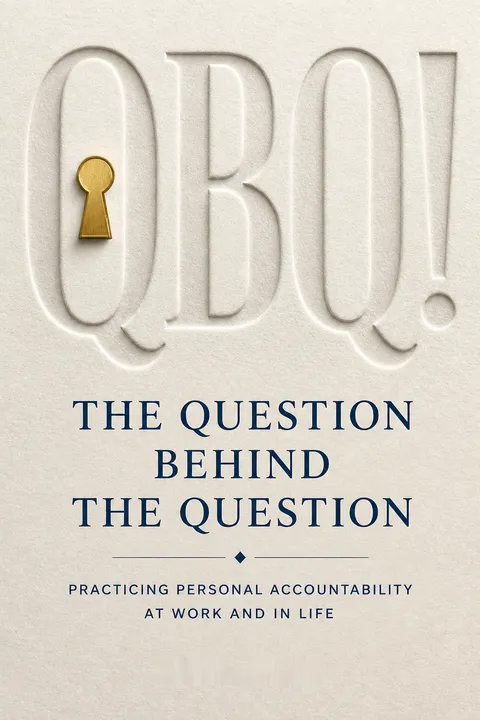
QBQ!
Accountability question toolThe Question Behind the Question is a self-questioning tool for practicing personal accountability. It redirects attention from blame, delay, or victim thinking toward a useful action. A QBQ begins with what or how, includes the person asking rather than shifting responsibility to others, and focuses on action. The tool is intended primarily for questions asked internally.
Incorrect Questions
Blame or delay questionsIncorrect Questions, abbreviated IQs, are questions that encourage blame, victim thinking, complaining, or procrastination rather than productive action. They often focus on why a problem is happening, when someone else will fix it, or who is at fault. The author treats them as warning signs, not as forbidden words: context and intent determine whether a question is unhelpful.
The Ultimate QBQ
A question about controlThe Ultimate QBQ is the author’s prompt for releasing attention from circumstances a person cannot control. It asks how the person can let go of what is outside their influence. The question complements the book’s focus on action by recognizing that personal accountability sometimes means accepting limits rather than spending energy on an unchangeable person or condition.
Ownership
Personal commitment to fixOwnership is the personal commitment to face a problem and contribute to its solution without defaulting to blame, complaint, delay, or excuses. It does not depend on a formal title or financial stake in an organization. In the book, ownership means bringing one’s attention and effort to resolving the issue, while recognizing that doing so does not require taking over another person’s responsibilities.
FAQ
What's "QBQ! The Question Behind the Question" about?
- Focus on Personal Accountability: The book emphasizes the importance of personal accountability in both work and life, encouraging individuals to take responsibility for their actions and decisions.
- Asking Better Questions: It introduces the concept of the Question Behind the Question (QBQ), which involves asking better, more accountable questions to improve outcomes.
- Practical Guidance: Through real-life examples and stories, the book provides practical guidance on how to implement QBQ thinking in everyday situations.
- Cultural Impact: The book aims to create a culture of accountability within organizations and personal lives, leading to improved productivity and satisfaction.
Why should I read "QBQ! The Question Behind the Question"?
- Improve Accountability: Reading the book can help you develop a mindset of personal accountability, which is crucial for personal and professional growth.
- Enhance Problem-Solving Skills: By learning to ask better questions, you can enhance your problem-solving skills and make more effective decisions.
- Reduce Stress: The book offers strategies to reduce stress by focusing on what you can control and taking proactive steps.
- Positive Change: It provides tools for creating positive change in your life and work environment by shifting your perspective and actions.
What are the key takeaways of "QBQ! The Question Behind the Question"?
- Personal Accountability: The core message is that personal accountability is essential for success and satisfaction in life and work.
- The Power of Questions: Asking the right questions can lead to better solutions and outcomes, while the wrong questions can lead to blame and inaction.
- Action-Oriented Thinking: The book encourages focusing on actions you can take rather than waiting for others to change or solve problems.
- Continuous Improvement: It emphasizes the importance of continuous self-improvement and learning through personal accountability.
What is the QBQ method introduced by John G. Miller?
- Question Behind the Question: The QBQ method involves looking beyond initial, often negative, questions to find more constructive and accountable ones.
- Three Guidelines: QBQs should begin with "What" or "How," contain an "I," and focus on action to ensure they lead to personal accountability.
- Avoiding Victim Thinking: The method helps individuals avoid victim thinking and instead take responsibility for their actions and outcomes.
- Practical Application: The QBQ method is designed to be applied in real-life situations to improve decision-making and problem-solving.
How can "QBQ! The Question Behind the Question" improve my work life?
- Enhanced Teamwork: By fostering personal accountability, the book can improve teamwork and collaboration within your organization.
- Better Communication: It encourages asking questions that lead to understanding and effective communication, reducing misunderstandings and conflicts.
- Increased Productivity: By focusing on what you can do and taking action, you can increase your productivity and effectiveness at work.
- Leadership Development: The principles in the book can help you develop leadership skills by modeling accountability and inspiring others.
What are some examples of QBQs versus Incorrect Questions (IQs)?
- IQs to Avoid: Questions like "Why is this happening to me?" or "Who is to blame?" focus on blame and victimhood.
- Effective QBQs: Instead, ask "What can I do to improve the situation?" or "How can I contribute to a solution?"
- Focus on Action: QBQs are designed to lead to action and personal responsibility, rather than deflecting responsibility onto others.
- Positive Outcomes: By asking QBQs, you can achieve more positive outcomes and foster a culture of accountability.
What are the best quotes from "QBQ! The Question Behind the Question" and what do they mean?
- "Stress is a choice." This quote emphasizes that stress often results from how we choose to respond to situations, not the situations themselves.
- "Ownership is personal accountability in its purest form." It highlights the importance of taking full responsibility for one's actions and their consequences.
- "The answers are in the questions." This means that by asking the right questions, we can find the solutions we need.
- "I can only change me." This underscores the idea that personal change is the only change we can control, and it starts with ourselves.
How does "QBQ! The Question Behind the Question" address the issue of blame?
- Blame as a Barrier: The book identifies blame as a major barrier to personal and organizational success, as it prevents problem-solving and accountability.
- Circle of Blame: It describes the "Circle of Blame," where individuals and teams pass responsibility onto others, hindering progress.
- Breaking the Cycle: By using QBQs, individuals can break the cycle of blame and focus on what they can do to contribute positively.
- Encouraging Ownership: The book encourages taking ownership of problems and solutions, rather than looking for scapegoats.
What role does leadership play in "QBQ! The Question Behind the Question"?
- Leadership at All Levels: The book asserts that leadership is not about titles or positions but about the mindset of personal accountability.
- Servant Leadership: It promotes the idea of servant leadership, where leaders support their teams by modeling accountability and facilitating success.
- Humility and Service: Effective leaders demonstrate humility and a willingness to serve others, which fosters a culture of accountability.
- Empowering Others: By practicing personal accountability, leaders can empower others to take responsibility and contribute to the organization's success.
How can "QBQ! The Question Behind the Question" be applied in personal life?
- Improving Relationships: The principles of QBQ can improve personal relationships by encouraging accountability and proactive communication.
- Parenting and Family: It offers insights into how parents can model accountability for their children, fostering a responsible family environment.
- Personal Growth: By focusing on what you can control and taking action, you can achieve personal growth and fulfillment.
- Life Satisfaction: Practicing personal accountability leads to greater life satisfaction by reducing stress and increasing a sense of control.
What are the risks of not practicing personal accountability as described in "QBQ! The Question Behind the Question"?
- Increased Stress: Without accountability, individuals may experience increased stress due to a lack of control over their circumstances.
- Stagnation and Inaction: Failing to take responsibility can lead to stagnation and inaction, preventing personal and professional growth.
- Blame Culture: A lack of accountability fosters a blame culture, which can damage relationships and hinder organizational success.
- Missed Opportunities: By not practicing accountability, individuals may miss opportunities for improvement and positive change.
How does "QBQ! The Question Behind the Question" suggest handling change and challenges?
- Adaptability: The book encourages asking questions like "How can I adapt to the changing world?" to foster adaptability and resilience.
- Proactive Problem-Solving: It emphasizes the importance of proactive problem-solving and taking action in the face of challenges.
- Embracing Change: By viewing change as an opportunity rather than a threat, individuals can navigate challenges more effectively.
- Continuous Learning: The book advocates for continuous learning and improvement as a way to handle change and overcome obstacles.
Download PDF
Download EPUB
.epub digital book format is ideal for reading ebooks on phones, tablets, and e-readers.








