

Key Takeaways
Treat quitting as the other half of grit, not its opposite.
The unseen decision. Muhammad Ali’s persistence carried him back to the heavyweight title, but he kept fighting for years after doctors and friends saw serious warning signs. The same determination that powered his rise also prolonged his exposure to harm. Grit can serve a goal, but it cannot tell you whether the goal is still worth serving.
The 1996 Everest disaster makes the contrast stark. Three climbers turned back before their expedition’s 1 p.m. cutoff and returned safely. Guide Rob Hall continued upward despite the rule he had set, then died on the descent with client Doug Hansen. The summit was not the real objective; getting back alive was. A sound decision to stop is easy to overlook because it often produces no dramatic story.
The Everest account exposes a selection effect in how achievement is remembered: dramatic persistence attracts attention, while successful restraint often leaves no spectacle. That imbalance can distort what people learn from role models. In safety-critical fields, from aviation to medicine, protocols and stopping rules help counter the charisma of heroic improvisation. Such rules are not guarantees, as Hall’s decision shows, but they make prudent withdrawal legible and discussable. The broader point is not that persistence is suspect. It is that persistence without a continuing reason becomes mere momentum.
Judge the next step by future value, not past investment.
Forecast beyond appearances. Expected value is the average value of possible outcomes, weighted by how likely each one is. It helps compare continuing with switching, using the benefits and costs still ahead rather than the effort already spent.
Stewart Butterfield used this logic to close the online game Glitch. The game had a loyal core of about 5,000 users, and a marketing push brought in 10,000 new accounts over one weekend. But more than 95% of trial users had played for less than seven minutes and never returned. Butterfield judged that growth and conversion would not support the business, even with $6 million left. The team redirected its work toward an internal communications tool, Slack. The lesson does not depend on Slack’s success: stopping Glitch preserved resources when its future prospects no longer justified continuing.
Expected value disciplines attention by shifting the question from whether a project looks promising today to whether its next investment is worthwhile. That resembles Bayesian updating, where new evidence should change a forecast instead of being bent to protect an old one. The method is only as reliable as its assumptions, however. In a new market, probabilities are difficult to estimate, and a spreadsheet can disguise guesswork as precision. Scenario ranges, explicit assumptions, and outside scrutiny make forecasts more useful than a single confident number.
Evaluate the next bet, not whether you are ahead or behind.
Results distort judgment. Prospect theory describes how people evaluate gains and losses relative to a reference point. In the book’s examples, people often lock in a paper gain to avoid losing it, but gamble to escape a paper loss. That instinct can make them sell a promising investment too soon and cling to a failing one.
A study of New York cab drivers found another version of miscalibration: drivers often stopped early on high-demand days after reaching an earnings target, then kept working through low-demand days trying to reach it. The author reports that allocating the same work hours according to demand could have raised earnings by 15%. The useful question is not whether the day feels successful or disappointing. It is whether the next hour, trade, or project still offers better prospects than the alternatives.
Reference points are psychologically powerful because people experience outcomes as changes, not just as final totals. This helps explain why a small paper loss can feel like an emergency even when the investment remains sound, or why a modest win can trigger premature relief. The cab-driver finding also shows that a simple target can overpower changing conditions. These patterns are not proof that people should always continue when ahead or stop when behind. They show why the current choice deserves a fresh forecast.
Treat every sunk dollar as gone, then assess the next dollar.
Past costs cannot be recovered. The sunk cost effect is the tendency to let already-spent money, time, or effort influence whether to spend more. A ticket bought for a rainy outdoor concert does not make standing in cold rain more enjoyable. If the same event would be a bad choice with a free ticket, its purchase price should not decide whether to go.
The bias can intensify as losses accumulate. In Barry Staw’s experiment, participants who had funded a division and then saw it perform badly later allocated it about $13 million of a new $20 million budget. Participants given the same information without personal responsibility for the first choice allocated about $9 million. The original decision became something to defend. Each extra investment made it emotionally harder to stop, even as the evidence worsened.
The distinction between sunk costs and future costs matters. Money already spent is unrecoverable, but switching may carry real expenses, obligations, or risks that still belong in the calculation. The error is not caring about costs; it is treating an irretrievable past expense as a reason to incur another one. Staw’s comparison also points to governance: people who did not make the initial decision can sometimes assess its continuation with less pressure to justify themselves.
Test the hardest uncertainty before polishing what is already easy.
Find the real bottleneck. At Google’s innovation lab X, Astro Teller used the image of a monkey that must learn a difficult trick and a pedestal that is easy to build. The metaphor separates the uncertain obstacle from the supporting work that feels productive but does not prove the idea can succeed. The team’s shorthand was to tackle the difficult uncertainty first.
Project Foghorn aimed to turn seawater into fuel. The team had evidence that the basic science could work, but the key challenge was producing fuel cheaply enough to compete. When early analysis suggested that commercial target was unlikely within a reasonable period, X shut the project down. By contrast, building familiar infrastructure before resolving a project’s central engineering obstacle can create activity without learning. The practical test is whether today’s work reduces the uncertainty that could invalidate the whole plan.
This approach resembles experimental design: a useful test is one that can meaningfully distinguish success from failure, not merely demonstrate that the team can complete familiar tasks. It also limits the psychological ownership that grows around polished plans and visible output. A caution is necessary: hard problems can be difficult because the test itself is poorly designed, not because the idea is impossible. The strongest early experiment is therefore informative and proportionate, not simply a demand to solve the entire challenge at once.
Set measurable exit conditions before sunk costs and pride accumulate.
Decide while clearheaded. Kill criteria are advance-set signals that trigger reconsideration or termination of a project. They can be made concrete with a state and a date: if a specified condition has not been reached by a specified time, stop or reassess. Everest’s turnaround time served this role, although following a rule still requires enforcing it under pressure.
A premortem can help identify useful criteria. It asks a team to imagine that a project has failed and work backward to identify warning signs it may have missed. A sales team, for example, might treat the absence of a decision-maker from early meetings as a signal to request executive involvement. If the prospect will not engage, the team can stop pursuing the lead. Such rules do not guarantee perfect decisions. They make it less likely that present excitement will erase earlier judgment.
Precommitment works by moving part of a difficult choice to a moment when identity, sunk costs, and urgency have less influence. In organizational psychology, the method also clarifies accountability: a team can be evaluated for recognizing evidence, not only for reaching a target. Criteria need periodic review, since rigid thresholds can become outdated when conditions change. Their value lies in making reconsideration routine, rather than treating every stop signal as a personal crisis.
Stop treating a changed mind as proof you were foolish.
Identity can trap decisions. When people connect a project or belief to who they are, contrary evidence can feel like an attack on the self. Cognitive dissonance is the discomfort produced by a conflict between beliefs, actions, or new information. People may reduce that discomfort by dismissing the evidence rather than revising their position.
Sears became identified with retail, even as its retail business struggled and its financial services businesses grew. It sold valuable assets, including Allstate and Dean Witter, to refocus on its familiar identity, yet the retail business still failed. Philips, also known for lighting, took the opposite course and shifted toward health technology. These cases show that a company’s historic label need not dictate its next move. A changed judgment can reflect learning, not weakness.
Identity provides continuity and purpose, but it can also turn ordinary updating into a threat to self-respect. A useful distinction is between commitment to a value and commitment to one particular vehicle for expressing it. A person can care about helping patients without remaining in a job that is damaging their health; a company can preserve its capacity to serve customers while leaving a once-famous product line. That distinction creates room to adapt without pretending the past never mattered.
Give a trusted outsider permission to challenge your staying story.
Borrow a clearer view. A quitting coach is someone who has your long-term interests at heart and can assess a decision without carrying the same personal history. Ron Conway, an investor who works with start-up founders, does not usually argue when a founder insists a struggling company can recover. Instead, he asks what measurable signs of success should appear over the next few months and agrees to revisit the decision if they do not.
The method respects the founder’s agency while creating a concrete checkpoint. Permission matters: people may offer reassurance when they do not know that honest criticism is welcome. The role can also be built into organizations by separating the people who approve a project from those who review whether it should continue. An outside perspective cannot remove uncertainty, but it can expose stories that insiders have stopped questioning.
This practice combines social support with a form of independent review. It is stronger than blunt advice because it preserves dignity, elicits the decision-maker’s own standards, and creates a future moment for accountability. Yet an outsider can also be wrong or lack relevant context. Good coaching therefore means asking sharper questions and testing assumptions, not assuming distance automatically confers wisdom. Explicit permission and agreed benchmarks help make candor useful rather than merely harsh.
Keep exploring while your current path still looks successful.
Maintain alternatives. Ant colonies send most foragers toward a productive food source, while some continue searching elsewhere. Those explorers may find a backup if the food disappears, or discover a better source. The same logic applies to careers, interests, and business ideas: continuing to learn about alternatives can reduce the fear of leaving a familiar path.
A London Underground strike forced many commuters to try new routes. About 5% kept a route they discovered during the disruption, saving more than six minutes per journey on average. The better route had been available before the strike, but routine kept it out of view. Maya Shankar’s forced departure from violin led her toward cognitive science, while Stewart Butterfield’s abandoned game effort made room for Slack. Exploration is not a promise of a better outcome. It expands the options available when circumstances or preferences change.
The ant example makes exploration a form of resilience rather than a lack of commitment. In portfolio thinking, several skills and relationships can reduce dependence on one fragile opportunity. Exploration also has costs, including divided attention, so it need not mean constantly abandoning a stable path. Small, deliberate experiments can preserve focus while revealing alternatives. The key is to keep the search from falling to zero simply because the current option is working today.
Keep score after quitting, or you will never learn to exit well.
Exits need feedback. Decisions to continue are easy to track because their outcomes unfold in front of you. The alternative path you abandoned is harder to evaluate, and once an investment or project leaves view, people often stop monitoring it. That makes it difficult to learn whether a decision to quit was well timed.
A study of institutional portfolio managers found that their stock purchases outperformed a market benchmark, but their selling choices performed worse than randomly selecting which holding to sell. The book notes that the managers often sold extreme winners or losers rather than comparing all holdings by future prospects. A practical remedy is a shadow record: track what was sold and compare its later performance with plausible alternatives. The same habit can be adapted to careers or projects by recording the evidence and reasoning behind an exit.
A decision journal turns quitting from a verdict on character into a hypothesis that can be reviewed. Its value is not to punish every mistaken forecast, since uncertainty guarantees some bad outcomes even after sound reasoning. The useful distinction is between decision quality and result quality. Tracking exits alongside the reasons for them helps reveal whether a person systematically leaves promising paths too soon, waits too long, or simply encounters ordinary bad luck.
Analysis
Quit is most useful when read not as a campaign for abandoning commitments, but as a corrective to a culture that treats persistence as proof of virtue. Its strongest move is to connect the emotional difficulty of stopping with the technical difficulty of deciding under uncertainty. New information arrives after commitment, but sunk costs, identity, goals, and public expectations make that information unusually easy to discount. The book’s case studies make this mechanism concrete across mountaineering, business, investing, careers, and ordinary routines.
The most practical contribution is procedural. People are not asked to become perfectly detached judges of their own lives. They are asked to make early tests, define exit conditions, consult someone outside the decision, and preserve alternative opportunities. These tools shift quitting from an improvised act of defeat into a planned response to evidence. They also make the quality of a decision less dependent on willpower at the moment when willpower is most compromised.
Expected value is a powerful organizing idea, but it should not be mistaken for a precise calculator. Probabilities may be unknowable, personal values are difficult to compare, and a switch can carry substantial costs that remain in the future. In addition, evidence that people often persist too long does not establish that they should generally quit sooner. Some valuable achievements require tolerating long periods of weak feedback. The central task is calibration, not a new slogan favoring exit over endurance.
The book’s deeper institutional implication is that organizations should reward good stopping decisions as visibly as successful launches. When a team is judged only by completion, members have incentives to conceal bad news and keep building familiar components. Benchmarks, independent review, and learning records can make revision safer and more rational. A mature commitment is not an oath to continue regardless of evidence. It is a willingness to keep updating what the commitment is for, and which route still serves it.
Review Summary
Quit receives mostly positive reviews for its thought-provoking insights on when and why to quit. Readers appreciate Duke's fresh perspective on perseverance, challenging the notion that quitting is always negative. The book offers practical advice on decision-making, using examples from various fields. Some find it repetitive, but many consider it life-changing. Readers value the book's emphasis on reassessing goals, understanding cognitive biases, and making better choices. Overall, it's praised for its unique take on a often-overlooked aspect of success.
People Also Read










Glossary
Expected value
Probability-weighted outcomeExpected value is the average result of a choice across its possible outcomes, with each outcome weighted by its probability. It helps assess whether continuing is worthwhile and compare it with alternatives. The measure can include money, time, health, fulfillment, or other valued consequences, though its accuracy depends on the quality of the estimates.
Prospect theory
Model of gain and loss choicesProspect theory describes how people make choices involving risk by evaluating outcomes relative to a reference point, such as a current gain or loss. The book uses its account of loss aversion to explain why people may protect gains too quickly yet take excessive risks to avoid realizing losses.
Escalation of commitment
Doubling down after bad newsEscalation of commitment is the tendency to increase investment in a chosen course of action after receiving negative evidence that it is failing. People may add money, time, or effort to defend an earlier decision, even when someone without that history would be more willing to stop.
Sunk cost effect
Past spending distorts future choicesThe sunk cost effect occurs when money, time, effort, or other resources already spent influence a decision about whether to continue. Because those resources cannot be recovered by continuing, a sound choice should focus on future costs and benefits. The effect often makes people persist in endeavors whose prospects have deteriorated.
Mental accounting
Separate psychological ledgersMental accounting is the tendency to treat related resources or outcomes as separate psychological accounts rather than evaluating them together. In quitting decisions, an activity or investment can feel like an account that should not be closed at a loss. This framing can outweigh the broader question of where future resources would be most valuable.
Endowment effect
Ownership inflates perceived valueThe endowment effect is the tendency to value something more highly because it is owned. The book extends this idea beyond physical objects: people can feel ownership of ideas, beliefs, projects, and decisions. That attachment can make selling, changing course, or abandoning a self-created venture feel more costly than an outside assessment would suggest.
Status quo bias
Preference for the existing pathStatus quo bias is a preference for existing arrangements, decisions, or routines over alternatives, even when a change may offer greater value. The familiar path carries less uncertainty and can seem like inaction rather than a choice. In fact, choosing not to change is still an active decision about what to continue.
Cognitive dissonance
Discomfort from conflicting beliefsCognitive dissonance is psychological discomfort that arises when new information conflicts with existing beliefs, past actions, or a person’s self-image. One way to reduce the discomfort is to revise a belief or course of action. Another is to dismiss or reinterpret the new evidence, which can strengthen commitment to a failing choice.
Kill criteria
Pre-set signals to stopKill criteria are conditions identified in advance that signal when a project, strategy, or commitment should be stopped or reconsidered. They can specify measurable performance, evidence, or changes in circumstances. Setting them before a decision becomes emotionally loaded reduces reliance on improvised judgment when sunk costs and identity are already involved.
Monkeys and pedestals
Test the hardest uncertainty firstMonkeys and pedestals is Astro Teller’s mental model for separating a project’s hardest unresolved challenge from its easier supporting work. The monkey represents the critical uncertainty that could make the whole effort unworkable; the pedestal represents familiar tasks that can be completed without answering that question. Testing the bottleneck first can prevent false progress and wasted investment.
Premortem
Imagine failure, identify warning signsA premortem is a planning exercise in which a team imagines that a project has failed and then works backward to identify likely causes and overlooked signals. Those signals can inform benchmarks or exit conditions before the project is underway. The method is designed to surface risks that optimism or group agreement might otherwise leave unexamined.
Explore-exploit problem
Balance discovery with useThe explore-exploit problem concerns how to divide limited resources between searching for new opportunities and using opportunities already known to be valuable. Too much exploration can waste effort, while too little can leave a person or organization dependent on an option that may fail or be surpassed. The book uses ant foraging to illustrate the value of keeping some search active.
Quitting coach
Trusted outside decision partnerA quitting coach is a trusted person who can view a commitment with less personal attachment and help its owner assess whether continuing still makes sense. The coach can ask for concrete measures of future success, agree on a time to review them, and speak candidly with permission. The aim is to support sound judgment, not simply to tell someone to quit.
FAQ
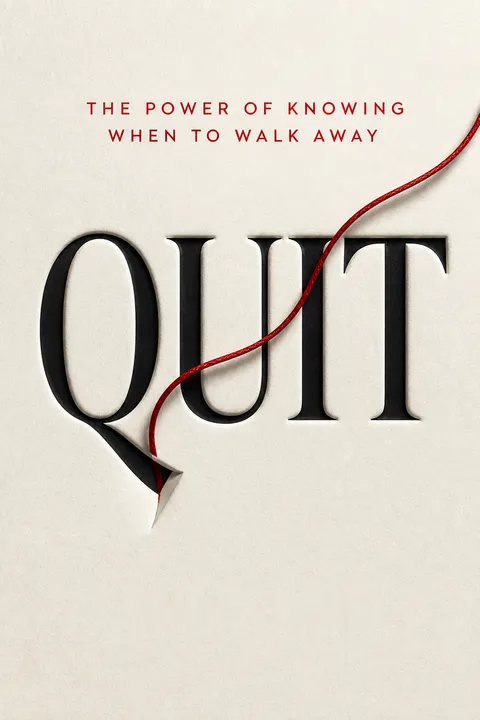
What's Quit: The Power of Knowing When to Walk Away about?
- Focus on Quitting: Annie Duke emphasizes the strategic importance of knowing when to quit, challenging the societal bias that favors persistence.
- Decision-Making Tool: Quitting is presented as a tool for adapting to new information and changing circumstances, helping align decisions with long-term goals.
- Cognitive Biases: The book explores biases like the sunk cost effect and status quo bias that hinder effective quitting, leading to poor decision-making.
Why should I read Quit: The Power of Knowing When to Walk Away?
- Challenge Conventional Wisdom: The book offers a fresh perspective on quitting, portraying it as a sign of strength and strategic thinking.
- Practical Strategies: Annie Duke provides frameworks like kill criteria and the monkeys-and-pedestals model to aid in making better quitting decisions.
- Real-Life Examples: Compelling stories from various fields illustrate the power and benefits of quitting, making the concepts relatable and actionable.
What are the key takeaways of Quit: The Power of Knowing When to Walk Away?
- Quitting is a Skill: Recognizing quitting as a skill that can be developed is crucial for better decision-making and outcomes.
- Cognitive Bias Awareness: Understanding biases like the sunk cost effect is essential for rational quitting decisions and avoiding over-commitment.
- Set Kill Criteria: Establishing specific signals for when to quit helps manage resources and opportunities effectively.
How does Quit: The Power of Knowing When to Walk Away differentiate between grit and quitting?
- Grit vs. Quit: Grit and quitting are seen as complementary, with quitting being about knowing when to change course.
- Context Matters: The effectiveness of grit depends on context; sometimes persistence is beneficial, while other times quitting is smarter.
- Balance is Key: Balancing grit and quitting enhances decision-making, leading to more successful outcomes.
What is the sunk cost effect as described in Quit: The Power of Knowing When to Walk Away?
- Definition: The sunk cost effect is a bias where past investments influence future decisions, often leading to irrational persistence.
- Emotional Impact: Emotional attachment to past investments can cloud judgment, causing further losses.
- Real-Life Examples: Examples like the California bullet train project highlight the importance of recognizing when to cut losses.
What are kill criteria, and how can they help in decision-making according to Quit: The Power of Knowing When to Walk Away?
- Definition of Kill Criteria: Pre-established benchmarks indicating when to quit, helping make rational decisions based on objective measures.
- Proactive Decision-Making: Setting kill criteria in advance avoids escalation of commitment, allowing timely exits from unproductive paths.
- Application Across Contexts: Useful in various situations, providing a structured way to evaluate progress and make informed quitting decisions.
What is the monkeys-and-pedestals model mentioned in Quit: The Power of Knowing When to Walk Away?
- Concept Overview: This model emphasizes tackling the hardest challenges first, ensuring efforts focus on what truly matters for success.
- Avoiding False Progress: Prioritizing difficult tasks prevents the illusion of progress from completing easier tasks.
- Real-World Application: Helps organizations manage projects by addressing significant challenges upfront, leading to efficient resource use.
How does Quit: The Power of Knowing When to Walk Away address the sunk cost fallacy?
- Understanding Sunk Costs: Sunk costs are unrecoverable resources that often lead to continued pursuit of unproductive paths.
- Psychological Impact: The fallacy clouds judgment, making it hard to recognize when to quit, leading to escalating commitment.
- Strategies to Overcome: Reframing decision-making and focusing on future value rather than past investments can empower rational quitting.
What role does identity play in quitting, according to Quit: The Power of Knowing When to Walk Away?
- Identity and Commitment: Identities are often tied to commitments, making quitting challenging as it feels like abandoning oneself.
- Cognitive Dissonance: Maintaining a consistent self-image can lead to rationalizing continued commitment to unproductive paths.
- Examples of Identity Impact: Cases like Sears illustrate how identity can trap companies, preventing necessary changes.
How can I apply the lessons from Quit: The Power of Knowing When to Walk Away in my personal life?
- Evaluate Commitments Regularly: Regular assessment of commitments helps identify when they no longer align with goals and values.
- Set Kill Criteria: Implementing kill criteria provides a structured framework for decision-making, aiding in informed choices about quitting.
- Seek External Perspectives: Engaging a quitting coach or trusted friend offers valuable insights and helps overcome psychological barriers.
What is the explore-exploit problem discussed in Quit: The Power of Knowing When to Walk Away?
- Definition of Explore-Exploit: Balancing the search for new opportunities with utilizing known resources is crucial for decision-making.
- Ants as a Metaphor: Ant behavior illustrates the balance between exploration and exploitation, ensuring adaptability and survival.
- Application in Life: Maintaining a balance between exploring new paths and exploiting current ones enhances decision-making and quitting.
What are the best quotes from Quit: The Power of Knowing When to Walk Away and what do they mean?
- “Success does not lie in sticking to things. It lies in picking the right thing to stick to and quitting the rest.”: Emphasizes strategic quitting as key to success.
- “The opposite of a great virtue is also a great virtue.”: Highlights the balance between grit and quitting, suggesting both are valuable depending on context.
- “Quitting is not just an art; it’s also a science.”: Encourages systematic approaches to quitting, developing skills and strategies for informed decisions.
About the Author

Download PDF
Download EPUB
.epub digital book format is ideal for reading ebooks on phones, tablets, and e-readers.








