

Key Takeaways
Quit compulsive porn to reclaim effort, not as a guaranteed route to wealth.
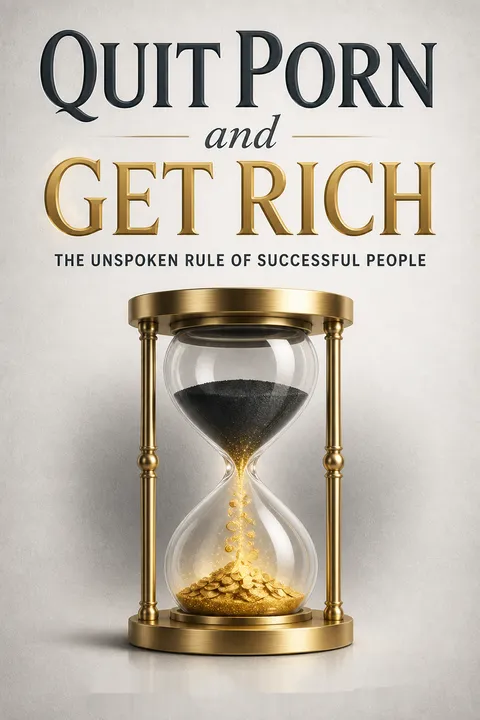
The promise is possibility. Prescott tells a personal story: he says frequent pornography use left him distracted, dissatisfied, and withdrawn, while quitting helped him redirect effort toward work, relationships, and ambition. His journey runs from failed business ventures to investment banking and a stake in a consulting firm. The title makes a bold link between quitting porn and getting rich, but Prescott explicitly says abstinence alone does not guarantee success. His narrower claim is that compulsive use can consume time and attention that might otherwise support a fuller life.
Start with the actual problem. The book is most relevant when use feels difficult to control or interferes with daily life. Prescott advises readers with serious symptoms to consult a specialist rather than diagnose themselves. The practical question is not whether every person must abstain, but whether a habit is crowding out goals they value.
The strongest version of the book's argument is about opportunity cost: a repeated escape can quietly displace activities that build competence and connection. That is more defensible than treating abstinence as a direct wealth-producing intervention. The autobiographical arc gives the claim emotional force, but a single person's before-and-after story cannot establish what caused the change. Readers can still use the story as a prompt to examine their own patterns without treating its outcome as a promise.
Treat endless novelty as a competitor for attention and motivation.
Novelty keeps the loop alive. Prescott explains the Coolidge effect, the tendency observed in some animal studies for sexual responsiveness to rise when a new partner appears. Online pornography offers rapid access to changing images and performers, which, he argues, can keep attention engaged after a familiar stimulus loses appeal. He connects this pattern to supernormal stimuli: unusually intense or exaggerated cues that can attract stronger responses than ordinary ones. His example comes from biologist Nikolaas Tinbergen, whose birds preferred oversized model eggs to their own eggs in experiments.
The wider claim is about attention. The book compares sexual novelty with the internet's stream of new pages and headlines. Prescott argues that constant high stimulation may make slower rewards, such as study, work, and real-world relationships, feel less compelling. He cites studies on sexual cues and attention, but does not establish that every viewer experiences lasting impairment.
This is a useful lens for products designed around rapid novelty, not only sexual content. The key distinction is between having access to stimulating material and feeling pulled into repetitive use despite competing priorities. Novelty also helps people explore, learn, and discover; it is not inherently harmful. The practical issue is whether an attention system built to seek the next interesting cue is serving the user's aims or being captured by a platform's supply.
Change the room before relying on willpower to change the habit.
Reduce the number of traps. Prescott struggled most when tired, alone, and near a computer. His response was to alter the conditions around the behavior: he moved apartments, studied in a library, went to the gym or pool after class, and eventually took in a roommate. Sharing the room reduced his time alone with the computer and also brought him a friend with whom he could discuss business ideas. He further tried to avoid sexualized media and deliberate fantasizing, treating cues as part of the habit loop.
Plan for vulnerable moments. The book recounts research on American soldiers returning from Vietnam, many of whom stopped using heroin after leaving a drug-saturated war environment. Prescott uses this to argue that surroundings can shape behavior. The lesson is not that a new setting cures addiction, but that removing easy access and predictable triggers can make a difficult choice easier to sustain.
This approach shifts the task from an endless series of acts of resistance to changing the conditions that repeatedly demand resistance. It is especially practical when a habit clusters around a particular device, place, time, or emotional state. Environmental changes cannot resolve every cause of compulsive behavior, and isolation or rigid avoidance can create new problems. Still, altering cues is a concrete first move, especially when paired with support and meaningful activities that fill the space.
Train self-control through small, repeated acts that spill into other choices.
Practice before the hard test. Prescott draws on Roy Baumeister's self-control research, including an experiment in which some participants resisted freshly baked cookies and ate radishes instead. They later gave up sooner on an unsolvable puzzle than participants who had not first resisted temptation. Baumeister interpreted the result as evidence that self-control can be depleted. Prescott also cites studies in which exercise routines and tracking personal spending improved self-regulation in other areas. In one financial-monitoring study he discusses, the average savings rate rose from 8% to 38% over four months.
Build capacity deliberately. Prescott recommends starting with manageable routines, such as regular exercise or tracking spending, before tackling a more difficult habit. He treats quitting pornography as an especially demanding test of self-control. The book's advice is to replace shame with practice, while acknowledging that people may need more than willpower alone.
The useful takeaway is to make self-control observable and trainable through routines, rather than treating a lapse as evidence of a fixed character flaw. The cookie experiment is memorable, but the idea that willpower is a simple fuel tank has faced scientific debate. A careful reader can retain the practical value of preparation, rest, and repeated practice without assuming that every act of restraint drains a measurable resource. Structure and support may matter as much as effort.
Turn screen-free hours into business experiments, useful skills, and stronger relationships.
Replace, do not merely remove. When Prescott cut back on pornography, he says he began reading, reconnecting with friends, and looking for work and business ideas. His first ventures were poorly researched, but trying them taught him about costs, customers, and risk. A later online business selling discounted clothes and limited-edition shoes did better, partly because he tracked stock and cash flow. He also describes learning about companies while working in auditing, knowledge that helped him spot opportunities.
The benefit needs a destination. Prescott's story suggests that abstinence became more sustainable when it served goals beyond abstinence itself: a career, business experience, financial security, relationships, and travel. The book does not offer a guaranteed formula for converting saved time into success. It does offer a practical prompt: choose what that time and attention should build, then schedule actions toward it.
Removing a rewarding routine can leave a vacuum; a replacement activity gives time a direction and makes change tangible. Prescott's shift toward work and relationships illustrates how new sources of feedback can reinforce a different pattern. The caution is that productivity should not become the only measure of recovery. Rest, pleasure, intimacy, and well-being matter too. A useful plan includes valued activities, not simply a longer list of tasks.
Let failed ventures teach market discipline, not extinguish initiative.
An idea is not demand. At college, Prescott spent his savings on a seasonal crêpe stand. He overlooked sanitation requirements, the need for utilities, weak tourist traffic, and bad weather. He later bought T-shirts with designs his friends liked, but few sold. The failures taught him to research an industry, check whether customers actually want a product, and protect cash flow. His later shoe-resale business worked better because he noticed a specific gap: rural buyers had limited access to discounted and sought-after goods.
Use failure as information. Prescott's first instinct was to treat enthusiasm as evidence that a business would work. Experience made him more cautious without stopping him from trying. He learned to study suppliers, prices, inventory, and customer behavior before committing more resources. The lesson is not to avoid risk, but to turn an unsuccessful test into knowledge that improves the next decision.
The contrast between friends liking T-shirt designs and customers buying shoes captures a basic but costly distinction: approval is not the same as demand. Small experiments can reveal constraints before a person commits more capital. Prescott's later success also benefited from timing, access, and experience, so it should not be reduced to mindset alone. The disciplined entrepreneur is neither the reckless optimist nor the person who waits for certainty, but the one who learns quickly from reality.
Negotiate from preparation, alternatives, and ambitious but defensible targets.
Confidence needs evidence. Early in his investment-banking career, Prescott accepted a weak salary offer after a manager suggested a small raise. He feared losing the job and did not have another offer ready. Before a later negotiation, he researched typical salaries, prepared arguments based on his work, and decided on a higher target. He also set a deadline for a response. The bank eventually offered a 120% raise, and he accepted. The story shows how preparation and a credible alternative can prevent fear from dictating every concession.
Set the frame before the meeting. Prescott cites negotiation research suggesting that people with higher goals tend to obtain better outcomes than people with low or absent goals. He recommends planning responses to likely offers and identifying alternatives in advance. His advice is to aim high without confusing a bold target with a guaranteed entitlement or a reason to bluff recklessly.
A target can keep an anxious negotiator from accepting the first offer simply to end discomfort. Preparation also shifts attention from self-doubt to relevant evidence, such as market pay and contribution. But a high anchor is most useful when grounded in information and paired with a realistic understanding of leverage. In an unequal negotiation, the other side may have more options. Confidence helps, but it cannot substitute for bargaining power, alternatives, or careful judgment.
Take informed risks in manageable steps, then learn from the outcome.
Risk is not the same as gambling. Prescott describes early stock-market decisions driven by fear: he sold when prices fell and bought back after they rose. Later, after learning more at work, he invested in a technology company's public offering. He set rules to sell if the price moved too far up or down, and sold at a profit on the first trading day. The gain was a personal success, not proof that such a strategy reliably works.
Reduce uncertainty where possible. Prescott argues that courage grows through experience with difficult situations, while avoidance can make future risks feel more frightening. He advises learning the relevant field, deciding what loss is tolerable, and making a plan before acting. For him, this applied to investing, business, career choices, and relationships. A risk taken without knowledge or limits, he warns, is closer to gambling than considered action.
The most transferable part of the market story is not the profitable trade; it is the use of predefined exit rules to limit impulsive reactions. That principle applies broadly wherever uncertainty tempts people to improvise under stress. Still, an outcome can be favorable by luck as well as judgment. Readers should distinguish a sound process from a successful result and avoid treating one person's trading anecdote as investment guidance.
Give delayed rewards time, while measuring progress in concrete actions.
Patience is practiced behavior. Prescott discusses Walter Mischel's marshmallow test, in which children could take a small snack immediately or wait for a larger reward. He notes that some children managed the wait by turning away from the treat or otherwise reducing its pull. He also cites research in which people who abstained from pornography for three weeks showed greater willingness to wait for a larger reward than a comparison group. He presents these findings as evidence that behavior can influence patience, not as a fixed trait determined at birth.
Waiting should have a purpose. In his own account, rebuilding habits and developing a business took months or years, not a sudden burst of motivation. He recommends using abstinence to support long-term goals and giving change time, while continuing to act: learning, building relationships, and testing ideas. Patience is not passive hope; it is sustained effort without demanding an immediate payoff.
The emphasis on waiting usefully counters the instant-feedback loop described throughout the book. The marshmallow test is also a reminder that patience can depend on context: a child may reasonably prefer a reward now if promises about the future seem unreliable. For adults, delayed gratification is not automatically virtuous either. Its value depends on whether the future reward is credible and worth the present cost. Pairing patience with visible steps makes the choice less abstract.
Analysis
The book combines self-help, business advice, and memoir, with its central case made through a sequence of personal reversals: compulsive pornography use, faltering early businesses, deliberate changes to environment and routine, then professional and commercial progress. Its most useful contribution is this narrative of redirection. It asks readers to see a habit not only as a private indulgence, but as a possible competitor for attention, relationships, learning, and work. The business episodes strengthen that argument because they show what redirected effort can look like in practice, including failures rather than only polished success.
The scientific account requires more caution than the memoir. Prescott draws on research about novelty, sexual cues, brain activity, self-control, testosterone, and delayed gratification, but sometimes treats association as proof of a direct cause. Studies linking pornography use with brain measures or mood do not, by themselves, show that pornography caused the difference. The book also moves between occasional masturbation, frequent use, and compulsive behavior as though they were interchangeable. They are not. Nor does its story establish that abstinence reliably raises testosterone, cures anxiety, or produces wealth. The author's own disclaimer recognizes that his opinions are not all scientifically established.
A reader can retain the practical insights without accepting every biological claim: notice whether a behavior feels controllable, whether it disrupts valued parts of life, and which situations make it harder to choose differently. Reduce avoidable cues, create replacement routines, and seek professional advice when symptoms are serious or persistent. This framing avoids both blanket reassurance and moral panic. The book is strongest as a prompt for self-observation and a case study in how changing routines can open room for different choices. It is weaker as a universal theory of sexual behavior or a scientific explanation of success. Its title is best understood as a provocation about opportunity cost, not a causal promise that quitting pornography makes anyone rich.
Review Summary
"Quit Porn and Get Rich" receives mixed reviews, with an average rating of 3.78 out of 5. Many readers find it informative and eye-opening, praising its scientific evidence and personal anecdotes. The book's main argument is that quitting pornography leads to improved focus, productivity, and ultimately financial success. Some criticize the direct link between quitting porn and getting rich as oversimplified. Readers appreciate the practical advice for overcoming addiction but note that some sections feel long-winded. Overall, it's recommended for those seeking motivation to quit porn and improve their lives.
People Also Read










Glossary
Coolidge effect
Renewed response to noveltyThe tendency, described in some animal studies, for sexual responsiveness to return when a new partner is introduced after interest in a familiar partner has declined. Prescott uses the idea to explain why rapidly changing online sexual images may sustain attention. The animal finding is an analogy for human behavior, not proof that every person responds in the same way.
Supernormal stimulus
Exaggerated cue that attractsAn unusually intense or exaggerated cue that can trigger a stronger response than the naturally occurring stimulus it resembles. Prescott uses biologist Nikolaas Tinbergen's bird experiments with oversized model eggs to illustrate the concept, then applies it to highly stimulating commercial and sexual media. The term describes a possible mechanism of attraction, not a diagnosis.
Reward system
Motivation and reward circuitryThe brain systems involved in learning from rewards and motivating behavior that may lead to them. Prescott emphasizes dopamine's role in anticipation, motivation, and novelty, and argues that intense repeated stimulation can make ordinary activities feel less rewarding. The book's account simplifies a complex set of processes and should not be read as a clinical assessment of an individual's brain.
PMO
Porn, masturbation, orgasmAn abbreviation used in some online communities for a sequence involving pornography, masturbation, and orgasm. Prescott notes that shorthand can make a repeated behavior feel less consequential, and uses the term while discussing attempts to stop the pattern. It is community vocabulary, not a medical diagnosis or a formal name for an addiction.
Ego depletion
Proposed limit on self-controlThe theory that exerting self-control in one situation temporarily reduces the capacity to exert it in another. Prescott describes experiments in which resisting tempting food was followed by less persistence on a difficult task. The idea has influenced research on self-regulation, but the claim that willpower operates as a limited resource remains debated.
Marshmallow test
Study of delayed rewardsA series of experiments associated with psychologist Walter Mischel in which children could take a smaller treat immediately or wait for a larger reward. Prescott uses the test to discuss patience and delayed gratification. A child's choice reflects the conditions of the experiment as well as individual behavior, and should not be treated as a complete forecast of adult success.
FAQ
What's "Quit Porn and Get Rich: The Unspoken Rule of Successful People" about?
- Core Premise: The book by Martin Prescott explores the idea that quitting pornography can lead to personal and financial success. It suggests that many successful people have abstained from porn to achieve their goals.
- Personal Journey: Prescott shares his own transformation from a life hindered by pornography to one of success in investment banking and entrepreneurship.
- Scientific Insights: The book delves into the psychological and physiological impacts of pornography, including its effects on motivation, self-control, and brain function.
- Practical Advice: It offers strategies for overcoming pornography addiction and harnessing the resulting energy and focus to pursue ambitious life goals.
Why should I read "Quit Porn and Get Rich"?
- Unique Perspective: The book provides a unique angle on success, linking personal habits with professional achievements.
- Self-Improvement Focus: It emphasizes self-control and discipline as key components of personal development and success.
- Scientific Backing: The book references various studies and research to support its claims about the negative effects of pornography.
- Actionable Steps: Readers are given practical advice on how to quit pornography and redirect their energy towards more productive endeavors.
What are the key takeaways of "Quit Porn and Get Rich"?
- Impact of Pornography: Pornography can negatively affect motivation, self-control, and brain function, hindering personal and professional success.
- Self-Control as a Muscle: Self-control can be strengthened through practice, much like a muscle, and is crucial for achieving long-term goals.
- Importance of Patience: Patience is vital for success, and the ability to delay gratification can lead to greater rewards in the future.
- Building Relationships: Genuine relationships and social intelligence are essential for business success and personal fulfillment.
How does Martin Prescott suggest quitting pornography?
- Change Environment: Altering your environment to avoid triggers and temptations is crucial for breaking the habit.
- Develop Self-Control: Practice self-control in various aspects of life to strengthen your ability to resist pornography.
- Avoid Sexual Stimuli: Stay away from all forms of sexual stimuli, including media and situations that may lead to temptation.
- Focus on Goals: Redirect your energy and focus towards achieving long-term personal and professional goals.
What are the effects of pornography on the brain, according to the book?
- Dopamine Desensitization: Frequent exposure to pornography can desensitize the brain to dopamine, reducing motivation and pleasure from everyday activities.
- Memory and Focus: Pornography can impair short-term memory and focus, making it difficult to concentrate on tasks and make decisions.
- Physical Brain Changes: Studies cited in the book show that pornography can lead to physical changes in the brain, affecting areas related to reward and motivation.
- Emotional Impact: It can lead to increased anxiety, depression, and social withdrawal, further hindering personal and professional growth.
How does "Quit Porn and Get Rich" link self-control to success?
- Self-Control as a Foundation: The book posits that self-control is foundational for achieving success, as it allows individuals to prioritize long-term goals over short-term pleasures.
- Training Self-Control: Self-control can be improved through regular practice, such as resisting small temptations or maintaining a disciplined routine.
- Impact on Decision-Making: Strong self-control enhances decision-making abilities, crucial for business negotiations and personal life choices.
- Broader Benefits: Improved self-control leads to better health, relationships, and financial stability, contributing to overall success.
What role does patience play in achieving success, according to the book?
- Delayed Gratification: Patience allows individuals to delay gratification, leading to greater rewards and success in the long run.
- Building Skills: Patience is essential for developing skills and gaining experience, which are necessary for achieving ambitious goals.
- Overcoming Challenges: It helps individuals persevere through challenges and setbacks, maintaining focus on their objectives.
- Balanced Life: A patient approach contributes to a balanced life, reducing stress and improving decision-making.
What are the best quotes from "Quit Porn and Get Rich" and what do they mean?
- "Life is short, don’t waste it watching someone else’s." This quote emphasizes the importance of living your own life fully rather than being a passive observer.
- "Most powerful is he who has himself in his own power." It highlights the significance of self-control and personal mastery in achieving success.
- "He that can have patience can have what he will." This underscores the value of patience in attaining one's goals and desires.
- "Strive not to be a success, but rather to be of value." It suggests that true success comes from being valuable to others and contributing positively to society.
How does Martin Prescott address the relationship between pornography and testosterone?
- Testosterone Levels: The book discusses how frequent masturbation and pornography use can lower testosterone levels, affecting confidence and motivation.
- Hormonal Balance: Maintaining a natural hormonal balance is crucial for self-control, risk-taking, and overall success.
- Impact on Behavior: Lower testosterone can lead to increased anxiety, fear, and social withdrawal, hindering personal and professional growth.
- Rebuilding Testosterone: Abstaining from pornography can help restore testosterone levels, leading to improved energy and drive.
What scientific studies does "Quit Porn and Get Rich" reference?
- Brain Function Studies: The book references studies on how pornography affects brain structure and function, particularly in areas related to reward and motivation.
- Self-Control Research: It cites research on self-control as a limited resource that can be strengthened through practice.
- Testosterone and Risk-Taking: Studies on the relationship between testosterone levels and risk-taking behavior are discussed.
- Patience and Delayed Gratification: The book includes research on the benefits of patience and the ability to delay gratification for long-term success.
How does "Quit Porn and Get Rich" suggest building relationships for success?
- Genuine Connections: Building genuine relationships based on trust and empathy is crucial for personal and professional success.
- Social Intelligence: Developing social intelligence helps in understanding and interacting effectively with others, a key skill in business.
- Networking: Expanding your network and maintaining valuable contacts can open doors to new opportunities and collaborations.
- Selflessness: Being selfless and valuable to others fosters strong relationships and mutual support.
What is the significance of the title "Quit Porn and Get Rich"?
- Direct Correlation: The title suggests a direct correlation between quitting pornography and achieving financial and personal success.
- Unspoken Rule: It implies that abstaining from pornography is an unspoken rule among successful people, contributing to their achievements.
- Focus and Energy: By quitting porn, individuals can redirect their focus and energy towards more productive and rewarding pursuits.
- Transformative Journey: The title encapsulates the transformative journey from addiction to success, as experienced by the author.
Download PDF
Download EPUB
.epub digital book format is ideal for reading ebooks on phones, tablets, and e-readers.








