

Key Takeaways
Your phone turns ordinary life into data, then makes that data governable
A city becomes legible. Greenfield opens with an evening in Paris: traffic, purchases, police encounters, and commutes all leave digital traces. Once connected devices collect and combine them, events that once vanished can be mapped, compared, and used to guide decisions. The network does not simply record city life. It changes how officials, companies, and residents can see and act on it.
A pocket-sized dependency. The smartphone absorbs the jobs of keys, tickets, maps, cameras, and cash, making daily routines easier while tying them to networks, apps, and corporate services. Its polished surface hides both dependence on infrastructure and the labor and extraction behind its manufacture. Convenience is real, but so are the systems and costs attached to it.
The Paris scene gives a powerful way to notice mediation: ordinary actions become legible to institutions even when nobody experiences the data collection directly. That shift matters because visibility is not the same as understanding. A location trace may show where someone went, but it cannot explain why, and the party interpreting it may have interests the person never agreed to. The phone also genuinely expands access to maps, communication, and knowledge. The useful question is not whether mediation is good or bad in the abstract, but who sets its terms and who can challenge the resulting picture.
Treat connected convenience as a negotiation over data, labor, and control
Measure the body. The internet of things connects sensors in bodies, homes, and public spaces to networks that analyze and respond to data. Wearables can help users notice patterns in sleep or activity, but the Quantified Self movement also frames self-knowledge as performance improvement. Employers or insurers can turn voluntary measurement into pressure to meet standards set by others.
Make ease profitable. Amazon's Dash Button lets a customer reorder detergent with one press. The shortcut also reports when and how often the household needs it, useful data for the seller. Meanwhile, cheap connected cameras and hotel room controls have exposed private spaces because manufacturers skimped on security. At city scale, sensors may support traffic or public services, yet their measurements are selective, and policy choices remain political. Data gathered for benign purposes can become dangerous under new owners or regimes.
The same sensor can serve self-understanding, public infrastructure, commercial prediction, or surveillance. Its ethical character therefore depends less on the object than on who controls the data, what decisions follow, and whether people can opt out without losing essential services. The chapter also makes convenience look less innocent: reducing friction for a customer can increase the seller's knowledge and influence. Still, rejecting measurement altogether would discard genuine benefits, including accessible health feedback and better-managed transit. A sound test is whether users gain meaningful capability and control, rather than merely supplying information to a system that acts on their behalf.
Keep the street a shared place, not a private augmented feed
Two realities collide. Augmented reality, or AR, places digital information over a view of the physical world. Pokémon Go made this vivid in 2016: players searched real streets for virtual creatures, and one player discovered a body while following the game. The same overlays drew players into memorials and other sites where play felt disrespectful. The software's map could not understand what a place meant to those who shared it.
Access can fragment. AR could help people navigate or recover layers of local history, but phone-based overlays demand attention and can make users less available to other pedestrians. Wearable displays promise greater immediacy while raising harder questions about privacy, consent, and who gets access to information embedded in public space. If directions and context exist only in someone's personal display, the street stops offering the same world to everyone.
AR's central promise is immediacy: information appears where it matters, instead of requiring a separate search. That can make history, navigation, or assistance more vivid. But the overlay also claims authority over a place, even when its data is incomplete or its interpretation is wrong. Public space depends on more than accurate directions; it also depends on people noticing one another and sharing cues. The concern is not that every screen ruins public life, but that systems designed for individual attention can quietly move essential knowledge out of common view.
Use fabrication to repair and share, not to promise instant abundance
A factory on a desk. Digital fabrication includes 3D printers, laser cutters, and computer-controlled milling machines. Adrian Bowyer's RepRap project aimed to create a printer able to make many of its own parts, lowering the cost of production and spreading access to tools. The hoped-for explosion of self-replicating machines did not arrive: buying manufactured parts was often cheaper than printing them.
The missing conditions. Printers still need energy, feedstock, designs, multiple materials, and people who can assemble the output. The book's strongest practical case is therefore not a sudden end to scarcity, but local repair and making useful objects from shared plans. A Barcelona fabrication lab intended to serve a poor neighborhood was instead occupied and used as a food bank, a reminder that technology must answer actual community needs. Open designs and welcoming workshops matter as much as the machine.
Fabrication can change the relationship between people and objects even when it cannot compete with mass production on price. Repair, customization, and learning by making offer forms of agency that a cheap retail item does not. Yet access to a machine is not the same as ownership of productive capacity: materials, skills, energy, and the right to use designs all matter. The neighborhood lab episode sharpens the point. A tool becomes empowering when a community can decide what it is for, not when outsiders declare it universally liberating.
A distributed ledger removes some intermediaries, not politics or trust
Replace the central ledger. Bitcoin records transactions on a shared blockchain, a ledger copied across many network participants. Cryptographic checks and proof-of-work help the network agree on transaction history without a central bank or payment processor maintaining the sole record. That design addresses problems such as double spending, but requires costly computation and can be difficult for ordinary users to navigate.
Code does not settle governance. Greenfield describes mining power becoming concentrated, weakening the promise of decentralization. The next idea, a smart contract, encodes an agreement so that software can execute its terms when specified conditions occur. Ethereum's 2016 DAO venture raised a large pool of funds, then lost roughly a third of its value through an exploit in its code. A ledger can preserve a record; it cannot by itself decide what counts as fair, who is accountable, or how disputes should be resolved.
Distributed ledgers are compelling because they turn verification into a shared process rather than a service supplied by a single trusted institution. That is a meaningful design shift, especially where intermediaries exclude participants or can block transactions. But technical verification and social legitimacy are different achievements. A system can execute exactly what its code says while producing outcomes its members consider unjust. The DAO episode makes this distinction concrete: immutability may prevent arbitrary alteration, yet it can also make an error hard to repair. Governance is not an optional layer added after the code; it is part of the system's design.
Automation's first promise is often cheaper, more controllable labor
Work is the target. Automation is not limited to industrial robots. Scheduling software, self-service kiosks, warehouse systems, and performance tracking can all reduce the need for workers or narrow their discretion. Greenfield points to trucking as a particularly exposed occupation: a 2015 US map showed truck driving as the most common job category in many states, while the book cites research estimating that 47 percent of US job categories were vulnerable to computerization.
Efficiency has a human price. Employers may describe automation as safer or more productive, but it can also make remaining workers do more under closer monitoring. Amazon warehouse metrics and wearable employee trackers illustrate how algorithms set pace, measure conduct, and shape schedules. A universal basic income could cushion lost wages, but its effects depend on whether it supplements public support or replaces it. Work also provides routines, shared interests, and a way to organize skills, not just income.
Automation has more than one motive. Machines can remove people from dangerous tasks, and some jobs are genuinely exhausting or degrading. But the same technical capacity can shift bargaining power toward employers by making labor easier to monitor, schedule, and replace. That distributional question deserves more attention than a simple tally of jobs lost or created. The chapter is also right to resist treating employment as either sacred or disposable: work can be exploitative and still provide social structure. Any transition policy must address both material security and the loss of institutions built around working life.
Ask what a model measures before trusting what it predicts
Data is selected, not raw. Machine learning trains algorithms to detect patterns in examples. A model's output depends on which facts are collected, which features are treated as meaningful, and what counts as success. Predictive policing illustrates the danger. A system trained on past arrests may send more officers to the same neighborhoods, producing more recorded incidents there and reinforcing the original pattern.
False positives matter. Chicago's Heat List identified people considered more likely to be involved in shootings, though police did not publicly explain its full method. A model tuned to catch every possible risk may also label many innocent people, with serious consequences. The choice between catching more cases and avoiding wrongful suspicion is a political judgment, not a neutral technical setting. Greenfield calls the harm caused by making people or patterns too visible through algorithmic sorting overtransparency.
Prediction often sounds like foresight, but a model usually extends patterns in historical records. When those records reflect unequal enforcement or unequal access, the model can make yesterday's treatment look like tomorrow's risk. This does not mean every predictive tool is useless; it means its feedback effects must be evaluated alongside its accuracy. A particularly important distinction is between a model identifying a statistical association and establishing a cause. Public agencies should be judged not only by whether a system predicts an outcome, but also by who bears its errors and whether those people can contest the decision.
Separate machine performance from human understanding and accountability
Patterns can be reproduced. Machine learning systems can generate work resembling human styles and can master tasks that once seemed to require intuition. The Next Rembrandt project analyzed the painter's works and produced a new portrait in a similar style. AlphaGo defeated champion Lee Sedol at Go, a game whose huge number of possible positions had long challenged computers. These results show that impressive performance does not require human-like methods.
Capability is uneven. The book also describes a robot trained to repeat a swordsman's movements, raising questions about turning embodied skill into portable instructions. Yet contemporary systems can fail on ordinary ambiguities or unfamiliar situations. Tesla's Autopilot, described in ways that encouraged confidence, failed to detect a truck in a fatal crash. The crucial distinction is between what a system can do in a defined setting and what users believe it can safely do elsewhere.
The examples unsettle a familiar boundary: artistic style and strategic play can contain patterns that machines learn to reproduce or exploit. That achievement need not prove that a machine experiences meaning as a person does. Nor does lack of human-like understanding make its effects trivial. Systems can reshape work, safety, and cultural expectations through performance alone. The practical challenge is to communicate limits as clearly as capabilities. A label, interface, or marketing claim can alter human behavior before the underlying system is reliable enough to justify the trust it invites.
Track how platforms connect desire, delivery, and data into power
A Stack integrates. Greenfield uses the term Stacks for large technology companies that seek control across devices, software, services, and infrastructure. Their influence grows when separate tools work together. Amazon's combination of online shopping, warehouses, delivery, cloud computing, smart speakers, and reorder buttons makes it possible to connect a spoken request at home to a physical delivery, while collecting data at each step.
Integration shapes choice. A platform does not need to own every part of everyday life to influence it. Defaults, recommendations, payment systems, and app marketplaces can steer users toward particular services and business models. The companies gain efficiency and convenience, while the public may have little say over how its behavior is measured or how alternatives are presented. Yet even dominant firms are internally fragmented and can misjudge users. Their power is substantial, not magical or inevitable.
The Stack is more than a large company. It is a strategy of connecting points of contact so that one service makes another more valuable and the combined system becomes difficult to leave. This helps explain why the most consequential innovation may be integration rather than a dazzling new device. Still, corporate dominance is not perfectly coordinated: departments clash, products fail, and users refuse offerings that violate social expectations. That friction creates openings for public standards, competition, and collective pressure. Treating platform power as absolute obscures the points where it can be challenged.
Judge technology by its effects, then organize for the world you want
Intent is not outcome. Greenfield closes with Japan's concrete tetrapods, built to protect beaches but associated with continued erosion and support for the concrete industry. They show why a technology should be evaluated by what it does in its real setting, not by the intentions attached to it. The same test applies to tools promoted as naturally democratic, liberating, or efficient.
Change needs institutions. No device automatically ends scarcity, bias, or state power. Those outcomes require people to build organizations, contest decisions, and direct resources. Everyday resistance may be small: adapting tools, sharing knowledge, or finding room to act within systems designed to constrain behavior. But tactics alone are not enough. The book's closing challenge is to understand technology well enough to participate in its design and to organize for social goals directly, rather than waiting for a machine to deliver them.
The tetrapods supply a disciplined test for technological claims: compare promised benefits with observed effects, including who receives the costs and who captures the gains. That test avoids two easy errors, technological salvation and technological fatalism. A tool can be repurposed, but its use is shaped by institutions, resources, and power. The emphasis on organizing is therefore not a rejection of design. It is a demand to connect technical choices to durable public capacity, so that people affected by a system can influence its purposes and revise its consequences.
Analysis
The book's central move is to shift attention from the device to the arrangement around it. A phone is not merely a personal object, a sensor is not merely a measurement instrument, and an algorithm is not merely a mathematical procedure. Each operates through infrastructures, labor, business models, laws, and habits. Those connections determine who receives convenience, who supplies data, who becomes visible, and who can make decisions.
That approach gives the book unusual breadth. Its examples range from a body-tracking watch to Bitcoin mining, predictive policing, and automated employment. The recurring question is not simply whether a technology works, but what work it performs in society. A smart city's traffic data may improve flow while presenting contested policy as technical necessity. A blockchain may distribute verification while concentrating computation. A 3D printer may enable repair without overcoming the costs of materials, skills, or access. In each case, technical possibility is real, but it does not determine social outcome.
The book is strongest when it shows how design choices carry political consequences without pretending that technology dictates them. Its critique of neutrality is especially persuasive: selecting a metric, training set, default, or interface already establishes what the system can notice and what it treats as irrelevant. At the same time, its emphasis on capture and exploitation can make beneficial uses seem secondary. Navigation, assistive interfaces, safer machinery, and new forms of making matter too. Their value does not refute the critique; it raises the harder question of how benefits can be shared and governed.
The final lesson is practical rather than fatalistic. Technology cannot substitute for collective judgment, and good intentions cannot guarantee good effects. The relevant work is to understand systems, expose their assumptions, preserve alternatives, and build institutions capable of steering them. The book's map of technological power is also a reminder that the future is not a product launch. It is a contest over which arrangements become ordinary.
Review Summary
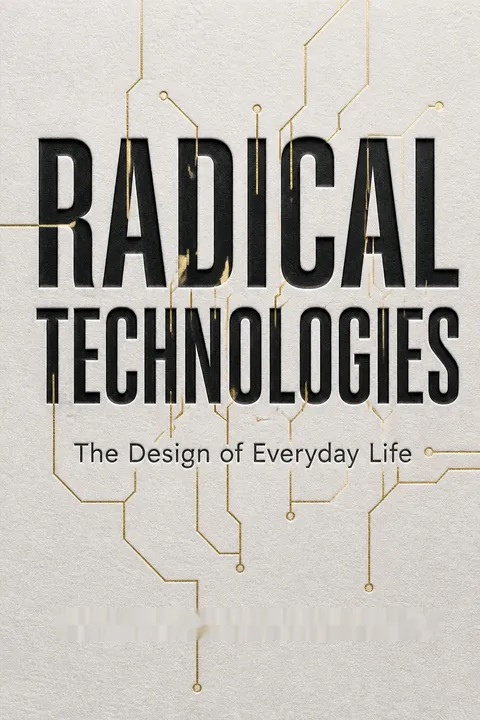
Radical Technologies by Adam Greenfield examines emerging technologies and their societal impacts. Reviewers praise Greenfield's clear explanations and critical analysis of smartphones, AI, blockchain, and more. The book is lauded for its balanced approach, avoiding both techno-utopianism and excessive pessimism. Some readers found it repetitive or overly negative, while others appreciated its warnings about technological determinism. Many recommend it as an essential read for understanding modern technology's effects on society, though some wished for more concrete solutions or a more optimistic outlook.
People Also Read







Glossary
Quantified Self
Self-knowledge through measurementA movement and practice centered on collecting personal data, often through wearable devices and apps, to learn about patterns in one's body or behavior. Examples include tracking steps, sleep, or heart rate. Greenfield questions how often this information serves genuine self-understanding, and how often it imports workplace or market demands for efficiency into personal life.
ideology of ease
Frictionless use as an idealThe design priority of making connected products and services require as little thought or effort as possible. Greenfield argues that this ideal can obscure commercial incentives, normalize particular services as defaults, and encourage users to trade data or security for convenience. In connected homes, ease can also increase complexity by multiplying devices that compete for attention.
proof-of-work
Costly computational validationA process used in Bitcoin mining in which network participants perform resource-intensive calculations to propose and confirm transaction blocks. The cost helps discourage fraudulent histories, while successful miners receive newly issued coins. Greenfield emphasizes that the process consumes large amounts of energy and can encourage mining power to concentrate among operators able to afford specialized equipment and cheap electricity.
smart contract
Code that executes agreementsA program, commonly associated with a blockchain platform such as Ethereum, that specifies conditions and automatically performs actions when those conditions are met. It can hold and transfer digital assets without a conventional intermediary. Its precision is also a limitation: code may execute exactly as written even when circumstances change, and it cannot automatically resolve disputes or enforce obligations outside the network.
distributed autonomous organization
Code-coordinated collective organizationAn organization whose membership rules, decision procedures, and handling of resources are represented through blockchain accounts and smart contracts. It can coordinate members and manage digital assets without relying entirely on a conventional central administrator. Greenfield questions whether existing DAO designs can support democratic, open-ended collective life, given their reliance on ownership, formal participation, and rules that may be difficult to change.
overtransparency
Harmful exposure through dataGreenfield's term for making people, identities, or social patterns excessively visible through data collection and algorithmic classification. Such visibility can produce stigma, surveillance, or discrimination, even when the underlying data appears ordinary. The risk is especially acute when people cannot control how information is interpreted, when classification errors are consequential, or when public anonymity and assembly are weakened.
Stacks
Integrated technology empiresGreenfield's name for major technology companies that seek influence across multiple layers of everyday digital life, including devices, operating systems, applications, cloud infrastructure, and services. Integration allows a company to connect user activity across products and shape defaults, transactions, and access. The term describes a strategic ambition, not a claim that any company has achieved total control.
posthuman everyday
Daily life organized beyond humansGreenfield's description of a condition in which automated systems, networked data, and algorithmic decisions increasingly shape daily rhythms, environments, and opportunities. Human needs and judgment cease to be the only standards by which systems are organized. The phrase highlights a direction of change, not a completed future or a claim that people have become literally nonhuman.
infrapolitics
Everyday covert resistanceA term associated with James C. Scott for forms of resistance practiced by people with limited formal power. It includes indirect actions such as jokes, gossip, concealment, slowdowns, and small acts of noncompliance. Greenfield asks whether such tactics can persist when workplace and public systems use data analysis to detect deviations from expected behavior.
FAQ
What's Radical Technologies: The Design of Everyday Life about?
- Exploration of Technologies: The book by Adam Greenfield examines technologies like smartphones, IoT, AR, and blockchain, and their influence on daily life and societal structures.
- Impact on Society: Greenfield argues these technologies alter the fabric of life, often reinforcing existing power structures, and emphasizes understanding these changes for future navigation.
- Call for Awareness: It serves as a manual for understanding the implications of these technologies, urging readers to be aware of their design and impact on human experience.
Why should I read Radical Technologies?
- Understanding Modern Life: The book helps readers grasp how pervasive technologies influence daily experiences and societal structures, revealing hidden mechanisms.
- Critical Perspective: Greenfield encourages questioning the design and intentions behind technologies, essential for engaging thoughtfully with the digital world.
- Future Implications: It critiques current technologies and speculates on future developments, relevant for those interested in technology's trajectory and societal impacts.
What are the key takeaways of Radical Technologies?
- Technological Mediation: Networked digital information technology mediates almost every aspect of life, shaping choices and perceptions.
- Power Dynamics: Technologies often reinforce existing power dynamics rather than disrupt them, leaving modes of domination mostly intact.
- Need for Agency: Retaining agency in a rapidly evolving technological landscape is crucial, and understanding these technologies is vital for exerting control over our lives.
What is the significance of the smartphone in Radical Technologies?
- Central Role: Described as the "signature artifact of our age," smartphones alter how we interact with the world, becoming indispensable for communication and social interaction.
- Replacement of Other Objects: Smartphones have subsumed many everyday objects, transforming daily rituals and practices.
- Impact on Identity: They shape personal identity and social relationships, mediating interactions and experiences.
How does Radical Technologies define the Internet of Things (IoT)?
- Definition and Scope: IoT is a "planetary mesh of perception and response," with everyday objects embedded with sensors and connected to the internet.
- Surveillance and Control: IoT enables unprecedented levels of monitoring and data collection, leading to potential privacy and autonomy loss.
- Potential Benefits: Despite risks, IoT can improve efficiency and resource management, with thoughtful design harnessing positive outcomes.
What are the implications of augmented reality (AR) discussed in Radical Technologies?
- Interactive Experience: AR is an "interactive overlay on the world," enhancing perception by superimposing digital information onto the physical environment.
- Cultural and Ethical Concerns: Raises ethical questions about social interactions and public spaces, potentially leading to disconnection from the immediate environment.
- Potential for Misuse: Instances of inappropriate or dangerous behaviors highlight the need for responsible design and implementation.
How does Radical Technologies address the concept of cryptocurrency?
- Definition and Function: Cryptocurrency is a digital medium of exchange operating independently of traditional financial institutions, with potential to disrupt economic systems.
- Blockchain Technology: Underlying blockchain technology ensures security and transparency in transactions, offering broad utility.
- Challenges and Limitations: Significant challenges include volatility, regulatory issues, and environmental impact of mining.
What is the role of digital fabrication in Radical Technologies?
- Empowerment through Production: Digital fabrication democratizes production, allowing local and on-demand creation, potentially shifting power dynamics in manufacturing.
- Challenges of Accessibility: Barriers include cost, accessibility, and technical knowledge, affecting widespread adoption.
- Environmental Considerations: Advocates for sustainable practices and material recovery, enabling a way of being in the world.
How does Radical Technologies address automation?
- Impact on Labor: Automation threatens traditional jobs, particularly in manufacturing and service sectors, with significant economic and social implications.
- Technological Unemployment: References Keynes' concept of "technological unemployment," highlighting potential widespread job loss.
- Need for New Frameworks: Advocates for new social and economic frameworks, like universal basic income, to address automation challenges.
What is the concept of the "unnecessariat" in Radical Technologies?
- Definition of Unnecessariat: Describes individuals rendered superfluous by automation, facing economic precarity and social marginalization.
- Cultural and Social Implications: Reflects broader societal issues, including inequality and erosion of meaningful work.
- Call for Solidarity: Emphasizes solidarity and collective action to address challenges and advocate for a more equitable future.
How does Greenfield critique the idea of technological utopia in Radical Technologies?
- Skepticism Towards Potential: Argues technologies are often presented as solutions but lead to unforeseen negative consequences.
- Historical Context: Places current trends within a historical framework, suggesting past failures should inform understanding of present and future technologies.
- Need for Critical Discourse: Calls for questioning narratives that promote uncritical acceptance of technological solutions.
What are the best quotes from Radical Technologies and what do they mean?
- "One has to become a cybernetician to remain a humanist.": Understanding complex systems is essential for navigating the modern world while maintaining humanistic values.
- "The gaze of the state intensifies—but the state may find, to its surprise, that its subjects command many of the same capabilities.": Highlights the dual nature of surveillance technologies, suggesting potential for resistance and agency.
- "The smartphone has come to stand between us and an ever-greater swath of the things we do in everyday life.": Reflects the centrality of smartphones, raising questions about dependency and implications for personal agency.

Download PDF
Download EPUB
.epub digital book format is ideal for reading ebooks on phones, tablets, and e-readers.








