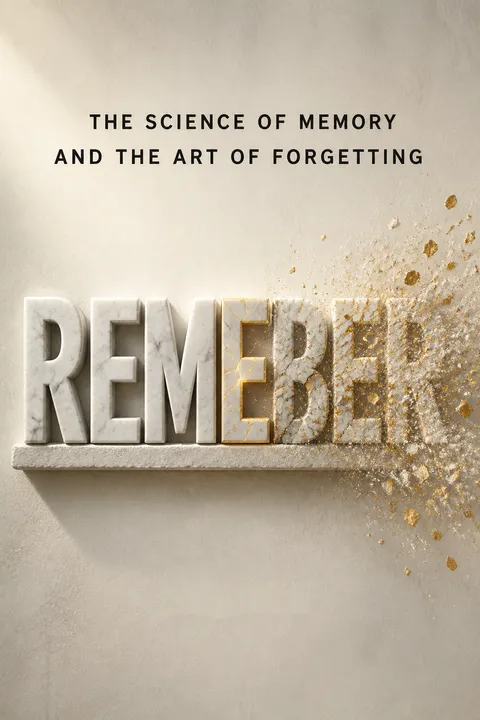


Key Takeaways
Expect your brain to keep the meaningful and discard the ordinary.
Memory is selective. The brain is not a camera recording every day. It prioritizes what feels important, emotional, surprising, or useful, while familiar routines rarely leave lasting traces. That is why a first kiss may remain vivid while an ordinary dinner disappears. Genova estimates that most people can recall only eight to ten full, specific days from the previous year. Even a penny, seen countless times, is hard to reproduce accurately because its tiny details rarely matter to anyone’s daily life.
Forgetting is often normal. The missing details of routine life are not proof that memory is broken. The brain’s selectivity is part of how it avoids being overwhelmed by a flood of unimportant information.
What's striking is that memory acts less like a storage device than a relevance filter. That is useful, but relevance is personal: emotion, current goals, and identity shape what gets preserved. The same selective process can help someone remember a hard-won achievement while leaving out mundane context, or reinforce a narrow story about the self. The practical question is not simply whether something is memorable, but whether its significance deserves attention. Ordinary forgetting is reassuring, though it should not be used to dismiss persistent changes in everyday functioning.
Pay attention before blaming memory for a detail you never encoded.
Memory starts with noticing. A lasting memory requires more than seeing or hearing something. The brain must attend to it so the experience can be encoded, linked with other information, stabilized, and later retrieved. Genova’s parking-garage story makes the distinction clear: she could not find her car because she had rushed away without noticing its location. The memory had never been made, so there was nothing to retrieve.
Distraction blocks the first step. Names, parking spots, and misplaced glasses often vanish because attention was elsewhere. Repeated exposure does not guarantee a memory: Genova’s father had driven home for years without remembering his address or the color of his house, details he had never bothered to notice.
This distinction between failing to store information and failing to retrieve it changes how a lapse should be interpreted. It also gives a direct intervention: pause long enough to register a name, location, or instruction. Attention research broadly supports the idea that divided focus weakens later recall, while the modern habit of switching between screens makes that division easy to overlook. Still, attention is not a moral virtue or a cure-all. Fatigue, stress, and competing demands can make focused noticing genuinely difficult, so environments matter as much as intention.
Chunk information because working memory is a small, vanishing workspace.
The present has limits. Working memory is the brief mental workspace holding what a person is conscious of right now. It keeps a sentence in mind long enough to understand it, or a number long enough to enter it. Genova describes its capacity as roughly seven items, plus or minus two, and says information may last only about fifteen to thirty seconds without rehearsal.
Group details into meaning. A ten-digit phone number is easier to hold when divided into familiar sections than when treated as ten separate numbers. Likewise, a string of letters becomes manageable when arranged as a meaningful sentence. Chunking does not increase the workspace itself. It lets the brain treat several details as one organized unit, making the limited space go further.
The useful lesson is that memory capacity depends partly on how information is structured. A novice sees separate pieces; an expert may recognize a meaningful pattern and handle them as a single chunk. This helps explain why a short, well-organized explanation can be easier to retain than a dense paragraph with the same facts. The familiar seven-item figure is a rough guide, not a universal personal limit: complexity, familiarity, and the time required to rehearse all affect performance. The best practical move is to organize information rather than test raw capacity.
Test yourself across days; rereading feels fluent but teaches less.
Recall strengthens learning. Semantic memory is knowledge and facts that can be recalled without remembering when they were learned. To build it, Genova recommends spacing study over time and repeatedly retrieving information instead of merely rereading it. The spacing effect is the advantage of distributing practice across separate sessions rather than cramming.
A test can be practice. In one study described in the book, people learning Swahili word pairs who used self-testing recalled about 80 percent a week later. Groups that studied without testing recalled about 35 percent. Meaning also helps: expert chess players remembered far more pieces in realistic game positions than novices, but lost that advantage when the pieces were randomly arranged. Connect facts to knowledge already understood, then practice bringing them to mind.
Self-testing is powerful because it makes learning effortful in the right way: the learner must reconstruct the answer, exposing gaps that rereading can conceal. Spacing also prevents the temporary feeling of mastery that comes from seeing the same material repeatedly in one sitting. The deeper principle is to make practice resemble the eventual task. A student who must explain a concept should practice explaining it, not only recognizing it on a page. Testing is not inherently beneficial if it only punishes or ranks learners; its value here comes from retrieval and feedback.
Practice procedures until the brain can run them without narration.
Skills become automatic. What people call muscle memory is procedural memory for how to perform an action. Despite the name, the memory is in the brain, not the muscles. Repeated practice links separate movements into a coordinated routine that can be performed with little conscious effort. Skiing, typing, and riding a bicycle are examples.
Practice changes the brain. Henry Molaison, whose hippocampi were removed to treat severe seizures, could not form new conscious memories, yet he improved at a mirror-drawing task through repetition. He had no conscious memory of practicing, but his procedural skill had changed. Practice and feedback refine movement patterns, while the body’s abilities and predispositions still limit what any individual can master.
Procedural learning shows that memory is not one faculty but a collection of systems. A person can lose conscious recollection while retaining the ability to learn a skill, a distinction with major implications for teaching and caregiving. Repetition alone, however, is not a magic formula: useful practice needs attention and correction, and the same movement repeated badly can stabilize an error. The book’s strongest point is that skilled performance can become less mentally demanding over time. That frees attention for decisions that the routine itself cannot make.
Treat vivid memories as edited stories, not recordings of the past.
Episodic memory reconstructs. Episodic memory is recollection of personal events tied to a time and place. It begins with incomplete attention, and later can be altered by assumptions, other people’s accounts, emotion, and new information. Each retrieval reconstructs the event rather than replaying a perfect record; changes can then be saved back into the memory.
Confidence is not proof. In a study of the Challenger disaster, students’ accounts changed over time, yet many remained confident in the newer version. Experiments also found that leading questions could alter estimates of a car’s speed or lead people to remember broken glass that was not present. The book notes that roughly 75 percent of the people exonerated through DNA testing had been convicted in cases involving eyewitness testimony.
The implication is not that memory is useless, but that confidence and accuracy are different things. Recollection remains essential for ordinary life, yet high-stakes decisions should not treat vividness as verification. Independent records, contemporaneous notes, and multiple sources can help distinguish what was observed from what was inferred or learned afterward. There is a genuine trade-off: retelling can keep an event accessible while also reshaping it. Recognizing that tension makes disagreement about shared memories less like a contest of honesty and more like a problem of evidence.
Put future intentions in calendars, lists, and impossible-to-miss cues.
Intentions need prompts. Prospective memory is remembering to do something in the future, such as taking medication or bringing a gift. The intention may be clear when formed and still disappear when the moment arrives, especially if no cue triggers it. In a study cited by Genova, only about half of adults aged thirty-five to forty remembered a request made two hours earlier.
Design for the cue. Yo-Yo Ma once left his valuable cello in a taxi because the case was not visible to remind him to take it. Lists, calendar alerts, pillboxes, and objects placed by the door make reminders external and noticeable. A specific plan, tied to a time, place, or routine, is more dependable than a vague promise to remember.
External reminders are examples of distributed cognition: the task is handled by a person and a tool together, rather than by unaided memory alone. That is not cheating; it is sensible system design, especially when a missed action has serious consequences. Checklists in aviation and surgery reflect the same principle: reliability should not depend on someone remembering every step under pressure. A reminder only helps if it appears at the right moment and is noticed, so placement and timing matter. The aim is not to eliminate responsibility, but to make successful action less fragile.
When a word vanishes, change cues before declaring it forgotten.
Retrieval depends on routes. A tip-of-the-tongue state occurs when a person knows a word but cannot produce it at that moment. The information may remain stored while the path to its sound or name is weak. A helpful cue can activate the right associations; an incorrect guess can instead send attention toward a competing word. Recognition is often easier than recall, which is why an answer may feel instantly familiar once supplied.
Rebuild the context. A forgotten intention may return when someone re-enters the room where it was formed. Likewise, a person’s name may become easier to remember when linked with a vivid image or personal association. Looking up a blocked name is a practical aid, not evidence that memory has been damaged.
This section makes a valuable distinction between stored knowledge and access to it. A search engine, a familiar setting, or a well-chosen prompt can act as a retrieval scaffold, much as a map helps someone navigate a place already known. The distinction also lowers the emotional temperature around ordinary word-finding problems. At the same time, not every repeated or worsening retrieval difficulty is automatically benign. Frequency, change over time, and interference with daily life matter more than one isolated blank.
Protect sleep and manage chronic stress to preserve memory machinery.
Sleep consolidates learning. During sleep, patterns formed while awake are reactivated and strengthened. Genova reports that recall for studied material can be 20 to 40 percent better after sleep than after an equal period awake. In a finger-tapping task, participants who slept improved speed by 20 percent and accuracy by 35 percent, without extra practice. Adults generally need seven to nine hours nightly for healthy functioning.
Stress has two faces. A brief, moderate stress response can focus attention and strengthen memory for the stressful event itself. Chronic stress is different: prolonged cortisol exposure can impair thinking and memory formation and is associated with harm to the hippocampus, a key structure for forming new memories. Rest, exercise, and practices that reduce stress support healthier conditions for memory.
Sleep is not merely downtime after learning; it is part of the learning process. That reframes late-night studying as a trade between extra exposure and the biological consolidation that follows. Stress adds nuance: a short-lived challenge may sharpen attention, while persistent threat can consume the resources needed for reflection and recall. The reported dementia associations are reasons to take chronic stress and sleep seriously, not proof that either factor alone determines an individual outcome. Health behavior can reduce risk and improve functioning without guaranteeing a particular result.
Forget deliberately when yesterday's information crowds out today's needs.
Forgetting can help. Solomon Shereshevsky, studied for decades because of his extraordinary recall, found that his inability to discard irrelevant information made daily life difficult. Forgetting old hotel room numbers or yesterday’s parking spot can prevent confusion and leave attention available for what matters now. In this sense, a useful memory system must filter as well as store.
Stop rehearsing what should fade. Repeatedly revisiting a memory tends to strengthen it, so leaving an unwanted memory alone may allow it to weaken. That is not a simple solution for trauma: people with PTSD may involuntarily relive and reinforce painful memories, and the book describes memory revision as a possible therapeutic approach requiring trained guidance. Procedural habits, such as an old password, are better replaced through repeated practice of the new routine.
The insight challenges the assumption that more recall is always better. Cognitive systems need some form of selection, whether the goal is finding today’s parking space or learning a replacement behavior. Yet deliberate forgetting should not be confused with commanding distress to disappear. Intrusive memories are not ordinary clutter, and advice to avoid thinking about them can be inadequate or harmful for someone with trauma. The book’s distinction between everyday selective forgetting and clinical suffering is important: the same memory mechanisms can be helpful in one setting and profoundly difficult in another.
Separate ordinary aging from Alzheimer's by tracking what is actually lost.
Aging changes access. Healthy aging can slow processing and make free recall, working memory, and remembering intentions less reliable. Recognition often remains stronger: a name may not come to mind, yet feel familiar when heard. Such lapses differ from Alzheimer’s, which commonly first disrupts the formation of new memories. A person may forget a conversation from minutes earlier or repeat a question, while still recalling older events.
Look at the pattern. Losing keys after setting them down inattentively is different from no longer knowing what keys are for. Alzheimer’s can also affect language, planning, spatial orientation, emotion, and learned skills as it progresses. The book stresses that ordinary forgetfulness is not itself a diagnosis; persistent, substantial changes in daily functioning deserve professional evaluation.
The most useful diagnostic idea here is qualitative change, not simply counting forgotten names. A familiar retrieval glitch differs from losing knowledge, repeating recent conversations, or becoming disoriented in places once well known. The distinction can reduce unnecessary fear while helping families notice meaningful change. It should not become a home diagnostic checklist: many conditions can affect cognition, and only qualified clinicians can assess the cause. The book’s humane framing is especially important because fear of dementia can make every ordinary lapse feel like evidence.
Value memory without mistaking it for the whole person.
Risk can be influenced. Age is the strongest Alzheimer’s risk factor, but the disease is not simply inevitable aging. The book highlights physical exercise, adequate sleep, heart-healthy eating, and mentally engaging new experiences as ways associated with better brain health. The Nun Study found that some women showed little outward impairment despite brain changes associated with Alzheimer’s, a result the book connects to cognitive reserve: additional or redundant connections that can help the brain function despite damage. These measures reduce risk; they do not promise prevention.
Identity exceeds recall. Genova’s friend Greg lives with early-onset Alzheimer’s, yet retains humor, relationships, and emotional life. Her grandmother eventually failed to recognize family members but could still feel loved. Memory shapes a life story, but its loss does not erase a person’s capacity for connection or dignity.
Cognitive reserve offers a useful model of resilience: learning and engagement may create alternatives that help the brain cope with injury or disease. It is more realistic than the idea of a single exercise that prevents decline, and it resists reducing brain health to puzzles or supplements. The emotional conclusion is equally important. If memory is treated as the sole measure of identity, dementia appears to erase the person before the person is gone. Relationships, feeling, and agency remain morally significant even when autobiographical recall becomes unreliable.
Analysis
The book’s most useful move is to replace a single, moralized idea of memory with several distinct mechanisms. Forgetting a name, losing a newly learned conversation, failing to remember an appointment, and forgetting how to perform a skill may feel similar from the inside, but they arise from different processes. That distinction turns self-blame into a practical question: Was the information attended to, consolidated, retained, cued, or rehearsed? The answer suggests a different remedy for each failure.
Its account also refuses a comforting but false image of memory as a faithful archive. Episodic recall is selective and reconstructive, which means vividness cannot certify accuracy. This is especially important in family disputes and eyewitness settings. The limitation does not make memory worthless; it makes corroboration and careful language necessary where the costs of error are high.
The book’s advice is strongest when it redesigns the conditions around memory: focus attention, space learning, retrieve rather than merely reread, create visible prompts, and sleep. These approaches respect the brain’s constraints instead of demanding perfect willpower. The broader principle is a partnership between internal memory and external systems. A calendar is not a confession of incompetence, any more than glasses are a failure of vision.
The medical claims require a more cautious reading than the practical tips. Sleep, exercise, diet, stress, and cognitive engagement are connected to brain health, but no lifestyle guarantees protection from Alzheimer’s. Risk reduction is not prevention for every individual, and association is not proof of a single cause. Genova’s strongest final insight is therefore both scientific and humane: memory can be trained, supported, and sometimes lost, but it is not the whole of personhood. A sound relationship with memory combines care for its capabilities with humility about its limits.
Review Summary
Remember receives high praise for its accessible exploration of memory science. Readers appreciate Genova's clear explanations of brain function, memory formation, and forgetting. The book provides reassurance about normal memory lapses and offers practical tips for improving retention. Many find it both informative and engaging, with personal anecdotes enhancing readability. While some felt it repetitive or basic, most recommend it for anyone interested in understanding memory or concerned about cognitive decline. The book's insights on Alzheimer's and advice for brain health are particularly valued.
People Also Read










Glossary
Working memory
temporary mental workspaceThe limited, short-lived system that holds information currently in conscious attention. It helps a person follow a sentence, conversation, or instruction and keep a number in mind long enough to use it. Without rehearsal, information can disappear within seconds as new information takes its place.
Semantic memory
stored facts and knowledgeMemory for facts, concepts, vocabulary, and personal information that can be known without recalling the particular occasion on which it was learned. Knowing that Paris is the capital of France is semantic memory; remembering a specific trip to Paris is episodic memory.
Episodic memory
personal events in contextMemory for personally experienced events linked to a time and place. It can include details about who was present, what happened, and how the person felt. Episodic memories are reconstructed during recall, so they can be incomplete or altered rather than exact records.
Prospective memory
remembering future intentionsMemory for carrying out an intended action at a later time or when a particular event occurs. Remembering to take medication at bedtime or bring something to an appointment are examples. Because the intention must be recalled at the right moment, external cues and reminders are often useful.
Muscle memory
automatic procedural skillA common name for memory of how to perform learned movements and procedures. The memory is stored in brain systems, not in the muscles themselves. With practice, a sequence of actions can become automatic, allowing a person to perform it without consciously recalling each separate step.
Flashbulb memory
vivid memory of a major eventA vivid autobiographical memory for the circumstances in which a surprising, emotional, or personally significant event was learned or experienced. People may recall where they were and who was with them. The intensity and confidence of such memories do not guarantee that their details are accurate.
Tip of the tongue
blocked word retrievalA temporary retrieval failure in which a person feels certain that a word or name is known but cannot produce it. Related details, such as a first letter or associated fact, may be available. The word may later return with a useful cue or become recognizable when someone else supplies it.
Spacing effect
learning improved by spaced practiceThe finding that practice distributed across separate sessions generally supports longer-term retention better than the same amount of study massed into one session. Spacing gives learning more time to consolidate and creates repeated opportunities to retrieve information from memory.
Method of loci
placing images along a routeA memorization technique that links items to be remembered with familiar locations arranged along a mental route. The learner imagines distinctive images at each location, then mentally revisits the route to retrieve the items. It uses visual and spatial associations as cues.
Ebbinghaus forgetting curve
pattern of memory loss over timeA pattern identified by Hermann Ebbinghaus while studying memory for meaningless material. Forgetting is rapid soon after learning, then tends to slow. The curve illustrates how quickly unsupported information can fade, while repetition and meaning can help preserve what has been learned.
Reconsolidation
restoring a retrieved memoryThe process through which a retrieved memory can be updated and stored again. Because recall reconstructs an event, newly added information, omissions, or reinterpretations can become part of the version remembered afterward. Repeated retrieval can therefore strengthen a memory while also changing it.
Cognitive reserve
backup capacity for brain functionThe brain’s capacity to maintain function despite damage or disease, associated in the book with having more or more-redundant neural connections. Education, literacy, and mentally or socially engaging activity are discussed as contributors. Reserve may delay noticeable impairment, but it does not prevent brain pathology.
Highly superior autobiographical memory
exceptional memory for personal datesA rare ability to recall extensive details about events from nearly every day of one’s life, usually from late childhood onward. People with this ability can often connect a date with the day of the week and personal events. It does not mean they have exceptional memory for every kind of information.
FAQ
What's "Remember: The Science of Memory and the Art of Forgetting" about?
- Exploration of Memory: The book delves into the complexities of human memory, explaining how memories are formed, stored, and retrieved.
- Art of Forgetting: It also addresses the natural and necessary process of forgetting, highlighting why it is essential for cognitive function.
- Scientific Insights: Author Lisa Genova combines neuroscience with personal anecdotes to provide a comprehensive understanding of memory.
- Practical Advice: The book offers strategies to improve memory and manage forgetfulness, making it both informative and practical.
Why should I read "Remember: The Science of Memory and the Art of Forgetting"?
- Understanding Memory: Gain a deeper understanding of how memory works and why we forget, which can be both enlightening and reassuring.
- Practical Tips: Learn practical strategies to enhance memory and reduce forgetfulness in everyday life.
- Alzheimer’s Insights: The book provides valuable insights into Alzheimer’s disease, helping readers understand its impact on memory.
- Engaging Writing: Lisa Genova’s engaging writing style makes complex scientific concepts accessible and interesting.
What are the key takeaways of "Remember: The Science of Memory and the Art of Forgetting"?
- Memory Formation: Memory is formed through encoding, consolidation, storage, and retrieval, each step crucial for creating lasting memories.
- Role of Attention: Paying attention is essential for memory formation; without it, memories cannot be effectively encoded.
- Forgetting is Normal: Forgetting is a natural part of memory function, often serving a beneficial role in cognitive processing.
- Improving Memory: Techniques such as visualization, repetition, and creating meaningful associations can enhance memory retention.
How does Lisa Genova explain the process of memory formation in the book?
- Encoding: This is the initial stage where sensory information is perceived and translated into a form that can be stored.
- Consolidation: The hippocampus plays a key role in linking and stabilizing the encoded information into a coherent memory.
- Storage: Memories are distributed across various brain regions, not stored in a single location, making them complex and interconnected.
- Retrieval: Accessing a memory involves reactivating the neural pathways that were formed during the initial experience.
What does Lisa Genova say about the importance of forgetting in "Remember"?
- Adaptive Function: Forgetting helps clear out unnecessary information, allowing the brain to focus on what is important.
- Memory Efficiency: It prevents cognitive overload by discarding routine and inconsequential details.
- Emotional Regulation: Forgetting can aid in emotional healing by allowing painful memories to fade over time.
- Balance with Memory: An optimal memory system involves a balance between remembering and forgetting, retaining what is meaningful.
What strategies does "Remember" suggest for improving memory?
- Pay Attention: Focused attention is crucial for encoding memories effectively; minimize distractions to enhance memory formation.
- Use Visualization: Creating vivid mental images can strengthen memory by adding more neural connections.
- Repetition and Practice: Regularly revisiting information helps reinforce memory and prevent forgetting.
- Create Meaningful Associations: Linking new information to existing knowledge or personal experiences can make it more memorable.
How does "Remember" address the topic of Alzheimer's disease?
- Early Symptoms: The book explains that Alzheimer's typically begins with the inability to form new memories due to hippocampal damage.
- Progression: As the disease advances, it affects other brain regions, leading to widespread memory and cognitive impairments.
- Prevention Strategies: Genova discusses lifestyle changes, such as diet and exercise, that may reduce the risk of developing Alzheimer's.
- Emotional Memory: Despite memory loss, emotional memory often remains intact, allowing individuals to experience love and joy.
What role does attention play in memory according to "Remember"?
- Essential for Encoding: Without attention, information cannot be effectively encoded into memory, leading to forgetfulness.
- Focus and Distraction: The book emphasizes minimizing distractions to improve attention and, consequently, memory retention.
- Mindfulness Practices: Techniques like meditation can enhance attention span and improve memory performance.
- Attention as a Gateway: It acts as a gateway to memory, determining what information is processed and stored.
What are some of the best quotes from "Remember" and what do they mean?
- "Memory is everything and nothing." This quote highlights the paradoxical nature of memory, being both crucial and fallible.
- "Forgetting is quite important; it helps us function every day in all kinds of ways." It underscores the adaptive role of forgetting in cognitive efficiency.
- "Memory is the sum of what we remember and what we forget." This reflects the balance between memory and forgetting in shaping our experiences.
- "You are more than what you can remember." It reassures that identity and worth are not solely dependent on memory.
How does "Remember" differentiate between normal aging and Alzheimer's-related memory loss?
- Normal Aging: Involves slower processing speeds and more frequent TOT (tip-of-the-tongue) moments but retains overall memory function.
- Alzheimer’s Symptoms: Characterized by rapid forgetting of recent events and difficulty forming new memories, beyond typical aging.
- Memory Retrieval: Normal aging affects free recall but not recognition, whereas Alzheimer’s impacts both.
- Cognitive Decline: Alzheimer’s leads to significant cognitive impairments, affecting daily functioning and identity.
What does "Remember" suggest about the relationship between stress and memory?
- Acute Stress: Can enhance memory formation by increasing attention and activating the amygdala.
- Chronic Stress: Detrimental to memory, leading to hippocampal shrinkage and impaired memory formation.
- Stress Management: Practices like meditation and exercise can mitigate the negative effects of stress on memory.
- Balance is Key: A moderate level of stress can be beneficial for memory, but chronic stress is harmful.
How does sleep affect memory according to "Remember"?
- Memory Consolidation: Sleep plays a critical role in consolidating new memories, enhancing recall and learning.
- Sleep Deprivation: Leads to impaired memory formation and increased risk of Alzheimer’s due to amyloid accumulation.
- Napping Benefits: Short naps can improve memory performance and free up cognitive resources for new learning.
- Optimal Sleep Duration: Seven to nine hours of sleep per night is recommended for optimal memory function and health.

Download PDF
Download EPUB
.epub digital book format is ideal for reading ebooks on phones, tablets, and e-readers.








