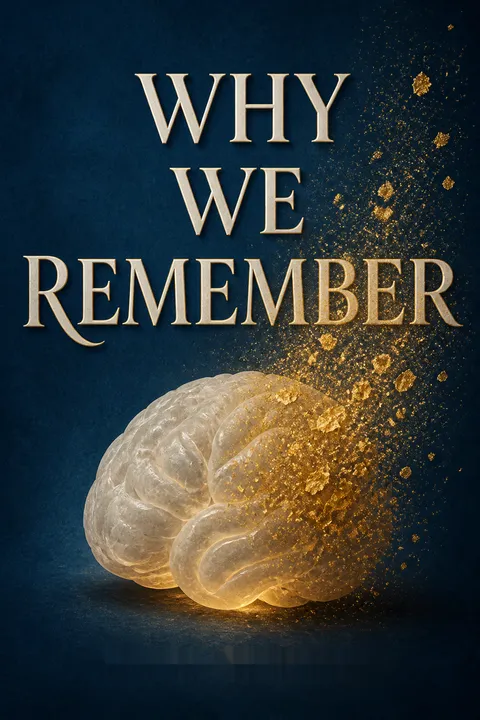


Key Takeaways
Use memory to steer the future, not to archive every past detail.
Forgetting has a purpose. Memory is selective because the brain must prioritize information that helps it navigate a changing world, not preserve a perfect record. That is why Ranganath reframes the question from why we forget to why particular things stick. In Hermann Ebbinghaus's experiments with meaningless letter lists, he forgot nearly half within twenty minutes and about two-thirds after a day. Those findings do not precisely describe memories of meaningful life events, but they show how quickly unprioritized information fades.
The memorable exception. Ranganath filmed many of his daughter's birthday parties, yet could scarcely recall most of them. The one he remembered vividly was a chaotic party at home, where candy, mud, and a stubborn piñata turned the afternoon into an ordeal. Distinctiveness, not importance alone, helped it survive.
This view replaces the fantasy of memory as a private video archive with a more useful model: a system that keeps what helps action and prediction. That shift can ease everyday anxiety about forgotten names or blurred milestones. It also explains why accuracy matters differently across settings. A fuzzy memory of a pleasant afternoon is usually harmless; a confident recollection used to accuse someone is not. The practical question is less whether memory is good or bad, and more whether its limits fit the decision being made.
Give ordinary moments a distinctive cue before distraction erases them.
Attention selects what lasts. A memory can be hard to find when it competes with many similar experiences. Ranganath calls this competition interference. When you put down your keys while checking messages, greeting a dog, and listening to music, the moment may leave no distinctive trace. Later, it competes with every other time you put the keys somewhere.
Make the moment stand out. Attention is what the brain prioritizes; intention is the deliberate effort to direct that attention. Instead of vaguely noticing the keys, register one feature of the moment, such as the unusual mail beside them. The prefrontal cortex helps coordinate this goal-directed focus, resist distractions, and use strategies. It is less a storage box than an executive directing other systems. Sleep loss, stress, and constant task-switching can undermine that coordination.
The advice is a small example of a broader design principle: when a future action depends on remembering, make the relevant cue distinctive at the point of encoding. This is especially useful for prospective memory, remembering to do something later, which often fails amid routine rather than because information vanished. External reminders remain valuable; a phone alert is not a failure of memory but a tool that protects attention. The brain's executive control is limited, so good systems should not require it to supervise every ordinary action.
Rebuild the setting to retrieve what seems forgotten.
Context is a retrieval handle. Episodic memory is recollection of a particular event in its setting, including its time, place, and surrounding details. Semantic memory is knowledge that can be used without recalling when or where it was learned. The hippocampus helps link the parts of an episode so that a cue can bring related details back together. Ranganath describes old memories of India returning when he is surrounded by its distinctive heat, sounds, smells, and colors.
Use the surrounding clues. If a wallet is missing, mentally revisit where you were and what you were doing when you last had it, rather than searching only where it usually goes. Context also shifts at event boundaries, such as entering a new room. In a survey of 120 students during lockdown, 95 percent said days felt slow, while 80 percent felt weeks passed quickly, amid repetitive days with few memorable boundaries.
Context-dependent recall helps explain why a seemingly lost memory can return with the right cue, but it also warns against treating recall as a simple search through files. A familiar smell or place can unlock useful information, while a changed context can make access difficult. In practice, retracing steps is not merely a metaphor: reconstructing goals, surroundings, and recent actions can generate better retrieval cues. The method is not guaranteed, and a context that feels vivid does not certify that every detail recalled within it is accurate.
Let schemas compress experience, while episodic memory protects exceptions.
Patterns save mental space. A schema is a reusable framework for organizing familiar information. It lets someone recognize the usual structure of an event without encoding every repeated detail from scratch. Chunking similarly groups separate pieces into a more manageable unit. In the United States, a nine-digit Social Security number is easier to handle as three groups than as nine unrelated digits. Memory athletes use more elaborate versions of the same principle.
Expertise is organized knowledge. Chess grand masters can remember a realistic board after a brief look because they recognize familiar arrangements. Put the pieces in random positions, and their advantage largely disappears. The brain's hippocampus can rapidly preserve a particular episode, including unusual exceptions, while the neocortex gradually extracts broader regularities. This division helps people learn a general rule, such as most birds fly, without losing the specific fact that penguins do not.
Schemas are efficient because they let prior knowledge guide perception, memory, and prediction. They resemble a useful prior in statistical reasoning: the mind starts with what is typical, then adjusts when evidence differs. That is a strength, not merely a source of bias. But the same compression can erase the unusual detail that matters most, especially when a case is forced into a familiar category. Good judgment therefore depends on holding two questions together: what usually happens, and what in this instance does not fit?
Treat vivid memories as useful reconstructions, not perfect recordings.
Remembering involves imagination. Ranganath draws on psychologist Frederic Bartlett's account of memory as reconstruction. In Bartlett's study, British students retold a Native American folktale unfamiliar to them, gradually changing its details to match their own expectations. The brain retrieves fragments and uses schemas to build a coherent account, rather than replaying an intact recording.
Check the source of detail. In a classic word-list experiment, people who studied many words related to anger often later remembered the related word anger, although it had not appeared. The feeling of remembering can be strong even when a detail was inferred. Reality monitoring means evaluating whether a mental image came from direct experience, imagination, or information heard later. Sensory detail can help, but vividness alone is not proof. A reconstruction may preserve real elements while getting the overall story wrong.
A reconstructive memory system has a creative advantage: it can recombine past experience to imagine possibilities and plan. Its cost is that coherence can masquerade as evidence. This distinction is especially important in interviews, therapy, and legal settings, where a compelling narrative can emerge from suggestion as well as experience. The right response is neither to distrust every recollection nor to treat confidence as verification. Independent corroboration and careful questions help separate what someone experienced from what their mind reasonably filled in.
Separate the remembered event from the emotion it reignites.
Feeling and recollection differ. The hippocampus helps recover an event's context, while the amygdala links emotionally charged experiences with bodily responses. They work together, but they do not do the same job. A person can recall what happened without reexperiencing its emotional force, or show a threat response without consciously remembering its source. Emotional arousal also narrows attention, strengthening memory for salient details while leaving other parts less clear.
The past can feel present. Ranganath describes a Gulf War veteran who prepared the bodies of dead soldiers and later experienced nightmares and persistent distress. Treatment helped her ground herself in present safety when traumatic memories arose. Stress can also impair attention and make retrieval harder. Dopamine, meanwhile, is more involved in motivation to seek rewards than in pleasure itself, helping explain why a craving can persist even when its expected payoff disappoints.
The separation between an event and its emotional response creates room for change without requiring denial of the past. A powerful bodily reaction is important information about a person's current state, but it is not a measurement of how accurately every remembered detail is being retrieved. This distinction supports compassionate responses to trauma while avoiding the mistaken demand that survivors simply reason their way out of distress. Stress effects vary among people and situations, so clinical approaches need more than a single brain-based explanation.
Do not mistake familiarity for evidence or independent judgment.
Familiarity can exist without recall. Someone may feel certain a face or place is known without retrieving a particular encounter. Ranganath describes this as distinct from episodic recollection. The perirhinal cortex contributes to familiarity, while the hippocampus is especially important for retrieving context. Repeated exposure can also make a name, idea, or product feel more appealing, a pattern known as the mere exposure effect.
Fluency quietly guides choices. People in one study were more likely to name a laundry detergent after seeing a related word pair, yet explained their answer with reasons unrelated to that exposure. Familiarity can also produce unconscious borrowing: George Harrison's song melody resembled an earlier hit he knew but said he had not deliberately copied. Face recognition has similar limits. One review found people recognized faces from their own racial group, on average, 1.4 times better than faces from other groups.
Familiarity is a fast and often useful shortcut. It lets perception and recognition run more efficiently, but efficiency is not the same as truth. Repetition can make a claim feel credible, and exposure can make a face seem known even when its distinctive features were never learned well. That has consequences beyond advertising, including eyewitness identification and algorithmic face matching. Deliberately asking what supports a judgment, apart from the sense that it feels familiar, can interrupt this shortcut without requiring suspicion of every intuitive response.
Turn surprise into curiosity before uncertainty hardens into avoidance.
The unexpected grabs attention. Memory supplies expectations about what should happen; a mismatch can trigger an orienting response, the brain and body's coordinated shift toward something new or surprising. Ranganath recounts entering his apartment after a burglary and feeling that the moved furniture and open window were wrong before he understood why. Such a response can direct attention before conscious recognition catches up.
Curiosity can broaden learning. Psychologist George Loewenstein describes curiosity as an information gap between what someone knows and wants to know. In Ranganath's trivia experiments, people remembered answers better when a question made them curious. They also remembered unrelated faces shown while waiting for those answers. Curiosity can therefore prepare the brain to learn incidental information, though uncertainty can provoke anxiety when the person feels unable to close the gap.
Surprise is not automatically a lesson. It first signals that a prediction failed, then attention and motivation determine whether the person investigates, withdraws, or dismisses the anomaly. Curiosity is most constructive when the unknown feels approachable, a useful insight for teaching and for organizations that want people to surface problems. A climate that punishes uncertainty can turn the same information gap into concealment. Yet curiosity should not be romanticized: in genuinely dangerous settings, caution may be wiser than exploration.
Every recollection can edit the memory it seems to replay.
Retrieval can update memory. Remembering is not always passive playback. Information available in the present can become blended with an older recollection, so later versions may include details that were learned or imagined afterward. In one study, participants who saw a car stop at a stop sign were later asked a question that referred to a yield sign. Many eventually remembered the incorrect sign.
Suggestion raises the stakes. In the case of Richard Ivens, an innocent man under intense interrogation confessed to a murder, then denied remembering the confession. The episode illustrates the danger of pressure and supplied details. Laboratory studies of memory implantation found that about one in three participants developed confident false memories under particular conditions, including repeated recall and misinformation from a trusted source. This does not mean memory is useless or that trauma survivors are generally unreliable. Memory is malleable, not limitless.
This research has direct implications for investigative practice: questions can shape the evidence they appear to collect. Open-ended interviewing, avoiding confirming feedback, and recording initial accounts help reduce contamination. The nuance matters just as much. Lab demonstrations of false memory do not license blanket dismissal of testimony, especially when people may accurately recall significant aspects of trauma. The responsible position is procedural humility: treat recollections seriously, assess how they were elicited, and seek independent evidence where possible.
Practice retrieval, space it out, then let sleep connect the pieces.
Struggle can strengthen learning. Error-driven learning describes how the brain can refine a memory when retrieval exposes what is not yet secure. In a study comparing repeated rereading with retrieval practice, students who tested themselves retained more than 85 percent of the material after a week, while the rereading group retained about half. The effort is useful when feedback helps correct mistakes; random struggle without guidance is less helpful.
Give learning time to reorganize. Spacing study sessions across different days makes retrieval harder at first, but can make knowledge less tied to one study context. Sleep also reactivates and integrates recent experiences, helping the brain find connections across them. In one technique, sounds paired with learning were replayed during deep sleep, improving memory for associated material. The evidence supports protecting sleep and using retrieval practice, not treating any one trick as a guaranteed shortcut.
The educational implication is to measure learning by durable access, not by the comfort of rereading. Retrieval practice reveals gaps while there is still time to repair them, and spacing turns those repairs into repeated, context-varied access. Sleep may then support integration rather than simply storing a finished lesson. These methods are most effective when mistakes receive informative feedback and tasks are pitched within reach. Difficulty alone is not a virtue; productive difficulty must leave a learner able to identify what changed.
Build shared stories deliberately, because groups can heal or distort memory.
Stories shape identity. Memories are continually reconstructed in conversation with family, friends, and communities. Research on parent-child reminiscence suggests that open-ended questions and attentive follow-up help children form fuller accounts of their experiences and a stronger sense of authorship over their own stories. Ranganath's veterans' group used shared discussion to reinterpret painful memories in a supportive setting.
Groups also prune and spread errors. People remembering together can recall less than the same people working separately, partly because one person's details interfere with another's. The first or most confident speaker can dominate the shared account, and repeated social transmission tends to preserve stereotype-consistent or negative details. In an online study described in the book, fact-checking after exposure to fabricated headlines made participants 25 percent less likely to endorse them. Diverse voices and active correction can protect a group's account from becoming too narrow.
Collective memory is a form of distributed thinking: no individual holds every relevant detail, but conversation can combine knowledge and provide retrieval cues. Its weakness is unequal influence. Confidence, status, and speaking order can determine which version becomes the group's accepted past. Good discussion therefore requires more than inviting people into the room; it requires making space for quieter accounts and checking claims that feel familiar. Shared stories can support repair and belonging, but they should remain open to revision rather than hardening into unquestionable group identity.
Analysis
The book's central move is to replace the storage metaphor with a functional one. Memory is not a faithful archive that sometimes malfunctions; it is a selective, reconstructive system that helps organisms orient, learn, imagine, and choose. This reframing unifies mechanisms that can otherwise seem contradictory. The hippocampus binds events to contexts, schemas compress recurring structure, familiarity speeds recognition, and executive control directs attention. Their cooperation makes flexible intelligence possible, while each component introduces characteristic errors.
The most valuable implication is epistemic, not merely mnemonic. Confidence, emotional intensity, and familiarity are experiences generated by the system, not independent guarantees that its output is accurate. Yet the same reconstructive flexibility that creates distortion also supports generalization, counterfactual thought, creativity, and revision of painful interpretations. The challenge is not to eliminate memory's errors, an impossible goal, but to match confidence and procedure to the stakes. Everyday recollection can tolerate approximation; criminal judgments require corroboration and methods that limit suggestion.
The book also makes memory social. A personal identity is partly assembled through conversations, family narratives, and cultural accounts. Collaboration may cue details and support healing, but it can also suppress minority recollections and stabilize shared misinformation. This means memory competence is not only an individual skill. It depends on environments that protect attention, invite curiosity, support sleep and retrieval, and allow dissenting perspectives to remain audible.
Some neuroscience explanations are necessarily simplified. Brain regions do not work as isolated modules, and mechanisms demonstrated in scanners, animals, or laboratory word lists do not automatically predict every real-world case. Ranganath often marks this gap, especially around stress and memory updating. The broad thesis nevertheless holds up as a practical model: encode what matters with intention, use context to retrieve, test recollections rather than worship their vividness, and treat memory as a living guide to action rather than a transcript of the past.
Review Summary
Why We Remember explores the science of memory, explaining how memories shape our identities and experiences. Ranganath combines research with anecdotes to discuss memory formation, retrieval, and malleability. Readers found the book accessible and insightful, praising its exploration of memory's role in decision-making and perception. Some criticized its textbook-like presentation, while others appreciated its practical applications. Overall, reviewers considered it a fascinating dive into the complexities of human memory, offering valuable insights for both laypeople and neuroscience enthusiasts.
People Also Read








Glossary
Episodic memory
Memory for situated eventsEpisodic memory is the capacity to recollect a particular event as belonging to a specific time and place. It can bring back aspects of the context and a sense of mentally revisiting the past. In the book's account, the hippocampus is essential for binding event elements into this context-specific form of memory.
Semantic memory
Context-independent knowledgeSemantic memory is knowledge of facts, meanings, and general information that can be used without recalling the specific occasion on which it was learned. Knowing that Paris is in France is semantic memory; mentally revisiting a particular trip there is episodic memory. The book links semantic learning especially to gradual knowledge-building in the neocortex.
Schema
Reusable mental frameworkA schema is a framework for organizing and interpreting familiar information. It captures recurring features of objects, places, people, or events, allowing the brain to process new experiences efficiently and focus on what differs. Schemas aid prediction and memory, but can also lead people to fill gaps with what usually happens rather than what happened this time.
Default mode network
Network for internal modelsThe default mode network is a connected set of brain regions active during internally oriented thought, including autobiographical remembering, imagination, navigation, and making sense of stories. Ranganath describes it as helping represent reusable knowledge and schemas. In concert with the hippocampus, it supplies components that can be assembled into a memory of a particular event.
Reality monitoring
Checking a memory's sourceReality monitoring is the process of judging whether information in a mental experience came from direct perception, imagination, thought, or another source. It can use features such as sensory detail and the way an experience was generated. It is imperfect, especially when a person is stressed, distracted, or vividly imagining an event.
Mere exposure effect
Exposure increases likingThe mere exposure effect is the tendency for repeated encounters with a stimulus to increase liking or preference, often without conscious awareness of the influence. Familiarity can make a word, brand, tune, or face feel easier to process and more appealing. Because this fluency may be mistaken for independent judgment, repetition can subtly steer decisions.
Orienting response
Attention shifts to noveltyThe orienting response is a coordinated shift in attention and bodily activity when something unexpected or surprising occurs. It involves changes in brain activity and physiological readiness that help a person investigate what has changed. In the book, the response links memory-based expectations with attention to novelty and the formation of new memories.
Error-driven learning
Learning through mismatchError-driven learning is a process in which a mismatch between an attempted retrieval or action and a desired result helps refine the relevant neural connections. Testing can expose what a learner does not yet know, and feedback can strengthen or adjust the memory. The benefit depends on errors being correctable, rather than on failure for its own sake.
Retrieval-induced forgetting
Recall weakens competitorsRetrieval-induced forgetting occurs when recalling one item makes related, competing items harder to retrieve. Practicing a subset of material can strengthen those items while suppressing alternatives that overlap but were not practiced. The effect depends on how memories compete and is not inevitable; related details from the same event can sometimes benefit instead.
Targeted memory reactivation
Sleep cues reactivate learningTargeted memory reactivation is a research technique in which a cue associated with learning, such as a sound, is presented again during sleep. The cue can reactivate related material without waking the sleeper, and studies described in the book found improved memory for some associated information. It is an experimental method, not a guaranteed general-purpose memory aid.
Collective memory
A group's shared pastCollective memory is the shared account of the past that develops as people communicate, remember together, and interpret events within a community. It shapes group identity and can combine different people's knowledge, but social influence also filters out details and spreads errors. The account may be disproportionately shaped by people who speak first, confidently, or often.
FAQ
What's Why We Remember about?
- Exploration of Memory: The book delves into how memory shapes our identity, influences decisions, and affects emotions. It presents memory as a dynamic process that helps us navigate the present and future.
- Understanding Forgetting: Charan Ranganath argues that forgetting is essential, allowing us to prioritize important information. The focus is on why we remember rather than why we forget.
- Interconnectedness of Memory and Emotion: The book explores how emotions impact memory formation and recall, highlighting the role of neuromodulators like noradrenaline and dopamine.
Why should I read Why We Remember?
- Insight into Human Experience: It provides a comprehensive understanding of memory functions, essential for those interested in psychology, neuroscience, or personal development.
- Practical Applications: Ranganath offers practical advice on improving memory retention and navigating the complexities of remembering, applicable to learning and decision-making.
- Engaging Narratives: The book includes engaging stories and case studies that illustrate memory principles in real-life contexts, making complex concepts accessible.
What are the key takeaways of Why We Remember?
- Memory is Dynamic: Memory changes each time we recall an event, influenced by new information and experiences.
- Importance of Context: Context plays a significant role in memory retrieval, with the right environment triggering dormant memories.
- Emotional Influence: Intense emotional experiences are more memorable, with the amygdala and hippocampus playing key roles in this relationship.
How does Why We Remember define memory?
- Memory as a Process: Ranganath defines memory as an imaginative reconstruction, highlighting the active role our brains play in shaping memories.
- Episodic vs. Semantic Memory: The book distinguishes between episodic memory (personal experiences) and semantic memory (general knowledge), explaining their interaction.
- Role of the Hippocampus: The hippocampus is crucial for forming and retrieving memories, particularly episodic ones, helping us connect past experiences to the present.
What are the best quotes from Why We Remember and what do they mean?
- “Memory is much, much more than an archive of the past...”: This quote emphasizes that memory shapes our identity and perceptions, influencing our interactions with the world.
- “We are not supposed to remember everything from our past.”: It challenges the misconception that we should retain all memories, highlighting forgetting as a natural process.
- “Remembering is not the re-excitation of innumerable fixed, lifeless and fragmentary traces...”: This reflects the view that memory is an active process, shaped by context and emotions.
How does Why We Remember explain the forgetting process?
- Natural Human Experience: Forgetting is fundamental, allowing us to prioritize and retain relevant information for effective decision-making and learning.
- Forgetting Curve: The book references Hermann Ebbinghaus's forgetting curve, illustrating how quickly we forget information after learning it.
- Interference and Context: Interference from similar memories can lead to forgetting, while context plays a crucial role in memory retrieval.
What techniques does Why We Remember suggest for improving memory?
- Chunking Information: Grouping information into manageable units enhances memory retention, allowing efficient processing and recall.
- Using Intention and Attention: Focusing on unique aspects of an experience helps create distinctive memories, guided by intention.
- Testing Effect: Self-testing as a learning tool reinforces memory retention, leading to better long-term retention compared to passive studying.
How does Why We Remember connect memory to social interactions?
- Memory and Relationships: Memories are shaped by social interactions, with shared experiences creating stronger memories.
- Collective Memory: Groups share and shape memories together, influencing cultural narratives and personal identities.
- Impact of Misinformation: Social interactions can lead to misinformation, affecting memories, particularly in legal contexts.
What role do emotions play in memory according to Why We Remember?
- Emotional Arousal: Emotionally charged experiences are more memorable due to neuromodulators like noradrenaline enhancing retention.
- Amygdala's Function: The amygdala links emotions to memories, making them feel vivid and immediate.
- Impact on Decision-Making: Emotions influence decisions, often leading us to act based on past emotional experiences.
How does Why We Remember address the concept of false memories?
- Malleability of Memory: Memories can be altered through suggestion and misinformation, leading to false memories.
- Experiments on False Memories: Studies, such as those by Elizabeth Loftus, show how easily false memories can be implanted.
- Reality Monitoring: Reality monitoring helps distinguish between real and imagined memories, mitigating false memory effects.
How does sleep affect memory according to Why We Remember?
- Memory Consolidation During Sleep: Sleep, particularly slow-wave and REM stages, plays a crucial role in consolidating memories.
- Targeted Memory Reactivation: Specific memories can be cued during sleep to enhance recall, improving learning outcomes.
- Neural Activity During Sleep: The hippocampus and neocortex interact during sleep to facilitate memory processing, transforming experiences into lasting knowledge.
What is error-driven learning in Why We Remember?
- Definition of Error-Driven Learning: The brain learns from mistakes during memory retrieval, identifying weak connections for updates.
- Practical Implications: Embracing errors leads to more effective learning strategies, enhancing long-term retention.
- Examples in Learning: Testing oneself reveals knowledge gaps, prompting targeted study efforts and reinforcing memory connections.
Download PDF
Download EPUB
.epub digital book format is ideal for reading ebooks on phones, tablets, and e-readers.








