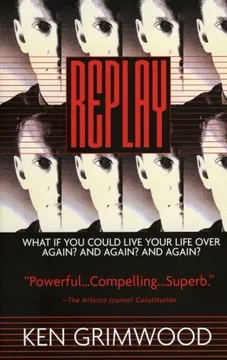


Plot Summary
The First Heart Stops
In 1988, New York radio news director Jeff Winston collapses during a call with Linda, his distant wife. He expects death, then wakes in his Emory dorm room in 1963, eighteen years old again, with his adult memories intact. His roommate Martin Bailey is alive, though Jeff remembers Martin’s later suicide, and familiar campus details confirm this is not a hospital dream.
Jeff checks the date, sees his young reflection, and realizes his whole life has apparently been folded back into his college years. His marriage, stalled career, and lost hopes are still ahead of him, but so are choices he once made without knowing their consequences. He has returned to the beginning with a past no one else remembers.
The opening makes regret concrete before it makes time travel extraordinary. Jeff’s thoughts at death dwell on the unspoken needs of his marriage, not on grand achievements, establishing the emotional problem the replay cannot automatically solve. His memories give him power, but they also separate him from Martin and Linda, who meet him as a young man rather than as someone who has already shared decades with them. The altered youth of his body is less a gift than a forced encounter with the self he once was, now burdened by knowledge that cannot be shared.
Chateaugay's Long Shot
Jeff tests whether his memories contain reliable facts by wagering nearly everything he can gather on Chateaugay in the 1963 Kentucky Derby. Student Frank Maddock places the bet for him, and the horse wins, multiplying Jeff’s stake.
Jeff then backs Chateaugay at the Belmont and, with Frank, risks their accumulated money on the Dodgers sweeping the Yankees in the World Series. All four games fall as Jeff remembers, and the partners collect more than twelve million dollars. Jeff stops asking whether he is imagining the future: the results have answered that.
With Frank managing operations, he turns the winnings into Future, Inc., buying stocks and property ahead of trends he remembers. His financial precarity vanishes, but the knowledge that made him rich remains unexplained.
The bets give Jeff’s impossible knowledge an immediate, measurable use. Money offers relief from the ordinary humiliations he remembers, while gambling’s clean outcomes temporarily quiet his deeper uncertainty. Yet the partnership with Frank is built on an asymmetry Jeff cannot honestly explain: one man stakes money, the other knows the result. Their success therefore generates intimacy and suspicion at once. Jeff’s first response to freedom is not to repair his private life, but to control the future through prediction. The market rewards that impulse, even as it leaves untouched the emotional failures that made his earlier life feel empty.
Kennedy Still Dies
As Future, Inc. prospers, Jeff becomes troubled by the coming assassination of President John F. Kennedy. He travels to Dallas and sends a threatening letter in Lee Harvey Oswald’s name, hoping Secret Service attention will prevent the killing.
Oswald is arrested, but Kennedy is shot anyway. A different man, Nelson Bennett, is named as the assassin and is later killed by Jack Ruby. Jeff’s intervention has altered details without changing the catastrophe.
Frank, unnerved by Jeff’s apparent advance knowledge and the Dallas trip, leaves the partnership, though Jeff keeps the company. The failed rescue punctures Jeff’s sense that foreknowledge makes him master of events: he can redirect a life or a fortune, but history seems to resist his most consequential attempt to steer it.
The assassination is Jeff’s first moral test, and its failure complicates the fantasy of replay as a clean second chance. His intervention is not passive observation, but neither does good intent guarantee a better outcome. The changed identity of the assassin suggests that history may absorb local disturbances while preserving its larger violence, though Jeff cannot know whether this is a rule or coincidence. Frank’s departure matters because it removes the one person who helped turn Jeff’s private advantage into public power. After Dallas, Jeff is wealthy but less certain that knowledge confers responsibility he can successfully discharge.
Linda Becomes a Stranger
Jeff pours money into stocks and enjoys an intensely physical relationship with Sharla Baker, the Las Vegas woman he met after the Derby. The arrangement loses its allure, so he pays Sharla to leave and later seeks Linda, the woman who became his wife in the life he remembers.
On a Boca Raton beach, he approaches her as if their shared past should bind them. Linda sees only a rich stranger who knows too much about her and rejects his calls and letters. Jeff cannot recover a relationship by importing its history into someone else’s present.
He marries Diane, a socially polished heiress, and their daughter Gretchen becomes the center of his affection. Wealth gives him comfort and a child he once longed for, but cannot restore the marriage he wanted.
Jeff’s attempt to reclaim Linda exposes the ethical limit of memory: a relationship is not shared merely because one person remembers it. His intimacy with Sharla and marriage to Diane each offer forms of connection, but neither can reproduce the mutual recognition he seeks. Gretchen changes the stakes. Jeff’s love for his daughter is not an investment or a correction of the past; it is a genuine attachment formed in this life. The contrast between his financial command and emotional helplessness prevents success from functioning as compensation. He can purchase security, but not another person’s trust or the precise family he imagines.
Gretchen's Borrowed Childhood
Jeff gives Gretchen a protected, affectionate childhood on his Dutchess County estate, even as his marriage to Diane remains brittle. He keeps Martin employed and financially secure, hoping to prevent the ruin that once drove his friend to suicide. A doctor finds Jeff’s heart healthy, but in October 1988 he collapses beside the river and dies anyway.
He wakes in 1963, in Martin’s car after a screening of The Birds, with Judy Gordon beside him. The return strips away Gretchen, the child he and Linda could never have had in his first life and whom he has now loved as a father. His knowledge of the future has not spared him from loss; it has taught him exactly what has vanished.
Gretchen’s life makes the replay’s central paradox intimate: an experience can be emotionally real and still be erased from everyone else’s world. Jeff’s precautions for Martin show that he can improve someone’s material circumstances, but they do not give him control over mortality or recurrence. His return beside Judy forces grief into the same space as youthful innocence. The child’s absence is not a puzzle to solve but a loss that no one around him can recognize. This is where Jeff’s accumulated knowledge begins to feel less like privilege than a private archive of people who do not remember him.
Judy's Ordinary Future
After waking beside Judy, Jeff initially withdraws from her, unable to bear rebuilding a love that has just been erased. He soon returns to her, however, and chooses a quieter path. He avoids the huge Derby and World Series wagers, finishes his education, and marries Judy in 1968.
They build a modest investment business and a peaceful life. When they cannot have children, they adopt April and Dwayne, giving them a home and adventures such as rafting the Chattooga River.
Jeff refuses to tell Judy about his vasectomy or the daughter he lost in another life, but he accepts adoption as a way to love children without fearing he has created lives that can be erased. He reaches 1988 expecting another death, despite medical precautions and hospital monitoring.
This life is Jeff’s deliberate experiment in limits. He gives up extraordinary wealth not because he has ceased to understand its uses, but because he wants a life whose scale does not overwhelm intimacy. Judy’s openness contrasts with the transactional relationships he pursued before, while adopting April and Dwayne lets the couple form a family through care rather than biological expectation. Yet Jeff’s secrecy shows that restraint is not the same as freedom from fear. He makes a loving home while privately organizing it around the possibility that everything will disappear. The ordinary life he chooses is meaningful precisely because he cannot guarantee its permanence.
The Cabin Above Shasta
Jeff’s heart fails again in 1988 despite his hospital precautions. He wakes in 1963, flees from Judy and Martin, and later seeks out Sharla in Las Vegas, choosing the old escape of sex, alcohol, and drugs over another family he expects to lose.
A near-fatal aircraft failure on a flight to Hawaii finally breaks that routine. Jeff leaves Sharla and withdraws to an isolated farm near Mount Shasta, where he works the land and avoids close relationships. Years later, a local shopkeeper’s account of an unfamiliar hit film, Starsea, draws him back into the world.
Its vision of humans, dolphins, and distant life echoes ideas he has carried privately. Jeff seeks out its creator, Pamela Phillips, and discovers that another person remembers lives that have already ended.
Jeff’s retreat is both a defense against attachment and an attempt to find steadiness in work that repeats without becoming identical. Farming offers seasonal continuity, but it cannot meet his need for human touch. The plane emergency briefly restores the instinct to live, even as Jeff turns away from Sharla afterward. Starsea breaks his isolation because it places his private questions into a public artwork. The film does not solve the mystery, but it provides evidence that someone else has made meaning from a similar rupture. Jeff’s turn toward Pamela begins not in romance, but in the recognition that solitude has become another form of surrender.
A Film Finds Its Witness
Pamela tells Jeff that she has also returned to earlier points in her life. In one life she became a physician caring for children; in another she became an artist, married Dustin Hoffman, and made Starsea.
She created the film to awaken people to the repeated nature of existence, but her follow-up, Continuum, proves too abstract to reach its audience. Jeff distrusts her plan to guide humanity, and their first conversations end in anger. When Pamela later visits his cabin, she admits the film failed and accepts that her work still mattered as an act of creation.
Jeff, in turn, stops treating her ambition as a threat. They travel together, share their histories, and become partners in confronting the mystery, finding in each other the first person capable of understanding their losses.
Pamela and Jeff embody competing responses to the same rupture. She tries to make private knowledge socially transformative; he distrusts projects that claim to redeem humanity, especially after his failed effort to save Kennedy. Their conflict is not simply optimism against pessimism. Pamela’s filmmaking gives form to experience, while Jeff’s skepticism guards against confusing artistic reach with actual control. Her willingness to acknowledge Continuum’s failure allows their relationship to move beyond ideological combat. Their eventual closeness comes from a more modest recognition: neither can explain the phenomenon, but each can witness what it has cost the other.
The Killer's Appeasement
Jeff and Pamela place notices seeking others who remember the future. One reply leads them to Stuart McCowan, a repeat returner confined to a psychiatric institution after murdering four young women. Stuart claims that alien beings watch human history as entertainment and that repeaters must commit violence to keep them interested.
Jeff and Pamela reject his explanation, but learn that Stuart believes his crimes are a duty and intends to kill again if released. His case forces them to confront the danger of exposing their experiences to people who may be unstable or exploit the idea.
They cannot safely reason him out of murder, nor can they rely on his confinement forever. The encounter changes their search: finding others is no longer only a route to understanding, but a question of responsibility.
Stuart’s story turns repetition from a private metaphysical burden into a vehicle for harm. His belief in an audience beyond Earth converts murder into performance and gives his violence an invented moral purpose. The novel does not confirm his cosmic account; the danger lies in the way a theory can organize a person’s actions, whether or not it is true. Jeff and Pamela face an uncomfortable asymmetry: they possess foreknowledge but not a reliable means to intervene. Stuart also anticipates their later public strategy, demonstrating that disclosure can protect people while exposing others to stigma, institutional control, or dangerous ideas.
Foreknowledge Goes Public
To make scientists take them seriously, Jeff and Pamela publish a year of specific predictions and explain that they remember events from lives already lived. Reporters ridicule their account, but the forecasts come true: a plane crash kills fewer passengers after warnings prompt travelers to stay away, and residents flee ahead of deadly storms.
Their public warnings also prevent the aircraft carrier Melbourne from colliding with the destroyer Evans. The pair name Stuart McCowan in their press conference, drawing scrutiny to him before he can repeat his crimes.
Their evidence gains the attention of the State Department, which wants to use their knowledge for national security. Jeff and Pamela have proved that they can alter outcomes, but the audience they hoped to reach now includes officials with power to act on their information.
Going public is a strategic answer to disbelief, but it transforms knowledge into a public resource that others can claim. The saved passengers and storm victims establish that their interventions matter, directly challenging Jeff’s earlier conclusion that history cannot be changed. Yet the same forecasts invite government attention and turn the couple into instruments of policy. Their exposure of Stuart shows the most ethically compelling use of foreknowledge, protection of identifiable potential victims. The difficulty is that prediction cannot be cleanly separated from power: once officials believe Jeff and Pamela, they will ask not only what they know, but what their knowledge can help the state do.
The State Takes Them
State Department representative Russell Hedges brings Jeff and Pamela into secret consultations, demanding information about coups, wars, and foreign leaders. Their warning about Libya leads to the killing of Muammar Qaddafi before he can take power; his brother’s retaliatory November Squad then launches terrorist attacks.
As the altered world grows more violent, Jeff and Pamela lose confidence in their predictions because events no longer match the future they remember. Hedges nevertheless keeps them under guard, subjects them to interrogations, and treats uncertainty as withholding.
Pamela blames their choices, and their partnership breaks under guilt and anger. In 1988 Jeff wakes again in Miami, where Linda arrives with daisies, while the dangerous world shaped by their advice continues along a new path.
The government’s involvement exposes the danger of treating foreknowledge as neutral intelligence. Jeff and Pamela offer partial, morally selected information; officials translate it into interventions whose consequences multiply beyond their control. Their responsibility is real, but not total, a distinction they struggle to preserve as the world deteriorates. Pamela’s anger expresses grief for victims and self-reproach for having entered the bargain; Jeff’s insistence on limits can sound like evasion because he has also chosen what to reveal. Their separation is therefore both personal and political. The new 1988 return does not erase the damage; it carries the weight of a world they helped alter.
Daisies, Then Distance
In another altered replay, Jeff returns in 1968 and finds Linda at his apartment, young and in love with him again. He leaves radio work, builds a life with her, and writes books about isolation and exile. Pamela returns years later, in 1974, as a mother with a husband and another child on the way.
She and Jeff meet, but she puts her children first and refuses to disrupt their family. Years later they secretly grow close after Pamela resumes making art, while Jeff’s own relationship with Linda falters.
Their intimacy lasts until Pamela suddenly regains the memories of her other lives in Central Park on October 13, 1988. She sees that Jeff has loved her without understanding who she was in that moment and accuses him of using her. Pamela leaves, and Jeff loses her again just before his expected death.
The shifted return dates make the couple’s reunion less a romantic reward than a collision between incompatible obligations. Jeff’s life with Linda is genuine, as are Pamela’s commitments to her children; their past intimacy cannot erase the claims of the present. The secret affair grows from affection but also from a profound imbalance: Jeff knows the shared history that Pamela does not yet remember. Her awakening recasts the relationship without making her earlier feelings false. The scene asks whether love can respect a person’s present self when one partner knows a hidden past. Pamela’s departure insists that memory grants knowledge, not ownership.
One Minute Past Death
Jeff dies on October 18, 1988, then awakens in his original office and is trapped in a sequence of heart attacks and returns to the same minute. Each reset ends at the same call from Linda. Eventually, at 1:09, his heart keeps beating and time advances. Jeff phones Pamela, who confirms that she remembers their lives too, but is caring for her children in the present.
He no longer knows whether they will reunite, and he must also face the marriage he once failed to discuss honestly with Linda. Instead of treating life as an endless supply of retries, Jeff accepts that this time has an unknown limit. He chooses to step back into the newsroom and meet events without knowing their outcome.
The final loop turns the novel’s recurring mechanism into a psychological ordeal: Jeff is forced to experience death without the consoling distance of another immediate restart. Survival arrives not as proof that he has solved the mystery, but as the first moment he cannot reduce to remembered outcomes. His call to Pamela confirms that the preceding lives were real to both of them, while her children keep their reunion uncertain. The ending therefore refuses the fantasy of a perfectly repaired past. Jeff’s new freedom comes from finitude: he must act without assuming another chance, and love without making another person’s life answer to his memories.
Epilogue
Peter Skjøren, a Norwegian businessman, dies in 2017 while visiting the Bantu Republic and wakes decades earlier in the shop where he began his career. His son and wife, whose losses shaped the future he remembers, have not yet entered his life.
Peter understands that he has been given another chance to avoid his former mistakes. His return confirms that Jeff and Pamela’s experience is not unique, while offering no explanation for the force that sends people back.
Peter’s brief return widens the story beyond Jeff and Pamela without supplying the cosmic answer they sought. His memories are specific and painful, shaped by family losses rather than financial power or artistic ambition. Like Jeff, he interprets another life as an opportunity to correct what went wrong, a tempting conclusion the novel has repeatedly complicated. The epilogue leaves open whether Peter can change his fate or merely make it different. By ending on another person at the beginning of a replay, the book restores the cycle’s unsettling scale just as Jeff has chosen to live without certainty.
Analysis
Replay treats foreknowledge less as a superpower than as a pressure placed on ordinary moral judgment. Jeff can get rich by remembering a horse race, but the same certainty does not let him recover Linda’s trust or keep the people he loves. The novel repeatedly distinguishes knowing an outcome from understanding its causes. Jeff’s attempt to save Kennedy changes the assassin’s identity without preventing the murder; later, his and Pamela’s public warnings save lives, then draw the government into decisions that generate new violence. Neither simple fatalism nor confident intervention proves adequate.
The emotional center is the mismatch between private memory and shared reality. Jeff remembers Martin’s death, a daughter no one else has met, and a marriage Pamela may not yet remember. His memories are evidence to him, but they cannot automatically become obligations for other people. Pamela’s rejection in Central Park makes this ethical problem personal: his love may be sincere, yet he has acted toward a version of her who cannot consent from the same history he carries. The replay grants opportunities while destabilizing the mutual recognition relationships require.
The novel’s recurrent deaths also test the fantasy that more time guarantees a better life. Jeff and Pamela waste years pursuing wealth, certainty, public influence, or protection from loss, only to learn that another chance can reproduce avoidance as readily as wisdom. Their eventual return to the ordinary present does not solve the mystery or promise reunion. It changes the terms of living: with no dependable next attempt, uncertain choices become more valuable, not less. The epilogue then widens the premise without closing it, leaving another person to face the seductive belief that remembered pain can be edited out of a future life.
Review Summary
Replay is widely praised for its emotionally resonant exploration of regret, second chances, and the meaning of life. Most readers celebrate its unique time-loop premise, compelling characters, and philosophical depth, with many calling it a hidden gem that influenced later works like Groundhog Day and 11/22/63. Critics, however, point to the protagonist's selfishness, overly descriptive prose, and an unsatisfying lack of explanation for the replaying phenomenon. Despite divided opinions, the novel's central question—what would you do differently?—resonates deeply with nearly every reader.
People Also Read




Characters
Jeff Winston
The remembering newsmanJeff is a New York radio journalist whose dissatisfaction with his marriage and career makes him acutely aware of what life has failed to become. He is observant, intellectually restless, and quick to turn knowledge into action, whether by betting on a remembered race or trying to prevent a public tragedy. Yet his confidence in prediction repeatedly exceeds his ability to understand consequences. Relationships expose what money cannot repair: his longing for a child, his difficulty accepting other people’s independent present, and his fear of losing those he loves. His deepest struggle is not simply to explain his extraordinary experience, but to live without allowing the possibility of another chance to excuse the choices he makes now.
Pamela Phillips
The visionary filmmakerPamela is an artist and filmmaker whose intellectual curiosity develops into a drive to make private experience meaningful to others. She is decisive, ambitious, and willing to risk public ridicule for an idea she believes could change how people see themselves. Her earlier work as a physician reflects the same impulse in a more intimate form: she wants her effort to matter to real lives. Pamela is also protective of her children and wary of being reduced to someone else’s remembered version of herself. Her relationship with Jeff draws out both her capacity for closeness and her insistence that love cannot cancel present responsibilities.
Linda Winston
Jeff's first great loveLinda is Jeff’s wife in his first remembered life, a warm and capable woman whose marriage with him becomes constrained by what they cannot say to each other. She wants ordinary signs of care and shared effort, while Jeff often answers with silence or private assumptions about what their life should be. Her independent perspective matters: she is not simply a lost ideal waiting for Jeff to retrieve her. In different circumstances, she can meet him with openness or distrust, responding to the man actually in front of her. Linda represents both the intimacy Jeff longs for and the hard truth that shared history cannot be imposed on someone who does not remember it.
Judy Gordon
The steady-hearted partnerJudy is Jeff’s college girlfriend, young, affectionate, and more perceptive than her sheltered manner first suggests. She values reliability and emotional sincerity, and she is unsettled when Jeff abandons school and gambles his future on unexplained certainty. Her warmth offers Jeff a route toward domestic life, but she is not merely a refuge from his grief. She questions his plans, holds to her own judgment, and seeks a family when the couple cannot have children biologically. Judy’s relationship with Jeff shows how a life can become meaningful through daily trust, even when one partner carries memories that the other cannot share.
Martin Bailey
Jeff's old college friendMartin is Jeff’s roommate and closest college friend, sociable and quick to make light of trouble. Jeff remembers the painful adult future Martin once faced, which gives their renewed friendship an undercurrent Martin cannot perceive. Martin’s presence anchors Jeff’s return in the familiar details of youth, while his vulnerability reminds Jeff that foreknowledge can help someone materially without granting control over every choice.
Frank Maddock
The gambling partnerFrank is an ambitious Emory student who becomes Jeff’s partner in turning a few wagers into a fortune. He is practical, energetic, and initially delighted by the rapid success they build together. But his curiosity about Jeff’s uncanny accuracy gradually becomes unease. Frank values opportunity, yet he also needs a comprehensible world in which success has a reason. His departure shows the emotional cost of a partnership founded on knowledge one person cannot explain.
Sharla Baker
The sensual escapeSharla is a free-spirited Las Vegas woman whose appetite for pleasure matches Jeff’s early hunger to escape confusion. She is candid about wanting excitement and resists the conventional roles others might assign her. Their relationship offers physical intensity without the mutual emotional history Jeff keeps seeking elsewhere. Sharla’s directness makes her less a villain than a revealing companion: she understands the terms of their arrangement better than Jeff understands his own need for connection.
Diane
The society-minded wifeDiane is a wealthy Boston socialite who shares Jeff’s comfort with privilege but not his emotional priorities. She is polished, socially adept, and accustomed to treating money and status as ordinary facts of life. Her marriage to Jeff has little foundation beyond convenience and compatible surroundings. Their different expectations become clearest in their approaches to raising Gretchen, as Diane favors elite institutions while Jeff values a less insulated childhood.
Gretchen
Jeff's beloved daughterGretchen is Jeff’s bright, imaginative daughter, especially interested in music and the world beyond her home. Her affection for animals, playful storytelling, and sensitivity to current events make her presence vivid in Jeff’s memories. She gives him a form of love he had once assumed he could only imagine. Gretchen’s importance lies in the care she inspires and the way her curiosity helps Jeff see familiar life freshly.
Stuart McCowan
The volatile outsiderStuart is a damaged, intelligent man whose life has been shaped by poverty, family conflict, alcoholism, and personal collapse. He has a strong instinct for financial opportunity and a compelling need to make sense of suffering. That need makes him vulnerable to explanations that turn cruelty into purpose. Stuart’s story presents a stark contrast with Jeff and Pamela: all three confront extraordinary knowledge, but their beliefs about what it demands lead toward radically different forms of action.
Russell Hedges
The government's hard negotiatorHedges is the official assigned to question Jeff and Pamela about their foreknowledge. He is disciplined, skeptical, and focused on the strategic value of information rather than the personal cost of providing it. His calm manner conceals a willingness to restrict their freedom when they cease to be useful on his terms. Hedges represents institutions that can accept extraordinary claims without accepting the claimants’ right to decide how their knowledge should be used.
Christopher Robison
Pamela's thoughtful sonChristopher is Pamela’s son, an observant boy whose interests include books, technology, and the questions adults often leave unanswered. He can be impatient with family routines, but he listens closely when a story reaches him. His presence makes Pamela’s responsibilities concrete and helps explain why she cannot treat her family as an incidental part of her life.
Kimberly Robison
Pamela's imaginative daughterKimberly is Pamela’s daughter, lively and expressive, with an imaginative streak that appears in her drawings and questions. She can be impatient with the isolation of rural life, yet she responds strongly to stories that connect personal experience with the wider world. Her place in Pamela’s family grounds the emotional stakes of decisions that might otherwise seem abstract.
Steve Robison
Pamela's family-minded husbandSteve is Pamela’s husband and the father of Christopher and Kimberly. He is a steady presence in their family life, invested in his children and proud of Pamela’s creative work. His existence represents the ordinary bonds Pamela must consider whenever her extraordinary history pulls her toward Jeff.
Peter Skjøren
The Norwegian returning businessmanPeter is a Norwegian businessman whose experience appears in the epilogue. He remembers professional success alongside painful family losses, and approaches his unexpected new beginning with a determination to do better. His brief appearance echoes Jeff’s temptation to treat remembered mistakes as a map for the future.
Plot Devices
The replay
A life restartedAfter dying in 1988, Jeff awakens in a younger version of himself and carries his memories into a life already in progress. The reset changes his body and circumstances but does not initially explain its cause. Repeated deaths bring him back to earlier points, while the start dates gradually shift for Jeff and Pamela. The device grants foreknowledge but makes relationships asymmetrical: one person may remember a shared life that the other has not yet lived or cannot recall. It is the engine of the plot and the source of its central emotional problem.
Remembered outcomes
Knowledge made actionableJeff’s memory of races, elections, markets, and disasters lets him test whether the future he remembers is reliable. Early bets fund his fortune, while later warnings avert deaths and draw the attention of officials. Each use also tests the boundaries of prediction: small personal choices can change, major events may resist intervention, and government action can create consequences Jeff and Pamela never anticipated. The device converts memory into power without granting either character a complete understanding of the systems they affect.
Starsea
A signal across livesPamela’s film Starsea imagines a bond among humanity, dolphins, and extraterrestrial life, and reaches Jeff when he has withdrawn from society. It is not proof of what causes the replays, but it gives artistic form to questions he has been unable to resolve. The movie leads him to Pamela, whose own repeated lives make her the first person who can understand his experience. Her later attempts to turn art into a program for global transformation also reveal the difference between communicating an idea and controlling its effects.
The public predictions
Proof with consequencesJeff and Pamela publish specific forecasts to persuade scientists and the public that their knowledge is real. Accurate predictions prompt people to avoid danger, but they also make the pair valuable to state officials. Once their knowledge enters politics, information becomes intervention, and intervention produces new events outside the future they remember. Their attempt to make the phenomenon understood therefore creates a second problem: how to remain morally responsible when the consequences of disclosure cannot be contained.
Download PDF
Download EPUB
.epub digital book format is ideal for reading ebooks on phones, tablets, and e-readers.








