

Key Takeaways
Treat 1 Enoch as historical context, not automatically as Scripture
Context is not canon. First Enoch is an ancient Jewish work, probably composed in Aramaic, whose fragments were found among the Dead Sea Scrolls. Most Christian traditions do not include it in the Bible, though the Ethiopian Church does. Heiser does not argue that Christians must treat it as inspired. He argues that it helps explain the world of ideas New Testament writers inhabited, especially because Peter and Jude echo its account of rebellious angels.
Ancient texts travel. Biblical writers also drew on surrounding culture: the Old Testament uses patterns familiar from ancient treaties, and Paul quotes Greek poets. Reading a source used by a biblical author is not the same as granting that source scriptural authority. It is a way to recover context that later readers may have lost.
The distinction between authority and usefulness is essential to historical reading. A text can illuminate what an author assumed without becoming a rulebook for the reader. This is familiar in literary history: understanding a novel's allusions does not require agreeing with every source it invokes. The approach also guards against a common mistake, treating anything outside a canon as worthless. Its limit is equally important: a parallel in 1 Enoch can clarify a New Testament passage, but does not by itself prove direct borrowing or settle the truth of every Enochic claim.
Let Peter and Jude anchor Genesis 6 in a supernatural rebellion
The New Testament matters. Genesis 6:1-4 briefly describes the sons of God taking human women and producing the Nephilim. Heiser reads the sons of God as heavenly beings, not the descendants of Seth or human kings. He argues that the phrase elsewhere in the Old Testament refers to divine beings, while the human interpretations require details the passage never supplies, such as a ban on intermarriage between Seth's and Cain's families.
Peter and Jude clarify the backdrop. Both letters describe angels who sinned before the Flood, abandoned their proper dwelling, and were confined for judgment. Their comparison of this offense with Sodom's sexual wrongdoing points, in Heiser's reading, to Genesis 6. The punishment details come from Jewish works such as 1 Enoch, where the Watchers are bound beneath the earth.
The argument gains force by reading a difficult passage alongside authors who appear to interpret it, rather than isolating four verses from their reception history. It also explains why Peter and Jude's references to imprisoned angels sound so specific. Still, the conclusion depends on judgments about shared language, literary dependence, and how much later interpretation can illuminate Genesis. A careful reader can accept that the supernatural reading was widespread in ancient Judaism while recognizing that the Genesis passage itself is terse and that interpreters continue to debate its meaning.
Read Genesis 6 as a rebuttal to Babylon's flattering origin story
Wisdom gets inverted. Mesopotamian tradition celebrated the apkallu, seven antediluvian sages who brought divine knowledge and the arts of civilization to humanity. Their wisdom helped explain the greatness of Babylon and its rulers. Heiser, drawing on modern scholarship, argues that Genesis 6:1-4 and its Enochic retelling turn that account upside down.
The teachers become corrupters. In 1 Enoch, the Watchers teach people warfare, sorcery, cosmetics, and the reading of heavenly signs. What Mesopotamian stories could present as gifts of civilization becomes, in the Jewish retelling, illicit knowledge that fuels violence and disorder. The Flood is not simply punishment for private wrongdoing. It answers a breakdown of the boundary between divine and human realms, and rejects claims that civilization's achievements prove Babylon's divine favor.
This proposal makes a small biblical passage more intelligible by locating it within a cultural argument. Ancient texts often competed over who had legitimate access to divine wisdom, so reversing a rival society's origin story is a plausible form of polemic. The key insight is not that every Mesopotamian detail maps neatly onto Genesis, but that cultural prestige itself is being contested. The evidence is comparative rather than conclusive: similarities can reflect shared traditions, reinterpretation, or direct influence. Keeping those possibilities distinct makes the reading stronger, not weaker.
Trace evil to both human rebellion and the Watchers' legacy
The book broadens the diagnosis. Heiser does not replace Adam's rebellion with the Watchers' sin. He argues that Second Temple Jewish thought could explain wrongdoing both as an inner human tendency and as corruption intensified by hostile spiritual powers. Some Dead Sea Scroll prayers describe sinfulness as rooted within people; 1 Enoch adds a supernatural source of corruption.
The damage outlives the Flood. In the Enochic account, the Watchers are imprisoned, but their giant offspring die and leave behind roaming evil spirits. These spirits afflict and mislead people. Heiser connects this worldview to Paul: Galatians says the Law was added because of transgressions, and he suggests the plural may evoke the Watchers' cosmic offense as well as human sin. Christ's mission, on this reading, addresses both human guilt and a corrupted creation.
A layered account of wrongdoing avoids a false choice between personal responsibility and social or environmental influence. People can possess harmful desires while also inheriting practices, institutions, and pressures that amplify harm. The book's ancient spiritual explanation is a theological version of that layered model, not a modern psychological diagnosis. Its most useful interpretive contribution is showing that early Christian accounts of evil were not limited to a single origin story. The specific reading of Galatians remains a proposal, however, and should not erase Paul's explicit use of Adam elsewhere.
See Jesus' birth as the start of creation's cosmic repair
The sky becomes a sign. Heiser reads Revelation 12's woman, sun, moon, stars, and child as an astronomical image of Israel giving birth to the Messiah. He follows a proposal that places the celestial arrangement on September 11, 3 B.C., which he identifies with the Jewish Day of Trumpets. That festival was associated with the New Year, kingship, judgment, and the renewal of creation.
Noah supplies the echo. Jewish tradition connected Noah's birthday with that same date. The Pleiades became visible in the following month, near the time Noah's family left the ark. Heiser links the constellation Orion, associated in ancient cultures with a giant, to the Nephilim story, then presents Jesus as a new Noah: the Messiah whose arrival begins the lasting repair the Flood could not complete.
This reading shows how ancient audiences could connect calendars, constellations, kingship, and scriptural stories into one symbolic system. It also gives Revelation 12 a concrete historical horizon rather than treating its imagery as free-floating decoration. But the proposed birth date depends on several steps: identifying the woman with a constellation, reconstructing the sky, and accepting a disputed chronology for Jesus' birth. The symbolic connection can be interesting even if the exact date is not established. Readers should distinguish the author's astronomical hypothesis from the broader claim that the passage portrays messianic renewal.
Matthew's scandalous women turn the Watchers' pattern toward redemption
The genealogy is deliberate. Matthew names Tamar, Rahab, Ruth, and Bathsheba, while leaving out better-known matriarchs. Heiser presents Amy Richter's argument that their stories echo the Watchers' pattern: sexual boundary-crossing, seduction, beautification, warfare, unusual questions about offspring, and encounters with messengers or angels.
The pattern changes direction. Tamar disguises herself to secure an heir; Rahab helps Israel's spies; Ruth prepares herself before approaching Boaz; Bathsheba's story joins sexual abuse to a military campaign. These are not identical situations, and Bathsheba is better understood as a victim of David's power. In Matthew's reading, the stories do not reproduce the Watchers' destructive outcome. Instead, these women belong to the Messiah's line, and their histories point toward repair rather than further corruption.
The reading turns an awkward list into a claim about how a community remembers its past: damaged or morally complicated histories can be reinterpreted around a future of restoration. It also gives the women narrative importance instead of treating them as incidental names. The danger is making every story fit one template, or reducing women to sexual temptation because the Watcher myth does so. The details resist that simplification: Rahab acts strategically, Ruth seeks security, and Bathsheba is subjected to David's authority. Those differences should remain visible within the proposed pattern.
Read Jesus' northern ministry as an assault on death's territory
Place carries meaning. In 1 Enoch, Mount Hermon is where the Watchers swear their oath. Heiser connects Hermon to Bashan, a region associated in Israelite memory with giant clans, the underworld, and hostile spiritual powers. Caesarea Philippi, near Hermon, was also a center of worship associated with Baal and Pan.
Jesus enters the contested ground. Heiser reads Jesus' promise that the gates of Hades will not withstand the church as an attack on a stronghold, since gates defend rather than advance. He proposes that the Transfiguration may also have taken place on Hermon, though the Gospels do not name the mountain. In Mark, Jesus crosses into the Gerasenes and casts out Legion, a crowd of spirits. The location and the encounter portray his authority extending into territory associated with the powers of death.
Geography can function as theology: a story changes when its setting carries memories of invasion, worship, or danger. Heiser's reading asks readers to notice that the Gospels are not only sequences of teachings and miracles; their locations can stage symbolic confrontations. The interpretation is most persuasive as a reading of ancient associations, not as proof that every place-name carries one fixed meaning. The Transfiguration's location is uncertain, and the Gospels do not explicitly explain the gates saying through Bashan's history. The proposal nevertheless makes the regional setting worth taking seriously.
Treat Paul's head covering as boundary-making against remembered angelic violation
Angels are the puzzle. In 1 Corinthians 11, Paul discusses women's head coverings and says the practice matters because of the angels. Heiser favors a connection to the Watchers: covering signals sexual propriety and helps mark the boundary between human and heavenly beings, a boundary crossed in Genesis 6.
The argument uses ancient physiology. Scholar Troy Martin proposes that Paul's word for covering, peribolaion, could refer to a body part, and that ancient medical writers associated women's hair with reproduction. On this account, Paul treats hair as sexually charged and calls for a covering during worship. The book therefore reads Paul's instruction as both a matter of public modesty and a warning against repeating an angelic violation. The word's meaning and the physiological reasoning remain debated, and the passage has other interpretations.
The proposal takes Paul's strange phrase seriously instead of explaining angels away as human visitors or generic observers. It also illustrates how ancient assumptions about the body can shape religious rules. Those assumptions are not modern biology, and recognizing that difference helps explain why the practice may not transfer unchanged across cultures. The argument has a long inferential chain: a disputed word sense, ancient medical theories, social meanings of veiling, and an Enochic allusion. Each link deserves scrutiny. Even so, the Watcher background offers a coherent explanation for why angels appear in a discussion of worship and sexual boundaries.
Make baptism a public pledge against the powers that once corrupted humanity
Peter's sequence is purposeful. In 1 Peter 3, Christ proclaims victory to imprisoned spirits linked to the days of Noah, then Peter compares the Flood with baptism. Heiser identifies the spirits as the original Watchers, not the human dead or the roaming spirits of the giants. In the Enochic story, the Watchers are imprisoned while their offspring's spirits remain active on earth.
Baptism declares allegiance. Peter's word translated as appeal can mean pledge, and conscience can refer to one's disposition or loyalty. Heiser therefore reads baptism as a public commitment to the risen Christ, not a ritual that cleans the body or automatically saves. Early Christian baptismal practice included renouncing Satan and his angels. In this framework, the act declares which side a believer serves in the cosmic conflict and celebrates Christ's authority over the powers.
This interpretation makes baptism more than a private symbol: it becomes an embodied act of allegiance, which fits the passage's emphasis on suffering, hope, and Christ's victory. Ritual studies likewise show how public actions can form identity by making commitments visible to a community. The analogy should not collapse into the claim that baptism is merely political or that all Christian traditions assign it the same role. Peter's compressed language permits debate. Still, the loyalty-oath reading explains why the passage links water, resurrection, imprisoned spirits, and spiritual authorities.
Keep the Antichrist human, while tracing his power to cosmic rebellion
The enemy has a profile. Heiser argues that Jewish texts before Christianity already pictured a final tyrant opposing God's Messiah. The figure was human, often modeled on foreign rulers such as Antiochus IV, and acted in league with Belial, a name for the leader of dark spiritual powers. This profile differs from the popular idea of a Jewish false messiah whom Jews mistakenly accept.
Association is not identity. Some Jewish and early Christian interpreters connected the enemy with fallen angels, giants, or the Greek Titans, who also rebelled and were confined in Tartarus. Heiser argues that these traditions help explain the imagery surrounding the Beast. He does not claim that the Antichrist must literally be a giant or a descendant of the Nephilim. The point is that the human tyrant's opposition belongs to a larger story of supernatural rebellion.
This historical profile usefully separates an adversary's political identity from the spiritual forces said to empower him. It also warns against treating later popular doctrine as though it were the only ancient interpretation. The comparison with Titans and giants is suggestive because traditions often borrow one another's images of rebellion and punishment. Yet the evidence supports a network of associations more securely than a single, settled doctrine of Antichrist. Keeping the human tyrant distinct from Satan or the Watchers preserves the distinction the book's own sources sometimes blur.
Read Revelation's abyss and purity imagery as reversal of Watcher transgression
The old rebellion returns for judgment. Revelation 9 describes the Abyss opening and destructive beings emerging. Heiser reads this against 1 Enoch's account of the imprisoned Watchers, whose release precedes final judgment. Revelation does not name them directly, but its prison-and-release imagery resembles the earlier tradition.
The faithful become the counter-image. Revelation's 144,000 are described as male virgins standing with the Lamb. Heiser sees them as a holy, priestly mirror image of the Watchers, who abandoned their place and took human wives. Revelation ends the arc with the powers of evil judged in the lake of fire, a destiny for rebellious angels already pictured in 1 Enoch. These connections make the book's apocalypse more than a forecast of disasters: it portrays the final undoing of the disorder introduced by the Watchers.
The apocalyptic reading gains coherence by treating images as part of a shared symbolic world rather than as isolated predictions. The contrast between sexual disorder and ritual purity, for example, gives the 144,000 a role in the book's moral architecture. A useful caution is that Revelation's images can sustain several layers of reference at once, and the release from the Abyss does not explicitly identify every creature as a Watcher. The strongest claim is thematic: Revelation imagines evil as a rebellion against created order and its judgment as the restoration of that order.
Analysis
Reversing Hermon is both an argument about biblical interpretation and a reconstruction of an ancient imagination. Heiser asks readers to set aside inherited habits, especially the tendency to read Genesis 6 only through later Christian tradition, and recover the Jewish texts and Mesopotamian debates that shaped the New Testament's world. His most consequential move is to connect separate materials: the apkallu sages, Enoch's Watchers, giant traditions, demons, and New Testament language about imprisoned spirits. That synthesis makes passages in Peter, Jude, Paul, and Revelation appear less like disconnected oddities and more like pieces of a coherent cosmic story.
The method's strength is contextual breadth. It treats noncanonical literature not as a rival Bible but as evidence for what ancient writers and audiences could recognize. It also distinguishes, at least in principle, direct quotation from thematic inheritance. Its vulnerability is the distance between evidence and conclusion. Shared motifs can establish a meaningful cultural background without proving that every New Testament passage intentionally invokes the Watchers. The book sometimes moves from a plausible association to a confident theological explanation, especially in its readings of the head covering, the birth astronomy, and the symbolic geography of Jesus' ministry.
The strongest way to use the book is therefore neither to accept every connection nor to dismiss the project as speculation. Its interpretive proposals vary in evidential weight. Peter and Jude's use of Watcher traditions is comparatively explicit; a precise date for Jesus' birth based on Revelation 12 is much less secure. Readers benefit from keeping those categories separate. The larger lesson is methodological: ancient texts acquire meaning through their literary neighbors, inherited stories, and contested cultural settings. Recovering those settings can change what a passage seems to say, while careful interpretation still marks the boundary between a compelling context and a demonstrated conclusion.
Review Summary
Reversing Hermon explores the influence of 1 Enoch on New Testament authors, offering a new perspective on biblical interpretation. Heiser's work challenges traditional views, providing insights into supernatural elements often overlooked in Scripture. While some readers find certain arguments speculative, many praise the book's scholarly approach and its ability to illuminate difficult passages. It builds on Heiser's previous work, The Unseen Realm, and is recommended for those interested in understanding the context of Second Temple Judaism and its impact on early Christian thought.
Glossary
Book of the Watchers
Enochic retelling of Genesis 6The opening section of 1 Enoch, chapters 1-36. Its chapters 6-16 expand the brief Genesis account of the sons of God and the Nephilim into a story of heavenly beings who take human women, teach forbidden knowledge, produce giant offspring, and face divine judgment. It is a key source for Heiser's account of New Testament references to the Watchers.
apkallu
Mesopotamian antediluvian sagesIn Mesopotamian tradition, the apkallu are legendary sages associated with divine wisdom and the origins of civilization before the Flood. Heiser, following comparative scholarship, argues that their stories provide an important background to Genesis 6 and 1 Enoch. Jewish retellings reverse their celebrated role, portraying the transmission of divine knowledge as forbidden and corrupting.
Enochic Watchers Template
Pattern linking rebellion to evilA scholarly term used by Amy Richter for a pattern associated with the Watchers story in 1 Enoch. Heavenly beings cross their proper boundary, engage sexually with human women, and transmit forbidden knowledge. The resulting disorder includes violence, unrighteousness, and other evils. Heiser applies this template to proposed echoes in Matthew's genealogy and infancy narrative.
typology
Earlier event foreshadows fulfillmentA way of reading an earlier person, event, or institution as a pattern that points toward a later one. In Heiser's account of 1 Peter 3, Enoch's descent to imprisoned Watchers provides a pattern for Christ's proclamation of victory to imprisoned spirits. The earlier episode is not necessarily a direct prediction; its significance becomes visible through the later correspondence.
astral theology
Divine messages through celestial signsThe belief that God can use the sun, moon, stars, or their movements to communicate signs about events on earth. Heiser applies this idea to Revelation 12, arguing that its woman, child, and celestial imagery could be read as signs of the Messiah's birth. He distinguishes this from the claim that the complete Christian message can be decoded from the stars.
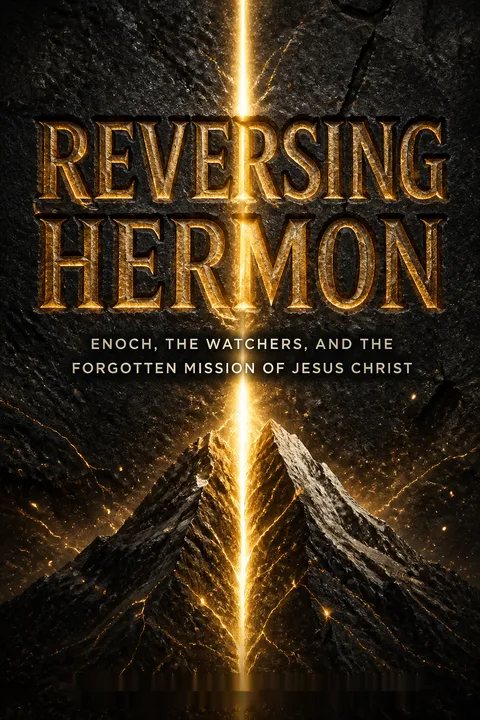
Reversing Hermon
Messiah's undoing of Watcher damageHeiser's organizing idea that Jesus' mission reverses the disorder associated with the Watchers' rebellion on Mount Hermon. The reversal includes healing human corruption, defeating hostile spiritual powers, overcoming death, and restoring the intended relationship between heaven and earth. The phrase links the Watchers' oath in 1 Enoch with the New Testament's portrayal of the Messiah's work.
FAQ
1. What is Reversing Hermon: Enoch, the Watchers, and the Forgotten Mission of Jesus Christ by Michael S. Heiser about?
- Focus on the Watchers’ Sin: The book explores the story of the Watchers’ rebellion in 1 Enoch 6–16 and its profound influence on New Testament theology, especially regarding Jesus Christ’s mission.
- Genesis 6:1–4 Expansion: Heiser argues that the Watchers narrative is an expansion of Genesis 6:1–4, preserving its original Mesopotamian context and theological polemic.
- Restoring Edenic Order: The central thesis is that Jesus’ mission was to reverse the spiritual and moral corruption introduced by the Watchers, restoring the original divine order.
2. Why should I read Reversing Hermon by Michael S. Heiser?
- Unveils Overlooked Context: The book reveals the supernatural worldview of the Bible, especially the role of the Watchers, which is often neglected in modern Christian interpretations.
- Bridges Ancient and Christian Thought: It connects Second Temple Jewish literature, like 1 Enoch, to New Testament theology, enriching understanding of sin, judgment, and salvation.
- Challenges Traditional Views: Heiser challenges common interpretations, such as the Sethite view of Genesis 6, and restores the ancient Near Eastern context to biblical passages.
3. What are the key takeaways from Reversing Hermon by Michael S. Heiser?
- Watchers’ Sin as Foundational: The sin of the Watchers is a major cause of human depravity and spiritual evil, not just Adam’s fall.
- Jesus’ Mission Reframed: The mission of Jesus is presented as a direct response to the Watchers’ rebellion, aiming to undo their cosmic damage.
- Influence of 1 Enoch: Early Christian thought and New Testament writings are deeply influenced by 1 Enoch and related traditions, especially regarding angels, demons, and eschatology.
4. What are the Watchers, and why are they important in Reversing Hermon by Michael S. Heiser?
- Divine Beings in Enoch: The Watchers are divine beings or angels who rebelled by cohabiting with human women, producing the Nephilim (giants) and corrupting humanity.
- Biblical and Extra-Biblical Roots: They are identified with the “sons of God” in Genesis 6:1–4 and are central figures in 1 Enoch and Second Temple Jewish literature.
- Theological Significance: Their sin is linked to the origin of evil spirits and demons, providing a backdrop for understanding New Testament references to fallen angels and spiritual warfare.
5. How does Michael S. Heiser in Reversing Hermon interpret Genesis 6:1–4 and the story of the Watchers differently from traditional Christian views?
- Rejects Sethite Interpretation: Heiser critiques the view that the “sons of God” were merely human descendants of Seth, arguing for a supernatural reading.
- Affirms Divine-Human Unions: The “sons of God” are seen as divine Watchers, and their offspring, the Nephilim, are giants with supernatural origins.
- Ancient Polemic Context: Genesis 6:1–4 is interpreted as a theological polemic against Mesopotamian apkallu traditions, with 1 Enoch expanding on this narrative.
6. What is the Mesopotamian apkallu, and how does it relate to the Watchers in Reversing Hermon by Michael S. Heiser?
- Divine Sages of Wisdom: Apkallu were pre-Flood divine sages in Mesopotamian religion who transmitted secret knowledge to humanity, paralleling the Watchers’ role in 1 Enoch.
- Hybrid Beings Post-Flood: Post-Flood apkallu were considered hybrid beings, similar to the Watchers and Nephilim narrative.
- Jewish Polemic Inversion: Jewish writers inverted the apkallu tradition, portraying the Watchers’ imparting of forbidden knowledge and sexual transgression as corrupting, a theme central to Heiser’s thesis.
7. How does Reversing Hermon by Michael S. Heiser connect the genealogy and birth of Jesus to the sin of the Watchers?
- Genealogy’s Four Women: Matthew’s genealogy includes Tamar, Rahab, Ruth, and Bathsheba—women associated with Gentile lineage and sexual scandal, countering the Watchers’ corruption of humanity.
- Birth as Reversal: The birth of Jesus, especially through astral prophecy (e.g., Revelation 12), is seen as the beginning of reversing the Watchers’ transgression.
- Messiah as New Adam/Enoch: Jesus is portrayed as the eschatological figure who undoes the cosmic damage caused by the Watchers, restoring divine order.
8. What role does Mount Hermon play in Reversing Hermon and New Testament theology according to Michael S. Heiser?
- Site of Watchers’ Oath: Mount Hermon is identified as the place where the Watchers descended and swore to corrupt humanity, making it a symbol of their rebellion.
- Spiritual Warfare Location: Key events in Jesus’ ministry, such as the Transfiguration and exorcisms, occur near Mount Hermon, symbolizing His confrontation with the Watchers’ influence.
- Gates of Hell Reference: The “gates of hell” in Matthew 16:18 are linked to this region, underscoring Jesus’ authority over demonic powers rooted in the Watchers’ rebellion.
9. How does Reversing Hermon by Michael S. Heiser interpret Paul’s teaching on head coverings and angels in 1 Corinthians 11?
- Angels as Watchers: Paul’s reference to women covering their heads “because of the angels” is interpreted as a warning related to the sin of the Watchers.
- Sexual Modesty and Protection: The head covering symbolizes a woman’s sexual fidelity and protection from angelic violation, recalling the Watchers’ illicit unions.
- Ancient Physiological Context: The Greek term for “covering” is linked to female genitalia in ancient texts, reinforcing the sexual and cosmic significance of Paul’s teaching.
10. What does Reversing Hermon by Michael S. Heiser say about the sin of the Watchers and human depravity?
- Twofold Cause of Sin: Human depravity is attributed not only to Adam’s Fall but also to the Watchers’ corruption through forbidden knowledge and demonic spirits.
- Demons as Watcher Spirits: The spirits of the dead Nephilim became demons, continuing to influence human sinfulness after the Flood.
- Paul’s Law and Transgressions: Paul’s statement that the Law was “added because of transgressions” is interpreted as referring to the Watchers’ cosmic rebellion, not just Adam’s sin.
11. How does Reversing Hermon by Michael S. Heiser interpret the Antichrist, Gog, and eschatological evil?
- Antichrist as Gentile Tyrant: The Antichrist is portrayed as a Gentile tyrant, not a Jewish pseudo-messiah, consistent with Second Temple Jewish expectations.
- Gog as Cosmic Evil: Gog is seen as a supernatural figure associated with the north, Bashan, and Mount Hermon, paralleling mythic adversaries like Typhon.
- Eschatological Defeat: Gog, Magog, and the Antichrist represent the final enemies of God’s people, symbolizing the defeat of evil powers including the Watchers.
12. What is the significance of 1 Enoch and other academic resources for understanding Reversing Hermon by Michael S. Heiser?
- 1 Enoch’s Influence: 1 Enoch was widely read among Second Temple Jews and early Christians, shaping New Testament views on angels, demons, and the Messiah.
- Composite and Ancient Text: 1 Enoch is a composite work, originally in Aramaic, with parts dating as early as the second century B.C., and preserved in Ethiopic, Greek, and Aramaic fragments.
- Recommended Scholarly Resources: Heiser recommends critical editions and commentaries by Nickelsburg, VanderKam, Knibb, and others for serious study of 1 Enoch and related literature.
About the Author

Download PDF
Download EPUB
.epub digital book format is ideal for reading ebooks on phones, tablets, and e-readers.








