

Key Takeaways
Treat witchcraft as a practice for changing shared political reality
Magic meets politics. Sarah Lyons presents witchcraft not as escape from the world, but as a craft for changing it. Magic, in her account, joins intention to action: people imagine a different reality, then use their power to help make it material. Politics concerns how power is distributed and exercised, so magical activism brings spiritual practice into contact with organizing, protest, and public life. The author grounds this argument in her own activist experience, including pipeline resistance and civil disobedience.
Practice, not aesthetic. The point is not to collect occult objects or adopt a look. Rituals and beliefs matter when they help people connect, persist, and act together. The book invites both witches unfamiliar with political organizing and activists unfamiliar with witchcraft to work across that divide.
The book’s strongest move is treating spiritual practice as a source of motivation and shared meaning, rather than as a substitute for political work. Social movements also depend on identity, trust, and a sense that collective action is possible, all of which ritual can help cultivate. The useful test is practical: does a ritual strengthen relationships, clarify a demand, or sustain participation? If not, it risks becoming a private feeling mistaken for public change. This framing welcomes spiritual readers without requiring skeptics to accept supernatural claims.
Belief shapes institutions, but collective power changes what belief can do
Ideas become material. Lyons argues that people help create reality by acting on shared beliefs. Money, borders, and corporate influence are not natural features of the landscape, yet they shape daily life because institutions and people treat them as real. The same principle applies to an individual: an imagined outcome can guide choices that make it more achievable. Magic, in this account, works through both inward shifts and changes to the material world.
Mind is not omnipotent. The author warns against the idea that people can think their way out of every hardship. A person cannot simply will away a financial crash, a polluted water supply, or rising seas. Power is distributed across people, institutions, and circumstances. Political action begins by recognizing those forces, then finding ways to combine individual capacity with collective leverage.
This account connects well with social construction: institutions depend on shared rules and expectations, yet their consequences are concrete. A border may be an invented line, but its legal enforcement is not imaginary. That distinction keeps the metaphor from sliding into magical voluntarism, the belief that conviction alone controls outcomes. The book’s emphasis on collective power supplies an important corrective. Still, people do not begin with equal influence over which beliefs become law or common sense. Effective change requires attention to resources, organized constituencies, and the unequal ability to set public narratives.
Read witch trials through land seizure, labor, and control of women
A political history. Lyons rejects the popular story that the European witch trials were a campaign to eradicate a surviving, continent-wide pagan goddess religion. She describes witchcraft as a diverse set of practices, often carried out by people who did not call themselves witches. In her account, the trials took place amid profound economic and religious change, including the enclosure of common land and the expansion of a system that made survival increasingly dependent on paid work.
Bodies and knowledge mattered. The people accused were often poor, female, elderly, or disabled. Lyons links persecution to the suppression of folk healers and to growing control over women’s reproductive lives. She argues that demonizing magic helped discredit relationships to land and bodies that did not fit the new order. The historical record is fragmentary, since accusations and coerced testimony tell us more about the accusers than about everyday practice.
This interpretation makes witch persecution legible as part of a wider struggle over property, labor, gender, and legitimate knowledge. It also usefully resists romanticizing the trials as a simple clash between ancient pagans and Christianity. The account should be read as a political interpretation, not as a complete explanation of a complex, varied history. Enclosure, religious conflict, local disputes, and gendered violence did not unfold identically across Europe. That nuance does not erase the book’s central insight: labels such as “witch” can authorize the punishment of people whose practices or social position threaten established power.
Trade magical shopping for relationships with people, objects, and place
Objects are not shortcuts. Lyons criticizes a consumer version of witchcraft in which people buy a crystal or herb expecting it to deliver a ready-made feeling. This approach can turn insecurity into a sales opportunity: if the object fails to produce calm or confidence, the buyer may blame themselves or conclude that magic is false. The author is not against owning things. She values objects more when they are part of an ongoing relationship, such as a stone gathered from a known place.
Ask where things come from. Magical goods may be produced through exploitative labor or damaging extraction. Buying an object for empowerment can therefore obscure the conditions of the person who made it. Lyons suggests shifting from consumption toward connection: learn an object’s origins, build practices that cost nothing, and let relationships with people and the land matter more than having the right supplies.
This critique offers a useful distinction between an object’s symbolic value and the promise that buying it will solve an emotional problem. In consumer culture, identity and self-improvement are routinely sold as products, and spiritual markets are not exempt. A personal relationship with an object can encourage attention to its history and material origins. Yet ethical consumption cannot by itself undo exploitative supply chains, nor should access to costly goods become a measure of spiritual seriousness. The book’s low-cost practices and emphasis on provenance make its alternative more inclusive and materially grounded.
Turn political awakening into names, choices, and ongoing self-correction
Awareness can break open. Lyons calls a profound shift in how someone sees the world an initiation. It may come through a personal event or through direct contact with injustice. Her experience at the Standing Rock encampment illustrates the difference between knowing about state violence intellectually and encountering its machinery in person. An awakening can be painful, but the author treats it as a beginning, not proof that someone now understands everything.
Give harm a name. Political language can turn diffuse discomfort into something identifiable, such as sexism or a system of economic power. Naming makes it possible to ask who benefits, who is harmed, and what action might help. The book also reframes cleansing as transformation: rather than pretending a harmful action never happened, examine its causes, learn from it, and commit to doing better.
The sequence from experience to naming to action resembles a core process in critical consciousness: recognizing that private troubles can reflect public arrangements, then developing language and agency to respond. Naming can reduce confusion, but it can also harden into a label that stops inquiry. The author’s emphasis on continued learning is therefore essential. An awakening is not a credential or a guarantee of moral clarity. The practice of examining one’s own behavior alongside larger systems makes political insight more accountable, especially when people with different histories encounter the same struggle.
Dream beyond what seems reasonable, then embody the alternative together
Imagination sets the horizon. Lyons argues that political movements need more than criticism of the present. People should be able to picture a world that current assumptions call impossible, then bring pieces of that vision into everyday life. She uses the Standing Rock encampment as an example: Indigenous leadership, shared food and supplies, prayer, and care for the land offered a lived alternative to ordinary social arrangements. The camp was not only a protest against a pipeline; it also demonstrated another way of organizing community.
Inspiration requires humility. The author emphasizes that this example belongs to the Indigenous people who led the struggle. Others can learn from it and support the cause without claiming its traditions or taking over its leadership. A large vision is most powerful when its practice respects the people whose knowledge and land are at stake.
The encampment illustrates a principle often found in prefigurative politics: movements can rehearse the social relations they hope to make widespread, rather than postponing them until victory. Shared care can make an alternative tangible and strengthen commitment. But a temporary community is not a complete blueprint for governing a society, and an inspiring example should not be treated as freely transferable. The book’s insistence on Indigenous leadership guards against turning solidarity into appropriation. Imagination becomes politically credible when paired with attention to who has authority, who bears risk, and what conditions make the alternative sustainable.
Map decision-makers before choosing tactics, and never mistake voting for strategy
Follow power to its source. Power mapping is a planning method for identifying a problem, the people who can change it, the resources available, and the pressure that could move a decision. Lyons examines power through three connected arenas: immediate actions by people, the laws that enable or limit those actions, and the cultural beliefs that make them seem acceptable. A broad problem such as patriarchy becomes more actionable when its specific actors and mechanisms are identified.
Choose tactics deliberately. The book advises setting a long-term vision, defining nearer victories, assessing allies and opponents, selecting a target, and choosing tactics suited to that target. Protests, lawsuits, elections, strikes, and public hearings can all be tactics. Voting matters, but it is one action inside a wider strategy, not a replacement for organizing and sustained pressure.
Power mapping translates moral urgency into a theory of change. It asks not only what is wrong, but who can alter a specific outcome and what would make them do so. This resembles strategic planning in labor and community organizing, where pressure is directed at decision-makers rather than dispersed across a vague system. The method also helps avoid mistaking visibility for leverage. Its limitation is that targets can be difficult to identify when authority is fragmented or opaque. Maps are hypotheses, not facts, and should be revised as opponents respond and alliances shift.
Give facts a human story, then make protest embody that story
Emotion can mobilize evidence. Lyons points to ACT UP, the AIDS Coalition to Unleash Power, as a movement that combined facts about the epidemic with disruption, public theater, and ritual. In one action, activists carried the ashes of loved ones to the White House and left them on its lawn. The gesture made grief visible and directed it toward political leadership. It showed that statistics can establish the scale of a crisis, while testimony and public action help people feel its human stakes.
Action tells a story. The book treats protest as a public ritual: participants use bodies, words, symbols, and shared risk to show what is wrong and what they demand. A strong action needs a clear target and outcome, not only a display of anger. Participants also need preparation, flexibility, and aftercare, since political action affects bodies and relationships as well as policy.
ACT UP’s example shows how ritual can make loss publicly legible without abandoning evidence. In movements, symbolic actions often compress a complicated injustice into a scene that people can remember and discuss. That compression is powerful, but it carries risks: spectacle can overshadow the policy demand, or attention can drift from affected people to the performers. The book’s focus on a specific target and a clear story helps counter that danger. Ritual works best when it deepens the public meaning of organizing and leaves participants better able to continue it.
Let the land shape your practice, not imported spellbook recipes
Relationship changes responsibility. Lyons describes animism as a way of relating to the world as alive and capable of relationship, rather than as a stockpile of resources. Protecting a forest then matters not only because it provides useful services, but because it is part of a community of life. The author encourages readers to observe the places they inhabit, keep notes on their impressions, learn local histories and species, and develop a personal way of attending to that land.
Localize the materials. A spellbook’s familiar herbs may not grow nearby or connect to the practitioner’s own environment. Lyons suggests researching local plants and adapting practices where appropriate. She also recommends acknowledging Indigenous peoples whose land a group occupies. These steps turn an abstract claim of being “earth-based” into habits of attention, historical learning, and responsibility.
The book’s relational approach resembles place-based environmental ethics, which asks people to understand ecological systems through sustained attention to local histories and living communities. It can make conservation less transactional than protecting nature only for human benefits. Still, personal intuition is not a substitute for ecological knowledge, and a felt connection does not grant authority over a place or its Indigenous traditions. Pairing observation with research, as the book recommends, helps keep spiritual practice accountable to material realities and to people whose relationship with the land predates a newcomer’s.
Join other struggles without taking over their leadership or spiritual knowledge
Solidarity crosses borders. Lyons presents the Zapatistas of Chiapas, Mexico, as a movement defending Indigenous autonomy against policies and economic forces that threatened land, culture, and livelihood. The movement built local schools and medical centers and included women in leadership. Its example links local self-determination with international cooperation: people elsewhere can learn from the struggle and recognize shared pressures without pretending their circumstances are identical.
Support is not ownership. The author argues that people can join a fight for another community’s liberation without making themselves its leaders or claiming its traditions. Solidarity means understanding how struggles connect, taking direction from those most affected, and contributing where useful. The Zapatistas’ own invitation to visitors to learn and carry ideas home is presented as an exchange, not a template to copy wholesale.
This account offers a strong model of internationalism: common cause without erasing difference. Movements can share lessons while remaining rooted in specific histories, institutions, and relationships to land. That balance is difficult because solidarity can slide into branding another community’s struggle as one’s own, or into exporting a preferred model without regard to local conditions. The book’s distinction between learning and taking over is therefore practical, not merely polite. Durable coalitions need reciprocal exchange, clear leadership from affected communities, and enough humility to let shared principles produce different local strategies.
Analysis
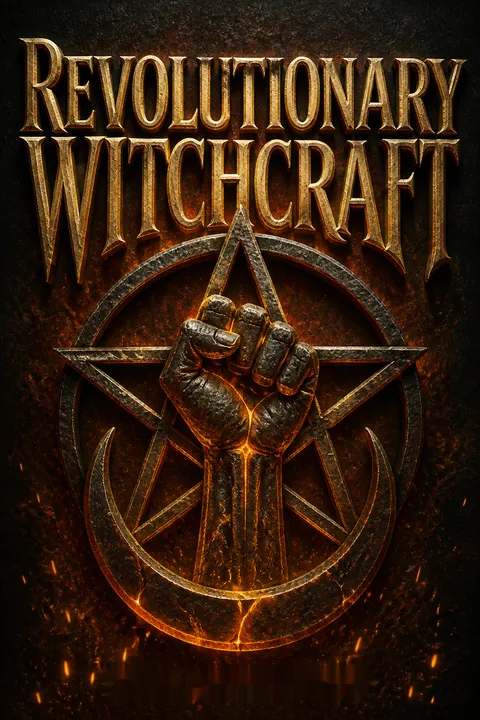
Revolutionary Witchcraft is best understood as a bridge between spiritual practice and movement strategy. Its central claim is not simply that political work can feel magical, but that shared beliefs, symbols, relationships, and rituals help organize material power. This lets Lyons speak to two audiences often kept apart: practitioners who want their spirituality to matter beyond private life, and activists who may undervalue ritual, imagination, and emotional meaning.
The book is strongest when it moves from metaphor to method. ACT UP shows how ritual can render grief politically visible; Standing Rock shows how a movement can enact an alternative social order; power mapping translates broad outrage into targets and leverage. Together, these examples argue that imagination needs organization, and organization needs a story people can inhabit. The practical advice also guards against two familiar failures: treating elections as a complete strategy, and treating personal intention as a substitute for collective work.
Its most debatable move is historical compression. Lyons connects witch persecution to enclosure, capitalism, gendered control, and suppression of folk knowledge. This framework illuminates important links, but it can make a varied history appear more unified and intentional than the evidence permits. A reader can retain the political question, who is made vulnerable when land, labor, and bodies are reorganized, while treating any single causal account as partial.
The book’s metaphysical claims also admit multiple readings. A skeptic can understand spells and spirit relationships as practices that focus attention, strengthen commitment, and create social meaning; a believer may understand them literally. The argument does not require those positions to be settled. Its public standard is whether practice cultivates connection, clarifies a goal, and supports accountable action. That flexibility is a strength, provided symbolic efficacy is not confused with proof of supernatural causation or with policy success. The book ultimately asks readers to make imagination answerable to relationships, history, and shared struggle.
People Also Read

Glossary
magical activism
Spirit-informed political actionAn approach that brings magical practice into political organizing and social change. It treats intention, ritual, symbols, and relationships as sources of motivation and collective meaning, while also emphasizing material action such as protest, organizing, and pressure on decision-makers. Magic is not presented as a substitute for political work.
The Disenchanted World
A world of imposed separationLyons’s term for a worldview that separates people from one another, their bodies, the land, and the objects and labor that sustain them. In this condition, nature and human life are treated as resources, while cynicism and alienation can seem inevitable. Witchcraft and activism offer ways to restore connection and imagine alternatives.
consensus reality
Shared assumptions treated as realThe collection of beliefs and assumptions that people commonly accept as describing what is real or possible. These shared understandings shape social rules and expectations, even when they change over time. Lyons argues that political conflict can fracture consensus and create opportunities to imagine and establish different arrangements.
power mapping
A map of leverage and targetsAn activist planning method for tracing a problem to the people and institutions that can change it, assessing allies and opponents, identifying available resources, and selecting tactics. It begins with a larger vision and defines nearer-term victories, then asks where pressure can most effectively shift a decision.
three faces of power
Three ways power operatesLyons’s framework for examining political power through direct actions by people, laws that authorize or constrain those actions, and cultural beliefs that make them seem acceptable. Considering all three can reveal why a problem persists and where intervention might work. The framework can be applied to issues such as patriarchy.
spectrum of allies
A map of political alignmentA way of thinking about people and groups according to how actively they support, oppose, or remain undecided about a cause. The framework helps activists decide whom to persuade, whom to mobilize, and where effort is unlikely to pay off. Lyons stresses that shifting someone’s position requires resources and judgment.
initiation
An experience that changes perceptionAn event or ritual that disrupts a person’s previous understanding and opens a new way of seeing the world. It may be spontaneous, such as encountering injustice directly, or deliberately created through ceremony. For Lyons, initiation begins a process of learning rather than certifying complete knowledge.
soul flight
A guided spiritual journeyA meditative practice in which a practitioner imagines the spirit or self traveling beyond the physical body. Lyons presents it as a way to explore spiritual realms, seek perspective, or connect with spirits and ancestors. She advises caution, noting that spiritual beings should not automatically be assumed trustworthy and that experiences require judgment.
sigil
A symbol of focused intentionA symbol made to represent a desired outcome or intention. In the practice described by Lyons, a practitioner condenses a statement into a design, charges it through a chosen activity, and places it where it can be encountered without constant attention to its meaning. The practice is intended to focus intention and influence action.
animism
Relationship with a living worldA philosophy that treats the world as alive and relational, rather than as inert matter or a storehouse of resources. Lyons emphasizes animism less as a fixed creed than as a way of interacting with people, animals, plants, places, and objects. It supports an ethic of care that does not depend on usefulness to humans.
Download PDF
Download EPUB
.epub digital book format is ideal for reading ebooks on phones, tablets, and e-readers.








