

Key Takeaways
Ask for change large enough to make extraordinary effort feel worthwhile.
Make the stakes real. Bernie Sanders called for free public college, universal health care, and ending mass incarceration, rather than smaller adjustments. The authors argue that people will commit when a goal could change their lives and the campaign offers a credible route to achieve it, with meaningful roles for both occasional and full-time volunteers.
A large ask can unlock action. In 2011, an email invited CREDO supporters to consider risking arrest to oppose the Keystone XL pipeline. One man who had never even signed a petition drove to Washington, joined the protest, and was arrested. The lesson is not to ask for anything dramatic, but to connect a consequential goal with a practical plan and work that matters.
The distinction between ambition and empty grandstanding is credibility. A hard ask can signal that an organization takes both the problem and its supporters seriously, but only if participants can see how their work contributes. This resembles a basic principle of collective action: people are more likely to bear costs when they believe their contribution is consequential. The risk is that dramatic demands can become a substitute for strategy. Organizers need to make the path visible, not merely make the stakes sound urgent.
Build campaign capacity from volunteer teams, not payroll alone.
Turn supporters into infrastructure. When the Bernie campaign’s distributed organizing team began, two organizers were trying to serve volunteers across forty-six states. They recruited volunteers to run a help desk, repair a failing event map, and solve other operational problems. One team eventually answered hundreds of thousands of emails and helped clear a backlog that paid interns had not been able to manage.
Teams can outlast individuals. The authors found that three or four committed volunteers could sometimes match or surpass one full-time employee, while sharing the work across more skills and schedules. The July 2015 livestream launch drew 100,000 people to 2,700 events. More than 45,000 signed up to volunteer. The point is not that staff are unnecessary, but that staffing every task puts a hard ceiling on growth.
Volunteer teams function as both labor and organizational resilience. Shared responsibility makes a project less dependent on any one person, while varied professional and community experience can improve problem-solving. Yet unpaid capacity is not limitless. Treating volunteers as endlessly available can shift the costs of an organization onto people with the least time or money. Sustainable participation depends on clear tasks, support, and respect for the difference between a volunteer role and a job.
Let one strategic plan coordinate work dispersed across thousands.
Distribute execution, not direction. Early Bernie supporters organized all kinds of activities, including public events and voter outreach. But some efforts were disconnected from the campaign’s priorities or took place in states that would not vote for months. The authors argue that decentralized energy becomes more effective when a shared plan identifies which voters to reach, where, and when.
Give volunteers useful pieces. Staff could set strategic goals, then assign repeatable chunks of work to volunteer teams operating across geography and time. That structure differed from simply multiplying independent campaigns. The distributed program eventually helped volunteers make more than 75 million calls. The authors’ core distinction is that leadership can remain centralized while implementation is widely shared. A movement need not rely on consensus at every step, but its plan must be clear enough for people to act together.
This is a coordination problem familiar from distributed computing: many independent nodes can increase capacity, but only if they share protocols and objectives. The campaign’s model makes a strong case for combining local initiative with strategic coherence. Central direction, however, can become a bottleneck or silence useful local knowledge. The practical test is whether information can travel back upward as readily as tasks travel outward, allowing the plan to adjust to conditions on the ground.
Use real conversations to recruit leaders, not just collect names.
A list is not a relationship. Zack Exley describes calling Corbin Trent, a Tennessee volunteer with no political background who was trying to organize his state. Several long conversations helped Exley understand Trent’s experience, judgment, and ambitions. The calls were not a scripted screening exercise. They were a way for two people to learn whether they could work together.
Make contact manageable. The campaign found that emailing 100 volunteers with an invitation to a conference call could bring roughly 15 to 20 people onto the call. Organizers could explain a task, hear people’s questions, and notice who followed through. Phone conversations also helped staff learn what volunteers were encountering locally. Digital tools can find supporters at scale, but the authors argue that leadership and trust are built through direct contact.
The phone serves as more than a communication channel. It creates a small setting where reliability, listening, and mutual expectations can be observed. That is valuable in organizations where participants may never share a physical office. At the same time, phone-based recruitment can favor people who are readily available during conventional hours. A well-designed organizing system should offer multiple ways to connect, while preserving some space for the richer exchange that a conversation provides.
Turn mass meetings into immediate commitments, not motivational rallies.
Make the meeting produce work. The Bernie team’s barnstorms were mass meetings designed to organize supporters into voter-contact teams. They were not rallies or lectures. The agenda explained the campaign’s strategy, then asked participants to commit immediately to hosting or attending a phone bank.
Improve the conversion. In Seattle, 500 people attended a meeting and 80 volunteered to host phone banks, but many events attracted few participants. The team changed the process: hosts pitched their events in the room, and attendees signed up on paper before leaving. That chaotic but effective method connected hosts with nearby callers. Eventually, volunteers led 650 of the campaign’s roughly 1,000 barnstorms. The meeting became a repeatable organizing tool because it ended with a specific task, a time, and a team.
A meeting is often treated as a container for discussion, but this example treats it as a designed transition from attention to action. That is a useful shift for any organization struggling with the gap between enthusiastic attendance and actual participation. Immediate commitments also create social accountability. Still, conversion is not the only measure of a good meeting. Participants need room to raise concerns, and a tightly scripted format works best when its purpose and limits are transparent.
Launch imperfect tools, then let real work reveal what to fix.
Prefer useful now to polished later. The campaign’s web-based dialer connected volunteers to live voters more efficiently than manual dialing. The authors estimate that callers went from reaching three or four people per hour to as many as twenty-five. The interface was confusing, but the team launched it within days rather than waiting for a custom, branded system and perfect training materials.
Let problems shape the structure. As use grew, volunteers created teams to monitor calls, support hosts, manage data, and help callers log in. The campaign also leaned on familiar consumer tools such as Slack and Google documents, adding custom software only where gaps blocked work. The authors’ approach was to add procedures and complexity in response to real problems, not begin with a grand organizational blueprint.
This is an iterative design strategy: release a workable version, observe friction, and improve the parts that impede use. It can reduce the risk of building an elegant tool that solves the wrong problem. The dialer story also shows why usability is not cosmetic. A confusing interface can waste volunteer time and weaken trust. Speed is valuable under a deadline, but launch decisions should include safeguards for privacy, data quality, and users who lack technical confidence.
Treat volunteers as capable peers, and give newcomers real authority.
Choose leaders by contribution. The campaign’s volunteer leaders were not simply assigned repetitive tasks. They managed technical systems, trained others, and built teams. The authors describe a Texas pilot where 15 of 16 volunteers trained to lead barnstorms went on to do so. Their events produced results comparable to staff-led meetings.
Experience is not a prerequisite. Many volunteers were new to politics, but brought skills from nursing, technology, business, and community life. The authors’ strongest teams blended professional organizers with people who had never worked on a campaign. They recommend asking who is ready to do the work, then giving proven contributors responsibility and accountability. Staff should make volunteer leadership possible, rather than treating volunteers as a labor pool to supervise.
The peer model widens the organization’s talent pool and challenges the assumption that political expertise belongs only to career staff. It also reflects a powerful learning principle: people develop competence by doing consequential work with feedback. Yet peer language can conceal unequal authority. Staff still control access, priorities, and often the data. Genuine partnership requires making those decision rights explicit, and ensuring that volunteers can question the plan without losing their place in the organization.
Make racial justice a shared organizing purpose, not a targeted appeal.
Put race at the center. The authors acknowledge that Bernie’s campaign often emphasized class and economic inequality without making structural racism central to its message. At a 2015 candidate forum, Black Lives Matter activists challenged the candidates; Sanders responded by citing his civil-rights history rather than fully engaging the challenge. The authors argue that personal credentials cannot replace a shared analysis of racial injustice.
Share leadership and responsibility. They call for movements led authentically by people of color and immigrants, while white supporters organize other white people toward multiracial solidarity. The book cites the unequal effects of drug enforcement and the racial wealth gap as evidence that economic reform alone does not address the problem. A movement’s message, leadership, and organizing practice must all reflect the change it claims to seek.
This argument treats racial justice as a question of power and institutional design, not merely language. That matters because a coalition can repeat inclusive slogans while leaving agenda-setting and leadership unchanged. The authors’ self-criticism makes the point concrete. A further test is whether affected communities can shape priorities, budgets, and measures of success. Broad economic appeals may build common ground, but they cannot stand in for confronting specific racial harms.
Organize across connected struggles instead of shrinking people to one issue.
People live with multiple problems. Latino families in the campaign did not care only about immigration policy. Organizer Cesar Vargas heard concerns about health care, college costs, and climate change, too. Students likewise supported Bernie for reasons that included climate, money in politics, and racial justice, not only free tuition.
Build a coalition without flattening differences. The authors argue that struggles connect: racial injustice shapes economic inequality, and immigration policy affects who can access health care. That does not mean every campaign must work on every issue at once. It means organizers should not assume that a community has one political concern, or demand that people set aside other needs to join a coalition. A broad movement can create room for focused campaigns while recognizing that their goals depend on wider alliances.
The point challenges a common shortcut in political outreach: treating demographic identity as a reliable proxy for a person’s priorities. Listening can reveal unexpected entry points and make coalitions more durable. There is also a genuine strategic tension. Campaigns have limited attention, and expansive agendas can blur what participants are being asked to win. The useful distinction is between acknowledging interconnected interests and promising to solve every problem through one campaign.
Raise money from the people your movement claims to represent.
Funding shapes accountability. Bernie’s campaign raised more than $231 million from 2.8 million individual donors. Small contributions helped the candidate avoid spending much of his time soliciting large donors and gave supporters a direct way to sustain the campaign.
Build a base before chasing scale. The authors warn that dependence on foundations or wealthy donors can narrow goals and messaging, even without explicit demands. Small-dollar fundraising creates a different test: if a broad base will not support the work, the leadership or plan may need to change. They do not argue that all institutional funding is corrupt. They advise accepting aligned support when useful, while building an independent constituency so a grant ending does not end the movement.
Funding is not merely a resource question; it is a governance relationship. A broad donor base can make leaders more answerable to participants and reveal whether a campaign’s message resonates. But small donations do not automatically democratize power. They can still reward emotionally charged appeals, and fundraising itself consumes time. Financial independence is most meaningful when paired with transparent priorities and ways for donors, volunteers, and affected communities to influence decisions.
Set firm boundaries so one disruptive voice cannot waste a room.
Protect the group’s shared time. At a Colorado Springs barnstorm, one attendee hijacked the microphone to attack Hillary Clinton, despite the meeting’s focus on organizing for Bernie. The organizer removed her after she refused to stop. The authors calculate that five wasted minutes in a room of 150 people costs the group more than twelve hours of collective time.
Make participation welcoming. Barnstorm guidance encouraged facilitators to select speakers deliberately, especially people new to politics and those often excluded from public attention. It also gave them permission to interrupt a speaker who ran on or derailed the agenda. The broader principle is that inclusion requires facilitation. Without boundaries, the loudest or most available participant can drive away people who came to contribute.
A group’s norms are not neutral when they allow a few people to monopolize attention. Clear facilitation can protect the participation of quieter members and keep scarce time directed toward the group’s purpose. The difficult question is who defines disruption. Rules should be explicit, applied consistently, and open to review. Otherwise, protecting a meeting’s agenda can become a convenient way to suppress uncomfortable but necessary disagreement.
Prepare for backlash, and build beyond the election’s deadline.
Success can provoke resistance. The authors describe supporters hearing that Bernie could not win, then seeing some critics recast his supporters as sexist once the campaign gained momentum. They use counterrevolution to describe pressure, including from supposed allies, to soften demands or return to incremental politics. Their advice is to recognize this pressure without letting it displace the work.
Keep the infrastructure. Bernie lost the nomination, but won 22 states and received 46 percent of pledged delegates. The distributed program reported more than 75 million calls, over 8 million texts, and more than 100,000 volunteer-led events. The authors see these as proof of organizing capacity, not proof that the campaign’s methods alone determined electoral outcomes. A movement must carry its leaders, relationships, and skills into fights that continue after election day.
The book’s most durable insight is that a campaign can be both a contest for office and a school for collective capacity. Its account also invites caution: political criticism is not automatically sabotage, and a losing result cannot establish that the organizing model caused the wins it did achieve. The distinction between principled disagreement and pressure to abandon core goals requires judgment. Treating every critic as an enemy can isolate a movement just as surely as surrendering its ambitions.
Analysis
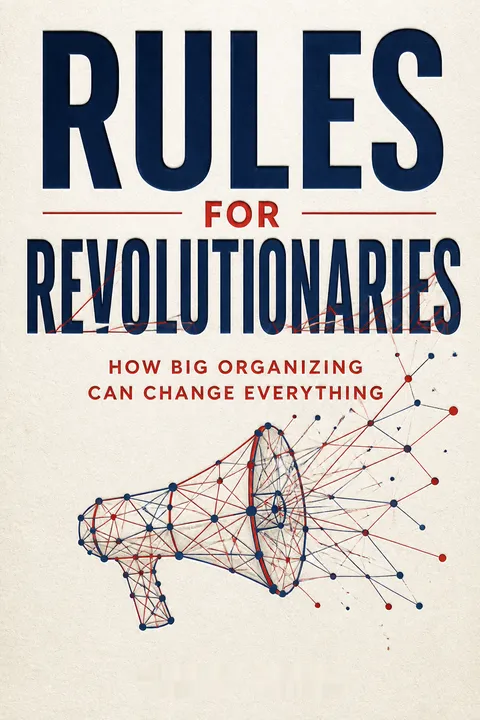
Rules for Revolutionaries is both a field report from the Bernie Sanders campaign and an argument about organizational design. Its central contrast is between small organizing, which relies on professional intermediaries and modest asks, and big organizing, which recruits large numbers of people into meaningful work. The book’s most convincing evidence is operational rather than electoral: volunteers built a help desk, supported a national calling program, led mass meetings, and handled complex technical processes. These stories show that participation can be structured at a scale that conventional staffing assumptions would rule out.
The model is not simply leaderless. Its real innovation is the combination of centralized goals with distributed execution, plus mechanisms for communication, training, and accountability. This explains why the book values management, schedules, team leads, and boundaries even as it criticizes hierarchy. Its vision of empowerment depends on coordination, not spontaneity.
The account also has limits. The campaign’s enormous activity does not establish how many votes those activities changed, or how much of the candidate’s performance they caused. The authors themselves identify missed opportunities, late access to voter data, and competition from paid advertising. The numbers demonstrate organizational capacity, not a clean causal comparison between volunteer contact and other campaign spending.
There is a second tension in the book’s politics. It argues that broad coalitions must confront structural racism directly, while also asking people to unite around shared economic interests. That combination is compelling only when affected communities hold real agenda-setting power. Likewise, volunteer leadership can democratize an institution, but unpaid labor can become an unacknowledged subsidy if an organization treats commitment as limitless.
The enduring contribution is therefore a practical proposition, not a guarantee of victory: design work that ordinary supporters can own, connect it to a credible common plan, and improve the system through the people doing the work. The book’s strongest lesson is that scale is not the enemy of human relationships. It requires building structures that let those relationships multiply without losing purpose or accountability.
Review Summary
The reviews for Rules for Revolutionaries are mixed, with ratings ranging from 1 to 5 stars. Positive reviews praise the book's insights into grassroots organizing and political campaigning, particularly regarding the Bernie Sanders campaign. Critics find it repetitive, overly focused on Sanders, and lacking broader applicability. Some readers appreciate the practical tips for organizing, while others feel the advice is basic or too specific to Sanders' campaign. The book's tone and emphasis on volunteer sacrifice are points of contention among reviewers.
People Also Read






Glossary
Big organizing
Mass volunteer-led organizingA model of social and political organizing that sets ambitious goals and gives large numbers of volunteers meaningful work toward a shared strategy. Volunteer leaders emerge across communities and take responsibility for teams and operations. Technology helps coordinate activity across distance, while a central plan connects local work to a common objective.
Small organizing
Staff-led incremental organizingThe book’s term for an organizing style built around paid professionals engaging people in limited steps, often toward incremental goals. The authors argue that it can produce useful local campaigns, but that its dependence on staff and modest asks restricts its ability to absorb large waves of public participation or challenge entrenched power at scale.
Barnstorm
Mass volunteer activation meetingA structured, replicable meeting designed to turn supporters into active campaign teams. Organizers explain a strategic plan, ask participants to take specific roles, and help them commit on the spot to volunteer work. In the Bernie campaign, barnstorms primarily recruited hosts and attendees for voter-contact events, and many were eventually led by volunteers.
Peer-to-peer
Networked work among equalsAn organizing approach in which volunteers and staff work through a network rather than relying only on a top-down hierarchy. Volunteers are treated as colleagues with skills and judgment, not simply as people receiving instructions. A central plan can still guide the network, while participants communicate, lead teams, and share responsibility for execution.
Bernie Dialer
Volunteer voter-calling systemThe web-based calling system used to connect Bernie campaign volunteers with voters. Instead of dialing each number manually, volunteers logged in and received calls when a person answered. The system increased the number of live conversations volunteers could have, but required volunteer teams to manage access, data, technical support, and training.
Ground Control
Volunteer event-management interfaceA lightweight tool developed for the Bernie campaign that let volunteer teams manage campaign events without using the campaign’s difficult constituent database directly. It supported tasks such as reviewing and approving events, entering sign-ups, creating multiple events, and contacting supporters near an event. It connected familiar volunteer workflows to the central campaign system.
Rinse and repeat
Repeatable organizing activityThe authors’ term for a simple task that volunteers can perform repeatedly to build progress toward a larger goal. Phone banking is one example: volunteers can make call after call wherever they are. The initial process may require substantial design and troubleshooting, but a reliable repeatable activity allows participation and results to accumulate.
Counterrevolution
Pressure against radical changeThe authors’ term for resistance that emerges when a movement threatens familiar political arrangements. It can include dismissal of ambitious goals, pressure to settle for smaller changes, or criticism from people who otherwise share some of the movement’s values. The concept is a warning to expect conflict, not a claim that every disagreement comes from bad faith.
FAQ
What's Rules for Revolutionaries about?
- Focus on Big Organizing: The book emphasizes "big organizing" as a method to mobilize large numbers of people for social change, contrasting it with "small organizing" that often results in limited engagement.
- Lessons from Bernie Sanders's Campaign: Authors Becky Bond and Zack Exley share strategies from their work on Bernie Sanders's presidential campaign, demonstrating how grassroots movements can challenge the status quo.
- Empowerment through Community: It advocates for empowering individuals within communities to take leadership roles, fostering ownership and collective action in social justice efforts.
Why should I read Rules for Revolutionaries?
- Practical Strategies for Activism: The book offers actionable rules and strategies for creating meaningful change, making it a valuable resource for both new and experienced organizers.
- Inspiration from Real Experiences: Readers will find inspiration in the authors' firsthand experiences from the Bernie campaign, showcasing how ordinary people can achieve extraordinary results.
- Framework for Future Movements: It provides a framework applicable to various social movements beyond electoral politics, relevant for anyone interested in activism.
What are the key takeaways of Rules for Revolutionaries?
- Ask for Big Change: Emphasizes the need for clear, bold demands that resonate with people's lived experiences, rather than settling for incremental improvements.
- Distributed Work with Centralized Planning: While work should be distributed among volunteers, a centralized plan is necessary to guide efforts and ensure effectiveness.
- Radical Trust: Encourages "radical trust" among organizers and volunteers, suggesting that autonomy and responsibility lead to greater engagement and innovation.
What are the best quotes from Rules for Revolutionaries and what do they mean?
- “You Won’t Get a Revolution If You Don’t Ask for One”: Highlights the necessity of making bold demands for change, rather than settling for incremental improvements.
- “The Revolution Will Not Be Handed to You on a Silver Platter”: Emphasizes that change requires active participation and effort; it won't come easily or without struggle.
- “The Revolution Will Not Be Staffed”: Suggests that movements thrive when driven by volunteers rather than relying solely on paid staff, highlighting the importance of grassroots involvement.
What is "big organizing" as defined in Rules for Revolutionaries?
- Mass Mobilization: Refers to mobilizing large numbers of people to work collectively towards significant social change, contrasting with small organizing.
- Emergence of Volunteer Leaders: Volunteer leaders emerge organically from communities, enhancing the movement's effectiveness and reach with their experiences and insights.
- Integration of Technology: Advocates for using technology to facilitate communication and coordination among volunteers, allowing for scalable and efficient organizing efforts.
How does Rules for Revolutionaries suggest we fund movements?
- Small Donations from the People: Argues for funding movements through small donations from supporters, fostering accountability and independence.
- Building a Supportive Base: Engaging the community and encouraging small contributions creates a sustainable funding model reflecting the people's needs and desires.
- Avoiding the Nonprofit Industrial Complex: Cautions against dependency on large donors, as it can compromise the movement's goals and integrity.
What is the significance of "barnstorming" in Rules for Revolutionaries?
- Mass Meetings for Engagement: Barnstorming involves organizing large, in-person meetings to mobilize supporters and put them to work immediately.
- Creating a Replicable Model: Emphasizes designing barnstorm meetings that can be easily replicated in different locations, ensuring scalability and consistency.
- Direct Action and Accountability: These meetings inspire participants and hold them accountable for taking action, fostering a sense of community and shared purpose.
How does Rules for Revolutionaries address the issue of racism in organizing?
- Core Message of Inclusion: Stresses that fighting racism must be central to any revolutionary movement, as true justice and solidarity cannot be achieved without addressing structural racism.
- Engagement of Diverse Voices: Advocates for the leadership of people of color and immigrants, emphasizing their crucial experiences and perspectives for effective organizing.
- Building Multiracial Solidarity: Calls for white allies to actively engage in dismantling racism and work towards multiracial solidarity, essential for building a powerful and inclusive movement.
How did the Bernie Sanders campaign utilize technology according to Rules for Revolutionaries?
- Consumer Software Focus: Prioritized using user-friendly consumer software tools like Slack and Google Apps to streamline communication and collaboration among volunteers.
- Custom Coding Solutions: Bridged gaps in existing software with custom coding, allowing for tailored solutions that met the campaign's specific needs.
- Integration of Tools: Effectively integrated various platforms for volunteer engagement and data management, demonstrating how technology can enhance grassroots organizing.
What does Rules for Revolutionaries say about the role of volunteers?
- Empowerment and Responsibility: Emphasizes giving volunteers significant responsibilities and treating them as peers, leading to greater engagement and investment in the movement.
- Diverse Contributions: Volunteers bring a wealth of experience and skills, often surpassing the capabilities of paid staff, and can be some of the most effective leaders.
- Building Community: Stresses the importance of fostering a sense of community among volunteers, vital for sustaining long-term engagement and collaboration.
How can I apply the principles from Rules for Revolutionaries to my own activism?
- Start with Big Goals: Set ambitious goals for your activism, focusing on engaging as many people as possible, aligning with the book's emphasis on scaling efforts.
- Utilize Peer-to-Peer Communication: Implement peer-to-peer strategies in outreach efforts, encouraging personal connections and conversations to increase engagement.
- Be Prepared for Challenges: Anticipate opposition and criticism, and develop strategies to stay focused and resilient, understanding that counterrevolutionary forces may emerge.
What is the significance of the "counterrevolution" discussed in Rules for Revolutionaries?
- Understanding Opposition: Refers to the resistance faced when pursuing radical change, often from those who may seem like allies, crucial for maintaining focus and momentum.
- Identifying True Allies: Helps clarify who genuinely supports the movement versus those who may seek to undermine it, strengthening the resolve of committed activists.
- Staying Committed to Change: Encourages activists to remain steadfast in their goals despite pushback, emphasizing perseverance in the face of adversity.
Download PDF
Download EPUB
.epub digital book format is ideal for reading ebooks on phones, tablets, and e-readers.








