

Key Takeaways
Treat the womb as a center of agency, not merely a reproductive organ.
A crisis becomes a calling. The book opens with women seeking help for frightening diagnoses, heavy bleeding, and proposed surgery. Queen Afua sees these stories as evidence that women need more knowledge, support, and authority over their care. She then reframes the womb as both a physical organ and a spiritual center linked to creativity, identity, and relationships. In this worldview, caring for the womb is part of reclaiming a whole self, not just addressing fertility or menstruation.
A symbolic map, not a diagnosis. Gateway 0 begins the training with reflection, prayer, and daily attention to the body. The author also presents the womb as a source of wisdom for women who have had hysterectomies. That claim belongs to her spiritual framework, not to medical anatomy.
What's compelling is the shift from passive patienthood to informed participation. A person who can describe symptoms, ask questions, seek another opinion, and name what matters has more agency in a medical encounter. The metaphor of a center can make bodily attention less clinical and more humane. Its limit is important: emotional or spiritual meaning cannot identify the cause of bleeding, pain, or a tumor. The most useful reading holds both truths together: bodily experience deserves respect, and medical diagnosis requires qualified care.
Use Maat as a daily test of whether your choices restore balance.
Ethics begins at home. The book presents Maat as truth, fairness, balance, and responsibility, a moral compass for private conduct as well as public life. Its Forty-two Laws address concrete behaviors: lying, violence, waste, exploitation, and harm to others. Rather than treating judgment as a distant event, the practice asks readers to review their actions each day. The author recommends speaking the laws in the morning as intentions and revisiting them at night as an inventory.
Spirituality becomes conduct. Maat also shapes the book’s wider Khamitic cosmology, where the Divine is present throughout nature and human life. The aim is not simply to believe in balance, but to practice it in speech, relationships, work, and care for the environment.
This framework turns spirituality into observable behavior. A person can assess whether a value is being lived by asking what it changes in daily choices, rather than by relying on identity or belief alone. The morning-and-evening review also resembles reflective practices used in ethical traditions and professional supervision: intention followed by accountability. The system is strongest when treated as a prompt for repair, not self-condemnation. A moral inventory becomes useful when it leads to a specific apology, boundary, or change in conduct.
Turn private pain into language before it hardens into nameless distress.
Writing makes experience visible. The Sacred Womb Journal invites readers to record bodily patterns, relationships, fears, memories, and hopes. Its central exercise is an imagined dialogue with the womb, a way of asking what a person feels and what remains difficult to name. The author’s own story gives the practice context: after her partner asked why she recoiled from being touched, she recalled a distressing examination during childbirth and was able to explain the reaction to him.
Listen without forcing an answer. The book encourages gradual reflection, sometimes alone and sometimes with trusted women. The journal is meant to help a person notice connections and express difficult experiences, not to prove that a particular memory caused a physical illness.
The story shows how a present reaction can make more sense when its history is understood. Journaling can create a record between sensation and interpretation, while dialogue with a trusted partner can turn a private response into a shared boundary. The womb’s literal memory, as described in the book, is a spiritual metaphor rather than an established biological mechanism. That distinction protects the value of the practice: a person can take emotional signals seriously without treating them as medical evidence or forcing a single explanation.
Build a women's circle that makes healing shared, practical, and intergenerational.
A circle gives care structure. The Sacred Womb Circle is a small group, ideally four to eight women, who meet regularly to share experiences, journal, pray, move, and support one another. The book suggests a commitment lasting at least twenty-one days, with a longer period possible. Its purpose is to make intimate health and life stories speakable, especially when mothers and daughters have inherited silence rather than useful guidance.
Support becomes a practice. One example is a mother whose daughter assembled a “village” of trusted women, each offering a different kind of guidance. The arrangement eased pressure on the mother-daughter relationship while giving the young woman more sources of help. The book treats that network as a modern expression of extended family and shared wisdom.
The circle’s distinctive contribution is not simply companionship. It creates a recurring place for attention, testimony, and practical help, making care less dependent on a single expert or family member. That can be especially valuable where embarrassment or mistrust has made health questions hard to raise. A supportive group still needs boundaries: confidentiality, consent, and a clear distinction between peer support and clinical or trauma treatment. Those safeguards let connection strengthen agency rather than replace professional care.
Let food, breath, and movement support vitality, but never replace medical care.
The body is part of the practice. The book links spiritual transformation to eating, breathing, resting, and moving. Its dietary program favors fruits, vegetables, legumes, herbs, and less processed food, while its movement centerpiece is a sequence of pelvic stretches, breathing, and dance. Afua describes dance as a way to shift mood, loosen tension, and reconnect with the body. The overall plan becomes progressively more demanding, including fasting and increasingly raw-food diets.
Claims need careful sorting. The author also recommends juices, herbal products, enemas, douches, clay applications, and other regimens, and attributes tumors, bleeding, or disease to particular foods and emotional states. These are the author’s claims, not established treatments. The book itself says it is not a substitute for medical supervision; readers should continue clinical care and check with a clinician before using restrictive diets or remedies.
The strongest, safest insight is that ordinary routines can express care: nourishing meals, gentle movement, rest, and mindful breathing can support general well-being. Dance also makes the method unusually embodied rather than purely verbal. The risk comes when symbolic ideas become causal medical claims, especially for serious symptoms or treatment decisions. Fibroids, infertility, cancer, and heavy bleeding require evidence-based assessment. Self-care is most empowering when it expands a person’s options and helps them work with clinicians, not when it asks them to delay or abandon treatment.
Make your surroundings reflect the inner order you are trying to cultivate.
Space shapes attention. In the book, a home is not just a backdrop. It is a place that can either support or obstruct calm, focus, and connection. The Sacred Space practice asks readers to clean and organize their surroundings, create a quiet place for reflection, and make ordinary tasks feel intentional. An altar, for example, gathers objects that represent values, ancestors, and a current purpose.
Order can be modest. The author imagines different rooms serving different functions, from a kitchen used to prepare nourishing food to a bedroom set aside for rest and intimacy. She also encourages extending these choices to work spaces. The practical principle is simple: choose surroundings that make desired routines easier and reduce avoidable distraction.
This section gives spiritual significance to a familiar design principle: environments cue behavior. A clear, prepared space can reduce friction around reflection, cooking, or rest, while a meaningful object can serve as a reminder of intention. The framework is useful even for readers who do not share its theology. Its strongest form is flexible rather than perfectionistic. A crowded home, limited money, disability, or caregiving responsibilities can make idealized order unrealistic; a small, repeatable act of care can still create a meaningful refuge.
Reclaim beauty as cultural self-definition, not obedience to someone else's ideal.
Appearance carries history. Sacred Beauty connects grooming and dress to self-respect, cultural memory, and resistance to imposed standards. The book celebrates natural hair, colorful garments, wraps, jewelry, and adornment drawn from the author’s understanding of Afrakan traditions. It argues that beauty begins in conduct and inner dignity, then becomes visible in how a person presents herself.
Choice is part of the message. The author’s own account of going natural during the Black cultural movement shows how a change in appearance became a declaration of belonging and self-acceptance. Her suggestions range from caring for skin and hair to choosing clothes that feel expressive. The point is not that one look is beautiful, but that beauty need not be defined by assimilation.
The chapter connects everyday appearance to larger systems of power. Hair and clothing can be personal choices while also carrying social histories, so self-presentation may become a form of cultural authorship. The author’s insistence on natural Afrakan beauty offers a counterweight to narrow commercial ideals. A useful nuance is that reclamation should not become a new rulebook. Cultural identity is plural, and no hairstyle, garment, or gender expression can serve as a universal test of authenticity or self-respect.
Choose relationships by reciprocity, safety, and shared responsibility, not longing alone.
Connection requires discernment. The relationship gateways ask readers to examine patterns, release resentment where possible, and seek relationships grounded in respect. The book gives special attention to mothers and daughters, friendship among women, and intimate partnership. Its example of a young woman creating a “village” of sister-mothers shows how different trusted adults can provide guidance without expecting one relationship to meet every need.
Commitment is not enough by itself. The author favors careful courtship, family and elder guidance, honest discussion of practical responsibilities, and mutual effort. She also rejects abuse and urges people to consider whether a relationship is healthy. Some advice, however, places much of the burden on women to nurture or reform men. The more durable principle is mutual responsibility, with safety and autonomy taking priority.
The best relational insight is that closeness should be evaluated by what it makes possible: trust, honesty, care, and room to be oneself. The extended-family example expands the idea of support beyond the couple, a useful corrective to romantic exclusivity. The book’s prescriptive gender roles can pull in the opposite direction by assigning women the work of serving and changing male partners. Reciprocity must mean shared labor, not a new standard women are expected to meet alone.
Treat transformation as initiation: practice, mark progress, then serve others.
Change takes a path. The book’s training begins with Gateway 0, focused on the sacred womb, then moves through nine initiations concerning speech, nourishment, movement, beauty, space, healing, relationships, union, and spiritual integration. Each stage pairs reflection with repeated practices. The prescribed schedule ranges from a seven-day focus on an individual gateway to a longer, sequential course of study.
Make growth tangible. Participants are invited to record their experiences and sew a “senab” shawl or quilt from pieces representing each stage. The finished cloth becomes a material history of change, linking private effort to community and ancestry. The final lotus initiation is framed as a return to one’s inner seat of authority, followed by sharing skills and support with others.
The framework gives an expansive book a memorable shape: bodily awareness opens into habits, relationships, and service. The cloth project is especially effective because it turns abstract reflection into an object that can be revisited and shared. The sequence also asks an important question about completion: transformation is not a permanent status but a practice renewed in ordinary life. Its spiritual language will resonate unevenly across readers, but its architecture can still be adapted as a personal, culturally grounded curriculum.
Analysis
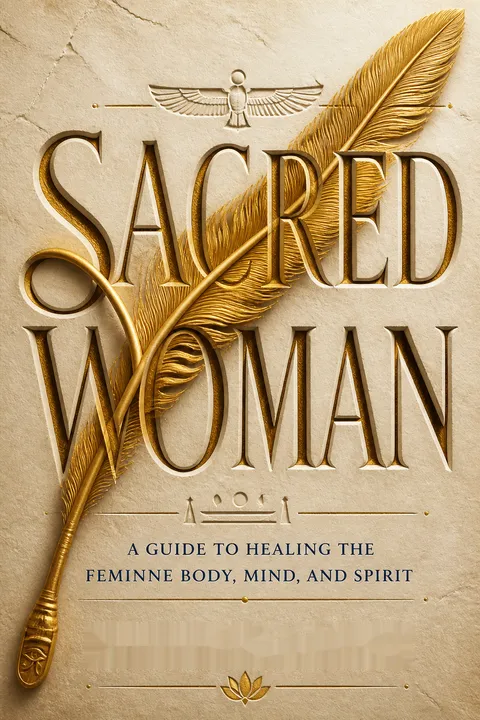
Sacred Woman is simultaneously a spiritual manual, a memoir of healing, a cultural reclamation project, and a highly prescriptive wellness program. Its organizing image is the womb, which moves between literal anatomy, emotional history, creativity, and a symbol of Afrakan continuity. That flexibility gives the book its emotional force: a reproductive health crisis becomes an invitation to recover voice, lineage, and communal support. The nine initiations then turn this broad ambition into a sequence of practices, from language and food to relationships and spiritual integration.
The book’s strongest contributions are its attention to women’s stories, its insistence that care includes the social environment, and its refusal to treat beauty or health as consumer products. Journaling, dance, ritual, intergenerational teaching, and group support give readers concrete ways to make reflection embodied and communal. The Khamitic cosmology is not decorative background. It supplies a counter-image to patriarchal religious structures and gives the program a coherent moral vocabulary through Maat.
The same breadth produces a serious boundary problem. The book often moves from spiritual metaphor to medical causation, asserting that emotional pain, diet, or a partner’s food choices produce or remove tumors and other diseases. It also recommends restrictive fasting, enemas, vaginal treatments, and herbal products. These claims and practices should not be treated as established medicine, and some can be harmful. The author’s own disclaimer to continue medical supervision is essential, not incidental. A responsible reading preserves the book’s value as a source of reflection, cultural meaning, movement, and peer connection while rejecting unsupported promises of cure. Its most defensible message is not that ritual can replace clinical care, but that dignity, knowledge, and community belong alongside it.
Review Summary
Sacred Woman receives mixed reviews, with an overall positive reception. Many readers find it transformative, praising its holistic approach to women's health and spirituality. The book is valued for its unique perspective on African traditions and feminine empowerment. However, some criticize its density, lack of scientific evidence, and extreme lifestyle recommendations. Readers appreciate the practical advice on diet, self-care, and spiritual practices, but suggest taking the content selectively. The book is often described as a journey rather than a casual read, requiring commitment to fully benefit from its teachings.
People Also Read


Glossary
NTR
Divine sourceIn the book’s Khamitic spiritual vocabulary, NTR names the unified Divine source from which life and its sacred qualities emerge. The author presents it as encompassing both feminine and masculine aspects, rather than as a distant, exclusively male deity. This is the book’s theological framework, not a clinical or historical definition.
NTRU
Divine attributesNTRU are the differentiated attributes or expressions of NTR, the Divine source. The book associates particular NTRU with qualities such as wisdom, balance, healing, beauty, movement, and rebirth. Figures including Maat, Ast, Sekhmet, Tehuti, and Nefer Atum are treated as spiritual principles that can guide reflection and ritual.
Maat
Truth and balanceMaat is the book’s central ethical principle, associated with truth, justice, balance, order, and reciprocity. It appears in the Forty-two Laws and in the image of a feather used to symbolize a balanced heart. The author uses Maat as a standard for daily conduct, relationships, and spiritual practice.
Gateway 0
Womb-centered foundationGateway 0 is the preparatory stage of Sacred Woman training, centered on the womb as both a physical organ and a spiritual symbol of identity, creativity, and life. Its practices include reflection, prayer, journaling, and group support. The author presents it as the foundation for the nine initiations that follow.
Nine Gateways of Initiation
Nine-stage spiritual curriculumThe Nine Gateways of Initiation are a sequence of spiritual studies that organize the book’s transformation program. They address communication, food, movement, beauty, living space, healing, relationships, intimate union, and spiritual integration. Each gateway combines reflection with repeated daily practices, and the final stage represents an integrated, service-oriented identity.
Sacred Womb Circle
Women's healing groupA Sacred Womb Circle is a small group of women who meet to share stories and support personal reflection and wellness. The book suggests a group of four to eight participants who gather regularly for prayer, journaling, movement, and discussion. It is presented as a community practice, not as a substitute for medical care or psychotherapy.
Womb Scroll
Womb-zone guideThe Sacred Woman’s Womb Scroll is a structured guide that divides womb-focused reflection into zones, each linked to spiritual guardians, colors, stones, foods, and actions. It is intended to help readers identify perceived blockages and cultivate a desired state of wellness. Its correspondences are part of the book’s spiritual system, not validated diagnostic measures.
Senab
Health clothSenab refers to a cloth project, often a shawl or quilt, made during the initiatory journey. The maker adds pieces, colors, and symbols associated with personal learning and spiritual stages. It functions as both a creative ritual and a visible record of the participant’s experience, with the possibility of sharing or passing it on.
Nefer Atum
Sacred lotus idealNefer Atum is the book’s image of spiritual illumination, beauty, purity, and potential, symbolized by a lotus rising from muddy water. It names the final gateway and the aspirational state of integration after the preceding practices. The lotus represents growth through difficulty, not a guarantee of physical healing.
Aritu
Energy centersAritu is the book’s term for subtle energy centers in the body, also described as chakras. The author links them with spiritual, emotional, and physical qualities, and uses breath, color, stones, and meditation to work with them. These associations belong to the book’s spiritual model and should not be confused with anatomical structures.
Download PDF
Download EPUB
.epub digital book format is ideal for reading ebooks on phones, tablets, and e-readers.








