

Plot Summary
Prologue
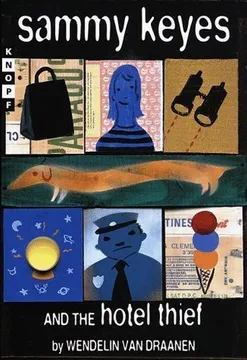
Twelve-year-old Sammy Keyes lives secretly with her grandmother, Grams, in a senior apartment building. Bored indoors, she scans the street with binoculars and spots a bearded man rifling through a purse in a hotel room.
He looks up and catches her watching. Sammy, startled and unsure what to do, waves. The stranger vanishes from the window, leaving her to wonder whether he knows who saw him.
The binoculars begin as Sammy’s answer to confinement, but they turn looking into responsibility: once she witnesses a crime, she cannot return to being merely curious. Her impulsive wave is funny and alarming in equal measure. It also introduces the story’s central tension between what people appear to be and what careful observation can uncover. Sammy sees more than the adults around her, yet she has little power to make them believe her.
A Witness With a Lie
When police gather at the Heavenly Hotel, Sammy slips inside to learn what happened. The robbed woman, Gina, says four thousand dollars disappeared from her purse. Sammy reveals that the thief wore gloves, then describes the man she saw. Officer Borsch doubts her account and presses her about how she could see into a fourth-floor room.
Sammy admits she used binoculars, but gives the police Marissa’s East Jasmine address instead of her real home. The lie protects the secret that she lives with Grams, but it also gives officers reason to look for her at Marissa’s house. As Borsch watches her leave, Sammy senses that he recognizes her from an earlier encounter.
Sammy’s false address is not a casual prank. Her living arrangement has taught her that official attention can threaten the fragile household she shares with Grams. Yet concealment makes her testimony easier to dismiss. The police encounter establishes a recurring bind: Sammy must tell the truth about what she sees while hiding the truth about herself. Borsch’s skepticism also turns her into an investigator before she has decided to be one.
The First-Day Punch
On her first day at junior high, Sammy and her friend Marissa meet Heather Acosta, whose red hair and sharp insults make her an instant adversary. At lunch, Heather needles Marissa for money, then jabs Sammy with a pin. Sammy punches Heather in the nose and walks away, but Vice Principal Caan sends her to the Reflection Room and suspends her for a day.
Grams covers for Sammy when the school calls, pretending to be her mother, while Sammy’s own mother, Lady Lana, remains distant on the phone. Later, at the market, Sammy recognizes Gina as the robbed hotel guest. Gina’s astrology business gives her the name Madame Nashira, and Sammy’s curiosity about the theft deepens.
Sammy’s punch is both a defense and a costly refusal to submit quietly. The school sees the visible blow but not Heather’s pin, reproducing the larger problem Sammy faces with Borsch: institutions judge the evidence they notice first. Grams’s protective lie contrasts with Lady Lana’s affectionate but absent promises. Sammy’s loyalty is rooted in who actually shows up for her, even as her temper sometimes makes that loyalty harder to defend.
The Fire Escape Lie
After Sammy returns from the market, Mrs. Graybill catches her using the fire escape and accuses her of secretly living with Grams in subsidized senior housing. Grams defends Sammy and stages the apartment as a home without a child, but warns that the arrangement may not stay hidden.
Sammy slips out again and visits Hudson Graham, an older neighbor with a house full of books and a new renter, Bill Eckert. Hudson’s newspaper reports another nearby burglary, and he reasons that the thief may know when residents are away. The theory gives Sammy a way to think about the crimes, while Bill’s guarded manner makes him one more person she cannot easily read.
The fire escape is both a practical route and a map of Sammy’s precarious belonging. Mrs. Graybill treats the child’s presence as a violation, while Grams treats it as family, exposing how rules and care can point in opposite directions. Hudson offers Sammy a different model of authority: he asks her to reason through evidence rather than dismissing her age. The renter’s introduction also plants suspicion without making reserve itself proof of guilt.
Rommel Finds Evidence
Hudson’s dog Rommel drags a muddy purse onto the porch. Sammy and Hudson identify the children in its photographs as the Keltners, then call police after finding the family away from home. Back at the apartment, Sammy finds Mrs. Graybill accusing her of leaving a threatening note under the neighbor’s door. Sammy denies it, but Grams initially believes the accusation.
Because Sammy gave Marissa’s address to police, officers arrive there seeking her. She runs across town, pretends to have just taken a shower, and rejects their photo choices. Marissa helps conceal the truth, then invites Sammy to stay overnight. Sammy is hurt when Grams refuses to speak with her, while Marissa admits that her wealthy parents rarely make time for her.
The purse converts Hudson’s abstract burglary theory into physical evidence, but the threatening note makes Sammy’s own safety feel uncertain. Her lie about her address now traps her in a second household and forces Marissa into complicity. The overnight stay exposes a quiet reversal: Marissa envies Sammy’s dependable grandmother, while Sammy envies the apparent freedom of Marissa’s comfortable home. Their friendship grows through recognizing what money cannot provide.
The Rooftop Witness
After returning home, Sammy finds the apartment empty and worries that Grams has been taken. Small signs of a recent morning routine reassure her, but she still wants to know where Grams went. At Madame Nashira’s, Gina explains how she builds astrological charts and encourages Sammy to look at the stars.
Sammy instead follows Brandon’s directions to the mall roof, where binoculars reveal Grams sitting with Hudson. When Grams returns, Sammy admits how much the unexplained absence frightened her, and Grams explains that she visited Hudson to learn more about him. Their argument gives way to a fuller account of Sammy’s troubles. Officer Borsch arrives to test whether the hotel room could be seen from Grams’s window.
The roof turns Sammy’s habit of watching into a way to understand her own relationships. She discovers that Grams has a life beyond tending to her, then recognizes how little information either of them shared. Their reconciliation depends on naming fear rather than disguising it as anger. Meanwhile, Sammy’s ability to see across town is becoming more than a private pastime: it produces observations that police can test, even when Borsch remains reluctant to trust her.
A Napkin at 423
After Borsch checks the view from Grams’s window, Sammy hides in a closet and hears him question the story. Grams protects her by confirming the false East Jasmine address. Later, Sammy and Marissa enter the Heavenly Hotel and persuade the desk clerk to let them visit Gina in room 423.
Gina recalls telling a friend that she planned to bank the cash she had been carrying, giving Sammy a possible explanation for how the thief knew about it. On their way out, the girls find a Double Dynamo napkin wedged in the fire-escape door, marked with the hotel initials and room number. Borsch takes it, but accuses Sammy of forging the clue and threatening Mrs. Graybill.
The napkin is persuasive because it links two separate events, but Borsch’s suspicion transforms evidence into another contest over credibility. Sammy has done the work of noticing and connecting; she cannot control how an adult interprets it. Grams’s decision to protect her preserves their bond, though it also keeps the false identity in place. The hotel visit marks a shift from passive observation to deliberate investigation, with greater personal risk.
The Wrong Suspects
Sammy tells Grams what happened, and Grams finally listens before offering to teach her knitting. At Maynard’s Market, Sammy overhears T.J. worrying about risky investments and money borrowed from his father, making him seem like a possible suspect. Hudson explains the dangers of commodity trading, but also assures Sammy that Bill has a well-paid job.
Sammy learns that Bill is secretly Rockin’ Rick, the radio host Marissa admires, another reminder that appearances conceal unexpected lives. Back at school, Sammy notices Heather wearing an exaggerated nose bandage. She calls the doctor’s office while pretending to be Heather and learns that Heather had only a nosebleed. The information gives Sammy a way to expose Heather’s performance.
The investigation broadens Sammy’s attention beyond criminals: T.J.’s desperation, Bill’s private identity, and Heather’s performance all complicate first impressions. Hudson’s explanation gives her a framework for judging financial motives without confusing risk-taking with proof. Knitting provides a quieter counterpoint to Sammy’s restless sleuthing, linking her hands to Grams’s patience. Her prank against Heather is morally messier than her detective work, but it grows from the same instinct to challenge a false account.
Heather’s Borrowed Bandage
Sammy tricks the doctor’s office into correcting Caan about Heather’s bandage. When he orders Heather to remove it in the cafeteria, the crowd learns she exaggerated her injury, and Tenille accidentally admits Heather knew the nose was not broken. Heather attacks Sammy and strikes Caan when Sammy dodges; Heather is suspended, and students demand their donations back.
Later, Sammy studies the Double Dynamo wrappers and remembers seeing the ice-cream vendor, Oscar, cleaning his glasses through binoculars. That detail clashes with his public claim of blindness. Sammy connects it to the matching napkins and realizes who may be behind the robberies, but she needs a way to prove it before going to police.
Heather’s public exposure temporarily reverses the school’s earlier judgment of Sammy, but the scene is not a simple victory: Sammy engineers the revelation and the confrontation escalates. The more consequential change happens afterward, when ordinary objects become evidence. The napkins and the glasses matter because Sammy has learned to revisit what she saw instead of treating a single impression as complete. Her next problem is not recognition but proof, a distinction that separates suspicion from justice.
Marked Bills at Mary
Sammy urgently asks Marissa for money without explaining why. Heather turns the request into evidence that Sammy is using her friend, and Marissa throws down cash before running off hurt. Heather grabs the bills, so Sammy tackles her and retrieves them. Marissa later finds Sammy near St. Mary’s and apologizes for misjudging her; Sammy admits she should have explained.
They mark two bills and hide behind the statue of Mary, waiting for the ice-cream cart. Oscar pauses, pretends to inspect his shoe, and takes the money. When Marissa screams at a spider, Oscar looks directly toward them. Sammy tells Marissa to get help, then kicks free when Oscar grabs her ankle.
The money plan costs Sammy something before it produces evidence. Her secrecy, meant to protect the investigation, repeats the pattern that has already hurt Grams and Marissa. The reconciliation matters because Marissa returns without being forced, and Sammy acknowledges her own part in the misunderstanding. Their trap then tests the theory in public, shifting the friendship from emotional repair to shared danger.
The Cart Behind the Wall
Oscar escapes the churchyard, and Sammy searches for him rather than letting him disappear. Bike tracks in the dirt near the mall suggest where his cart has traveled. Sammy asks T.J. to call police, then follows the tracks through an alley and over a wall into a vacant lot. Behind a pepper tree, she finds Oscar removing his disguise beside the ice-cream cart.
He spots her and chases her through the streets. Sammy hides behind a parking-lot Dumpster; when Oscar leans inside to find her, she drops its heavy lid on him and climbs on top to hold him there. Officer Borsch arrives with another officer, and they arrest Oscar as Marissa reaches Sammy.
Sammy’s victory depends on the physical details she has gathered: a cart leaves regular tracks, and a disguise must be changed somewhere. Yet the climax is not a flawless solo triumph. Sammy’s plan becomes dangerous, and she survives by improvising until police arrive. Borsch’s presence at the arrest complicates his earlier disbelief, but the immediate consequence is concrete: Oscar can no longer flee or threaten the girls.
The Evidence in the Cart
At the station, Sammy recounts the case to Sergeant Jacobson, who learns that Borsch had dismissed the napkin evidence without reporting it. Jacobson compares the matching Double Dynamo napkins and follows Sammy’s reasoning about the stolen purse, the overheard conversation, Oscar’s glasses, and the cart tracks.
He identifies the thief as Larry Daniels, a probationer who used several disguises and had been known by different names at the hotel. Police find wigs, gloves, cash, jewelry, and Gina’s moon-and-sun watch in the cart. Marissa’s marked bills can be identified, while Gina comes to identify her property. Sammy declines another night away and heads home to Grams, ready to tell the story from the beginning.
The station scene supplies what Sammy lacked throughout the mystery: institutional verification. Jacobson does not merely accept her conclusion; he checks the physical clues and reconstructs how the crimes worked. The recovered watch and marked money turn private observations into evidence that can be acted on. Sammy’s final choice to go home rather than stay with Marissa completes the emotional line of the case. Solving the mystery matters, but so does returning to the person whose trust she most needs.
Analysis
The mystery is built around the difference between seeing and being believed. Sammy sees the hotel thief, but her age, her lies about where she lives, and her previous encounters with authority make adults doubt the witness before they assess the evidence. Her investigative strength is not supernatural intuition. It is attention: she remembers the napkin, the glasses, the overheard conversation, and the cart tracks, then tests what those details might mean.
The book also treats secrecy as both shelter and strain. Grams hides Sammy to keep her safe, while Sammy hides information from Grams to avoid worry or punishment. Each concealment creates a new misunderstanding. Her friendship with Marissa is tested by the same habit when Sammy asks for money without explaining why. Repair comes not from perfect trust, but from admitting the hurt and returning to the problem together.
The secondary conflicts echo the central mystery without becoming identical to it. Heather manipulates school gossip, T.J. risks money he cannot afford to lose, Bill conceals a surprising public identity, and Sammy’s mother offers affection at a distance. These characters make appearance an unreliable guide, but the story avoids claiming that everyone hides something sinister. The decisive distinction is between curiosity and proof. Sammy can suspect, observe, and improvise, yet Jacobson must verify the clues before the law can act. Her success therefore depends on both personal courage and an adult willing to examine what she has found.
Review Summary
Reviews for Sammy Keyes and the Hotel Thief are largely positive, averaging 3.98/5. Readers praise the protagonist Sammy as courageous, witty, and relatable, often comparing her to Nancy Drew. Many adults enjoy revisiting the series from childhood. Common criticisms include a slow-building plot, excessive subplots, and some dated content. Fans particularly appreciate Sammy's authenticity as a flawed but good-hearted character. The book is widely recommended for middle-grade readers, with many expressing enthusiasm for continuing the series.
People Also Read





Characters
Sammy Keyes
Binoculars-wielding sleuthSammy is a sharp, impulsive seventh-grader who notices details adults overlook and often acts before considering the cost. She lives with Grams while her mother pursues an acting career, so privacy and belonging shape her daily choices. Sammy’s humor helps her face fear, but her quick temper and habit of concealing things can wound the people she trusts. She is resourceful rather than polished: her deductions come from remembering ordinary details, testing them, and admitting when she needs help.
Grams
Sammy’s steady homeRita Keyes, whom Sammy calls Grams, is protective, practical, and prone to worry. She gives Sammy the consistency her mother cannot provide, while trying to keep their living arrangement private. Her care can become overprotective, and her first response to trouble is often to control risk. Still, she is capable of apologizing and listening. Knitting becomes one way she invites Sammy into shared time rather than simply telling her what to do.
Marissa McKenze
Sammy’s loyal best friendMarissa is warm, expressive, and easily flustered, especially when she feels responsible for other people. Her wealthy parents provide comfort but little attention, leaving her sensitive to friendships that might be based on money. Sammy’s refusal to borrow from her is one reason Marissa trusts her. She brings energy and affection to Sammy’s investigations, while learning to state her own needs and question the assumptions that make their friendship vulnerable.
Officer Borsch
Skeptical investigatorBorsch is a large, forceful officer who trusts his own judgment more readily than a child witness. He treats Sammy’s age and earlier lies as reasons to doubt her, then mistakes a real clue for evidence she manufactured. His certainty makes him an obstacle as well as a representative of the law Sammy hopes will help. He is distinct from Sergeant Jacobson, who later listens to her account and examines the evidence.
Gina
Robbed astrologerGina, who works as Madame Nashira, is a hotel resident and professional astrologer with a theatrical appearance and a practical understanding of how she earns a living. She dislikes the fortune-telling she sometimes performs for cash, but takes her detailed chart work seriously. Her frankness helps Sammy think through the theft, and her willingness to answer questions gives the investigation its first useful lead.
Hudson Graham
Bookish neighbor and mentorHudson is an older neighbor with a vast library, an eccentric wardrobe, and a patient habit of asking Sammy to reason things out herself. He offers information without treating her as incapable, making him an important counterweight to dismissive adults. His friendship with Grams also reminds Sammy that the people who care for her have independent lives and relationships.
Mrs. Graybill
Watchful neighborDaisy Graybill is a suspicious resident who monitors the senior building and challenges Sammy’s presence there. Her vigilance threatens the secrecy on which Sammy and Grams depend. She is not simply a comic nuisance: her attention reflects the real power she has to expose their household and make life harder for both of them.
Heather Acosta
Schoolyard antagonistHeather is a socially ambitious classmate who uses ridicule, money, and spectacle to control how others see her. She targets Sammy’s clothes and provokes her physically, then turns school gossip into leverage. Her confidence depends on an audience, making public perception one of her favorite tools.
Oscar
Neighborhood ice-cream vendorOscar is a familiar vendor who pushes an ice-cream cart along a regular neighborhood route. His public manner encourages people to speak around him without much caution. Sammy first treats him as part of the ordinary street scene, which makes her later observations about him especially consequential.
T.J.
Market clerk in debtT.J. works at his father’s market and often seems impatient with customers. His risky investments and borrowed money make him look like a possible suspect, though Sammy’s questions reveal that a financial motive alone proves little. He also provides a glimpse of the pressure building beneath his bluster.
Bill Eckert
Hudson’s guarded renterBill rents an apartment behind Hudson’s home. He is quiet, avoids eye contact, and carries himself like someone who prefers not to be noticed. His reserve draws Sammy’s curiosity, but Hudson cautions her not to confuse an unusual manner with evidence of wrongdoing.
Brandon McKenze
Friendly older cousinBrandon is Marissa’s high-school cousin and a friendly presence who treats Sammy as a person rather than a little kid. He works at the mall and helps her find a route to the roof, while Sammy’s self-consciousness around him hints at her early adolescent awkwardness.
Mikey McKenze
Candy-loving younger brotherMikey is Marissa’s eight-year-old brother, happiest around fish tanks and sweets. His habit of wandering off creates trouble for Marissa, who feels responsible for him. His comic appetite and evasions offer a lighter counterpoint to Sammy’s more serious worries.
Lady Lana
Absent actress motherSammy’s mother, Lana, is pursuing acting work in Hollywood and has left Sammy in Grams’s care. She expresses affection over the phone but remains physically absent, leaving Sammy unsure how much to trust promises of reunion. Sammy’s guarded responses reflect disappointment rather than a lack of feeling.
Sergeant Jacobson
Evidence-minded officerJacobson is the officer who takes Sammy’s account seriously after the arrest. He asks for a complete timeline, checks the clues, and follows the evidence rather than relying on assumptions about Sammy. His method offers a sharp contrast with Borsch’s earlier dismissal.
Plot Devices
Grams’s binoculars
Turn looking into evidenceThe binoculars let Sammy witness the hotel theft from across the street and later observe people around town from the mall roof. They also create danger because the thief sees her watching. Their repeated use ties Sammy’s curiosity to the mystery while making her responsibility as a witness impossible to ignore.
The false address
Protect a hidden householdSammy gives police Marissa’s address because she is living secretly with Grams in senior housing. That choice keeps her real home out of the first report, but sends officers to Marissa and forces the girls to invent explanations. The lie turns Sammy’s family circumstances into a practical obstacle in the investigation.
Double Dynamo napkins
Connect separate threatsA napkin from the ice-cream vendor’s cart appears at the hotel fire escape and resembles the one used for the threatening note under Mrs. Graybill’s door. The matching paper gives Sammy a physical link between events that adults treat as unrelated. Borsch dismisses it, but Sergeant Jacobson later compares the evidence.
The marked bills
Test a suspect in publicSammy marks two of Marissa’s bills and places them along Oscar’s route to see whether he takes them. His behavior confirms Sammy’s suspicion, and the markings later let police distinguish Marissa’s money from other recovered cash. The plan exposes the girls to immediate danger before officers arrive.

Download PDF
Download EPUB
.epub digital book format is ideal for reading ebooks on phones, tablets, and e-readers.








