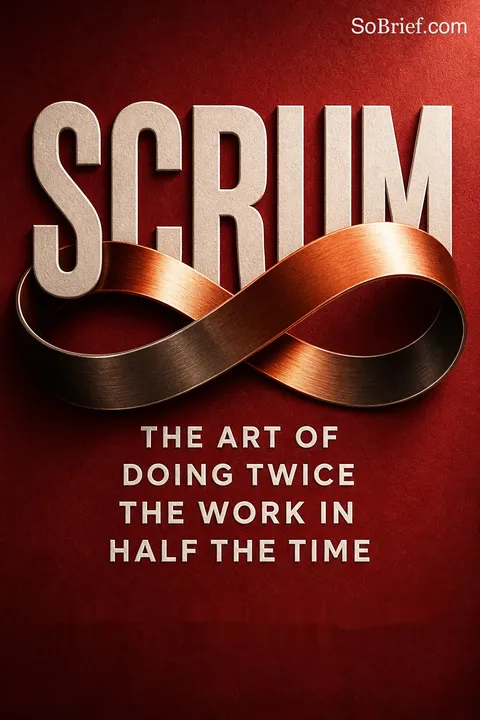


Key Takeaways
Replace long-range certainty with short cycles that expose reality.
Plans meet reality. The FBI’s Sentinel modernization project shows the cost of mistaking a detailed plan for control. Its contractor had spent about $405 million of a $451 million budget and completed only half the project. Forecasts still suggested years of work ahead. The problem was not a shortage of charts or smart people. The project relied on a sequential process that hid trouble until enormous sums had been spent.
Treat plans as provisional. Scrum replaces extended prediction with an Inspect and Adapt cycle: do a bounded amount of work, examine what happened, and change the next move. Planning still matters, but its job is to guide the next stretch, not pretend uncertainty has disappeared.
This is an argument for adaptive control, not for abandoning foresight. In engineering, a feedback controller corrects its behavior by comparing the intended state with observed results. A long project plan without frequent measurement is closer to an open-loop system: it keeps issuing instructions even when conditions have changed. The distinction matters because complex work contains unknowns that cannot be researched away in advance. Still, fixed plans remain useful for repeatable tasks with stable requirements. Scrum is most persuasive where discovery is part of the work.
Show users working slices before sunk costs swallow the project.
Make progress observable. A Sprint is a fixed, short work period, usually one or two weeks, that ends with a usable increment rather than a report about progress. Sentinel teams demonstrated what they had built to agents, records staff, and other stakeholders every two weeks. Their feedback tested whether the system worked for the people who depended on it, rather than merely satisfying a written specification.
Learn by showing. The product need not be complete to be useful. A first release can be a small, functioning piece that reveals whether the team is solving the right problem. Scrum’s Inspect and Adapt cycle uses those demonstrations to update priorities and direction. The book calls the smallest useful first release a Minimum Viable Product: a working version that can generate meaningful feedback.
Demonstrations convert abstract progress into evidence that different groups can challenge. This resembles experimental science: a claim becomes more credible when others can inspect the result and attempt to reproduce it. The approach also limits the sunk-cost trap, where continued investment feels justified mainly because so much has already been spent. A useful caution is that an early release must be genuinely safe for its context. In law enforcement, medicine, or infrastructure, learning quickly cannot mean exposing users to careless or unvalidated systems.
Give small, cross-skilled teams authority over how they reach the goal.
Design for complete work. Scrum teams are small, autonomous, and cross-functional: together, they have the skills to take a piece of work from idea to usable result. The book points to a common working size of about seven people, plus or minus two. In a study of 491 software projects, larger groups took markedly more effort than teams of three to seven. More people can mean more handoffs and more communication paths, not automatically more output.
Share purpose and information. The NPR team covering Egypt’s 2011 uprising had a clear mission and the freedom to adapt as events changed. Regular check-ins helped reporters coordinate without waiting for distant managers to direct each move. Such teams need a meaningful goal, the authority to organize their own work, and access to the different skills the mission requires.
Small teams reduce coordination costs, while cross-functional membership reduces the delays and information loss that occur when work passes between departments. This aligns with research on team cognition: shared understanding can let a group act as more than a collection of specialists. Autonomy, however, is not the same as absence of accountability. A team needs a clear outcome, dependable access to decision-makers, and enough expertise to recognize when a choice exceeds its competence. In high-stakes work, independence needs explicit boundaries.
Put the most valuable work first, even when everything feels urgent.
Order by value. A Product Backlog is the evolving list of work that might contribute to a product or project, ordered by importance. A Product Owner maintains that order by weighing customer needs, business value, and what can realistically be built. The book highlights a recurring product-development pattern: a minority of features often supplies most of a product’s value. Building everything before testing demand can therefore turn much of the effort into waste.
Choose what to leave out. At Medco, teams turned a huge pile of requirements into visible work items, then ranked them by value. The same logic applies to a wedding, a service, or a building project: identify what matters most, do that first, and keep low-value additions from crowding out the essentials. Priorities must be revisited as new evidence arrives.
Prioritization is a form of resource allocation under scarcity. The Pareto pattern is a useful prompt to search for concentrated value, but it is not a law that guarantees a neat 80-to-20 split in every domain. The deeper lesson is to make tradeoffs explicit instead of labeling every request urgent. A visible backlog also gives stakeholders a shared object to debate. That can replace political bargaining with a more concrete question: what outcome is worth the next unit of effort?
Estimate relative effort, then forecast from what teams actually finish.
Use comparisons, not false precision. Early project estimates can be wildly wrong. The book’s Cone of Uncertainty describes initial estimates ranging from one quarter of the time ultimately needed to four times as much. Teams are better at comparing tasks than predicting exact hours, so Planning Poker has members privately select relative effort scores, then reveal and discuss their choices. The Fibonacci sequence, such as 1, 3, 5, 8, and 13, separates estimates enough to make meaningful disagreements visible.
Let results improve forecasts. A team’s Velocity is the amount of estimated work it completes in a Sprint. After several cycles, the team can compare remaining work with its actual pace. At Medco, teams increased from 20 to 90 points per Sprint after surfacing and removing obstacles. Velocity is a local planning aid, not a universal measure of employee worth.
Relative estimates are valuable partly because they expose disagreement. A quiet range of assumptions becomes a conversation about complexity, dependencies, or missing knowledge. Private card selection also reduces anchoring, the tendency for an early number to pull later judgments toward it. Velocity makes a forecast more empirical, but it can be distorted if teams are compared by points or pressured to inflate them. Its sound use is within one team, as a way to plan and notice change, not as a league table.
Eliminate work in progress before asking people to work harder.
Attention has limits. Scrum discourages spreading people across many projects at once. The book cites estimates that when someone divides time among five projects, only about 5 percent of working time may remain available to each, while context switching consumes much of the rest. Partly completed work also ties up effort without giving customers a finished result. Teams therefore try to complete a small number of items instead of filling the room with unfinished tasks.
Prevent avoidable rework. Toyota workers could stop the production line to address a defect where it appeared. At Palm, a bug fixed on the day it was introduced reportedly took about an hour to resolve, compared with 24 hours if left for three weeks. The same principle applies to pace: the book argues that routinely working late creates fatigue, mistakes, and still more work.
This section combines cognitive limits with production economics. Every open task carries a switching cost, and every unfinished deliverable delays the moment when effort becomes useful to someone else. The advice is especially relevant to knowledge work, where restarting a complex train of thought can be expensive. Yet not all parallel work is waste: emergencies, maintenance, and genuinely independent activities may require it. The practical test is whether parallelism protects a real constraint or merely makes everyone look busy.
Fix the system that produces failure, not the person carrying it.
Look for the conditions. Scrum treats an impediment as anything in the way of a team’s progress, including unclear decisions, slow approvals, or missing tools. A Scrum Master helps the team improve how it works and helps remove those barriers. This differs from a conventional manager assigning tasks. After each work cycle, the team reviews its process and chooses a practical change to try.
Blame misses the mechanism. The book uses the NUMMI car plant to make the point: General Motors had labeled its Fremont workforce troublesome. Toyota rehired most of the same workers, changed the operating system, and produced cars with quality comparable to its Japanese plants. The lesson is not that individuals never matter. It is that incentives, procedures, and authority can shape behavior more powerfully than a manager’s judgment of character.
This is a systems view of responsibility: behavior emerges from interactions among people, rules, resources, and incentives. It connects naturally to safety engineering, which investigates how ordinary decisions combine to create failure instead of relying on a single culprit. That approach can make improvement less defensive and more specific. It should not become an excuse to erase individual accountability, especially when someone knowingly causes harm. Strong teams distinguish a mistake encouraged by the system from misconduct that requires a direct response.
Track happiness as an early signal, then change one thing.
Ask before morale collapses. The book argues that well-being can precede stronger performance, and cites a review of 225 studies involving more than 275,000 participants. Its Happiness Metric asks team members to rate their feelings about their role and company, explain those ratings, and name one change that would improve the next Sprint. The team then makes a specific improvement its priority and checks whether it happened.
Make improvement concrete. Sutherland’s consultancy used this process to discover that its work items were vague and poorly defined. After addressing successive team concerns, reported output rose from 40 to 120 points per Sprint. The point is not to chase cheerfulness as an end in itself. The metric is a prompt to find conditions that help people do meaningful work, learn, and contribute.
The useful move is turning a vague cultural goal into repeated, discussable observations tied to action. This resembles employee voice systems and continuous-improvement practices: people closest to the work identify friction that leadership may not see. But happiness scores are signals, not objective verdicts. Teams may report low satisfaction during necessary, demanding work, or high satisfaction while avoiding difficult goals. Pairing sentiment with quality, customer outcomes, and sustainable pace helps distinguish healthy challenge from preventable misery.
Apply short feedback loops to classrooms, farms, and public services, not only software.
Transfer the working logic. In the Netherlands, chemistry teacher Willy Wijnands used eduScrum: students worked in small teams, tracked lessons on visible boards, and checked one another’s understanding. He reported test scores rising by more than 10 percent. The method also made teamwork and awareness of different strengths part of the lesson, not just chemistry.
Turn information into agency. In rural Uganda, Community Knowledge Workers used smartphones to share farming guidance and market prices. One farmer described doubling her crop yield with agricultural advice and negotiating a higher price after learning what produce fetched in town. These examples extend Scrum beyond commercial products. The common ingredients are visible work, clear priorities, short review cycles, and the ability to act on new information.
These cases suggest that Scrum’s portable element is not a software ritual but a structure for learning together: make work visible, coordinate action, and respond to evidence. That structure can help organizations with scarce resources focus on what matters most. Transfer still depends on local conditions. A classroom needs a teacher who can diagnose learning, and farmers need reliable information and access to markets. A process can improve coordination, but it cannot substitute for expertise, infrastructure, or political support.
Analysis
The book’s central claim is that complex work improves when organizations replace distant prediction with frequent evidence. Its stories move from a failed FBI modernization project to software teams, manufacturing, journalism, classrooms, and rural farming. Across those settings, the mechanism is consistent: a small group pursues a clear outcome, makes work visible, delivers a complete increment, gathers feedback, and changes its approach. Scrum is presented less as a checklist than as an operating rhythm that brings learning into the work itself.
That is a strong diagnosis of why large projects fail. Long plans can create the appearance of control while delaying the information that would reveal a mistaken assumption. Small teams, short cycles, and visible work shorten that delay. The book also links productivity to human conditions often treated as soft concerns: autonomy, shared purpose, reasonable workloads, and the ability to speak about obstacles without being punished.
Its boldest claims deserve careful interpretation. Dramatic productivity gains from selected case studies do not establish that every organization can double output or that one framework fits every task. Scrum may be less useful when work is highly routine, tightly coupled to external approvals, or constrained by safety and regulatory requirements. Even there, iterative learning can help, but the cadence and definition of a finished increment must fit the stakes. Metrics such as velocity and happiness can also be gamed if leaders turn them into individual performance targets.
The most durable insight is therefore not that process alone creates extraordinary results. It is that organizations should make reality visible soon enough to respond, give capable teams room to act, and treat improvement as part of production rather than an afterthought. Scrum offers a practical design for those behaviors. Its value depends on whether leaders protect the conditions that let teams use it honestly.
Review Summary
Scrum receives mixed reviews, with many praising its innovative approach to project management and productivity. Readers appreciate the emphasis on teamwork, adaptability, and continuous improvement. However, some criticize the author's self-aggrandizing tone and lack of discussion on potential challenges. The book is seen as more of a philosophical exploration of Scrum's origins rather than a practical guide. While some find it inspiring and applicable to various fields, others argue it oversimplifies complex issues and may not be suitable for all business contexts.
People Also Read







Glossary
Scrum
adaptive team-work frameworkA framework for organizing complex work through small teams, short fixed work cycles, visible progress, regular demonstrations, and continuous adjustment. A Product Owner orders work by value, a Scrum Master supports the team and helps remove obstacles, and the team decides how to complete the work. The framework is intended to reveal problems early and improve both delivery and collaboration.
Sprint
fixed short work cycleA time-boxed period, usually one or two weeks and always less than a month in the book’s implementation guide, during which a team works toward a defined goal. The team selects work at the start and aims to finish usable items before the cycle ends. A Sprint concludes with a demonstration and a review of how the team worked.
Product Backlog
ordered list of possible workThe evolving, prioritized list of work that could contribute to a product or project. It represents what might be done, not a fixed contract that everything must be completed. The Product Owner maintains its order in consultation with stakeholders and the team, placing higher-value work ahead of lower-value work and revising priorities as evidence changes.
Product Owner
person accountable for valueThe role responsible for defining what work matters and why. The Product Owner understands the customer or beneficiary, maintains and orders the Product Backlog, answers the team’s questions, and makes decisions about product direction. The role is accountable for translating the team’s completed work into value, such as revenue, better service, or another clearly chosen outcome.
Scrum Master
team process facilitatorA servant-leader who helps a Scrum team use its working framework effectively. The Scrum Master facilitates key meetings, supports transparency, helps the team examine its process, and works to remove obstacles that impede progress. The role is not a conventional project manager who assigns each person’s tasks or dictates how the work must be done.
Velocity
completed effort per SprintA team’s observed rate of completing estimated work during a Sprint, commonly tallied in relative effort points. After several cycles, the team can use its own velocity and the remaining work to make a more grounded forecast. The book treats velocity as a team planning measure and a prompt to identify impediments, not as a universal comparison between individuals or teams.
OODA loop
observe, orient, decide, actA decision cycle associated in the book with fighter pilot John Boyd: observe changing conditions, orient by interpreting them, decide on a response, and act. The cycle begins again as the results become new information. Scrum applies this logic through short delivery cycles, so teams and Product Owners can use actual reactions to adjust priorities and direction.
Planning Poker
group relative-estimation techniqueA collaborative method for estimating the relative effort of work items. Team members select numbered cards privately, reveal them together, and discuss substantial differences in their estimates. The book favors values spaced according to the Fibonacci sequence, because the gaps make meaningful differences easier to perceive than finely graded hour estimates.
Definition of Done
shared completion standardThe explicit conditions an item must satisfy before the team considers it finished. These conditions can include tests, quality requirements, compliance, and readiness to demonstrate or deliver the work. Agreeing on the standard in advance prevents a task from being called complete while important work remains hidden or must be added through later rework.
Minimum Viable Product
smallest useful first releaseThe least extensive version of a product or service that still provides some real value and can generate useful feedback from users. It is not merely a mock-up or an unfinished promise. The purpose is to learn what people actually need before committing resources to a large set of features that may prove unnecessary.
kaizen
small continuous improvementA Japanese term for improvement, used in the book for a manageable change a team can make to its process. At the end of a work cycle, the team identifies an improvement, defines how success can be observed, and makes it a priority in the next cycle. The practice emphasizes repeated action rather than discussion without follow-through.
Happiness Metric
team well-being checkA brief set of questions used at the end of a Sprint to gauge how people feel about their role and organization, why they feel that way, and what single change might improve the next cycle. The team uses the answers to surface sources of friction and select a practical improvement. It is intended as an early signal, not a substitute for measuring outcomes.
Inspect and Adapt
review results, adjust actionThe recurring practice of pausing after a bounded period of work to examine both the result and the process that produced it. A team checks whether it is building something valuable, identifies what is slowing or confusing the work, and adjusts its next steps. In Scrum, demonstrations and retrospectives make this learning routine rather than exceptional.
FAQ
What's Scrum: The Art of Doing Twice the Work in Half the Time about?
- Focus on Efficiency: The book introduces Scrum, a framework aimed at enhancing productivity and efficiency across various industries, not limited to software development.
- Real-World Applications: Jeff Sutherland shares examples from his experiences with organizations like the FBI to demonstrate Scrum's transformative potential.
- Philosophy of Work: It challenges traditional project management methods, advocating for a flexible, iterative approach that embraces change and creativity.
Why should I read Scrum: The Art of Doing Twice the Work in Half the Time?
- Transformative Insights: The book offers insights into streamlining work processes and eliminating waste, valuable for anyone seeking to boost productivity.
- Practical Framework: It provides a practical framework applicable across industries, detailing concepts like Sprints and Daily Stand-ups.
- Inspiring Success Stories: Readers will find motivating success stories that illustrate Scrum's effectiveness, backed by Sutherland's credible experiences.
What are the key takeaways of Scrum: The Art of Doing Twice the Work in Half the Time?
- Embrace Change: Regularly "inspect and adapt" to stay aligned with goals, encouraging teams to review progress and make necessary adjustments.
- Focus on Teamwork: Emphasizes teamwork and collaboration, stating that great teams have a purpose greater than the individual.
- Eliminate Waste: Identifying and eliminating waste in processes can lead to significant efficiency improvements, advocating for smarter work.
What is the Scrum framework as described in Scrum: The Art of Doing Twice the Work in Half the Time?
- Sprints: Organized into time-boxed iterations called Sprints, typically lasting one to four weeks, culminating in a review of accomplishments.
- Daily Stand-ups: Brief daily meetings to discuss progress, obstacles, and plans, fostering communication and accountability.
- Roles and Responsibilities: Key roles include the Scrum Master and Product Owner, ensuring everyone knows their responsibilities and works towards common goals.
How does Scrum improve productivity according to Jeff Sutherland?
- Focus on Deliverables: Encourages teams to deliver working products at the end of each Sprint, maintaining focus on tangible outcomes.
- Continuous Improvement: Promotes a culture of continuous improvement through regular reflection and adaptation.
- Reduced Context Switching: Minimizes waste associated with multitasking by focusing on one task at a time.
What are the common pitfalls in project management that Scrum addresses?
- Over-Reliance on Planning: Traditional methods involve extensive upfront planning, leading to unrealistic expectations; Scrum advocates for flexibility.
- Inefficient Communication: Many projects suffer from poor communication; Scrum fosters transparency and collaboration.
- Wasteful Processes: Identifies wasteful practices like unnecessary meetings, aiming to streamline processes and focus on value.
What is the Definition of Done in Scrum?
- Clear Standards: A shared understanding of what it means for a task to be complete, with specific criteria that must be met.
- Quality Assurance: Ensures quality is built into the process from the start, preventing rework and enhancing outcomes.
- Alignment with Goals: Aligns the team's efforts with project goals, ensuring everyone works towards the same standards.
How does Scrum handle change and uncertainty?
- Iterative Approach: Embraces change by allowing teams to adapt plans based on feedback and new information.
- Regular Check-ins: Includes regular check-ins like Sprint reviews to assess progress and make adjustments.
- Empowered Teams: Empowers teams to make decisions and take ownership, fostering accountability and innovation.
What are some real-world examples of Scrum in action?
- FBI Sentinel Project: Successfully completed using Scrum, overcoming previous delays and challenges.
- WIKISPEED: Uses Scrum to develop fuel-efficient cars, innovating rapidly with one-week Sprints.
- NPR Coverage: Applied Scrum principles for timely, high-quality news coverage during the Egyptian revolution.
What is the importance of the Product Owner in Scrum?
- Vision and Prioritization: Defines the project vision and prioritizes the Backlog, ensuring focus on valuable features.
- Customer Engagement: Engages with customers to gather feedback, helping the team meet market demands.
- Accountability for Value: Accountable for the value delivered, measuring success by meeting customer needs.
How does the concept of "velocity" work in Scrum?
- Measuring Progress: Velocity measures how much work a team can complete in a Sprint, aiding in productivity assessment.
- Improvement Over Time: Tracking velocity helps identify trends and areas for improvement, enhancing efficiency.
- Setting Realistic Goals: Provides a benchmark for setting realistic goals based on past performance.
How can Scrum be applied outside of software development?
- Education: Enhances student engagement and learning outcomes by fostering collaboration and self-directed learning.
- Nonprofits and Social Good: Empowers communities and addresses poverty by delivering valuable services effectively.
- Government and Public Services: Improves efficiency and responsiveness, better serving citizens and adapting to needs.
Download PDF
Download EPUB
.epub digital book format is ideal for reading ebooks on phones, tablets, and e-readers.








