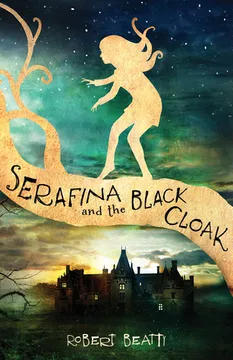


Plot Summary
The Cloak Takes Clara
At twelve, Serafina lives unseen in Biltmore’s basement with her father, catching rats while the household sleeps. One night, she follows unfamiliar footsteps into the subbasement and sees a man in a black cloak seize Clara Brahms, a visiting girl in yellow. The cloak folds around Clara, and she vanishes.
When the attacker turns on Serafina, she bites and claws her way free, then squeezes into a narrow laundry machine where he cannot reach her. By morning, she is alive but shaken. She tells her father what happened, yet he dismisses it as a nightmare. Her terror now has a second edge: Clara is missing, and nobody believes Serafina knows why.
Serafina’s first act of courage is also a failure: she runs toward Clara, but reaches her too late. That distinction matters. The scene does not make bravery a magical solution; it gives Serafina responsibility for what she witnessed and leaves her with the helplessness of survival. Her skill at hiding saves her, while the same secrecy that has protected her from society keeps her testimony unheard. The episode turns her private nighttime territory into a crime scene, forcing her to choose between obeying her father’s rules and acting on knowledge no one else has.
Serafina Meets Braeden Vanderbilt
Angry that her father has dismissed her, Serafina climbs upstairs and finds the bright, crowded world she has watched from hiding. There she meets Braeden Vanderbilt, the orphaned nephew of Biltmore’s owners, who treats her as a person rather than an intruder. Before she can explain what she saw, estate superintendent Mr. Boseman grabs her, and Clara’s mother rushes in to report her daughter missing.
Serafina recognizes Clara’s name and spots the same hard-soled shoes she heard below. When George Vanderbilt orders a search of the entire house, Serafina bolts downstairs to warn her father. He hides their bedding and cooking things, terrified that discovery will cost him his job and expose the secret life they have built in the basement.
The meeting with Braeden gives Serafina a first, fragile experience of being addressed without contempt. It also exposes the cost of her father’s protection: to keep her safe, he has made her invisible, leaving her without any public standing from which to report a crime. Clara’s mother changes the stakes by confirming that the girl is not a nightmare. Serafina’s attention to shoes begins her investigation, but the clue is not proof. The scene puts observation, social credibility, and fear of exposure into direct conflict.
A Forest-Born Secret
With searchers nearing the workshop, Serafina demands to know why her father has kept her hidden. In the locked electrical room, he finally tells her how he found a malformed newborn in the forest, saved her when others refused, and fled the authorities who wanted to take her away. He raised her as his daughter, though he never told her she was not born human.
Serafina recognizes herself in the story and feels both loved and betrayed. After the searchers leave, she finds a black satin glove in the subbasement, its lining marked with bloody, deteriorating skin. The clue strengthens her belief that the attacker is real. Rather than return to hiding, she sets out to find Braeden and help Clara.
The revelation gives Serafina two truths that pull in opposite directions: her father chose her, and he concealed the facts that shaped her life. His secrecy comes from fear of losing her, not shame, but that motive does not erase her anger at being denied knowledge of herself. The bloody glove makes the supernatural threat materially legible, much as her unusual body has always made her difference physical. Serafina’s decision to investigate is therefore more than disobedience. It is her first attempt to define her identity through action rather than through her father’s fear.
The Road Closes Behind Them
At the estate’s carriage entrance, a coachman named Crankshod shakes Serafina until Braeden intervenes and helps her pass as a shoeshine girl. In the carriage, Braeden tells her that another guest, Anastasia Rostonova, has also disappeared. Their journey to Asheville stops when a felled tree blocks the road; another crashes behind them, trapping the carriage in Dardin Forest.
During the night, the black-cloaked attacker strikes. Nolan, the young assistant coachman, throws himself between the attacker and Braeden, but the cloak swallows him. Serafina and Braeden fight back with Gidean and drive the attacker away. At dawn, searchers arrive. Serafina hides in the trees, while Braeden protects her secret and returns to Biltmore without her.
Braeden’s first decisive kindness is practical: he stops Crankshod from hurting Serafina and invents a cover that lets her leave with him. The road ambush tests that alliance under pressure. Braeden’s care for the horses steadies the group, while Nolan’s impulsive courage protects Braeden at terrible cost. Serafina’s warning that the attacker wants the young master gives the threat a personal target. When she remains hidden instead of returning with the rescue party, the partnership becomes more than an accidental adventure. She has chosen to pursue the danger alone.
Graves Beneath the Ravens
After the search party leaves, Serafina follows an overgrown track, hoping it will lead to the abandoned village. Ravens drive her into an old cemetery, where she finds empty graves, broken coffins, and a sunlit clearing marked by a sharp-bladed angel statue. There she discovers two mountain-lion cubs and plays with them, until their mother charges and forces her to flee.
Injured and disoriented, Serafina tumbles down a mountainside in the rain, then finds a stream and follows it toward the French Broad River. At night, she shelters beneath roots as wolves call across the water. A lantern approaches. Expecting the cloaked attacker, she prepares to fight, but the figure is her father, who has come into the forest to bring her home.
The cemetery turns local rumors into geography: graves without bodies show that the disappearances have a history older than the current guests. The angel’s blade is introduced as a concrete object within a landscape of uncertain rules, while the cubs offer Serafina a brief, unguarded sense of belonging that the mother lion’s attack violently complicates. Her route home depends on what she has learned from her father, especially that water flows downhill toward the river. The rescue reverses their earlier roles. The man who warned her away from the forest risks entering it to save her.
Friends Behind Locked Doors
Back at Biltmore, Serafina sees that the searchers have found no trace of the missing children. Her father takes her to their workshop, where they share dinner before he returns to the damaged dynamo. That night she sneaks into Braeden’s bedroom. Gidean recognizes her, and Braeden wakes relieved to find her safe.
As she recounts the forest, the two admit how few friends they have had and agree that their difference does not make either of them unworthy. Braeden gives her a winter gown meant for Clara. The cloaked man later tests the locked bedroom door, then moves on. In the morning, Braeden’s aunt reveals that the pastor’s son has disappeared during the night, confirming that hiding from the attacker only leaves another child exposed.
The bedroom visit converts an alliance formed in danger into a chosen friendship. Serafina asks whether Braeden sees her as a normal girl; his hesitation hurts, but his honesty lets them recognize their shared loneliness without pretending they are identical. The gown carries a tender complication because it was originally intended for Clara, linking Serafina’s new intimacy to the child she could not save. The locked door provides temporary safety, not resolution. When another boy disappears, the scene rejects the comfort of survival alone and pushes Serafina toward confronting the source of the danger.
Thorne's Borrowed Talents
Serafina and Braeden move through Biltmore’s hidden passages, searching guest rooms for the missing cloak. They find nothing, but Serafina recalls Montgomery Thorne accidentally addressing Anastasia’s father with Russian words for father and papa.
In the library, she and Braeden confirm the meanings. Serafina connects the slip to Thorne’s fluency, music, chess, and other seemingly effortless abilities: the cloak may absorb the knowledge of the children it takes.
Braeden resists accusing a man he admires, even after Serafina notices Thorne’s gloves and suspects he damaged the dynamo. At a gathering, Thorne plays beautifully and wins the adults’ trust. Then the Vanderbilts decide to send Braeden away with him the next morning. Serafina realizes she has only one night to act.
Serafina solves the mystery by treating talent as evidence rather than as proof of virtue. Thorne’s accomplishments make him socially credible, but their accumulation becomes suspicious when the Russian mistake suggests knowledge acquired from someone else. Braeden’s disbelief is not simple foolishness; loyalty makes the accusation painful because Thorne has offered him the attention and admiration he lacks elsewhere. Their disagreement also marks Serafina’s growing independence as a thinker. She does not wait for consensus. The planned journey turns her theory into an immediate danger: the person Braeden trusts is about to take him out of reach.
Serafina Sets the Trap
Serafina puts on Braeden’s gown and walks openly through the dark house, making herself look like the vulnerable child Thorne hunts. When he leaves the Billiard Room carrying the black cloak, she leads him through the Rambles and into the cemetery, toward the mountain-lion den.
Thorne follows her tracks to the den and reaches inside. The mother lion attacks, but then turns on Serafina as another intruder. Recognizing their matching amber eyes, the lioness spares her.
Serafina finds the cloak calling to her and briefly wears it, only to see the trapped faces of its victims. Thorne attacks to reclaim it. Gidean and the lioness hold him off, while Serafina drives the cloak onto the angel’s sharp sword and tears it apart. Thorne disintegrates with it.
Serafina’s plan depends on redirecting power rather than matching it. She cannot defeat Thorne by strength, so she uses his hunger and the lioness’s instinct to bring him to a place where he is vulnerable. The den becomes both a trap and a test of belonging: the lioness first treats Serafina as a threat, then recognizes her through their eyes. The cloak’s temptation is psychologically precise, offering not abstract evil but the answers, competence, and acceptance Serafina has long wanted. Seeing its captive faces makes the cost of borrowed power undeniable, and she chooses destruction over mastery.
The Captives Wake
As the cloak’s smoke clears, Clara, Anastasia, Nolan, and the other captives stir among the graves, alive but confused after years or nights imprisoned within its folds. Serafina recognizes the young people she saw taken, then notices a disoriented woman with the same amber eyes and unusual features as her own.
The woman calls the lion cubs to her and identifies herself as Leandra. She explains that she and Serafina’s biological father were catamounts, humans able to become mountain lions.
When Thorne’s cloak captured the human half of Leandra’s soul, she survived in lion form, gave birth in the forest, and entrusted the infant Serafina to the mechanic who found her. Serafina’s father was not her birth father, but he had saved and raised her. The woman’s return makes her origin comprehensible without diminishing that love.
The released captives transform the cemetery from a record of unexplained losses into the physical aftermath of Thorne’s violence. Serafina’s origin is revealed through a reunion, not a bloodline revelation alone: her mother’s account confirms the mechanic’s story while giving the animal life around Serafina a family history. The novel carefully refuses to make biological parentage cancel adoptive love. Leandra’s choice to entrust her newborn to a human stranger was an act of care under impossible conditions, while the mechanic’s years of protection made that choice meaningful. Serafina belongs to more than one family without having to disown either.
Biltmore Sees Its Guardian
At dawn, Braeden organizes a search party and sends Gidean to follow Serafina’s scent. She emerges from the forest beside her mother, the Doberman, and the freed children. Anastasia runs to her father, Clara to her parents, and Nolan to his father.
Leandra stays near the forest and her cubs, while Serafina promises to visit. Braeden welcomes Serafina back and apologizes for doubting her. She then approaches her own father, who embraces her without reproach.
Braeden introduces her to George and Edith Vanderbilt, and they praise her instead of punishing her father for hiding her. Edith offers proper beds for the basement, while Serafina proudly claims her work as Biltmore’s Chief Rat Catcher. Her father has also repaired the dynamo, and the house’s lights return.
The ending makes visibility a social event rather than a private wish. Serafina steps out where the estate’s guests and workers can see her, and the children’s reunions turn her solitary investigation into shared relief. Her father’s public acceptance matters as much as the Vanderbilts’ welcome: he no longer has to protect her by keeping her unknown. The repaired dynamo restores light to the house, but the deeper change is institutional and relational. Serafina moves from a hidden worker beneath Biltmore to a recognized defender of it, while retaining her bond with the forest and the family she has found there.
Analysis
Serafina’s central problem is not simply that she is different; it is that other people’s fear has turned difference into secrecy. Her father’s concealment saves her from those who would take her away, but it also denies her the ordinary recognition she craves. The plot makes that tension concrete through doors, vents, hidden beds, and the concealed life beneath Biltmore. She becomes visible not by changing her body or abandoning the forest, but by acting where others cannot: reading evidence, protecting children, and taking responsibility for what she has seen.
The novel also distinguishes inherited power from chosen conduct. Thorne acquires other people’s talents by imprisoning them, treating knowledge as property and children as resources. Serafina’s unusual abilities, by contrast, become meaningful through restraint and care. She refuses the cloak when it offers mastery, and she depends on cooperation with Braeden, Gidean, her father, and the lioness. Her strength is neither solitary nor limitless. It is the capacity to notice what others miss and to risk herself for someone who cannot repay her.
Family in the story is biological, adoptive, and communal without being interchangeable. Serafina’s mother explains her origin, but the mechanic who raised her remains her father in the deepest practical sense. Braeden’s attachment to animals and his grief over lost family make him a counterpart to Serafina, not a rescuer who completes her. By the ending, her welcome at Biltmore does not erase her forest ties. It expands the circle in which she can belong. The story’s resolution is therefore not normalization, but recognition: Serafina can be a daughter, friend, worker, and guardian without having to hide the creaturely qualities that make her herself.
Review Summary
Serafina and the Black Cloak is a middle-grade novel that captivates readers with its mysterious and spooky atmosphere. Set in the Biltmore Estate, it follows a unique protagonist with special abilities as she uncovers dark secrets. While some found the pacing slow and character development inconsistent, many praised the book's blend of history, fantasy, and horror. Readers appreciated the themes of friendship, self-discovery, and the battle between good and evil. The book's creepy elements and intriguing plot make it suitable for both children and adults, though some caution is advised for younger readers.
People Also Read





Characters
Serafina
Night-born rat catcherSerafina is a twelve-year-old who lives secretly beneath Biltmore with the mechanic she calls Pa. Small, swift, and acutely alert in darkness, she catches rats with her bare hands and learns the house by moving through its hidden spaces. Her unusual body and nocturnal habits have made her curious about ordinary family life, but years of secrecy have also taught her to expect rejection. She reads widely, notices details others overlook, and tends to trust what she can observe more than what adults tell her. Beneath her pride in being Biltmore’s Chief Rat Catcher is a strong desire to be seen and chosen. When danger arrives, her instinct to protect others competes with her fear of exposure.
Serafina's Pa
Protective adoptive fatherA broad-shouldered mechanic who helped build Biltmore, Serafina’s Pa repairs the machinery that keeps the estate running and secretly raises her in its basement. Practical, reserved, and uneasy with supernatural explanations, he expresses love through labor, shelter, food, and vigilance rather than emotional conversation. His silence about Serafina’s origins protects her from people who might fear or exploit her, but it also leaves her wondering whether he is ashamed of her. He is capable of extraordinary tenderness, even when worry makes him stern. His relationship with Serafina is founded not on biology but on years of daily care, and his deepest fear is that the wildness he has tried to keep her safe from will take her away.
Braeden Vanderbilt
Grieving boy, gifted horsemanBraeden is the twelve-year-old nephew of George and Edith Vanderbilt. Orphaned by a house fire, he has found steadiness in horses and his Doberman, Gidean, while adults interpret his reserve as a phase to be corrected. He understands animals through patience and close attention, but struggles to form friendships with children who seem to expect a version of him he cannot provide. His curiosity about Serafina begins with her unexplained presence in the house and grows into respect for her courage. Braeden is kind without being naïve, though affection can make him slow to question people he trusts. His emerging confidence is clearest when he acts to protect others and bring the household together.
Montgomery Thorne
Versatile Southern guestThorne is a polished guest at Biltmore, known for his Southern manners, striking musical performances, and seemingly wide command of languages and skills. His ease with the Vanderbilts makes him a welcome presence in a house crowded with anxious visitors. He is attentive to Braeden and appears to offer the boy a model of adult confidence and competence. Thorne’s past is described as a dramatic rise from ruin to respectability, a story that seems to explain his ambition while leaving some details unclear. Serafina, who watches people as carefully as she hunts rats, notices that his talents and habits do not quite add up. He embodies the difficulty of judging character through charm and reputation alone.
Gidean
Loyal black guardianGidean is Braeden’s black Doberman and closest companion. He is wary of Serafina at first, protective of his master, and quick to respond when danger approaches. His loyalty is not blind obedience: his attention to scents and threats often tells Serafina that something is wrong before the people around her understand it. After she and Braeden fight beside him, Gidean begins to accept her as an ally. The dog gives Braeden a bond that does not depend on conversation, and becomes a practical bridge between the grieving boy and the isolated girl.
George Vanderbilt
Bookish estate masterGeorge Vanderbilt is Biltmore’s wealthy, well-read master and the uncle who has taken Braeden into his household. He is accustomed to organizing people and resources, and he responds to the disappearances with searches, detectives, and plans to protect the guests. His confidence in official explanations can make him slow to recognize what lies outside ordinary experience. Yet he treats the staff and their families as part of the community he is responsible for, and his concern for Braeden is real, even when he presses the boy to act older than his grief allows.
Edith Vanderbilt
Generous estate mistressEdith Vanderbilt is George’s wife and the welcoming mistress of Biltmore. She pays attention to the children who visit the estate and tries to make the household feel like a community, especially when fear and grief spread among the guests. Her efforts to help Braeden make friends come from affection, though they sometimes mistake his need for a different kind of connection. During the crisis, she looks after families as well as prominent visitors. Her generosity is practical and personal: she notices what people need and tries to provide it.
Clara Brahms
Missing young pianistClara is a gifted young pianist visiting Biltmore with her parents. Her talent and gentle manner attract the Vanderbilts’ attention, and her disappearance gives Serafina the first clear evidence that the threat is real. Clara is not simply a mystery to be solved; her parents’ fear and persistence make the cost of each missing child visible throughout the estate. Her presence also links the adults’ plans for Braeden’s social life to the danger they have failed to recognize.
Anastasia Rostonova
Russian ambassador's daughterAnastasia is the daughter of the Russian ambassador, visiting Biltmore with her father. Braeden remembers her as a tall girl with elaborate dresses and a small white dog, and he doubts she would have left without the animal. Her disappearance predates Clara’s and establishes that the crisis has reached beyond a single family. The details of her language and family bond later become important to Serafina’s investigation, while her father’s determined search gives the household’s uncertainty a human face.
Nolan
Stable boy with nerveNolan is a young assistant coachman who knows the estate’s horses and wants to prove he can help. Crankshod repeatedly dismisses him as too small and inexperienced, but Nolan’s courage is greater than his size suggests. He cares about the horses and his family, and he is quick to act when Braeden is threatened. His presence shows how easily adults underestimate a child’s capacity, especially when the child lacks status or authority.
Mr. Crankshod
Rough estate coachmanCrankshod is a large, abrasive coachman trusted by George Vanderbilt to guard Braeden. He treats Serafina roughly and belittles Nolan, making him a source of immediate danger even before the supernatural threat appears. His version of events after the forest attack complicates Serafina’s effort to decide whom she can trust. He is a useful reminder that power and authority do not automatically make a person dependable.
Leandra
Mysterious forest wandererLeandra is a guarded figure associated with the deep forest and its older, stranger history. Her physical bearing and attention to the animals around her mark her as someone shaped by a life outside the household’s rules. She is resilient, instinctive, and difficult for Serafina to understand at first. Leandra’s presence draws the story’s questions about human identity and animal nature into sharper focus, without making the wilderness simply safe or simply hostile.
Mr. Rostonov
Anxious Russian fatherAnastasia’s father is a Russian ambassador who stays at Biltmore after his daughter disappears. His limited English makes it difficult for him to communicate the full force of his fear, and he depends on others to help him navigate the search. He is persistent, visibly heartsick, and devoted to bringing his daughter home. His distress gives Serafina an intimate view of what the missing children mean to their families.
Mr. Bendel
Thorne's cheerful companionBendel is a guest and friend of Thorne, known for joking with him and moving comfortably among Biltmore’s visitors. His confidence in Thorne helps make the gifted guest seem trustworthy. He also participates in discussions about the disappearances and joins the effort to search for the children. Bendel’s familiarity with Thorne becomes part of the social picture Serafina must interpret, though friendliness alone cannot establish what lies beneath a person’s public manner.
Mr. Pratt
Clever Biltmore footmanPratt is a footman who knows the mansion’s concealed doors and passages. His knowledge helps Serafina discover that Biltmore contains routes unseen by most residents, useful both for hiding and for moving through the house. He is clever, self-assured, and flirtatious with Miss Whitney, but his confidence in interpreting the disappearances is less reliable than his knowledge of the building.
Miss Whitney
Observant household maidMiss Whitney is a Biltmore maid who joins the search for Clara and moves through the house with Pratt. Serafina likes her and notices her kindness, as well as her fondness for Pratt. Her access to servants’ gossip helps show how rumors and fear travel through the estate. She is part of the household’s everyday human world that Serafina has watched from hiding.
Plot Devices
The Black Cloak
A trap for soulsThe cloak is the central supernatural mechanism behind the disappearances. It wraps around a victim and draws that person into its folds, taking their soul and retaining their abilities. Its wearer gains knowledge and skills, which helps explain the remarkable range of Thorne’s talents. The cloak also exerts a persuasive pull on anyone who touches it, promising power and understanding while concealing the imprisoned faces within. It drives the mystery, makes the victims’ fate uncertain, and creates the moral test at the climax: Serafina must refuse the power it offers and destroy the thing rather than use it.
Biltmore's hidden passages
A secret route networkThe mansion’s concealed doors, vents, coal chutes, and service spaces give Serafina a way to move through a world that does not know she exists. They let her evade the search parties, observe conversations, and investigate guest rooms without being seen. The passages also reveal how thoroughly she has learned the estate through solitary exploration. For Braeden, entering them means trusting Serafina’s knowledge rather than relying on the official routes of the house. Their practical function is suspenseful concealment, but they also embody Serafina’s unusual knowledge and her exclusion from the visible household.
The Broken Dynamo
Darkness enables the hunterThe damaged Edison dynamo leaves Biltmore without electric light and forces the staff to use candles and lanterns. Serafina’s father struggles to repair it, while the household’s darkness gives the cloaked attacker a greater advantage. The breakdown initially appears to be a separate mechanical crisis, but Serafina recognizes that someone knowledgeable may have sabotaged it. This device ties the estate’s modern machinery to the supernatural threat: the house depends on engineered light, yet its safest places can still be penetrated by an enemy who understands both machines and darkness.
The Forest Cemetery
A map of old disappearancesThe overgrown graveyard gives physical form to the mountain stories about missing bodies and abandoned settlements. Its crowded stones, empty graves, disturbed earth, and inscriptions make Serafina suspect that the current disappearances belong to a much older pattern. The clearing and its angel statue provide the setting for the climax, where the statue’s sharp sword becomes the only blade able to tear the cloak. The cemetery also shelters the mountain-lion den, bringing together the supernatural threat and the wild world tied to Serafina’s origins.
Download PDF
Download EPUB
.epub digital book format is ideal for reading ebooks on phones, tablets, and e-readers.








