

Key Takeaways
Treat the brain as your body's energy manager, not a thinking machine.
Survival came first. The book opens with amphioxus, a small sea creature with a rudimentary nervous system and few bodily systems to manage. As predators and more complex bodies evolved, animals needed better senses and movement, but also a way to spend energy wisely. A brain developed not as a throne for pure thought, but as a coordinator for a body navigating risk and opportunity.
Budget before need. Allostasis is the brain's process of anticipating and meeting the body's changing needs, such as water, glucose, and oxygen. Movement costs resources, so a brain predicts whether an action is worth the expense. Thoughts, feelings, and memories are among the brain's tools for managing that ongoing biological task. This is not evolution aiming toward a final purpose. It is a way to describe how brains help bodies cope with changing surroundings.
The energy-budget view makes mental life feel less detached from the body: attention, effort, and mood all have physiological context. It also resembles a control system that must act with incomplete information and limited resources. That frame can make ordinary choices easier to interpret without labeling them simply rational or irrational. Its strength is also a possible limitation: not every meaningful human act is best understood as a calculation about immediate energy. Long-term commitments, art, and care may consume resources while serving values that cannot be reduced to bodily efficiency. The account works best as a foundation for mental life, not a complete definition of it.
Stop blaming an inner lizard; emotion and reason share one brain.
A tidy story, not anatomy. Plato pictured inner conflict between appetite, emotion, and reason. In the twentieth century, neuroscientist Paul MacLean translated that story into the triune brain: a reptilian core, an emotional middle, and a rational outer layer. It is an intuitive explanation for why someone might resist a tempting cake, but it does not match current evidence about brain evolution.
Brains reorganize as they grow. Many animals share kinds of neurons and a common developmental sequence. As brains expand, regions can divide and redistribute tasks; human brain parts are not simply new layers added above animal instincts. A large cortex alone does not prove greater rationality. Barrett instead treats rational behavior as context-dependent body budgeting: a threat response can be useful in danger, while the same response can become costly when a person remains on alert in safety.
The critique matters because metaphors about an emotional brain being overruled by a rational one can turn complex behavior into a morality play. A network view replaces that drama with interacting processes serving one organism. It also discourages the mistaken idea that emotion must be suppressed before judgment can improve. Still, rejecting the triune brain does not mean every neural area does the same job. Specialized regions and pathways exist, even if their roles are shared and context-sensitive. The valuable correction is not that the brain has no organization, but that organization is not a stack of separate selves fighting for control.
Look for flexible networks, not one-purpose brain modules.
Connections make the system. The brain is a network of neurons communicating through chemical and electrical signals. The book estimates about 128 billion neurons, while noting that other counting methods produce lower estimates. Neurons cluster locally, and highly connected hubs help coordinate activity across distant parts of the brain. Like airport hubs, these connections improve efficiency but can also make failures ripple widely.
One structure, many patterns. Brain wiring changes quickly with chemical signals and more slowly through learning. A region associated with vision can help process touch when visual input is absent, and a single neuron may contribute to several mental activities. The same action or experience can also be assembled by different groups of neurons, a property called degeneracy. This flexibility gives the brain complexity: it can combine past patterns in new ways, adapt to unfamiliar situations, and sometimes compensate when parts are damaged.
The network model shifts attention from asking where a single faculty lives to asking how activity is coordinated. That is a useful move in systems thinking: a hub's importance comes from its relationships, not from a unique label on a diagram. Flexibility also helps explain why learning and recovery are not simply matters of switching one isolated circuit on or off. The caution is that a network description can become so broad that it explains everything after the fact. Specific claims still need to identify which connections matter, under what conditions, and how researchers know.
Give young brains responsive people, because genes need a world.
Development is a partnership. Human babies arrive with brains still being wired, a process that continues for many years. Genes guide development, but light, language, touch, and social interaction help shape the result. Tuning strengthens frequently used connections; pruning weakens or removes less-used ones. Caregivers also help regulate an infant's body until the child can manage more needs independently.
Neglect leaves a mark. In Romanian orphanages, many infants were fed and changed but received little conversation, play, or affection. Studies of children raised in severely deprived settings found difficulties with language, attention, and self-regulation, alongside physical effects. Some effects can improve when children move to supportive homes early. Poverty can also burden development through conditions such as poor sleep, inadequate nutrition, and unstable temperatures. The point is not that children need lives without stress, but that prolonged deprivation can deny their brains essential inputs.
This account makes caregiving a form of biological infrastructure, not merely a private matter of parenting style. It also makes the nature-versus-nurture split less useful: environments shape how genetic capacities develop, while biology shapes what kinds of environments matter. That insight supports attention to social conditions, including poverty, rather than assigning developmental outcomes to character or genes alone. Care is not a guarantee of a particular outcome, and the evidence does not justify blaming individual caregivers for structural hardship. The practical question is whether children have dependable relationships and conditions that let their developing systems recover and learn.
Update tomorrow's instincts by choosing what your brain practices today.
Perception is a prediction. A soldier in a forest once mistook a boy leading cows for an armed guerrilla patrol. His brain combined ambiguous sights with memories, danger, and a pounding heart to construct what seemed to be there. The brain does not passively photograph the world. It predicts what sensory information means and checks those predictions against incoming signals.
Experience trains the next guess. The brain also predicts bodily sensations. Thirst can ease seconds after drinking, even though the water takes much longer to reach the bloodstream, because the brain anticipates the drink's effects. When predictions fit poorly, the brain can learn from new information. Repeated experiences also shape future actions: someone can practice interpreting test anxiety as readiness rather than panic. Barrett argues that this offers limited but meaningful agency. People cannot choose every circumstance, but they can sometimes seek experiences that change what their brains expect.
Prediction offers a more realistic picture of agency than either total freedom or helpless automatism. Actions arise from histories and current conditions, yet learning can alter the conditions from which future actions emerge. This makes preparation important: practice, relationships, and exposure to unfamiliar viewpoints can change what feels automatic. The concept should not be confused with the claim that perception is arbitrary. The soldier's error shows how expectations can dominate, but sensory evidence and other people can still correct a prediction. The useful question is not whether the brain constructs experience, but how it can be given better material for doing so.
Treat words and relationships as biological inputs, not social extras.
Other people help regulate bodies. In close relationships, people's breathing and heart rhythms can synchronize, and a reassuring touch can ease another person's pain. The effect is not limited to physical contact: words can alter activity in brain systems involved in movement, vision, heart rate, hormones, and metabolism. Language is one way humans help each other manage bodily resources.
Stress accumulates without recovery. Supportive relationships are associated with better health, while persistent loneliness and chronic stress can burden the body. In one study described in the book, social stress shortly before a meal was associated with the body processing about 104 additional calories. Repeated daily, that difference was estimated at roughly eleven pounds over a year. The broader point is not that a single insult or stressful meal causes illness, but that repeated strain without recovery can contribute to harm.
The social view of health challenges the image of a self-contained individual whose nervous system is unaffected by other people. It also gives ordinary communication real stakes: tone and context can determine whether a difficult message is heard or experienced as threat. The findings do not mean every conflict is dangerous, or that a person's illness can be traced to particular words. Chronic stress interacts with sleep, illness, finances, and other pressures. A humane application therefore asks both how people treat one another and what conditions leave them with too little chance to recover.
Expect many human minds, because culture tunes shared brain architecture.
Culture shapes what feels natural. The book describes Balinese people who may respond to fear by falling asleep, unlike familiar Western stereotypes of freezing or fleeing. It also contrasts Western habits of inferring what others think with Himba practices that focus more on observable behavior. These examples suggest that minds are shaped by the cultures in which brains develop, not just by a universal psychological template.
Variation has value. The same basic brain plan can produce different patterns of attention, feeling, and social understanding. Mood, or affect, is a broad sense of how pleasant or unpleasant, calm or activated, the body feels; it is widespread, though people differ in what produces it and what it means. Moving between cultures can require acculturation, the adjustment of expectations and behavior to a new social environment. Variation can be useful to a species, even when it makes neat personality labels feel tempting.
This perspective makes cross-cultural difference a challenge to assumptions, rather than a catalogue of exotic customs. If expectations are learned, then unfamiliar behavior should invite interpretation before judgment. It also clarifies why personality labels can feel reassuring while failing to capture how a person behaves in different settings. Cultural variation does not erase shared biology or make every practice beyond criticism. Nor do brief examples represent every member of a culture. Their value is methodological: they warn researchers and readers not to mistake a familiar way of thinking for the only possible human mind.
Remember that shared inventions become real, then shape bodies and lives.
People make social reality. Borders, money, laws, and national identities are not features of physics, but they become real when people collectively recognize and act on them. Barrett calls this social reality. It can alter perception: wine may taste better when presented as expensive, for example, because expectations shape experience.
Shared ideas need shared skills. The book groups the capacities behind large-scale social reality as the Five Cs: creativity, communication, copying, cooperation, and compression. Compression means that the brain summarizes incoming information, helping it recognize a shared function across physically different objects. People can then communicate and copy ideas, cooperate around them, and maintain institutions. Social reality is powerful but not limitless: people cannot agree their way past physical constraints. It can also distribute benefits and harms, as with socially created categories that are treated as natural divisions.
The distinction between physical and social reality is useful because it explains how an idea can be invented and still have concrete consequences. Money is collectively sustained, but its effects on access to food and shelter are not imaginary. The same lens reveals that institutions and categories can be changed because people maintain them through repeated behavior. That does not make every social boundary equally arbitrary or easy to undo. Material conditions constrain what communities can accomplish, and power shapes whose version of reality becomes official. The framework invites a practical audit: which shared rules protect people, and which preserve unequal costs?
Analysis
The book's most consequential move is to shift the unit of explanation. Instead of treating a mind as a rational executive housed in a brain, it presents an organism whose brain predicts, regulates bodily needs, learns from its surroundings, and coordinates with other people. That shift links neuroscience to development, culture, and civic life. The same explanatory pattern recurs at different scales: a brain budgets energy, a child is wired through relationships, and a society sustains shared rules through collective behavior.
The short-essay structure makes this argument memorable by dismantling familiar stories one at a time: the three-layer brain, the brain as camera, the isolated individual, and the idea of one universal human nature. The opening evolutionary tale supplies a through-line, while vivid cases make abstract claims legible. This accessibility has a cost. Compression can make contested or nuanced scientific explanations sound more settled than they are. The author acknowledges debate in the appendix, but the main narrative often moves briskly from evidence to interpretation. Readers should distinguish well-supported findings, such as the brain's plasticity and dependence on sensory input, from broader theoretical claims about prediction, allostasis, and the origins of social reality.
The account also complicates responsibility in a productive way. If action is shaped by memory, development, and social context, responsibility cannot mean that every person freely chose the conditions that formed them. Yet learning and exposure can sometimes reshape future behavior. This points toward a layered account of agency: personal effort matters, but so do the opportunities and constraints that make effort possible. Similarly, socially constructed categories are not unreal simply because they are invented. Once institutions enforce them, their consequences become physical and durable.
The book's deepest practical implication is therefore relational. Understanding a brain means studying not only its tissue, but also the body it regulates, the environment that trains it, and the other people whose behavior changes its predictions. The reader is left with less certainty about a single human nature, and more responsibility for the conditions in which different minds develop and meet.
Review Summary
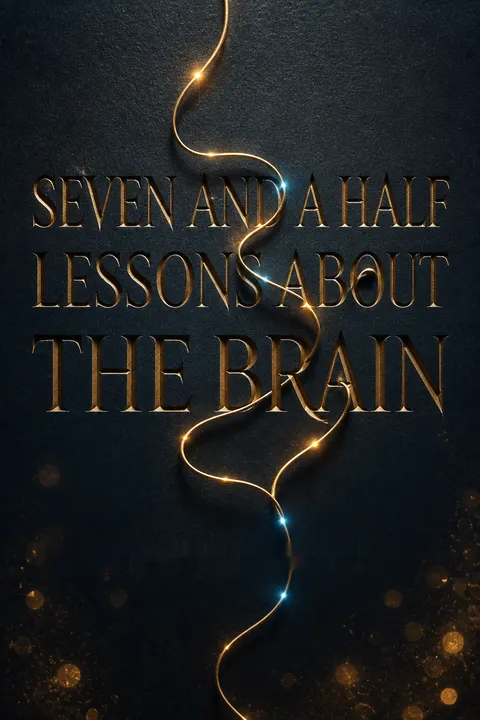
Seven and a Half Lessons About the Brain offers accessible insights into neuroscience, debunking common myths about brain structure and function. Readers appreciate Barrett's clear writing style, humor, and ability to explain complex concepts simply. The book covers topics like brain evolution, prediction, social connections, and how culture shapes cognition. While some find it overly simplistic, many recommend it as an engaging introduction to current brain science. Critics note its brevity and occasional political commentary, but most praise its ability to challenge outdated ideas and stimulate further interest in neuroscience.
People Also Read






Glossary
Allostasis
Predictive bodily regulationAllostasis is the brain's ongoing process of anticipating and meeting the body's changing needs. It helps regulate resources such as glucose, water, and salt before shortages or demands become urgent. Unlike homeostasis, which describes maintaining a relatively stable point, allostasis emphasizes adjustment over time as circumstances change.
Body budget
Account of bodily resourcesThe body budget is Barrett's accessible way of describing the resources the brain regulates, including water, glucose, oxygen, and other biological supplies. Actions use resources, while activities such as eating and sleeping replenish them. The metaphor helps explain why a brain may prepare for future needs rather than simply react to immediate events.
Triune brain
Outdated three-layer brain modelThe triune brain is a historical model that divides the human brain into a reptilian survival layer, a mammalian emotional layer, and a newer rational layer. Barrett argues that this account wrongly maps a story of inner conflict onto brain evolution. Brain structures are better understood as reorganized and interconnected, rather than as three separate evolutionary brains stacked together.
Plasticity
Capacity for neural changePlasticity is the brain's capacity to change its connections and patterns of activity in response to experience. Some changes happen through rapid shifts in chemical signaling; others develop as connections strengthen, weaken, appear, or disappear. Plasticity supports learning and adaptation throughout life, although development and environment shape which changes are most likely.
Tuning
Strengthening useful connectionsTuning is the strengthening and refinement of neural connections that are used often or matter for the body's needs. Repeated activity can make connections more efficient, increasing the likelihood that the brain will use them again. In development, tuning helps a young brain adapt its wiring to the physical and social environment it encounters.
Pruning
Removing unused connectionsPruning is the weakening or removal of neural connections that are used less often. Developing brains begin with more connections than they ultimately retain. Removing underused connections reduces the resources needed to maintain them and leaves room for connections that are more useful in a particular environment. Pruning continues, alongside tuning, throughout life.
Degeneracy
Different routes, same resultDegeneracy describes how different groups of neurons can contribute to the same action or experience. A single experience, such as fear, need not be produced by one fixed set of cells every time. This flexibility allows neural networks to vary their activity and may help the brain adapt when some connections are unavailable.
Affect
Basic bodily feelingAffect is the broad feeling that accompanies the brain's ongoing regulation of the body. It varies along dimensions such as pleasant to unpleasant and calm to activated. It is not the same as a specific emotion. Affect can provide a rough sense of how the body is doing, though it does not identify the exact need or cause.
Acculturation
Adjusting to a new cultureAcculturation is the process of adapting to the expectations and habits of a culture different from the one that shaped a person's earlier experience. It requires learning new meanings, social cues, and patterns of behavior. The adjustment can happen across national boundaries or when someone enters a new workplace or other social setting.
The Five Cs
Capacities supporting shared realityThe Five Cs name five capacities Barrett links to the human ability to create and maintain social reality: creativity, communication, copying, cooperation, and compression. Compression is the brain's ability to summarize information, helping people recognize shared meanings and functions. Together, these capacities allow ideas and norms to spread and support large-scale collective life.
Social reality
Shared human-made factsSocial reality consists of meanings and functions that people collectively create and sustain. Money, borders, laws, and national identities are not determined by physics alone, but they become consequential when people recognize and act on them. Social reality can change, yet its effects are constrained by the physical world and can shape people's material lives.
Compression
Summarizing neural informationCompression is a neural process in which larger, well-connected neurons summarize signals from many smaller neurons. Repeated layers of summarizing can help the brain form broad representations that preserve useful meaning while setting aside some detail. Barrett connects this process to abstraction, including the ability to recognize different objects as serving a similar function.
FAQ
What's "Seven and a Half Lessons About the Brain" by Lisa Feldman Barrett about?
- Overview of the book: "Seven and a Half Lessons About the Brain" is a collection of short essays that explore the brain's evolution, function, and its role in human nature.
- Purpose: The book aims to intrigue and entertain readers with scientific insights about the brain, challenging common misconceptions.
- Structure: It consists of seven full lessons and one half-lesson, each focusing on different aspects of neuroscience and psychology.
- Author's approach: Lisa Feldman Barrett uses informal essays to present scientific nuggets, encouraging readers to think about the kind of human they are or want to be.
Why should I read "Seven and a Half Lessons About the Brain"?
- Myth-busting content: The book debunks popular myths about the brain, such as the triune brain theory, providing a more accurate understanding.
- Engaging writing style: Barrett's informal and accessible writing makes complex scientific concepts understandable and enjoyable.
- Insight into human nature: It offers a deeper understanding of how the brain shapes our thoughts, emotions, and behaviors.
- Relevance to everyday life: The lessons have practical implications for personal growth, empathy, and social interactions.
What are the key takeaways of "Seven and a Half Lessons About the Brain"?
- Brain's primary function: The brain's most important job is to manage the body's energy needs, not just to think.
- Predictive nature: The brain constantly predicts and prepares for future needs, influencing our perceptions and actions.
- Social interdependence: Human brains are wired to work with others, affecting our health and well-being.
- Cultural influence: Our brains are shaped by cultural and social environments, leading to diverse kinds of minds.
How does Lisa Feldman Barrett explain the brain's evolution in the book?
- Evolutionary journey: Barrett describes the brain's evolution from simple creatures like amphioxi to complex human brains.
- Body budgeting: The brain evolved to manage the body's energy needs efficiently, a process known as allostasis.
- Complexity and reorganization: As brains evolved, they became more complex and reorganized to handle larger bodies and more sophisticated functions.
- Misconceptions addressed: The book challenges the idea of a triune brain, emphasizing that human brains did not evolve in layers.
What is the "triune brain" theory, and why does Barrett consider it a myth?
- Triune brain theory: This theory suggests the brain evolved in three layers: a reptilian brain for survival, a limbic system for emotions, and a neocortex for rational thought.
- Scientific inaccuracies: Barrett explains that this model is outdated and not supported by modern neuroscience.
- Brain reorganization: Instead of evolving in layers, brains reorganize as they grow larger, with no distinct emotional or rational parts.
- Impact on understanding: The myth of the triune brain has led to misconceptions about human behavior and rationality.
How does the brain's predictive nature influence our perceptions and actions?
- Predictive processing: The brain uses past experiences to predict and prepare for future events, shaping our perceptions and actions.
- Constructed experiences: Our experiences are a combination of sensory data and the brain's predictions, often leading to "controlled hallucinations."
- Learning from predictions: When predictions are incorrect, the brain updates its models, a process known as learning.
- Implications for free will: This predictive nature suggests that our actions are influenced by past experiences, raising questions about free will and responsibility.
What role does social interaction play in brain function according to Barrett?
- Co-regulation: Human brains regulate each other's body budgets through social interactions, affecting health and well-being.
- Empathy and prediction: Our ability to empathize and predict others' thoughts and feelings is influenced by social connections.
- Impact of words: Words can significantly affect our nervous systems, highlighting the power of language in social interactions.
- Loneliness and health: Lack of social connections can lead to loneliness, which negatively impacts physical and mental health.
How does Barrett describe the diversity of human minds in the book?
- Cultural influence: Different cultures shape different kinds of minds, leading to diverse mental experiences and behaviors.
- Variation as a norm: Human minds vary widely, and this variation is crucial for the survival and evolution of our species.
- No universal mind: There is no single human nature; instead, minds are shaped by individual experiences and cultural contexts.
- Adaptability: The brain's ability to adapt to different environments and cultures is a testament to its complexity and flexibility.
What is social reality, and how do our brains create it?
- Definition of social reality: Social reality consists of concepts and constructs that exist only in human minds, like money, borders, and laws.
- Five Cs: Creativity, communication, copying, cooperation, and compression are key brain functions that enable the creation of social reality.
- Abstraction and compression: The brain's ability to abstract and compress information allows us to impose new functions on physical objects.
- Impact on evolution: Social reality can influence human evolution by altering social structures and cultural practices.
What are the best quotes from "Seven and a Half Lessons About the Brain" and what do they mean?
- "Your brain is not for thinking." This quote emphasizes the brain's primary role in managing the body's energy needs rather than just processing thoughts.
- "Brains are predicting organs." It highlights the brain's constant prediction and preparation for future events, shaping our perceptions and actions.
- "We create a fantasy world to be able to stay." This reflects the idea that social reality helps us navigate and make sense of the physical world.
- "Variation is the norm." It underscores the diversity of human minds and the importance of variation for the survival of our species.
How does Barrett address the concept of free will in the book?
- Predictive nature and free will: The brain's predictive nature suggests that our actions are influenced by past experiences, raising questions about free will.
- Responsibility for actions: While predictions guide our actions, Barrett argues that we have some control over our future predictions and behaviors.
- Changing predictions: By learning new skills and experiences, we can alter our brain's predictions and gain more control over our actions.
- Implications for personal growth: Understanding the brain's predictive nature can empower individuals to take responsibility for their actions and shape their future.
What practical advice does Barrett offer for understanding and improving brain function?
- Challenge assumptions: Question common myths about the brain, like the triune brain theory, to gain a more accurate understanding.
- Cultivate empathy: Practice understanding others' perspectives to improve social interactions and reduce polarization.
- Embrace diversity: Recognize and appreciate the diversity of human minds, which can enhance personal growth and adaptability.
- Leverage social connections: Foster supportive relationships to improve health and well-being, as social interactions play a crucial role in brain function.
About the Author
Other books by Lisa Feldman Barrett
Download PDF
Download EPUB
.epub digital book format is ideal for reading ebooks on phones, tablets, and e-readers.








