

Key Takeaways
Your sex life is a living billboard advertising the gospel
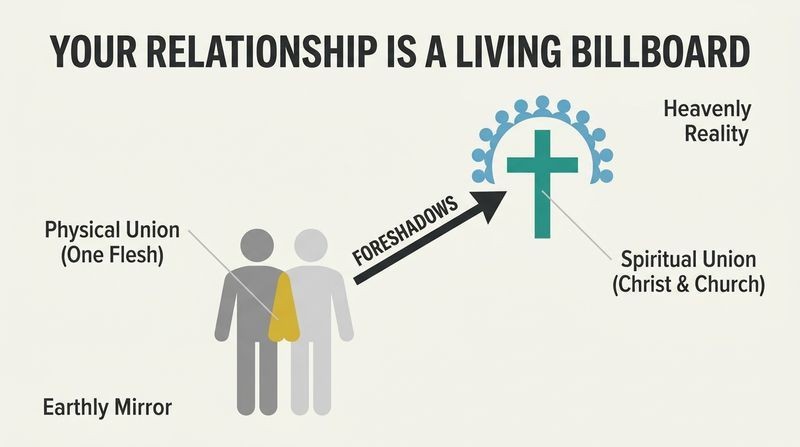
Sex points beyond itself. Hiestand and Thomas open with a claim most purity books never make: God designed physical union not primarily for pleasure or reproduction (He could have made us reproduce like amoebas) but as a "type," a visible foreshadowing, of Christ's spiritual union with the church. Just as the Passover lamb's blood prefigured Christ's sacrifice, marital oneness prefigures the believer's oneness with God.
Ephesians 5 is the hinge. Paul quotes Genesis ("the two shall become one flesh") and then reveals the mystery: this refers to Christ and the church. Salvation, the authors stress, is not mere bookkeeping forgiveness but being "born again" into Christ's very life. Because we are images of God, our sexual conduct must mirror what it depicts: exclusive, permanent, single-minded devotion.
What's striking is the reversal of causation: human marriage did not inspire the God metaphor, the divine reality came first and marriage was engineered to illustrate it. This echoes a broader sacramental view found in Augustine and Jonathan Edwards, both cited here, that earthly things are signs of heavenly ones. A skeptic might ask whether one text (Ephesians 5) can bear this much theological weight, and whether framing all sexuality around symbolism risks abstracting away the embodied goodness the authors also affirm. Still, the move is clever: it shifts the purity conversation from "what are the rules" to "what does your body signify."
God sorts every male-female bond into just three lanes

Three categories, not four. The authors argue Scripture recognizes only three kinds of male-female relationship, each with its own sexual standard:
1. Family (blood relatives): no sexual activity, ever.
2. Marriage: sexual activity commanded, not just permitted (1 Corinthians 7).
3. Neighbor (everyone else, following Jesus's broad definition): no sexual activity at all.
The neighbor category does the heavy lifting. Paul tells Timothy to treat younger women "as sisters, with absolute purity." That familial framing becomes the book's litmus test. If you would not do it with a sibling because it is sexual, it belongs only in marriage. The interfamily incest ban, the authors note, was not always in force (Abraham married his half-sister) but was codified under the Law, showing standards flow from God's evolving image-bearing purposes.
The taxonomy is elegant and pastorally useful because it converts a fuzzy spectrum into discrete boxes. Anthropologically, nearly every human society builds kinship categories with attached sexual taboos, so the instinct is not uniquely Christian. The weak link is definitional: the "neighbor" is defined as everyone who is neither kin nor spouse, which lumps a stranger and a marriage-minded courtship into one moral bucket. Critics might argue real life has gradations the three lanes flatten. The authors anticipate this by conceding many sub-relationships exist within "neighbor," but insist the purity standard, not the emotional texture, stays constant across all of them.
The sibling test answers "how far is too far" once and for all

Reframe the question. Instead of drawing a personal line somewhere between hand-holding and intercourse, the authors argue there is no line to negotiate: any activity that is sexual in nature is reserved for marriage. Their logic chain: sexual relations belong only in marriage, sexual relations include far more than intercourse (oral sex, fondling, and passionate kissing all qualify), therefore all of it waits.
The chewed-cake parable. They mock loophole reasoning with a man who chews cake and spits it out, then insists he didn't "eat" it because he never swallowed, echoing a president's "I did not have sexual relations." First-century readers hearing "avoid porneia" needed no clarification; respectable unmarried men and women simply did not make out. The point is not primarily the slippery slope but that even minor sexual acts, like Jesus's teaching on lust, are lesser expressions of a bigger sin.
This is the book's most controversial and clarifying claim: passionate kissing is treated as a species of sexual immorality. The strength is intellectual honesty, refusing the arbitrary "everyone sets their own boundary" advice the authors rightly find useless in the heat of the moment. The vulnerability is historical over-reach: reconstructing what "respectable" first-century couples did and universalizing it risks importing cultural mores as divine law, a hazard the authors elsewhere warn against. Behavioral science does support their instinct, though: arousal escalates in predictable stages, and precommitment (deciding rules before temptation) reliably beats in-the-moment willpower, a finding from research on ego depletion and hot-cold empathy gaps.
Dating is a phantom category you invented, so you invented its rules too
A man-made fourth lane. Modern "dating" quietly morphed from something you do (going on a date) into something you are (boyfriend and girlfriend). By treating romantic relationships as a distinct category, Christians unconsciously granted it the legitimacy of the three biblical categories, then panicked when the Bible gave no purity rules for it. The authors' punchline: Scripture is silent on dating boundaries not because dating didn't exist, but because God never viewed it as separate from the neighbor relationship.
No new category, no new rules. Cars and computers didn't exist in biblical times; premarital male-female conduct absolutely did, and Scripture addressed it constantly. Slapping the label "girlfriend" on someone does not exempt the relationship from the sibling standard. The label changes nothing about God's expectations.
The argument from silence cuts both ways, and the authors handle it well by distinguishing genuine novelty (technology) from mere repackaging (courtship customs). There is a compelling parallel in how legal systems treat "contracts of adhesion": when parties invent terms outside a recognized framework, ambiguity multiplies and someone gets exploited. The claim that dating simply is a subset of the neighbor relationship is logically tidy but pastorally demanding, since it asks readers to treat a romantic interest with the same physical restraint as a coworker. Whether most believers can hold that line without the authors' proposed alternative is the open question this chapter leaves hanging.
Dating "commitment" is a rope tied to nothing
Paper walls, unaided climbing. Gerald recounts learning to rock climb: his confidence came not from the rope but from the instructor anchoring it. A friend once finished a climb only to watch his anchor pins fall away, his security had been an illusion the whole time. Dating relationships, the authors argue, are exactly this: they feel secure (titles, anniversaries, exclusivity) but either party can end things anytime for any reason. The "commitment" is merely a promise to announce you're leaving before you leave.
Women bear the cost. Because a dating relationship looks like marriage-lite, women give themselves away emotionally and physically on the strength of a security that does not exist. One counselor described a distraught client as "going through the pain of a divorce, and she's never been married." The authors' slogan: it don't mean a thing without the ring.
The economic asymmetry argument is sharper than the theology here and lands hard. Behavioral economists would call the dating label a costly signal that isn't actually costly, a promise with no enforcement mechanism, so it conveys no real information about future intent. The critique of "permanent for now" exclusivity is genuinely useful even for secular readers navigating situationships. The gendered framing, that women uniquely lose, feels dated and arguably underestimates male emotional investment, but the core insight endures: mistaking attraction for commitment invites heartbreak, because attraction today promises nothing about tomorrow. Naming that confusion is the chapter's lasting gift.
Lust is craving what isn't yours, and desire bends to belief
Desire itself is morally neutral. The Greek word Jesus uses for lust (epithumeo) also describes His own holy longing to eat the Passover. Desire is like a loaded gun; morality depends on the target. Lust, the authors define, is desiring someone who is not yours to possess. Crucially, Jesus locates it "in the heart," not the mind, so a person can lust without any conscious fantasy.
Arousal follows perception, not environment. The authors challenge the popular claim that sexual response is an uncontrollable reflex. Using the analogy of a stunt-driver's passenger whose panic fades once he trusts the driver, they argue the autonomic nervous system fires based on our perception of a thing's benefit to our well-being, not the stimulus itself. A man's desire for a blackmailing mistress curdles into disgust. Change your deep convictions about sin's true worth, and arousal recalibrates.
The perception-drives-arousal thesis is the book's boldest psychological wager, and it partly overreaches. Cognitive appraisal genuinely shapes emotion, a point supported by Lazarus's appraisal theory and by cognitive behavioral therapy's whole premise. But sexual arousal has robust automatic components (priming, conditioned response) that resist pure belief-change, and the authors' dismissal of Dannah Gresh's autonomic-nervous-system claim may understate the biology. The stronger, defensible version is this: convictions shape which stimuli we approach and how we interpret them over time, so desire is trainable even if not instantly switchable. Framing lust as covetousness rather than as mere biology is a genuinely liberating reframe for the shame-prone.
Don't stoke a fire you have no lawful place to burn
Guard the heart, don't just guard the body. Drawing on Song of Solomon's refrain, "do not arouse or awaken love until it so desires," the authors argue God restricts not only sexual activity but romantic activity. The bride charges the young maidens not to stir up passion prematurely; love is personified as its own guardian, unwilling to wake before the wedding it was made for.
Romance is an invitation to the bedroom. Flowers, candlelit dinners, and "your hair looks beautiful" are not neutral; by nature they seek deeper intimacy. To fan those flames outside a marriage-bound relationship is, the authors say, like haunting a car dealership when you're twelve with no money. They contrast Jackie and Mike, a marriage-minded couple who deliberately skip the roses and staring-into-eyes routine, keeping things platonic so that if it ends, as Jackie says, "we haven't done anything we regret."
This extends the physical-purity argument into emotional territory, which is both the chapter's originality and its steepest ask. There is real wisdom here that maps onto attachment research: escalating intimacy creates pair-bonding neurochemistry (oxytocin, dopamine reward loops) that clouds judgment about compatibility, exactly the authors' concern. Yet the claim that all romance intrinsically aims at sex may flatten the varied human experience of courtship, affection, and delight. A gentler reading is that intentionally cultivating romantic longing you cannot righteously fulfill is a setup for suffering, a principle any behavioral economist studying anticipation and self-control would recognize as sound.
Skip "boyfriend" entirely; pursue a "dating friendship" straight to engagement
The proposed alternative. A dating friendship is defined simply as two friends getting to know each other with a view toward marriage, while keeping the neighbor relationship's purity standards. No titles, no premature exclusivity, no romantic escalation. When a man becomes sure, he doesn't ask her to be his girlfriend; he proposes. Then, and only then, he brings on the roses.
Guardrails make it workable. The authors recommend concrete structure:
1. Get separate accountability partners who ask hard questions.
2. Avoid alone time (no empty apartments, no parked cars, keep lights on).
3. Stay outward-facing and in community.
4. Start only when marriage is realistically possible.
5. Keep it short: six to eighteen months, then decide, then a brief engagement whose only job is planning a wedding.
Exclusivity, they stress, can only be voluntary, honest because chosen rather than pretended.
The dating friendship is the book's signature prescription and its most divisive. Its genius is stripping away false security so both parties assess character without the fog of romance, which aligns with research showing physical involvement accelerates commitment before compatibility is known. The obvious objection, that treating a potential spouse as "just a friend" is psychologically unnatural, the authors meet by noting the neighbor category already contains many relational textures. Practically, the model resembles intentional courtship movements and even secular "slow dating" advice. The risk is idealism: in a culture without arranged introductions or dense church communities, finding candidates for such a friendship may prove the hardest step of all.
Purity leaks unless the gospel governs your screen, closet, and solitude
Sexuality is not a sealed compartment. The authors argue you will not hold the line in dating if the rest of your life runs on different fuel. Purity must be integrated: modesty in dress (the key test word is "seductive," examine your motives, not just your hemline), media choices (onscreen violence is pretend, but onscreen nudity is real, making the viewer a kind of voyeur), and internet use (install filters, but know software alone always fails without inner change and accountability).
Harder cases. On masturbation they lean toward "better not," not from proof-texts but because it is usually born of lust, tends toward addictive coping, and portrays no relational union, the opposite of what sex is meant to image. On flirting they condemn "serial flirting," prematurely dispensing your sexuality to many, often springing from insecurity rather than security in Christ.
The holistic framing is the chapter's real contribution, and it anticipates a truth from habit science: willpower fails at isolated flashpoints, but environment design and identity-level change succeed. Their claim that screen nudity implicates the viewer as voyeur is a provocative ethical argument extending complicity beyond the actor to the audience, worth wrestling with in an age of ubiquitous streaming. The masturbation section is refreshingly non-legalistic, reframing compulsion as a symptom of unmet relational hunger rather than a standalone sin to white-knuckle. The weakness is that "seductive" and "immodest" remain culturally elastic, a subjectivity the authors concede even while building an objective system elsewhere.
Unwanted singleness is a divine fast, not a punishment
Celibacy is a calling, not a consolation prize. Reading 1 Corinthians 7, the authors note Paul actually prefers singleness for gospel work: the unmarried person has undivided devotion, while marriage rightly absorbs time, energy, and resources. In the Old Testament, singleness read as a curse; after Christ, it becomes a blessed, strategic state. But the "gift of singleness" is not being single, it is the ability to be single contentedly without burning with sexual frustration.
Fasting, not starvation. For those who long to marry but cannot, the authors offer their most tender image. Just as fasting from food heightens dependence on God, a season of enforced celibacy is a divinely appointed fast, not withheld to leave you destitute but to redirect appetite toward its true object. Starvation is purposeless and cruel; fasting has a loving purpose. God, they insist, takes gifts away only to give Himself.
The fasting metaphor is pastorally powerful and psychologically astute, reframing deprivation as meaning-bearing rather than random, which research on suffering (Viktor Frankl's logotherapy) identifies as the single greatest buffer against despair. Distinguishing the state of singleness from the gift of contentment within it is a genuinely clarifying correction to loose church talk. The honest limitation, which the authors themselves acknowledge as married men, is the credibility gap: counsel about the blessing of celibacy lands differently from those who never had to live it long-term. Still, decoupling a person's worth and purpose from marital status offers real dignity in a church culture that often idolizes the family.
Analysis
This is a thesis-driven work of popular evangelical theology aimed at Christian singles, built on a single audacious claim: sex is a "type" of the gospel, an enacted picture of Christ's union with the church. Everything else, the three relational categories, the sibling test, the critique of dating, the dating friendship, follows deductively from that premise. The book's intellectual signature is its refusal of pragmatism. Where most purity literature motivates through fear (STDs, pregnancy, heartbreak), Hiestand and Thomas explicitly reject those arguments as anthropocentric and instead ground everything in divine glory and symbolism. This makes the book internally coherent and unusually principled, but also fragile: if the reader rejects the typological reading of Ephesians 5, the entire structure loses its foundation.
The strongest material is diagnostic rather than theological. The demolition of dating-relationship "commitment" as a rope anchored to nothing is genuinely useful even to secular readers, anticipating what behavioral economists would call a non-costly signal. The dating friendship prescription mirrors findings that physical and romantic escalation clouds compatibility assessment. The reframing of lust as covetousness and singleness as fasting both offer real psychological relief from shame.
The weakest moves are the historical and biological over-reaches: reconstructing first-century sexual mores and universalizing them flirts with the very legalism the authors disavow, and the claim that arousal is fully governed by perception understates conditioned physiological response. The gendered assumption that women alone lose in dating feels dated.
Contextually, the book positions itself against Joshua Harris's "I Kissed Dating Goodbye," charting a middle path: date, but as friends, and never pretend a boyfriend label creates security only a proposal can. Its enduring value is not the rules but the reframe, shifting the question from "what can I get away with" to "what does my body signify." For its intended audience, that is transformative; for others, the theological scaffolding may be too specific to carry the practical wisdom buried inside it.
Review Summary
Sex, Dating, and Relationships receives mostly positive reviews, with readers praising its gospel-centered approach and fresh perspective on dating. Many appreciate the book's biblical foundation and its challenge to conventional dating norms. Readers find it helpful in understanding God's design for relationships and sexual purity. Some criticize the narrow focus on sexual boundaries and lack of practical examples. Overall, reviewers recommend it as a valuable resource for Christians navigating relationships, though a few caution about reading with discretion.
People Also Read









Glossary
Type (tupos)
Earthly image foreshadowing heavenly realityFrom the Greek word for the impression a hammer leaves in metal. A type is a person, event, or institution that points forward to and represents a deeper spiritual reality, as the Passover lamb prefigured Christ's sacrifice. The authors argue sex and marriage are types of the union between Christ and the church, created specifically to illustrate the gospel.
Neighbor relationship
All non-kin, non-spouse bondsOne of three God-ordained categories of male-female relationship, following Jesus's broad definition of neighbor. It includes everyone who is neither a blood relative nor a spouse: friends, coworkers, strangers, and, controversially, dating partners. Its sexual standard is identical to the family category: no sexual activity of any kind, treating the opposite sex with familial purity.
Dating friendship
Marriage-minded friendship without romanceThe authors' proposed alternative to conventional dating: two friends getting to know each other with a view toward marriage while maintaining the neighbor relationship's purity standards. No titles, no forced exclusivity, no romantic or sexual escalation. When certain, a man proposes marriage rather than asking someone to be his girlfriend, moving straight from friendship to engagement.
Porneia
Greek term for sexual immoralityThe New Testament's most common word translated "sexual immorality." A catch-all term the authors argue covered any sexual activity outside proper marital conduct in the first century, including even light activity between an unmarried man and a respectable unmarried woman. Original readers needed no further clarification about "how far is too far."
Gift of singleness
Contentment living celibate for GodFrom 1 Corinthians 7, a rare, divinely given ability to live happily celibate without being distressed by unfulfilled sexual desire. The authors stress the gift is not singleness itself but the contentment within it; those who "burn with passion" lack this gift and should marry rather than attempt celibacy.
Celibacy as fasting
Unwanted singleness as spiritual redirectionThe authors' pastoral framework for those who desire marriage but remain single. Like fasting from food heightens dependence on God, an enforced season of celibacy is a divinely appointed fast, not a starvation meant to harm but a purposeful redirection of appetite toward God as its true satisfaction.
FAQ
What is "Sex, Dating, and Relationships: A Fresh Approach" by Gerald L. Hiestand and Jay Thomas about?
- Biblical Framework for Purity: The book offers a theologically grounded, gospel-centered approach to sex, dating, and relationships, challenging both secular and Christian cultural norms.
- Redefining Relationship Categories: It argues that modern dating has created a new, unbiblical category of relationship, and instead calls for relationships to be understood within God-ordained categories: family, marriage, and neighbor.
- Sex as a Gospel Image: The authors emphasize that sex and marriage are designed to reflect the spiritual union between Christ and the church.
- Practical Guidance: The book provides practical advice for singles, parents, and church leaders on how to pursue purity, navigate romantic desire, and find a spouse in a way that honors God.
Why should I read "Sex, Dating, and Relationships: A Fresh Approach" by Gerald L. Hiestand and Jay Thomas?
- Clarity Amidst Confusion: The book addresses the confusion and subjectivity surrounding sexual boundaries in Christian dating, offering clear, objective biblical standards.
- Gospel-Centered Perspective: It reframes sex and relationships as fundamentally about the gospel, not just personal fulfillment or rule-keeping.
- Practical and Pastoral: Readers receive actionable advice for real-life situations, including how to guard their hearts, set boundaries, and pursue relationships with integrity.
- Countercultural Wisdom: The book challenges both secular and Christian dating norms, making it valuable for anyone seeking a fresh, biblically faithful approach.
What are the key takeaways from "Sex, Dating, and Relationships: A Fresh Approach"?
- Sex Reflects the Gospel: Human sexuality and marriage are designed to be living illustrations of Christ’s relationship with the church.
- No New Relationship Category: Dating is not a separate biblical category; all unmarried relationships fall under the "neighbor" category, with corresponding purity standards.
- Guarding Heart and Body: Both sexual and romantic desires should be carefully guarded and only fully awakened within marriage or engagement.
- Dating Friendships Model: The authors propose "dating friendships" as an alternative to traditional dating, focusing on friendship and clarity of intent without premature romantic or sexual involvement.
How does "Sex, Dating, and Relationships" by Hiestand and Thomas define the purpose of sex?
- Living Portrait of the Gospel: Sex is created by God to serve as a living image of the spiritual union between Christ and the church.
- Not Just for Procreation or Pleasure: While sex is pleasurable and procreative, its highest purpose is to point to a greater spiritual reality.
- Monogamy and Permanency: The exclusive, permanent nature of marital sex reflects Christ’s exclusive, eternal commitment to His people.
- Sexual Purity as Worship: Sexual boundaries are not arbitrary but are meant to preserve the integrity of this gospel image.
What are the three God-ordained categories of male-female relationships in "Sex, Dating, and Relationships"?
- Family Relationship: Sexual activity is prohibited between blood relatives, reflecting God’s commands in the Old Testament law.
- Marriage Relationship: Sexual activity is not only permitted but commanded within marriage, as it images the union of Christ and the church.
- Neighbor Relationship: All other male-female relationships (friends, coworkers, dating partners) are to be nonsexual, following the biblical standard of purity.
How does "Sex, Dating, and Relationships" answer the question, "How far is too far?" in dating?
- Sexual Activity Reserved for Marriage: Any activity that is sexual in nature, not just intercourse, is to be reserved for marriage.
- Family Test for Boundaries: If an action would be inappropriate with a sibling, it is sexual and should be avoided with a non-spouse.
- Passionate Kissing Included: The book argues that passionate kissing and similar activities are sexual and thus off-limits outside marriage.
- Objective, Not Subjective: Purity standards are not left to individual feelings or convictions but are grounded in biblical categories.
What is the "dating dilemma" according to Hiestand and Thomas, and how does it affect Christian singles?
- Dating as a New Category: Modern dating creates a pseudo-committed relationship that blurs the lines between neighbor and marriage.
- False Sense of Security: Dating relationships often give the illusion of commitment without the reality, leading to emotional and sexual vulnerability.
- Subjective Boundaries: Because dating is not a biblical category, couples invent their own standards, often leading to compromise.
- Return to Biblical Categories: The authors urge singles to treat all pre-marriage relationships as neighbor relationships, with corresponding purity.
What is a "dating friendship" as proposed in "Sex, Dating, and Relationships," and how does it differ from traditional dating?
- Definition: A dating friendship is two friends getting to know each other with a view toward marriage, without romantic or sexual involvement.
- No New Relationship Category: It maintains the neighbor relationship, avoiding the false security and premature intimacy of traditional dating.
- Clear Communication: Intentions are communicated openly, and exclusivity is voluntary, not assumed.
- Advantages: Dating friendships reduce heartache, clarify boundaries, and allow for genuine discernment of marriage potential.
How does "Sex, Dating, and Relationships" address the control of sexual and romantic desire?
- Desire Is Controllable: The book teaches that sexual and romantic desires are not uncontrollable urges but can be governed by the heart and will.
- Lust Defined: Lust is desiring someone sexually who is not your spouse; even emotional or spontaneous desire can be sinful if directed wrongly.
- Guarding the Heart: Romantic love should not be aroused or awakened until it can be fulfilled in marriage, following the wisdom of Song of Solomon.
- Faith and Conviction: True purity comes from being convinced of God’s goodness and the sufficiency of Christ, not just from external rules.
What practical advice does "Sex, Dating, and Relationships" give for living a life of purity beyond dating?
- Gospel-Integrated Life: Purity is not just about dating but about integrating the gospel into every area of life.
- Modesty and Media Choices: The book encourages intentional modesty in dress and discernment in entertainment to avoid arousing sexual desire.
- Internet and Accountability: It recommends using accountability and, if necessary, technology to guard against online temptation.
- Masturbation and Flirting: The authors lean against masturbation and warn against serial flirting, as both undermine the gospel image of sexuality.
How does "Sex, Dating, and Relationships" by Hiestand and Thomas view singleness and celibacy?
- Singleness as a Calling: Singleness is not a lesser state but can be a strategic, God-honoring calling for gospel ministry.
- Gift of Singleness: The "gift" is the ability to be content without marriage, not singleness itself.
- Celibacy as Fasting: Unwanted singleness is seen as a divinely appointed fast, meant to draw the single person closer to God.
- God’s Sufficiency: The book encourages singles to trust God’s goodness and sovereignty, finding ultimate satisfaction in Christ.
What are the best quotes from "Sex, Dating, and Relationships: A Fresh Approach" and what do they mean?
- "Sex and relationships are all about the gospel." This quote encapsulates the book’s central thesis that sexuality is designed to point to Christ’s relationship with the church.
- "You are not your own; you have been bought with a price and therefore must honor God with your body." This highlights the call to live out sexual purity as an act of worship and stewardship.
- "Don’t give your heart away until you know what he plans to do with it." This advice urges emotional and romantic caution, especially for women, until a man’s intentions are clear.
- "The time to bring on the romance is when you’re ready to bring on the ring!" This memorable line summarizes the book’s counsel to reserve romantic and sexual expression for engagement and marriage.
- "Strive for the ideal with all your heart while affording yourself the same grace God has granted to you through Christ." This quote encourages readers to pursue God’s standards while relying on His grace for their shortcomings.
Download PDF
Download EPUB
.epub digital book format is ideal for reading ebooks on phones, tablets, and e-readers.








