

Key Takeaways
Read handwriting as a map of personality, but never mistake the map for proof.
A brain behind the pen. Dresbold’s central claim is that writing reflects the brain’s patterns more than the hand’s movements. She calls it “brainwriting” and treats letter size, slant, spacing, and pressure as clues to a writer’s inner life. Her lessons move from everyday handwriting to criminal investigations, inviting readers to examine the page as a psychological portrait.
A clue is not a verdict. In the introduction, Dresbold says a bank-robbery note suggested a desperate first-time offender. The robber turned out to be a bus driver trying to pay for his son’s transplant. Another note that appeared to plead for a child’s rescue was written by a six-year-old playing detective with her teddy bear. Both stories show why context matters, even within the book’s own method.
The book’s most useful starting point is its insistence that writing is behavior, not merely a row of symbols. A page can invite questions about mood, effort, or self-presentation. That is different from proving stable personality traits. The distinction resembles the difference between noticing that someone looks tired and diagnosing a disorder from their face. Handwriting may be worth discussing with its writer, but a profile should remain a tentative hypothesis until independent evidence supports it.
Look for patterns across a page, not a personality diagnosis in one letter.
Three writing zones. Dresbold divides letters into upper, middle, and lower zones. The upper zone includes tall strokes and loops, which she associates with ideas and imagination. The middle zone contains most lowercase letters and is linked to daily life and social needs. The lower zone includes descenders such as the tails of g and y, which she interprets as signs of physical, material, and sexual appetites. She reads proportion and distortion across these zones as clues.
Mood enters the page. The book also interprets rising or falling lines as changes in mood, rightward slant as emotional approach, and leftward slant as reserve. Its examples range from Vincent van Gogh’s downward-sloping writing to Picasso’s upward-sloping writing. Such features can be observed; the leap from a feature to a specific inner state is much less certain.
A pattern-based reading is stronger than treating one unusual stroke as a confession. It encourages attention to variation and context, which are valuable habits in observation generally. Yet the same feature can have many causes: writing speed, the surface beneath the page, physical discomfort, schooling, or the writer’s chosen style. A useful profile would ask whether the writer recognizes the interpretation and whether other evidence supports it, rather than treating a slant or loop as a psychological measurement.
Treat a signature as deliberate self-presentation, not a transparent window into character.
Public and private selves. Dresbold distinguishes a signature from ordinary writing. She argues that a signature represents the image a person wants others to see, while the rest of the page reveals more private thoughts and feelings. She points to Elvis Presley, whose bold, showy signature contrasts with smaller, tighter writing in a letter to President Nixon. The contrast, she argues, reveals tension between a public persona and an inwardly anxious self.
A recognizable distinction. Even without accepting the personality reading, a signature is plainly a public act. People choose how to write their names on contracts, cards, and public documents, and that choice may differ from hurried notes. The book’s interpretation of the difference as a hidden psychological portrait, however, goes beyond what the contrast alone can establish.
The public-private distinction has a useful parallel in social psychology: people manage impressions differently across settings. A signature can be more stylized because it serves a different purpose, just as a person speaks differently in a job interview than at home. That observation can sharpen questions about audience and self-presentation. It does not show that the writer’s ordinary script exposes a truer self. The same contrast may reflect habit, practice, or the practical need to sign quickly.
Use a profile to generate investigative questions, never to name the guilty person.
The Bundy exercise. Dresbold presents a letter attributed to Ted Bundy and asks readers to build a profile from its features. She interprets the writing as socially oriented, educated, sexually dangerous, resentful, and marked by a distorted family history. She then compares that profile with known details of Bundy’s life, including his charm, education, concealed parentage, and murders. The apparent fit is offered as evidence that handwriting can help investigators narrow a suspect pool.
Retrospective fit is easy. The example is compelling, but the reader sees the handwriting and the known biography together. The book does not show how often the same features would produce a wrong profile, or how reliably analysts could identify an unknown offender before learning the answer.
Profiling can help organize inquiry when treated as a source of testable leads. The danger is hindsight: once the suspect is known, ambiguous clues can be made to fit a life story. A rigorous test would record predictions before investigators learn the suspect’s identity, then compare accuracy against chance and against other analysts. Without that safeguard, a vivid match can reflect selective attention rather than predictive skill. The discipline is most defensible when it proposes questions that conventional evidence can answer.
Separate handwriting identification from claims about what the writer was thinking.
Two different questions. Determining whether two documents share an author is not the same as inferring that author’s personality. Dresbold’s prison-note example makes the distinction neatly: the supposed signature Podge was actually an instruction to contact someone in Pod 6E. Her account of Ralph Kosloski also shows how comparing writing skill with the writer’s motor abilities helped rule him out as the author of a bank-robbery note.
The Hitler diary warning. Forgery complicates identification. Handwriting experts reportedly matched the forged Hitler diaries to samples in archives, but the archival samples had themselves been forged by Konrad Kujau. Matching documents can support an authorship investigation, but only if the comparison samples are trustworthy and the conclusion is corroborated by other evidence.
This is the book’s most important methodological distinction. Questioned-document examination asks whether features in a document are consistent with a known writer’s work. Personality profiling asks what those features mean about the writer’s mind. The first can be evaluated against physical documents and alternative writers; the second needs independent validation of each psychological inference. Confusing them lends personality claims the authority of forensic comparison. A careful investigator keeps the questions, methods, and standards of proof separate.
Interpret ominous-looking strokes as hypotheses, not hidden confessions.
A vocabulary of danger. The book assigns vivid names to features it considers warning signs: a “felon’s claw” for a backward-hooking stroke, “strangler strokes” for looped forms, and “explosive dots” for heavily marked punctuation or i dots. Dresbold connects these shapes to self-sabotage, violence, or anger. She also reads weapon-like marks and symbols in signatures as signs of hostile impulses.
Stories make symbols memorable. The BTK killer Dennis Rader’s signature is presented as containing a noose-like shape, while a man nicknamed the Hawk unknowingly drew a bird-like figure in his name. The examples are striking, but the interpretation depends on deciding what an ambiguous shape resembles. Recognizing a resemblance is not proof that the writer intended it or acted on it.
Symbolic readings are powerful because human perception is skilled at finding forms in ambiguous marks. That capacity helps people recognize faces in clouds, but it also makes accidental strokes feel meaningful after a dramatic story supplies a label. The book’s symbols can serve as prompts for asking about behavior, especially when other evidence raises concern. They should not be used to classify someone as dangerous. Such a judgment carries real consequences and requires evidence beyond visual resemblance.
Use handwriting changes for self-reflection, not as a substitute for care.
A deliberate experiment. Dresbold describes discovering a high initial stroke in her own p’s, which she interpreted as argumentative. She then practiced making the letter differently while reminding herself to listen and resolve disagreements calmly. She says both her writing and behavior changed. In the final section, she similarly recommends journaling and adjusting particular letters to address feelings or habits.
A reflective exercise. Writing slowly about a conflict can help someone notice what they feel and how they respond. Deliberately changing a letter may also act as a cue to practice a different behavior. But the book presents stronger claims too, including interpretations of handwriting as evidence of anorexia, illness, or emotional disturbance. Those concerns require assessment by qualified professionals, not diagnosis from a page.
The strongest version of handwriting therapy is modest: writing can support reflection, and a chosen mark can remind someone of an intention. Repeatedly practicing a calmer response may matter more than the shape of the letter itself. That is a plausible behavioral prompt, not evidence that handwriting directly diagnoses or cures a problem. The distinction protects readers from delaying medical or psychological care when a real health concern is present.
Do not let a compelling handwriting theory close a cold case.
Famous cases, unfinished evidence. The book examines the JonBenét Ramsey ransom note and compares its writing with samples from family members. It emphasizes similarities to Patsy Ramsey’s writing, while noting that investigators could not rule her out. It also argues that Francis Tumblety wrote the letter from hell associated with Jack the Ripper, based on a profile and many apparent similarities between samples written years apart.
A strong conclusion needs more. These cases are presented with dramatic confidence, but handwriting comparisons alone cannot establish who committed a murder. The book itself recounts how handwriting evidence contributed to the wrongful conviction of Omar Raddad, after a bloody message was treated as if the victim had written it. The lesson is to test a theory against physical evidence, timelines, witnesses, and plausible alternatives.
Cold cases reward narrative coherence, but coherence is not the same as confirmation. A suspect who fits a profile can become the center of a story that explains every ambiguous feature, while evidence that does not fit receives less attention. Strong forensic reasoning actively seeks disconfirming facts and keeps multiple explanations alive. That caution does not make handwriting comparison useless. It prevents a striking match from carrying more weight than the rest of the case can bear.
Analysis
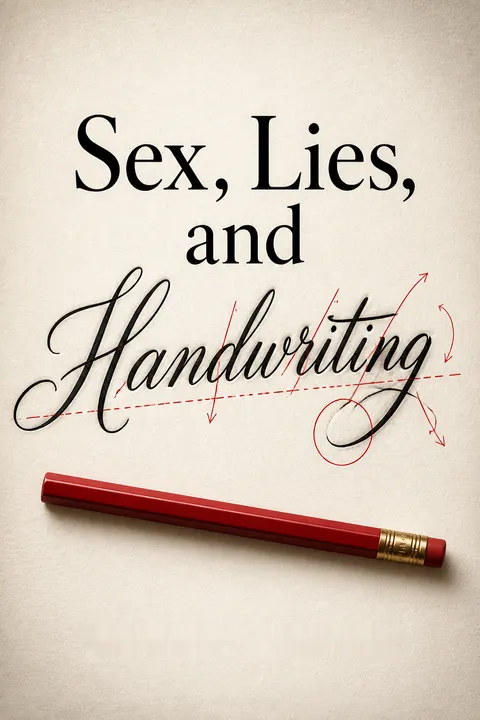
Sex, Lies, and Handwriting is part popular psychology, part crime anthology, and part guide to examining writing. Its narrative engine is the promise that small marks reveal large truths. Case histories give that promise emotional force: a threatening note points toward a desperate father, a tidy script conceals a killer, and an apparent signature turns out to be a prison location. The stories are memorable because the reader is invited to inspect evidence before learning the answer.
The central analytical problem is that the book moves between three different activities without consistently separating them: observing visible writing features, comparing documents for authorship, and inferring personality or criminal intent. These activities require different standards. A document examiner can compare recurring features across questioned and known writing, while accounting for variation, disguise, and the quality of samples. A claim that a particular loop signals deceit or violence requires a separate demonstration that the feature predicts those traits reliably across people and contexts. The book offers anecdotes and retrospective matches, but does not establish that predictive validity.
The method is especially vulnerable to confirmation bias. Once a reader knows that a writer is a murderer, an angled stroke can appear aggressive, a loop can become a weapon, and an inconsistent line can seem unstable. The same marks may have ordinary explanations, including motor habits, writing conditions, age, education, or deliberate style. Dramatic cases magnify the cost of error: a persuasive but unsupported profile can stigmatize an innocent person or distort an investigation.
The book remains useful as an invitation to look closely, ask questions, and remember that documents have context. Its cautionary cases, especially the wrongful conviction discussed in the Raddad chapter and the forged Hitler diaries, show why evidence must be checked rather than admired. The sound takeaway is not that handwriting exposes hidden truth. It is that handwriting can prompt hypotheses, while corroboration, alternative explanations, and disciplined uncertainty determine whether those hypotheses deserve belief.
Review Summary
Readers found Sex, Lies, and Handwriting an engaging and entertaining book on handwriting analysis. Many praised its accessible writing style and intriguing content, particularly the true crime examples. Some felt it focused too heavily on negative traits and serial killers. While some readers were skeptical of the accuracy of handwriting analysis, others found it fascinating and applicable to their daily lives. The book received mixed reviews on its scientific validity but was generally considered a quick, enjoyable read that provided insight into the connection between handwriting and personality.
People Also Read
Glossary
Brainwriting
Writing as brain behaviorDresbold’s term for the idea that handwriting reflects the brain’s direction more than the hand’s independent activity. She uses it to frame writing as a record of patterns in thought, feeling, and behavior. The book treats visible features as clues to personality, though it does not establish that those interpretations reliably diagnose a writer.
Zoning Laws
Three handwriting regionsDresbold’s system for dividing handwriting into upper, middle, and lower zones. The upper zone consists of tall strokes and loops, the middle zone contains most lowercase letters, and the lower zone includes descenders such as the tails of g and y. She associates each region with different areas of a writer’s life and interprets their relative size and form.
persona writing
Overcontrolled handwriting styleDresbold’s term for slow, carefully controlled writing that appears unusually regular or polished. She interprets it as an attempt to conceal flaws or maintain control, and associates it with a hidden risk of losing control. The book illustrates this interpretation with the writing of people later identified as criminals, but does not demonstrate that the style predicts criminal behavior.
felon’s claw
Backward-hooking strokeA label Dresbold gives to a backward-hooking formation, especially at the bottom of a letter. She associates it with self-sabotage, rejection, and criminal behavior, and claims it appears frequently in convicted offenders’ writing. The term describes the feature as the book interprets it; the presence of the stroke alone does not establish that a writer is a criminal.
explosive dots
Heavily marked dotsDresbold’s name for unusually heavy, dark i dots or punctuation marks that appear to have been pressed or retraced forcefully. She interprets them as signs of anger, irritability, tension, or obsessive thinking. The label is a descriptive part of her profiling vocabulary, not an independently validated measure of a person’s temperament.
lurking lunatic stroke
Ending stroke below baselineDresbold’s term for an ending stroke that crosses below the baseline of the writing. She associates it with secrecy, stealth, and concealed plans, and uses it in stories about people who attempted political assassinations. The feature can be identified visually, but the book’s psychological interpretation is not proof of a writer’s intent or dangerousness.
FAQ
What's "Sex, Lies, and Handwriting" about?
- Exploration of Handwriting Analysis: The book delves into the world of handwriting analysis, revealing how much can be discerned about a person's character, emotions, and even potential criminal tendencies through their handwriting.
- Real-Life Cases: Michelle Dresbold shares her experiences as a handwriting expert, including her work with law enforcement to solve crimes by analyzing handwriting.
- Practical Insights: The book offers readers a chance to learn basic handwriting analysis techniques, enabling them to uncover secrets hidden in their own handwriting and that of others.
- Intriguing Stories: It includes fascinating stories of famous cases and notorious criminals, providing a unique perspective on how handwriting played a role in their identification and capture.
Why should I read "Sex, Lies, and Handwriting"?
- Unique Perspective: The book offers a unique blend of true crime, psychology, and forensic science, appealing to readers interested in any of these fields.
- Practical Skills: Readers can learn practical skills in handwriting analysis, which can be applied in everyday life to better understand people.
- Engaging Stories: The real-life stories and cases are engaging and provide a thrilling insight into the world of criminal investigations.
- Expert Insights: Michelle Dresbold, a top handwriting expert, shares her professional insights and experiences, making the book both educational and entertaining.
What are the key takeaways of "Sex, Lies, and Handwriting"?
- Handwriting Reflects Personality: Handwriting is a reflection of the brain, not just the hand, and can reveal a lot about a person's character and emotions.
- Danger Signs in Writing: The book highlights specific handwriting traits that can indicate dangerous or deceitful behavior, such as "felon's claws" and "devil's forks."
- Profiling Skills: Readers can develop basic profiling skills to analyze handwriting and gain insights into people's personalities and potential behaviors.
- Complexity of Human Nature: The book underscores the complexity of human nature and how subtle details in handwriting can provide clues to a person's inner world.
How does Michelle Dresbold use handwriting analysis in her work?
- Criminal Profiling: Dresbold uses handwriting analysis to create psychological profiles of criminals, helping law enforcement narrow down suspects.
- Threat Assessment: She assesses anonymous letters and notes to determine the threat level and potential identity of the writer.
- Court Testimonies: Dresbold has testified in various legal cases, using handwriting analysis to provide evidence in court.
- Public Education: Through her syndicated column and this book, she educates the public on the basics of handwriting analysis and its applications.
What are some famous cases discussed in "Sex, Lies, and Handwriting"?
- JonBenét Ramsey Ransom Note: The book analyzes the infamous ransom note in the JonBenét Ramsey case, exploring handwriting clues that could point to the writer.
- Jack the Ripper: Dresbold examines letters attributed to Jack the Ripper, using handwriting analysis to discuss potential suspects.
- Ted Bundy: The book includes insights into Ted Bundy's handwriting, revealing traits that align with his criminal behavior.
- The Boston Strangler: Handwriting analysis is used to explore the case of Albert DeSalvo, the alleged Boston Strangler.
What are the basic concepts of handwriting profiling introduced in the book?
- Brainwriting: Handwriting is essentially "brainwriting," reflecting the writer's thoughts, emotions, and personality traits.
- Zones of Writing: The book explains the significance of the upper, middle, and lower zones in handwriting, each correlating to different aspects of personality.
- Danger Signs: Specific handwriting traits, such as weapon-shaped letters and ambiguous numbers, can indicate deceitful or dangerous behavior.
- Signature Analysis: The book teaches how to read signatures to understand how individuals present themselves publicly versus privately.
How can handwriting reveal someone's personality according to Michelle Dresbold?
- Size and Slant: The size and slant of handwriting can indicate whether a person is introverted or extroverted, and how they express emotions.
- Pressure and Speed: The pressure applied and the speed of writing can reveal a person's energy levels and emotional intensity.
- Letter Formation: Unique formations of letters, such as loops and angles, can indicate specific personality traits or psychological states.
- Consistency: Consistency or variability in handwriting can reflect a person's stability or unpredictability in behavior.
What are some practical applications of handwriting analysis?
- Personal Relationships: Understanding handwriting can help in assessing compatibility and potential issues in personal relationships.
- Employment Screening: Employers can use handwriting analysis as a tool to evaluate potential employees' personalities and suitability for certain roles.
- Threat Detection: Handwriting analysis can be used to assess the credibility and threat level of anonymous letters or notes.
- Self-Improvement: Individuals can use handwriting analysis to gain insights into their own personality traits and areas for personal growth.
What are the "danger signs" in handwriting that Dresbold highlights?
- Felon's Claws: These are backward claw formations that indicate self-sabotaging behavior and potential criminal tendencies.
- Devil's Forks: Pitchfork-like symbols in handwriting suggest a person may have satanic obsessions or fantasies.
- Strangler Strokes: Noose-like formations in handwriting can indicate a propensity for violence or aggression.
- Ambiguous Letters: Letters that are unclear or disguised can point to deceitful or manipulative behavior.
How does Dresbold's background influence her approach to handwriting analysis?
- Secret Service Training: Dresbold's training with the U.S. Secret Service provides her with advanced skills in document examination and threat assessment.
- Artistic Eye: Her background in fine arts helps her notice subtle patterns and variations in handwriting that others might miss.
- Psychological Insight: Her degree in psychology allows her to understand the deeper psychological implications of handwriting traits.
- Law Enforcement Experience: Her work with law enforcement agencies gives her practical experience in applying handwriting analysis to solve real-world cases.
What are the best quotes from "Sex, Lies, and Handwriting" and what do they mean?
- "Handwriting never lies." This quote emphasizes the idea that handwriting is a true reflection of a person's inner thoughts and feelings, unlike appearances that can be deceiving.
- "If you can change your handwriting, you can change your life." This suggests that by consciously altering one's handwriting, a person can influence their mindset and behavior.
- "The marks you place on the paper are your 'brain prints.'" This highlights the concept that handwriting is a direct expression of the brain's activity and personality.
- "When you see these traits in someone’s script, it’s time to stop reading and start running!" This warns readers to be cautious of certain dangerous handwriting traits that indicate harmful behavior.
How can readers apply the lessons from "Sex, Lies, and Handwriting" in their own lives?
- Self-Analysis: Readers can analyze their own handwriting to gain insights into their personality traits and areas for self-improvement.
- Relationship Insights: By understanding the handwriting of friends and partners, readers can better navigate personal relationships.
- Professional Use: Those in fields like HR, law enforcement, or counseling can apply handwriting analysis to enhance their professional practice.
- Everyday Awareness: Readers can use handwriting analysis to be more aware of the people they interact with, potentially identifying red flags in behavior.
Download PDF
Download EPUB
.epub digital book format is ideal for reading ebooks on phones, tablets, and e-readers.








