

Key Takeaways
Treat civilization as useful infrastructure, not a guarantee of rescue.
Comfort can conceal dependence. Strauss begins as a city-raised journalist who knows music, not how to grow food, make fire, or fix things. Y2K first draws him toward survivalists, but the feared computer collapse never comes. Then 9/11, government crackdowns, and Hurricane Katrina make the possibility of disruption feel less abstract. When New Orleans floods, the government response is slow and inadequate, and Strauss concludes that no system can promise to protect everyone in a crisis.
Preparedness starts with humility. His path from mocking doomsday believers to learning practical skills is not a claim that catastrophe is certain. It is a challenge to notice how much daily life depends on electricity, transport, shops, and public services, and to build some capacity beyond them.
The memoir’s strongest opening move is to make dependence visible without pretending that collapse is imminent. Infrastructure is usually noticed only when it fails, much like the hidden systems that keep hospitals, food distribution, and communications running. That makes modest preparation rational even when worst-case predictions are not. The caution is that repeated exposure to frightening scenarios can turn sensible readiness into a permanent emergency mindset. A useful standard is whether preparation improves ordinary competence and calm, rather than making every headline feel like proof that disaster is near.
Prepare for risks that kill routinely, not only the ones that terrify.
Fear misranks danger. While training as an emergency medical technician, Strauss examines U.S. death figures from 2005. He cites 652,091 deaths from heart disease and about 45,000 accidental deaths involving motor vehicles, compared with 56 civilian deaths from terrorism. The precise figures are historical, but the contrast is the point: he had spent years imagining attacks and political collapse while overlooking ordinary threats to health and safety.
Reorder your attention. The book makes a distinction between dramatic danger and probable danger. Terrorism is vivid and frightening, but driving, poor health, falls, and poisoning were far more likely to harm people in the data he reviewed. His girlfriend’s fear of driving seemed excessive to him until he recognized that she was anxious about a risk he had minimized.
This is a practical lesson in the availability heuristic: people often judge probability by how easily an example comes to mind. Terrorist attacks dominate attention because they are vivid, while chronic disease and traffic injuries feel mundane. A personal risk inventory can counter that distortion by separating likelihood, severity, and preventability. The numbers here describe 2005, not present-day conditions, and should not be treated as a current forecast. The durable insight is methodological: preparedness should follow evidence about exposure, not the emotional intensity of the news.
Test your readiness in practice; a packed bag can be theater.
Equipment is not ability. After 9/11, Strauss buys a gas mask and an elaborate emergency kit. A firefighter explains that the mask may not protect against the threats Strauss fears, revealing that the purchase has offered reassurance more than reliable protection. The kit does contain one unexpectedly useful item, a portable toilet, which he remembers during a later power-and-water shutdown exercise.
Find the gaps by trying. Strauss’s three-day test, in which he turns off his home utilities, exposes mundane failures his gear list did not solve: sanitation, washing dishes, spoiled food, and the limits of stored supplies. The exercise also shows that living without conveniences requires time and planning. A checklist can begin preparation, but rehearsal reveals whether the plan works in the actual home.
The distinction between possession and capability is central to sound risk management. Gear has value only when it is appropriate to the hazard, usable under pressure, and maintained. A small drill can expose dependencies that an expensive purchase leaves untouched. This resembles usability testing in engineering: a design is not validated because it looks complete on paper, but because it performs under realistic conditions. The limit is that a private simulation cannot reproduce a real disaster. It can still improve readiness by identifying ordinary bottlenecks before they become urgent.
Train calm judgment before stress starts making decisions for you.
Practice changes performance. At Gunsite, Strauss learns that pressure can undermine skills he has barely practiced. In a simulated house exercise, he mistakes a man holding a bottle for an armed threat and fires. The error shakes him, and repeated training helps him slow down, identify targets, and perform more deliberately. The lesson is not simply to become more forceful; it is to avoid acting blindly when frightened.
Confidence needs limits. His motorcycle training supplies a humbling counterexample. He panics during a turn, crashes, and injures himself. Later, emergency response classes give him a structured way to practice medical and disaster tasks. Across these experiences, competence grows through repetition, feedback, and learning to stay composed, not through collecting credentials or imagining oneself ready.
The most valuable form of preparation is often better judgment, not greater aggression. Training can reduce hesitation, but it can also make a person dangerously confident if it rewards speed over discrimination. The bottle misidentification captures this tension: a competent responder must know when not to act. Realistic practice is useful when it includes feedback, restraint, and consequences for mistakes. Simulations remain imperfect substitutes for emergencies, so humility should be treated as part of the skill set, not as a sign of weakness.
Build a household plan around shelter, water, food, and health.
Start with basic needs. Strauss describes the “triangle of life” as safety and health, shelter and warmth, and food and water. At Tom Brown’s Tracker School, he also learns a “sacred order” for wilderness survival: shelter, water, fire, then food. Both models redirect attention from elaborate scenarios toward the conditions that keep a person alive.
Make the plan concrete. During his three-day utility shutdown, Strauss discovers that cooking and eating are only part of the problem. He needs a way to use the bathroom, clean dishes, preserve food, and manage daily routines without power or running water. CERT training teaches him that emergency services may be delayed, so households should be able to manage basic needs themselves for a time. His practical test makes preparedness less glamorous, and more useful.
Simple priority frameworks help because crises create competing demands. A hierarchy keeps attention on essentials before comfort, convenience, or elaborate contingencies. The book’s models are memorable precisely because they reduce a sprawling subject to a short sequence. Their limitation is that needs vary by climate, disability, household size, and local infrastructure; no universal list can replace a locally informed plan. The wider lesson is to make basic needs explicit, then check whether supplies, skills, and neighbors can support them when ordinary services are interrupted.
Keep an exit option, but do not mistake a passport for survival.
Mobility is one layer. After Hurricane Katrina, Strauss pursues a second citizenship as insurance against political turmoil or a future crisis. He eventually buys property in St. Kitts and Nevis, but the process takes far longer and costs more than he expected. The passport gives him options, including easier travel, yet it cannot supply food, shelter, or protection by itself.
A blackout changes the calculation. While staying in his St. Kitts apartment, Strauss experiences a power failure and realizes the island has its own vulnerabilities. The episode punctures the fantasy that a distant refuge is automatically safe. He begins to see that preparedness must include practical skills and local knowledge wherever a person lives. An exit route can matter, but the destination needs a workable plan too.
The passport story illustrates diversification: dependence on a single jurisdiction can be reduced by having lawful alternatives. But mobility is not the same as resilience. A document may ease movement while doing nothing about disrupted services, unfamiliar surroundings, or local hazards. The book also reflects a particular political and economic moment, and its portrait of citizenship programs should not be read as current legal or financial advice. The broader principle is sound: preserve options, but assess the capabilities and dependencies of each place rather than treating distance as safety.
Build a network; the lone-wolf plan fails when real disasters begin.
Preparedness needs other people. Strauss initially imagines survival as an individual escape: supplies, weapons, routes, and a remote refuge. Community Emergency Response Team training challenges that picture. Its instructors stress that professionals may be delayed and neighbors may need to organize locally. Strauss also discovers that experienced responders deliberately build relationships with people whose skills will matter during emergencies.
Crisis can produce cooperation. After a commuter-train collision in Chatsworth kills 25 people and injures 134, local residents and businesses bring food, water, and supplies to survivors and responders. Passengers had tried to help one another before escaping the wreckage. The scene contradicts Strauss’s darkest assumptions about human behavior. People can become dangerous under threat, but they can also organize, share, and care for strangers.
This section connects individual readiness to social capital, the trust and practical relationships that let people coordinate. A stockpile can help one household; a practiced network can move information, skills, and supplies across a neighborhood. That does not mean community will always be benevolent or orderly. The train-crash response occurred after immediate danger had eased, and behavior can change when people compete for scarce necessities. Still, a network built before a crisis is more credible than an improvised alliance formed at the moment of need.
Turn preparedness from escape into service to the people nearby.
The motive shifts. Strauss begins learning survival skills because he wants to protect himself and leave danger behind. He joins a search-and-rescue organization, trains as an EMT, and responds to the Chatsworth train disaster. At the scene, he helps treat walking wounded and supports the emergency operation. Seeing the dead and meeting survivors makes the limits of personal control undeniable.
Being useful changes the goal. Before this experience, Strauss’s plans centered on getting out of danger. Afterward, his first impulse in a crisis is increasingly to help, provided doing so does not create another victim. Preparedness becomes more than a private stockpile or escape plan. It becomes the ability to contribute to family, neighbors, and responders when something goes wrong.
Service gives preparedness a civic purpose. Skills learned for self-protection can also make a person a resource to others, which strengthens the community that individual survival depends on. This is not an argument for reckless heroism: training, role clarity, and personal safety matter, as the book’s emergency command system demonstrates. The mature version of courage is neither fleeing every danger nor rushing into every scene. It is knowing what one can safely do, and being prepared to do it when others need help.
Make room for life, not just elaborate ways to postpone death.
Preparation cannot defeat chance. The train crash brings Strauss face to face with sudden death, including people whose lives ended while they were headed somewhere ordinary. His years of learning and planning cannot guarantee that he or anyone else will survive. He also recognizes that the purpose of staying alive is to keep living, not to spend every day rehearsing catastrophe.
Keep joy in the plan. By the end, Strauss includes family, health, laughter, and community alongside practical readiness. His friend Bozo the Clown, who lived beyond average life expectancy, offers a simple reminder to keep laughing. The final image of a young woman killed in a traffic accident reinforces the book’s hardest truth: tomorrow is uncertain, so preparedness should support a fuller life, not replace it with fear.
The memoir’s conclusion offers a useful boundary for risk management. Preparation can reduce avoidable harm and increase agency, but it cannot abolish mortality or chance. When vigilance becomes the organizing principle of every day, it exacts the very life it is meant to protect. A sustainable approach pairs competence with ordinary sources of meaning: relationships, play, health, and useful work. The book’s humor helps keep that balance visible, though its earlier catastrophic imagination shows how easily preparedness can slide into fixation.
Analysis
Emergency is a memoir organized around a change in the meaning of survival. Strauss begins by imagining safety as escape from threats: a foreign passport, protected assets, weapons, and a refuge. He then learns skills from survivalists, emergency responders, and wilderness instructors, often with comic discomfort. The book’s most important turn is not the acquisition of equipment, but the move from private fear toward practiced competence and public service.
Its central tension is productive. Strauss distrusts institutions after Katrina, yet the most consequential experience in the narrative occurs within an organized emergency response. The response depends on procedures, role assignment, and cooperation, not on a solitary expert improvising heroically. The memoir ultimately argues less for rejecting systems than for understanding their limits and helping communities function when systems are strained.
The narrative also reveals how preparation can distort perception. Strauss’s repeated contact with doomsayers and survival specialists amplifies his sense that catastrophe is imminent. His plans sometimes become a feedback loop: each new skill reveals another vulnerability, and every vulnerability demands another purchase or training course. His three-day test and EMT work are stronger evidence of readiness than the more extravagant escape schemes because they expose practical problems and create responsibilities to other people.
The book’s political claims and risk figures belong to its 2009 setting. Some judgments are rooted in that period’s anxieties, and they should not be mistaken for timeless forecasts. The durable contribution is a framework for agency: identify dependencies, practice basic skills, make realistic contingency plans, and cultivate trusted relationships. Most of all, the book insists that preparedness should make a person more capable of participating in life, not merely more practiced at fearing its end.
Review Summary
Emergency is a highly entertaining and thought-provoking book that chronicles Neil Strauss's journey from urban dweller to self-sufficient survivalist. Readers found it engaging, humorous, and informative, appreciating Strauss's honest and self-deprecating style. The book inspired many to consider their own preparedness and self-reliance. While some criticized the slow start and occasional sexist remarks, most praised the author's transformation and the valuable insights gained. Overall, reviewers recommended it as an enjoyable and eye-opening read, particularly relevant in today's uncertain world.
People Also Read










Glossary
Fliesian
pessimistic view of human natureStrauss uses “Fliesian” for a view of people inspired by William Golding’s Lord of the Flies. It assumes that social order can break down and that people may turn against one another when threatened. The term describes a lens through which Strauss interprets disaster, not a formal psychological diagnosis.
Just in Case
fear-driven contingency thinkingStrauss personifies the urge to prepare for every imaginable threat as a many-headed demon called Just in Case. It captures the way fear can motivate sensible precautions but also expand without limit, encouraging people to buy more equipment, plan more contingencies, and focus increasingly on unlikely disasters.
PT
perpetual travelerPT is shorthand in the book for perpetual tourist or permanent traveler. The idea is to use lawful residence, citizenship, and financial arrangements in multiple countries to gain flexibility rather than organizing life around one nation. Strauss encounters PTs through offshore-living networks and treats their approach as one possible form of independence, not a universal solution.
Three-flag system
multi-country personal arrangementThe three-flag system, described in the book through the writings of W. G. Hill and Harry Schultz, separates citizenship, asset location, and legal address across different countries. Additional versions add a business base and leisure destinations. The aim is to reduce dependence on one government or location. The book’s discussion is historical, not legal or tax advice.
Triangle of life
three essential survival needsIn Strauss’s usage, the triangle of life consists of safety and health, shelter and warmth, and food and water. It is a compact way to identify what matters most when ordinary comforts disappear. This is distinct from the disaster-response idea sometimes also called the triangle of life, which the book discusses as a preparedness myth.
Sacred order
wilderness survival prioritiesTom Brown’s sacred order is a sequence of wilderness priorities: shelter, water, fire, and food. The sequence helps a person address immediate exposure and hydration before spending time obtaining food. Strauss learns it at Tracker School as a practical organizing principle for primitive survival.
Bugging in
sheltering at homeIn survivalist vocabulary, bugging in means staying at home during a crisis and relying on stored supplies, skills, and shelter rather than traveling away. Strauss pairs it with bugging out as one of two broad emergency scenarios. The choice depends on the hazard, the condition of the home, and whether staying is safer than leaving.
Bugging out
leaving for a safer locationBugging out means leaving one’s home or an affected area for a safer destination. Survivalist language often refers to a bug-out bag for supplies, a bug-out vehicle for transport, and a bug-out location as the destination. Strauss’s experience shows that an escape route is useful only if it leads somewhere viable.
CERT
community disaster-response trainingCERT stands for Community Emergency Response Team, a program that trains residents to assist in local emergencies. Strauss’s classes cover basic preparedness, fire response, triage, first aid, and search and rescue. The program emphasizes that professional responders may be delayed during a large disaster and that trained community members can help bridge the gap.
START
rapid casualty triage methodSTART means Simple Triage and Rapid Treatment. In the book, it is taught as a way for first responders to quickly sort casualties into priority categories during a mass-casualty event. The purpose is to direct limited attention toward people who most urgently need treatment, rather than attempting to treat everyone at once.
Three-day test
home utility shutdown drillStrauss’s three-day test is a rehearsal in which he shuts off household electricity, water, gas, phone, and internet access and tries to live from stored supplies. The exercise exposes overlooked needs, including sanitation, dishwashing, food management, and social connection. Its value lies in finding practical failures before an actual emergency.
FAQ
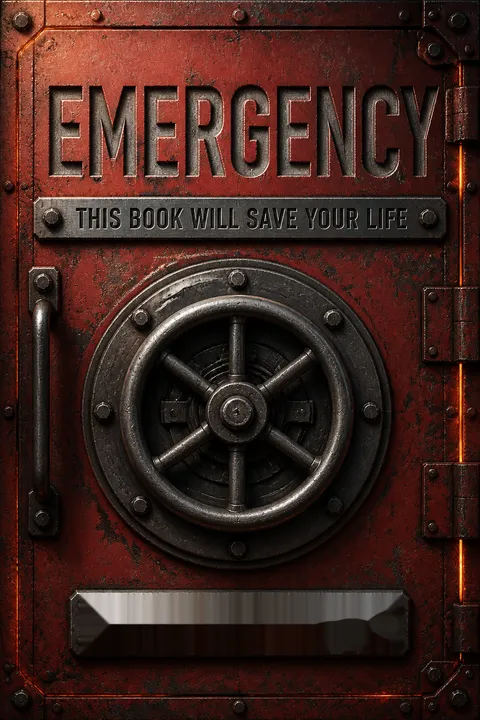
What's Emergency: This Book Will Save Your Life about?
- Survival and Preparedness: The book follows Neil Strauss's journey from a comfortable life to becoming a survivalist, focusing on preparing for potential disasters.
- Personal Transformation: Strauss shares his experiences learning survival skills, driven by societal vulnerabilities and personal fears.
- Cultural Commentary: It critiques modern society's complacency and the illusion of safety, emphasizing self-reliance in an unpredictable world.
Why should I read Emergency: This Book Will Save Your Life?
- Engaging Storytelling: Strauss combines humor, anecdotes, and practical advice, making the book both entertaining and informative.
- Practical Survival Skills: Offers insights into essential survival skills, from first aid to firearms training, applicable to readers' lives.
- Awareness of Societal Issues: Encourages critical thinking about the state of the world and personal safety, serving as a wake-up call.
What are the key takeaways of Emergency: This Book Will Save Your Life?
- Self-Reliance is Crucial: Emphasizes the importance of depending on oneself in emergencies, rather than relying on institutions.
- Prepare for the Unexpected: Encourages stockpiling supplies and learning survival skills, as disasters can strike anytime.
- Understanding Human Nature: Explores human behavior in crises, highlighting altruism and selfishness, vital for navigating emergencies.
What specific survival skills does Neil Strauss learn in Emergency?
- Firearms Training: Learns to handle firearms safely and effectively, emphasizing self-protection in dangerous situations.
- Motorcycle Riding: Takes lessons to prepare for potential escape scenarios, crucial for navigating urban environments.
- Emergency Preparedness: Participates in CERT training, learning first aid, triage, and basic rescue techniques.
How does Emergency address the concept of paranoia?
- Paranoia as Instinct: Discusses paranoia as a natural response to threats, leading to better preparedness.
- Critique of Complacency: Critiques societal complacency, suggesting ignoring threats is denial, encouraging skepticism.
- Balance Fear and Action: Emphasizes balancing fear with proactive measures, avoiding paralysis from paranoia.
How does Emergency reflect on the state of modern society?
- Critique of Dependency: Critiques reliance on government and institutions for safety, leading to vulnerability in crises.
- Awareness of Vulnerabilities: Highlights modern society's fragility, encouraging recognition and addressing of vulnerabilities.
- Cultural Complacency: Discusses denial about potential threats, urging confrontation of uncomfortable truths about safety.
What role does community play in Emergency?
- Community Support: Emphasizes building relationships with neighbors and local groups, vital for survival in emergencies.
- CERT Training: Through CERT, learns teamwork and collaboration during disasters, fostering community responsibility.
- Shared Knowledge: Illustrates sharing survival skills within a community enhances overall preparedness.
How does Neil Strauss's personal journey in Emergency inspire readers?
- Encouragement to Act: Transformation from passive observer to active participant inspires readers to take preparedness seriously.
- Embracing Change: Encourages stepping out of comfort zones, learning new skills, and adapting to challenges.
- Finding Empowerment: By taking control of safety, Strauss discovers empowerment, illustrating shaping destinies through preparation.
What survival skills does Neil Strauss learn in Emergency?
- Basic First Aid: Learns essential techniques like treating wounds and performing CPR, crucial in emergencies.
- Fire-Making Techniques: Explores methods like hand drill and bow drill, important for warmth and cooking.
- Shelter Building: Details constructing shelters with natural materials, vital for wilderness protection.
How does Emergency suggest preparing for economic collapse?
- Self-Sufficiency: Advocates growing food, raising livestock, and learning essential skills for self-sufficiency.
- Diversifying Assets: Emphasizes diversifying financial assets, like investing in precious metals, for economic stability.
- Community Support: Highlights building supportive communities to share resources and knowledge during hardships.
What is the "triangle of life" mentioned in Emergency?
- Basic Needs: Refers to three essential survival needs: safety and health, shelter and warmth, and food and water.
- Prioritization: In survival situations, prioritizing these needs above all else is crucial.
- Survival Mindset: Understanding this helps focus on important aspects in emergencies, fostering practical survival approaches.
How does humor play a role in Emergency?
- Coping Mechanism: Strauss uses humor to cope with serious themes, making the narrative engaging and relatable.
- Lightening the Mood: Humorous anecdotes provide relief from survival topics' tension, connecting readers personally.
- Perspective Shift: Encourages approaching survival with a lighter heart, reminding laughter's power in difficult situations.
About the Author




Download PDF
Download EPUB
.epub digital book format is ideal for reading ebooks on phones, tablets, and e-readers.








