

Plot Summary
A Soap-Dish Pact
After her father, Godfrey Poskitt, dies following years of dementia, Kay Wilkinson tells her husband, Cyril, how caring for him consumed her and her mother. Cyril, an NHS doctor, proposes that they end their lives together when Kay turns eighty, before illness can take away their independence.
Kay questions the severity of his plan, then agrees after noticing signs of memory loss in her mother, Dahlia. Cyril stores the means in a black box once used for a soap dish, hidden in the refrigerator. Over the following decades, Kay builds a second career in interior design while the couple plan their finances and care for elderly relatives. Cyril keeps the pact in view; Kay rarely mentions it.
The pact begins not with a simple fear of death, but with Kay’s intimate knowledge of what prolonged decline can demand from families. Her father’s illness has blurred love with exhaustion, while Cyril converts that experience into a fixed rule meant to protect them both. The black box gives an abstract agreement a physical, domestic presence: a quiet object tucked among ordinary food. Their different temperaments are already at work. Cyril seeks control through principle; Kay tends to accommodate him, even as she preserves an appetite for reinvention. The pact is therefore both a shared act of care and an early test of whose judgment will govern their future.
Lockdown on Kay's Eightieth
As their chosen date approaches, Cyril throws himself into campaigning against Brexit, while Kay becomes less certain that their planned departure is right. The December 2019 election defeats Cyril’s hopes for another referendum, and the coronavirus outbreak soon cancels the visits Kay arranged for their last days.
On her eightieth birthday, the couple share a carefully prepared dinner, but Kay secretly alerts their daughter Hayley. When Hayley arrives with paramedics, Kay says neither has taken the tablets; the box is missing, and Cyril is found dead in the tool shed. In this possible outcome, Kay later sells their house, moves into a flat, forms a relationship with her neighbour Ellis, and dies at ninety-two after a road accident.
The political crisis supplies Cyril with a cause that keeps him engaged even as he insists on abandoning life. Kay notices this contradiction but cannot resolve it for him. The pandemic then strips their plan of its intended ceremony: the outside world is sealed off, their children cannot visit normally, and the couple’s private ending risks disappearing among public death counts. Hayley’s arrival changes the outcome, but not cleanly. Kay is left to live with a loss she helped invite and could not prevent. The branch makes survival neither a reward nor a punishment; it becomes an unplanned future that must be built from grief, practical choices, and renewed attachment.
Kay Calls Time
In another possible ending to the birthday dinner, Kay returns from the bathroom and openly withdraws from the pact. She argues that they are healthy enough to keep living, that their children would be wounded, and that choosing death would surrender every chance of ordinary pleasure. Cyril objects that he made the commitment in earnest, but Kay’s decision frees them to finish the evening and share breakfast the next day.
She remembers that he secretly mailed police a note explaining their plan, so she hurries across the road to intercept it. After retrieving the letter from the post carrier, she rushes home without looking. A delivery van knocks her into a lamppost, killing her at eighty years and one day.
This branch makes Kay’s freedom brief and pointedly imperfect. She does not defeat mortality by choosing to live; she claims authorship of one decision, then meets a death no plan could schedule. Her attempt to retrieve Cyril’s letter is both practical and symbolic: she is taking responsibility for the consequences of changing course, rather than leaving the matter to him. The traffic accident refuses the comforting idea that a life can be made safe through either discipline or defiance. It also sharpens the book’s distinction between controlling one’s choice and controlling its outcome. Agency matters, but it does not make the world obedient.
Cyril Outlives His Conviction
In a darker alternative, Kay accepts the tablets during their final dinner and dies in Cyril’s arms. He discovers that he cannot take his own dose, despite decades of insisting he would. He stages the room to support the appearance of a private overdose, then hides the evidence of their shared plan. Hayley later confronts him after finding Kay’s message about the pact, and blames him for allowing her mother to die.
Cyril begins writing a memoir, but a stroke leaves him conscious and almost entirely unable to move. His children debate his care while he cannot answer them. He uses an alphabet board to ask doctors to withdraw life support, but his requests are dismissed, and he remains trapped in the hospital for years.
Cyril’s bodily refusal exposes a gap between conviction and lived experience. He has treated the wish for a controlled death as a matter of clear reasoning, but when Kay actually dies, grief and instinct break through his doctrine. His concealment compounds the tragedy: he tries to protect his wife’s dignity while also protecting his own account of events. The stroke then turns his deepest fear into a literal condition. His mind persists, but others control his body and interpret his wishes. The branch asks whether autonomy remains meaningful when the person who once demanded it cannot make himself heard, and whether care can become coercion even when it is offered as protection.
The Care Home Bet
In another timeline, a near collision with a van in 1993 makes Kay question the pact. She persuades Cyril to prepare for old age instead: they buy long-term care insurance, work beyond their preferred retirement dates, and save for private support.
They choose Journey’s End, an expensive Suffolk retirement facility, and move there while still healthy. The polished amenities cannot disguise the loss of freedom, and the couple find themselves increasingly sedentary and medically managed. During the pandemic, frightened residents support strict isolation.
Cyril challenges the facility’s assumptions about the virus, while Kay struggles with its closed routines. When he suffers a stroke, rapid treatment and therapy help him regain some speech and movement, though he must rebuild basic skills.
This alternative tests whether planning can make aging humane. The Wilkinsons replace a single hard deadline with insurance, savings, and an institution chosen in advance. Yet their preparations carry their own cost: by moving early, they surrender parts of ordinary life before illness requires it. Journey’s End offers comfort as a managed environment, but it also narrows the world to scheduled meals, treatments, and other residents’ decline. Cyril’s recovery complicates his suspicion of dependency; therapy gives him work to do, but does not restore the life he left. The branch resists easy answers. Preparation can reduce uncertainty, yet it may also move the feared future closer.
The Wrong Word in the Kitchen
In a separate branch, the couple survive the birthday crisis, but a police visit over Cyril’s note unsettles Kay. She cannot recall their home telephone number, then begins making mistakes in the kitchen and losing familiar words. Cyril takes over the cooking after she puts sponges in the toaster.
Hayley and the other children increase their visits, while Kay experiences their concern as an effort to control her. Her awareness fades into confusion: she mistakes familiar people for strangers, plays with food, and drifts through memories of her parents and an old sweetheart named Adelaide.
Cyril explains their past and their pact to family members, but Kay can no longer understand the choice they once faced. Her declining capacity means she cannot give meaningful consent to ending her life.
Kay’s decline alters the moral problem that began the novel. Cyril’s plan assumed they could choose an ending while they still recognized themselves, but dementia erodes the very continuity that made the choice intelligible. To Kay, the family’s reasonable safeguards look like persecution because her experience of reality has changed. The narrative grants her confusion its own vivid logic rather than presenting it only as a burden for others. That shift matters: the people around her may remember a capable woman, but the person she is now cannot simply be replaced by their memories. The branch exposes the limits of advance consent and the painful distance between protecting someone and speaking for them.
Children Invoke Section Three
In another version of the birthday night, Hayley arrives before Cyril can take the tablets and finds enough evidence to alert the authorities. Paramedics remove the medication, and Hayley empties the household medicine cabinets.
The next day, she brings Simon and Roy into a family meeting. The siblings decide their parents are a danger to themselves and arrange for them to be detained under mental health law. Cyril argues that he and Kay are competent adults, but Hayley points to Kay’s memory slips, their suicide plans, and their depleted finances.
Roy welcomes the financial protections that come with state-funded aftercare. A council vehicle takes the couple from their home to Close of Day Cottages, where they are separated and placed under strict supervision.
The children’s intervention grows from recognizably mixed motives. Hayley fears losing her parents; Simon wants a lawful, manageable solution; Roy is alert to money and inheritance. Their response is not simply malicious, but it gives the state and family authority over the very lives Cyril and Kay have tried to direct. The intervention also reveals how easily a rational plan can become evidence of incapacity once it conflicts with others’ beliefs about what life must mean. Their home, finances, and bodies are all reclassified as risks to be managed. In this branch, protection arrives as a transfer of power, and the parents’ claim to agency becomes difficult to distinguish from danger.
Smurfs Cannot Free Them
At Close of Day Cottages, director Dr Mimi Mewshaw confiscates the couple’s phones, books, alcohol, and ordinary medication, while staff control their clothing, food, and movements. Kay befriends an orderly named Leon, who helps her send a brief plea for help to Simon.
When a charity group dressed as Smurfs visits, Kay and Cyril disguise themselves in scavenged clothes and slip into the parade. They get only a few feet beyond the facility before staff catch them. Dr Mimi responds with prolonged isolation, denying them visitors and keeping them apart.
Kay clings to exercise, songs, and remembered scenes; Cyril recites his unwritten memoir. After three years, they are reunited, but Kay is severely diminished, and their attempt to stockpile medication has failed.
The Smurf escape is comic in its materials and desperate in its stakes. Kay turns the facility’s own enforced activities into camouflage, while Cyril follows because the alternative is separation. Their brief freedom proves how narrow the institution has made the world: the property line is only a few feet away, yet crossing it brings harsher confinement. Dr Mimi’s retaliation converts care into discipline, and the residents’ safety regime becomes a system that suppresses information, contact, and personal identity. Kay and Cyril survive by making inner worlds from exercise and memory, but these private acts cannot replace the freedom they have lost. Their failed escape is a small adventure with a devastating consequence.
Retrogeritox Reverses Time
In a radically different future, Kay secretly joins a drug trial after a brief episode of forgetfulness. The treatment, later named Retrogeritox, reverses aging and restores her strength, senses, and appearance; Cyril benefits too. The drug spreads, old-age illnesses recede, and people live indefinitely.
Then demographer Calvin Piper releases a pathogen that kills half the world’s population, forcing governments to limit births. Kay and Cyril resume work, travel, and experiment with new lives, but endless choice begins to feel like paralysis.
Their family suffers losses, and more people seek help for suicidal thoughts. Cyril becomes a therapist and advises patients to keep searching for meaning. On one birthday, he offers Kay access to the medication he once kept hidden, leaving their next decision unresolved.
The anti-aging cure grants the couple the future they once tried to refuse, but it does not solve the human problem of finitude. Removing bodily decline also removes the deadline that gives choices weight. Careers, partners, hobbies, and journeys can all be repeated, yet repetition drains them of urgency. Piper’s mass killing restores mortality only through catastrophe, showing the cruelty of treating population as an equation. Cyril’s new work reflects a genuine change: instead of prescribing one universal answer, he helps people confront the ongoing labor of making meaning. The branch turns longevity into a stress test for purpose. More time is not automatically more life.
The Loft Under Siege
In another future, Kay and Cyril decline the care home and remain in Lambeth, but the pandemic’s economic aftermath drains their pensions and savings. By the time they reach their late nineties, inflation has made basic food difficult to afford, and an enormous migration crisis has destabilized Britain.
Refugees and local radicals occupy the Wilkinsons’ house, forcing the couple into the loft. Their son Roy, now involved in people-smuggling, has little reason to rescue them; other children are unable to change the situation.
The couple receive scraps of food and hear reports of vandalized landmarks and failing institutions. As an armed young man climbs toward their hiding place, Kay and Cyril face the violence of a world they chose to live long enough to see.
This branch turns the wish to know what happens next into a harsh experiment. Kay once feared that leaving life early would mean abandoning unfinished stories; here, she survives long enough to watch public order and private security collapse together. The house that once embodied decades of work becomes occupied territory, and the couple’s savings cannot buy protection once money and institutions lose their force. Cyril’s humanitarian ideals and Kay’s insistence on limits collide under conditions neither can control. Their danger is not merely an argument about policy: it reaches them in the form of hunger, confinement, and a machete. Curiosity has a price when history’s next chapter is disaster.
Frozen Beyond Recognition
In a separate possibility, Cyril receives a diagnosis of pancreatic cancer and Kay learns she has ALS. Rather than endure the likely decline, they pay Sleeping Beauties Ltd to place them in suspended animation until medicine can treat both conditions.
When they awaken in a distant era, doctors cure their diseases, but the world, language, and human society have changed beyond recognition. Cyril struggles to communicate with his towering hosts and learns that their descendants see individual identity as quaint.
Kay is alive and medically well, yet neither spouse can recover their former intimacy. Their reunion feels like meeting a stranger. A therapist identifies their emotional numbness as a consequence of preservation, a kind of psychological freezer burn.
Cryogenics appears to offer a compromise between death and decline: the couple can leave the present without surrendering the possibility of a later cure. Yet their bodies survive more successfully than their emotional selves. Cyril and Kay awaken with no shared social world around them, and even their marriage cannot function as a complete shelter from historical change. The future’s collective culture makes their old individualism seem absurd, but the deeper estrangement comes from within: feeling itself has been blunted. The branch asks whether survival counts as rescue if the qualities that made survival meaningful have been preserved only in memory. Medical success cannot restore a life that has lost its texture.
A Century of Second Chances
In a sunnier alternative, Kay rejects Cyril’s pact and he supports her later career in interior design. Her work wins acclaim, while Cyril publishes popular books about medicine and the NHS. Their children find more settled paths, and the family grows closer through shared holidays, exercise, and long summers together.
The couple remain healthy and energetic into old age, while the world appears to resolve its political, economic, and environmental crises. At 110 and 111, Kay and Cyril begin to feel that their life together is complete.
They prepare the house, invite their descendants and friends to a celebratory wake, and share a final dance in the garden. Holding hands beneath the evening sky, they die together, with the story suggesting that their farewell is not the end.
This branch grants Kay the reinvention and mutual support she feared might be sacrificed in the harsher alternatives. Cyril’s encouragement allows her talent to flourish, while the children’s lives improve without needing their parents to impose a single model of success. Their later farewell differs from the original pact because it follows a long, vivid life rather than a date fixed in advance. The party allows the couple to witness their place in a living community, not simply to avoid becoming a burden. Even this apparently ideal world cannot make death disappear, but it changes its emotional shape. Completion comes through accumulated relationships and shared experience, not a rule imposed decades earlier.
The Last Last Supper
The novel returns to the night Kay turns eighty, now following the path in which she does not summon Hayley. She and Cyril drink wine, revisit the uncertainties beyond their lives, and acknowledge regrets from their marriage. Kay admits that she has feared the pact, but insists that fear has not erased her memory of her parents’ decline or the gradual losses already reshaping their days.
She argues that they should leave while they can still recognize one another and enjoy one another’s company. Cyril gives her room to refuse, but she chooses to continue. Kay brings water, the tablets, and the familiar black box to the sofa. They take the medication together, embracing as the night closes around them.
The final branch does not prove that Cyril’s original theory was correct; it shows Kay making the decision her own. Her reasoning is not free of fear, but neither is it reducible to submission. She has tested the alternatives through the imagined futures that precede this ending: accidental death, grief, dementia, institutional control, catastrophe, endless life, and a fulfilled old age. None offers certainty. What she values most is the present quality of their shared life, and she chooses to protect that bond from a future she believes would dismantle it. The ending remains ethically unsettled by design. Love gives their choice intimacy, but it cannot turn a wager into knowledge.
Analysis
The novel treats old age as a problem of agency, but refuses to reduce agency to a single decision. Kay and Cyril’s pact is born from real caregiving: they have watched dementia consume identity and family time, and they want to spare one another that experience. Yet their confidence that a deadline can protect them from uncertainty repeatedly collides with the unpredictable body, family, state, and historical circumstance. Each alternate future changes the moral shape of the original choice. Kay may survive by accident, lose the capacity to choose, face institutional coercion, witness social collapse, or live beyond aging itself. None of these outcomes turns longevity into an uncomplicated good.
Care is the novel’s most intimate political question. Cyril’s NHS commitment makes him alert to public cost, while Kay knows how unpaid family labor is distributed and exhausted. Their argument is not simply whether the state should pay for old age; it is who gets to define a life worth preserving. When children intervene, their fear and practical interests mix with genuine concern. When institutions take control, protection can become imprisonment. When medicine conquers aging, freedom expands so far that it risks becoming indistinguishable from emptiness.
The branching structure is essential to this argument. Rather than reward one philosophy with a clean victory, it imagines consequences that expose the blind spots in every position. Cyril’s certainty cannot guarantee that he will act on his own rule. Kay’s wish to keep living cannot keep chance from killing her. Even a fulfilled century ends, and even endless youth brings grief and boredom. The final choice is therefore neither a universal prescription nor a triumphant proof. It is a decision made within a particular marriage, under particular fears, by two people who know that no plan can make them masters of what follows. The book’s deepest claim is modest but difficult: uncertainty cannot be solved, only faced together, and the meaning of a life lies partly in the limits that make its choices matter.
Review Summary
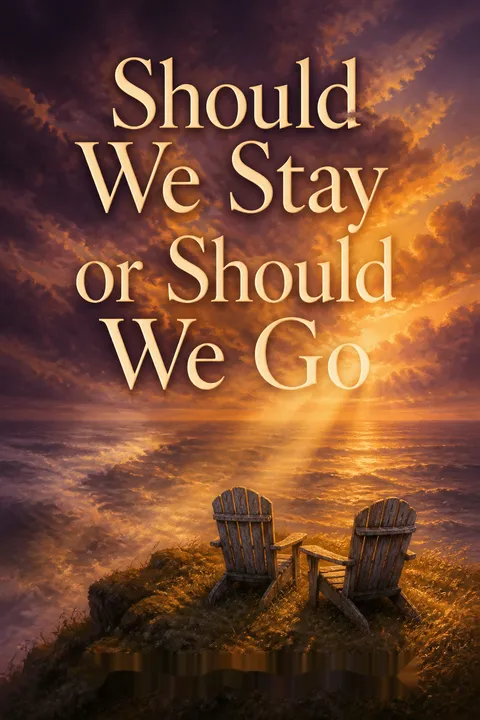
Should We Stay or Should We Go explores aging and mortality through multiple scenarios of a couple's suicide pact. Readers praised Shriver's sharp writing and thought-provoking premise, though some found it repetitive or disliked the political commentary. Many appreciated the dark humor and creative structure, calling it moving and incisive. Critics felt it lacked character development and pushed the author's views too forcefully. Overall, reactions were mixed, with some finding it brilliant and others disappointing.
People Also Read


Characters
Kay Wilkinson
Restless reinventionist nurseKay is a former nurse, a perceptive mother, and an energetic observer of the people and rooms around her. Her caregiving experience makes her attentive to the indignities of dependence, but she resists being reduced to self-sacrifice. She has an eye for beauty and function, a taste for mischief, and a capacity to change direction when a life begins to feel too narrow. In her marriage to Cyril, she often accommodates his certainty, yet she retains an independent judgment that can emerge sharply under pressure. Her central tension is between wanting to protect the life she loves and refusing to let fear, habit, or another person decide what that life should mean.
Cyril Wilkinson
NHS doctor turned absolutistCyril is a committed general practitioner whose faith in the NHS shapes his politics and his ideas about social responsibility. He is analytical, principled, and often rigid, with a strong impulse to turn difficult moral questions into plans that can be stated and followed. His long marriage to Kay gives him affection and companionship, but his certainty can crowd out her independence. He fears prolonged bodily and mental decline, both for its personal indignities and for its demands on families and public care. Beneath his argument lies a need to make suffering intelligible and preventable, even when the future refuses the tidy boundaries he wants to impose.
Hayley Wilkinson
Theatrical eldest daughterHayley is the Wilkinsons’ eldest child, an expressive and attention-conscious woman with a history of artistic ambitions. She can be impulsive, dramatic, and sharply critical of her parents, yet her intensity also reflects genuine concern for them. Family responsibility becomes a stage on which she wants to act decisively, especially when she fears that her parents are making a dangerous choice. Her relationship with Kay mixes affection with frustration, while her clashes with Cyril expose her resistance to his authority.
Simon Wilkinson
Cautious eldest sonSimon is the responsible, financially successful eldest son, inclined to assess problems through procedure, risk, and practical consequence. He is more dutiful than his siblings, though not always emotionally perceptive, and his preference for order can make him hesitant when a situation demands moral courage. He respects his parents but does not automatically share their politics or judgments. His place between Hayley’s forcefulness and Roy’s unreliability often makes him the family’s cautious intermediary.
Roy Wilkinson
Restless family dependentRoy is the Wilkinsons’ youngest child, impulsive and unreliable, with a pattern of unfinished plans and financial dependence. He resists family expectations and often appears more interested in immediate advantage than long-term obligation. His parents’ concern for him is complicated by their belief that an inheritance would not help him. Roy’s shifting role in the family makes him a measure of how responsibility, loyalty, and self-interest can coexist uneasily.
Godfrey Poskitt
The declining family patriarchGodfrey is Kay’s father, a former solicitor whose long decline places heavy demands on his wife and daughter. His illness alters his memory and behavior, obscuring the man Kay remembers and making ordinary care physically and emotionally difficult. His history gives Kay and Cyril a vivid example of what they fear in old age, while also showing how a patient’s needs can consume the lives of those closest to him.
Dahlia Poskitt
Polite, vulnerable motherDahlia is Kay’s mother, a gracious woman whose sense of propriety and wish not to trouble others shape how she meets the world. Her relationship with Godfrey is long and complicated, and her later vulnerability makes Kay attentive to the different forms cognitive decline can take. Dahlia’s gentleness contrasts with the volatility Kay witnessed in her father, but her experience still informs her daughter’s fears about dependence and memory.
Percy Poskitt
Estranged younger brotherPercy is Kay’s younger brother, who lives farther from their parents and has his own family strains. His distance from the daily labor of caregiving exposes the unequal ways relatives assume responsibility. He remains part of Kay’s emotional and family landscape, even when practical obligations put the siblings at odds.
Norman Wilkinson
Repair-minded Brummie fatherNorman is Cyril’s father, a vigorous Birmingham storyteller with practical skills and a fondness for fixing household appliances. His sturdy independence challenges Cyril’s assumptions about what old age must look like. Their affectionate relationship carries an undercurrent of disagreement about politics, work, and the value of continuing to live with energy.
Ellis
Late-life neighbour companionEllis is Kay’s neighbour in one possible future, a divorcee who meets her after she has moved into a smaller flat. He offers companionship without trying to reproduce her long marriage, and his presence gives Kay a different kind of domestic life. Their connection is practical, warm, and shaped by the recognition that time can feel short at any age.
Dr Mimi Mewshaw
Cheerful institutional tyrantDr Mimi directs Close of Day Cottages, where her bright manner masks a strict and controlling approach to residents. She treats compliance as proof of wellbeing and uses routines, restrictions, and institutional authority to manage people she considers vulnerable. Her polished cheer makes her more unsettling, because it allows coercion to present itself as kindness.
Leon
Kindly care-home orderlyLeon is an underpaid orderly at Close of Day Cottages. Unlike staff who treat residents as a problem to contain, he shows empathy and takes small risks to help them. His practical kindness gives Kay a rare point of human connection inside the facility.
Marcus Dimbleby
Displaced care-home allyMarcus is a former estate agent whose injuries and financial circumstances bring him to Close of Day Cottages. He is alert enough to remember the better facility he once lived in and shares those memories with Kay. His presence shows how quickly a person’s comfort and independence can change when savings and health fail.
Calvin Piper
Misanthropic population theoristCalvin Piper is a demographer whose bleak ideas about population growth gain influence in a world transformed by life-extending medicine. He treats humanity as a system to be managed rather than a collection of individuals with claims and attachments. His arguments challenge Cyril’s politics and become a disturbing reference point in one possible future.
Dr Marshall Evans
Cautious neurologistDr Evans is the neurologist overseeing Cyril after a severe stroke. He is wary of withdrawing life support and prioritizes caution, even when Cyril attempts to express a clear preference. His role highlights the tension between medical duty, professional uncertainty, and a patient’s right to refuse treatment.
Plot Devices
The Soap-Dish Box
A pact made tangibleA black cardboard container originally kept for an impractical soap dish hides the medication Cyril obtains for the couple’s plan. Kay notices it in the refrigerator, where it becomes a recurring physical reminder of an agreement they otherwise avoid discussing. Its ordinary setting matters: the means of a life-ending decision sits beside food and household routines. As the novel explores different outcomes, the box signifies both the couple’s wish for control and the danger of treating a complicated future as a problem that can be neatly stored away.
Branching Possible Futures
One choice, many outcomesThe novel repeatedly revisits the Wilkinsons’ decision about aging and death, following different possible consequences rather than a single uninterrupted timeline. The branches include suicide, reprieve, dementia, institutionalization, economic collapse, medical rejuvenation, and cryogenic survival. Each variation tests a different assumption about autonomy, care, and what makes a life worth continuing. The structure prevents any one outcome from serving as a definitive answer; the reader encounters the same underlying choice under sharply different conditions.
The Care System
A test of chosen carePublic services, private insurance, family support, and residential care shape several possible futures for Kay and Cyril. Their experience of Godfrey’s decline informs their fears, while their own planning sometimes protects them financially and sometimes places them inside restrictive institutions. Close of Day Cottages turns safety into surveillance, whereas the more comfortable Journey’s End still limits independence through routine. The care system is not merely background; it determines who controls information, movement, medication, and the couple’s ability to act on their wishes.
Retrogeritox
A cure that removes ageIn one future, a drug trial leads to Retrogeritox, a treatment that reverses bodily aging and prevents many illnesses associated with old age. Its introduction transforms work, family relationships, medicine, and mortality. Yet people who can remain young indefinitely still confront boredom, grief, suicide, and the problem of purpose. The treatment expands the couple’s options while showing that longer life does not automatically supply meaning. Its social effects become even more severe when population growth provokes a catastrophic response.
Cryogenic Suspension
A wager on the futureWhen Kay and Cyril face serious diagnoses in one branch, they pay a cryogenics company to preserve them until their diseases can be cured. They awaken in a distant era where medicine has advanced, but their language, culture, and descendants are gone. The device turns survival into a question of continuity: the couple retain their bodies and memories, but find their emotional connection altered. It tests whether being alive in a future world is enough when the people and shared context that gave life meaning have disappeared.
About the Author


Download PDF
Download EPUB
.epub digital book format is ideal for reading ebooks on phones, tablets, and e-readers.








