

Key Takeaways
Judge simplicity by the flavor achieved, not the effort required.
Simplicity is an effect. Olney rejects the idea that simple cooking must mean few steps or minimal effort. A ripe tomato served plainly can be simple, but so can cassoulet, whose beans, meats, preserved goose, and sausage are cooked separately before a long bake brings their flavors together. Rustic dishes can transform inexpensive ingredients; classical dishes can combine many carefully prepared elements. The test is whether the result tastes coherent and lets its central ingredients remain recognizable.
Goodness comes first. A roast should taste like lamb, not an imitation of something grander. Decoration is useful only when it helps the food look appetizing. Simplicity is therefore a judgment about the finished dish, not its price, recipe length, or convenience.
What's striking is that simplicity here describes a relationship between parts and whole, not the absence of work. That distinction helps explain why a stew can feel direct even when it takes hours: its complexity has been organized into a clear, legible flavor. The idea also offers a useful standard for evaluating recipes. Instead of asking whether a preparation is technically elaborate, ask whether each step contributes to the food's identity. The limitation is that coherence is ultimately a matter of taste, and Olney's confidence sometimes presents his personal palate as a broadly reliable judge.
Understand a technique's purpose before you start changing the recipe.
Rules explain cause. Olney argues that cooking instructions become memorable when the cook understands what each step does. Rinsing shredded potatoes removes excess surface starch, helping a potato cake turn crisp outside instead of gluey. Gentle heat keeps a stew from boiling hard, which can make its meat dry and its sauce cloudy. These are not arbitrary rituals; they express accumulated knowledge about ingredients and heat.
Knowledge creates freedom. Olney compares cooking to painting: skillful improvisation depends on knowing the medium and its limits. In his classes, students first worried when recipes and exact measurements disappeared. Once they began tasting, adjusting, and deciding together, the uncertainty became a source of invention. A recipe can be a starting point, but blind compliance does not teach the cook how to adapt.
The distinction between procedural memory and causal understanding is central to learning any craft. A cook who knows why a pan must be hot can adapt to a different stove; one who remembers only a number is stranded when conditions change. Olney's approach makes recipes more like annotated demonstrations than contracts. Still, tacit skill takes repetition, and understanding a principle does not instantly produce judgment. The strongest reading is not that recipes are unnecessary, but that they should gradually teach the cook to notice what the recipe cannot specify.
Let the market's season set the meal's limits and possibilities.
Shop with the season. Olney's Provençal markets offer the book's clearest picture of ingredient-led cooking: small quantities of freshly picked vegetables, herbs gathered from nearby hills, eggs, cheeses, chickens, and rabbits sit beside the larger produce stalls. What is available changes with the calendar, so the cook's choices change too. A salad, stew, or vegetable course begins with the day's ingredients rather than a fixed list.
Preserve what cannot travel. Olney treats fresh tomatoes as exceptional only in season, while good canned tomatoes become a useful pantry staple for the rest of the year. The point is not to insist that every cook live beside a Mediterranean market. It is to distinguish an ingredient at its best from a disappointing substitute, then choose a preparation that respects what is actually available.
The market scene connects flavor to place, labor, and timing. It also makes shopping part of cooking rather than a preliminary errand: the cook is gathering information about what the meal can become. That is a more flexible form of seasonality than simply following a calendar, since weather, supply, and access vary. Olney's ideal depends on exceptional produce and a culture that spends heavily on food, conditions not everyone shares. His more durable advice is to notice quality honestly and adapt the dish instead of pretending an inferior ingredient is equivalent.
Manage heat by the ingredient, not by the cookbook's timer.
Gentleness changes texture. Olney's stews should barely simmer, with only an occasional bubble breaking the surface. Boiling them harder does not make them cook better: meat can become dry and stringy, while the sauce turns muddy. Fish needs a different restraint. For poaching, he favors liquid just below a simmer, and he repeats James Beard's practical thickness rule as a rough timing guide: about ten minutes per inch of fish.
Watch and feel. The book repeatedly treats written times as estimates. A fish is ready when its flesh turns opaque near the bone and releases without crumbling; a custard should be just set, not rubbery. Meat also benefits from resting after cooking, allowing its heat to settle through the interior. Learning the cues makes the oven and pan less mysterious.
This is a practical lesson in process control: temperature is not a background setting, it is an active ingredient. The same cook can produce tenderness or toughness simply by changing the intensity of heat. Olney's sensory cues are particularly useful because ovens and cuts vary, although cues require experience and can be hard for beginners to interpret. A thermometer can help establish a baseline, but it cannot replace attention to texture, aroma, and the behavior of the food. The book's real argument is for observation, not for rejecting measurement.
Use herbs by character and timing, not by the handful.
Herbs are not interchangeable. Olney assigns each a role. Thyme can quietly bind the flavors of a long-cooked stew; basil is best added near the end because cooking quickly dulls its freshness. Sorrel contributes a clean acidity to fish, meat, eggs, and vegetables, often where another cook might reach for lemon. Tarragon can dominate if used too freely, while rosemary is often more successful as a brief scent in grill smoke than as a heavy coating on food.
Freshness matters. He objects to stale powdered seasonings and recommends keeping living herbs nearby when possible. His mixed herb pot for marinades and quick stews combines thyme, oregano, and winter savory, but he still treats that mixture as a practical starting point rather than a universal formula. The cook's task is to select herbs that support the dish's main flavor.
Olney's herb advice is really a theory of attention: seasoning is not about maximizing intensity but choosing the right kind of aromatic presence. His timing distinctions also make the cook consider how preparation changes an ingredient, instead of treating herbs as decorative greenery. This encourages precision without rigid formulas. The counterpoint is that his strong preferences reflect the herbs and regional dishes he knows best. A flavor he calls aggressive may be essential in another tradition. His most transferable rule is to taste herbs individually and learn what each one contributes.
Give vegetables room to be the main event.
Vegetables can lead. Olney objects to treating them as dull accessories to meat. In his cooking, a vegetable gratin can open a meal, and a carefully made vegetable stew can appear between fish and roast or become a course on its own. His mixed vegetable ragoût brings several young vegetables together, but adds each at the point that suits its cooking time. Five to seven vegetables are enough; too many blur their separate qualities.
Keep each flavor distinct. A good vegetable dish is not necessarily one in which everything becomes uniform. Olney aims for ingredients that remain identifiable while contributing to a larger harmony. He is equally skeptical of turning vegetables into imitations of meat. A fresh vegetable has its own flavor and texture, and good cooking should bring those qualities forward rather than apologize for them.
This approach changes menu structure as much as technique. Once vegetables are treated as full courses, the cook can build a meal around contrast, color, and texture instead of assigning every plant a supporting role. It also avoids the trap of judging vegetables by how convincingly they mimic meat. The method rewards restraint: a short list of well-chosen vegetables is easier to understand than a crowded medley. Still, Olney's rich use of butter, cream, and cheese means that vegetable prominence should not be confused with a single modern definition of light or health-focused cooking.
Turn leftovers into a dish with a clear center of gravity.
Begin with an inventory. Olney's method for improvising is to empty the refrigerator and cupboards, line up what remains, and look for combinations that make culinary sense. A memorable daube began with leftover beef, bits of wine from several bottles, roasting juices, herbs, and dried mushrooms. The pieces were not thrown together randomly: slow cooking gave them time to form a unified dish, served with pasta.
Let ingredients suggest forms. Leftover meat might become a stew, a filling for ravioli, or part of a composed salad. Cooked vegetables can become gratins, soups, or omelets. Olney sees recorded recipes as useful points of departure, but notes that improvisation itself resists exact transcription. The cook must taste, add, and adjust in response to the actual ingredients.
Improvisation here is not a license to combine everything in the refrigerator. It is a design problem: identify a main ingredient, then decide which leftovers support it and which should become another course. That framing makes constraint productive without romanticizing waste or pretending every experiment succeeds. The approach also requires a working memory of techniques, since the same ingredients behave differently in a soup, a salad, or a filling. Olney's example is a reminder that resourcefulness is learned through practice, not merely through good intentions.
Keep regional cooking alive by cooking its remembered dishes at home.
Recipes carry memory. Olney worries that Provençal dishes once prepared in ordinary homes are migrating to restaurants, where their character can become standardized. Men he meets at work breaks ask him to write down foods they remember from childhood, including rabbit stews and stuffed cabbage. Their requests are not for novelty; they want the flavors their families used to make.
Tradition lives at the table. Olney describes village markets, neighbors comparing soups and ratatouilles, and long meals among friends. A gueuleton is a convivial gathering around several dishes, wine, conversation, and laughter. These customs give recipes a social life beyond instructions on a page. Preserving a cuisine means cooking it, sharing it, and letting people remember it together.
The book treats food as a form of cultural transmission: a recipe can preserve not only a flavor but also a memory of who cooked it and who gathered to eat it. That makes the home kitchen a meaningful site of continuity, not just a smaller version of a restaurant. Yet preservation need not mean reproducing the past exactly. Olney himself values variation and improvisation, so living traditions must be allowed to change as ingredients, time, and households change. His concern is less about purity than about losing the everyday practice that gives regional food its meaning.
Cook fish gently and serve it with one sauce that clarifies it.
Freshness sets the ceiling. Olney argues that delicate fish cookery depends on fish being genuinely fresh, a standard he associates with Mediterranean markets where serious shoppers buy the morning's catch. He also acknowledges that American fish names can be confusing: a single market name may refer to different fish, and different names may describe similar ones. Knowing the actual fish matters because its flesh determines the best treatment.
Restraint protects flavor. Poached or grilled fish needs little more than a suitable cooking liquid, careful heat, and one uncomplicated sauce. Olney criticizes restaurant combinations that pile several fish, forcemeats, and sauces together until the palate loses its bearings. A well-cooked fish with a clear sauce lets its own flavor stay at the center.
The advice makes a case for subtraction as a form of technical confidence. A single sauce can reveal distinctions that a more elaborate construction hides, while overcooking can erase them altogether. Olney's point about fish names also exposes a problem of knowledge: cooks cannot make sound substitutions if they do not know what the label refers to. His standard of morning-fresh fish is an ideal, not a realistic everyday condition for many kitchens. The practical lesson is to match treatment to the fish at hand and avoid adding complexity to compensate for uncertainty.
Build the meal as a sequence, not a stack of impressive courses.
Courses form one composition. Olney says a successful menu depends on each dish relating to the next, and each wine relating both to its food and to the wine that follows. A table can fail even when every course is individually excellent if the whole meal becomes too rich, too heavy, or too demanding. He recalls a celebrated Lyonnaise cook who limited herself to about six mastered dishes, arguing that concentration can deepen skill.
Choose wine thoughtfully. Wine used in cooking should be good enough to drink, because heat cannot erase its unpleasant qualities. But cooking transforms even good wine, so serving the identical bottle alongside a dish is not a requirement. Olney's larger principle is balance: the meal should have a coherent direction, with enough contrast to keep attention alive.
Menu planning extends the book's definition of simplicity from a single preparation to an entire meal. The useful question becomes not merely, 'Is this dish good?' but, 'What does it ask of the courses around it?' That perspective values pacing and contrast, much like composition in music or writing. It also challenges the impulse to impress through abundance. Olney's ideal remains culturally and personally specific, especially in its wine-centered language, but the underlying insight is broadly useful: excellence accumulates only when the parts leave room for one another.
Analysis
Simple French Food is both a cookbook and an argument about how knowledge becomes taste. Its hundreds of preparations are less important as fixed formulas than as demonstrations of material relationships: how starch affects a potato cake, how a sauce changes under heat, how an herb can either bind or overwhelm. The organization by ingredient and technique gives readers a practical reference, while the long essays establish the standards behind the recipes. This dual form is the book's chief strength and its main challenge. It invites selective reading, but the reader must sort enduring principles from Olney's highly personal judgments.
The book's narrative is a defense of domestic regional cooking at a moment when Olney sees it weakening. Markets, village kitchens, work breaks, and meals among friends give the recipes social context. That attention makes the cookbook feel less like a catalogue and more like an account of a food culture. Its central paradox is productive: simple results often require detailed thought, patient preparation, and even elaborate technique. The goal is not minimal effort, but a result without needless interference.
Some of the book's standards are difficult to universalize. Its ideal larder assumes access to fresh, high-quality ingredients, while its devotion to offal, animal fat, wine, and long cooking reflects a particular regional appetite. Olney's sharp judgments about what is authentic or delicious can make his own preferences sound like laws. His strongest counterweight is his insistence on adaptation: substitute sensibly, taste, and change the recipe when the ingredients demand it. Read that way, the book offers more than Provençal dishes. It teaches cooks to recognize what an ingredient can do, to understand why a technique works, and to make each meal feel deliberate without making it feel overworked.
Review Summary
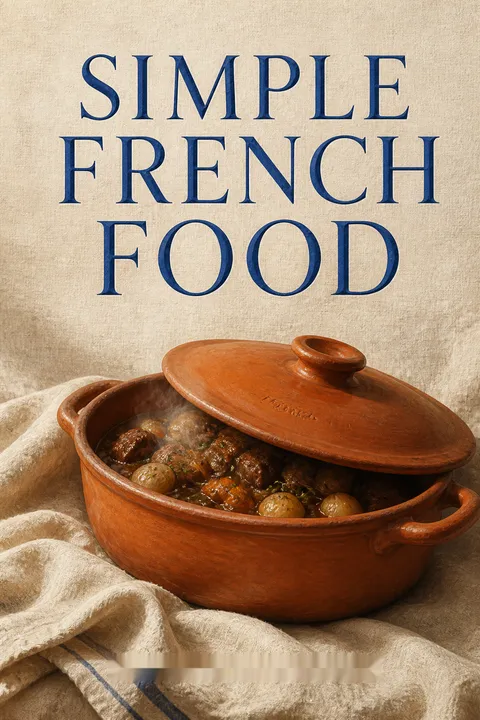
Simple French Food receives mixed reviews, with an overall positive reception. Many readers appreciate Olney's opinionated and entertaining writing style, finding the book enjoyable to read even if they don't cook from it. Some praise the detailed techniques and authentic French recipes, while others find them complex and outdated. Critics note that "simple" in the title is misleading, as many recipes are elaborate. Despite this, the book is often lauded for its passionate approach to cooking and its ability to transport readers into Olney's kitchen.
People Also Read




Glossary
Simple Food
Simplicity of final effectOlney uses Simple Food to mean more than easy preparation or a short ingredient list. It describes food whose finished effect is coherent and faithful to its ingredients. That result may come from serving a ripe tomato plainly, preparing a rustic stew from inexpensive ingredients, or carefully combining several separately cooked components into one harmonious dish.
sauté-type
Browned meat stew methodOlney's sauté-type is a general pattern for making stews from meat or poultry pieces. The ingredients are browned in fat, lightly thickened with flour, and moistened with wine, stock, water, or another liquid. The meat cooks gently until tender, while separately prepared garnishes and a reduced, skimmed sauce help preserve distinct flavors and textures.
daube
Slow, moist braiseA daube is a slow-cooked preparation in which meat and aromatic ingredients are moistened and gently braised together. Olney describes its character as a gradual blending of the ingredients into a unified flavor, unlike a sauté-type stew, where the meat, sauce, and garnish retain more distinct identities. The term also names many regional variations.
mijoter
Barely simmer and developOlney uses the French verb mijoter for the gentle condition of slow cooking, with only slight movement in the liquid. It describes both the low heat and the gradual development of a stew. A hard boil does not speed the process usefully; it can dry the meat and cloud the sauce.
persillade
Garlic and parsley seasoningA persillade is a mixture of parsley and garlic, chopped together or combined after the garlic is pounded into a paste. Olney often adds it near the end of cooking, where its aroma can lift sautéed mushrooms, fish, meat, or vegetables. The amount and fineness of the garlic change how assertive the mixture tastes.
pistou
Basil, garlic, cheese pastePistou is a Provençal paste made from garlic, fresh basil, grated cheese, and olive oil. In soupe au pistou, it is stirred into a hearty vegetable and pasta soup at the table or served separately so each person can add the amount desired. Unlike the pesto described as its Genovese relative, it contains no pine nuts.
court bouillon
Aromatic poaching liquidA court bouillon is a briefly cooked, seasoned liquid used to poach fish or other delicate foods. Olney's versions may include water, wine, onion, herbs, and vegetables, with ingredients adjusted to suit the dish. After fish is cooked in it, the liquid can serve as a light fumet, or stock, for a sauce or soup.
bain-marie
Gentle indirect cookingA bain-marie cooks a dish in a container set inside a larger vessel of hot water. The surrounding water moderates the heat, making the method useful for terrines, custards, and delicate mixtures that can turn grainy or rubbery if overheated. Olney cautions that the water should remain below a boil for especially fragile preparations.
gueuleton
Long meal among friendsOlney uses gueuleton for a convivial meal among friends, often made up of several dishes, generous wine, conversation, and laughter. It is not simply a large meal. The word captures the social pleasure surrounding regional cooking and helps explain why recipes matter to him as part of shared life, not only as a means of nourishment.
Download PDF
Download EPUB
.epub digital book format is ideal for reading ebooks on phones, tablets, and e-readers.








