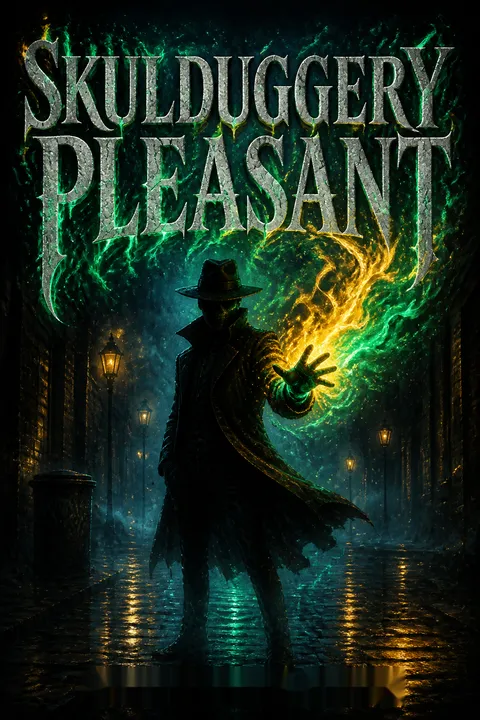


Plot Summary
The Inheritance at Haggard
Gordon Edgley dies suddenly at his desk, leaving his niece Stephanie grieving for the mischievous uncle who understood her better than most adults. At his funeral, she notices a strange man in a tan coat, scarf, hat, and sunglasses. He later finds her alone in Gordon’s study and speaks as if he knows her character.
The family gathers for the will, where Gordon leaves his grasping brother Fergus a boat he hates, while Stephanie’s parents inherit a French villa. Stephanie herself will receive Gordon’s house, possessions, and royalties when she turns eighteen. The stranger is named Skulduggery Pleasant, Gordon’s friend and guide. His cryptic inheritance suggests danger ahead, but no one explains why.
The inheritance turns a family gathering into a contest over who deserves Gordon’s affection, and Stephanie’s relatives expose their values by measuring every bequest in money. Gordon’s will does something subtler with Stephanie: it leaves her a future rather than simply a fortune, linking material independence to the question of who she might become. Skulduggery’s masked presence gives grief a second register. Stephanie has lost a beloved uncle, but his hidden friendships imply that she never knew the whole world he inhabited.
The Skeleton Detective
A broken-down car leaves Stephanie alone overnight at Gordon’s estate. While she reads her uncle’s unfinished manuscript, a caller threatens her, then smashes through a window and demands a key. Skulduggery bursts in, fights the attacker, hurls fire, and drives him away with a gun. When his disguise falls, Stephanie discovers the visitor from the funeral is a living skeleton.
Skulduggery explains that magic revived him after a war centuries earlier, and admits he was nearby because he had been watching Gordon’s house. Stephanie refuses his attempt to leave her behind and follows him into the city. After their car is rammed, the same attacker grabs her; she escapes by dragging him into a canal, where water dissolves him.
Stephanie’s curiosity becomes consequential when she chooses to follow Skulduggery rather than retreat to familiar safety. Her actions are not the product of seasoned courage: she is frightened, injured, and inexperienced, yet she insists on having a say in the danger already surrounding her. The attacker’s death in the canal also introduces the story’s practical approach to magic. Power is not simply spectacular; it has limits and costs that can be exploited. Stephanie survives by combining swimming skill with quick observation, not by suddenly becoming invulnerable.
A Hidden Society
Skulduggery takes Stephanie to China Sorrows, a beautiful sorceress who can cloud people’s judgment, and warns her about the power held in names. China reports that the former warlord Nefarian Serpine has been asking after the Sceptre of the Ancients, a legendary weapon. Skulduggery suspects Gordon possessed something that could only be stolen after his death.
At Ghastly Bespoke’s tailor shop, the scarred tailor rejects the theory that Gordon was murdered for a fairy tale, so Stephanie insists the danger is real because she has already been attacked. The Elder Mages dismiss Skulduggery’s evidence and refuse to move against Serpine. Mr Bliss, a powerful sorcerer, privately confirms that Gordon had acquired the Sceptre and hidden it.
This section makes secrecy a political system, not merely a magical trick. The Elders protect a fragile truce by refusing claims they cannot prove, while Skulduggery sees delay itself as a decision with victims. Ghastly’s skepticism, meanwhile, is not cowardice: he knows how easily wonder can become an excuse for recklessness. Stephanie is caught between these forms of caution and learns that neither guarantees safety. China’s persuasive magic sharpens the issue of consent, foreshadowing how vulnerable a person can be when another character controls what feels desirable or true.
The Vault of Ancients
To search for a way to destroy the Sceptre, Skulduggery and Stephanie break into a protected collection beneath Dublin’s art gallery. Skulduggery gives Stephanie a magical reflection to impersonate her at home, and Ghastly supplies her with protective clothes.
The pair evade the gallery’s vampire guards and find a puzzle box containing an Echo Stone, which preserves the memories of a dead scholar named Oisin. Oisin explains that no ordinary defense can withstand the Sceptre, though its black crystal may have a weakness.
His clue about how the Ancients hid the weapon points Skulduggery toward the caves beneath Gordon’s estate. The two escape the gallery past the vampires, but their discovery brings them closer to the people hunting Stephanie.
The Echo Stone turns scholarship into an encounter: the past can answer questions, but only briefly, and its knowledge arrives through a personality as eccentric as the history it preserves. Stephanie’s reflection is another kind of archive, copying her behavior and returning its experiences to her, yet it cannot become an independent self. Both devices complicate the boundary between a person and a record of that person. The scene also shifts the mystery from an abstract legend to a physical destination beneath Gordon’s familiar home.
Valkyrie Takes a Name
Before the pair can reach the caves, Serpine’s Hollow Men attack Gordon’s house and carry Skulduggery off. Stephanie turns to China for help, but China delays action and uses her knowledge of Stephanie’s given name to compel her obedience. In the library, Stephanie finds a way to resist by choosing a taken name: Valkyrie Cain.
She breaks into China’s apartment, retrieves Ghastly’s address, and persuades him to help. Together they force their way into the Sanctuary and convince Grand Mage Meritorious that Serpine has broken the truce. With only a small, unofficial team, they enter Serpine’s castle. Valkyrie, Ghastly, Tanith Low, and two Cleavers find Skulduggery and free him, though one Cleaver is left behind among the Hollow Men.
Taking a name is the first time Stephanie makes identity into an act rather than an inheritance. China’s control works because it exploits a vulnerability the magical society has normalized, but Stephanie’s resistance comes from deciding that she will not let someone else define her loyalties. Her new name does not erase her fear or make her powerful by itself; it gives her a boundary from which to act. The rescue also tests the difference between institutional authority and moral urgency. The Elders hesitate, so friendship and personal risk become the means of intervention.
The Brooch Holds a Key
After the rescue, Skulduggery reveals that Serpine once trapped him, killed his wife and child, and left him to die; his pursuit of Serpine carries grief as well as professional duty. He deciphers Gordon’s clue and realizes the key to the caves is the plain brooch left to Fergus and Beryl in the will. Valkyrie visits her aunt and uncle, endures their resentment, and quietly steals the brooch from Beryl’s jewelry box.
On the beach, Valkyrie’s father, Desmond, tells her that their family has long believed itself descended from the Last of the Ancients, a belief he rejected as madness. Soon after, Valkyrie moves a shell with magic. She and Skulduggery meet Mr Bliss, who takes the brooch and knocks Skulduggery over a cliff.
Gordon’s hiding place is a joke with ethical weight: the family most eager to inherit value receives the key without recognizing its importance. Valkyrie’s theft is not a triumph over her relatives so much as an acceptance that affection and obligation do not always align. Desmond’s confession reframes his earlier suspicion of Skulduggery and Gordon. He has not simply been dismissive; he has tried to escape a family story he fears might consume his daughter. Valkyrie’s first successful act of magic arrives just as that story becomes harder to dismiss.
Bliss Chooses Serpine
Mr Bliss admits that Serpine is too dangerous to oppose and takes the brooch to him, even pushing Skulduggery off the cliff. Skulduggery survives by walking out of the sea, and he and Valkyrie return to the estate to pursue Serpine into the caves. The underground passages are full of hazards, including a magic-eating beast that tears off Skulduggery’s leg before he reattaches it.
Valkyrie escapes a tentacled creature by tricking it into loosening its grip. She then finds Serpine at the hidden chest. The Sceptre’s crystal signals Skulduggery’s approach, but not Valkyrie’s; she reaches it unnoticed. Skulduggery attacks, yet Serpine recovers, seizes the weapon, and escapes the caves with its power.
Bliss’s betrayal demonstrates the danger of treating power as a reason to surrender in advance. He calls his retreat prudence, but his choice gives Serpine the advantage and leaves others to bear the risk. In the caves, survival depends less on mastery than on adaptation: Skulduggery repairs a dismembered body, while Valkyrie escapes by reading a creature’s limited senses. Her ability to approach the Sceptre unnoticed is a crucial anomaly, connecting her emerging magic to the family history Desmond has just revealed without yet explaining its full significance.
The White Cleaver
Skulduggery traces Serpine to a warehouse where magical experiments have been conducted, but a white-armored Cleaver ambushes the group and singles out Valkyrie. Ghastly stays behind to let Skulduggery, Tanith, and Valkyrie escape; he uses defensive earth magic and turns himself into stone rather than let the attacker reach them.
At the same time, Serpine and the Elder Sagacious Tome lure Grand Mage Meritorious and Morwenna Crow into a trap, then kill them with the Sceptre. The group learns that Tome betrayed the Council.
With the two strongest protections around the Book of Names gone, Skulduggery realizes Serpine’s true goal is not only the Sceptre: he wants the Book, which contains every person’s true name and could give him control over them.
The white Cleaver makes the conflict bodily and personal: Serpine’s ambitions now have a specific target in Valkyrie, and Ghastly pays the cost of protecting her. His transformation into stone is a defensive choice that preserves others at the price of his own freedom. The Council’s deaths expose the weakness of a system that mistakes continuity for stability. Tome’s betrayal is enabled by the very hierarchy that made him feel overlooked. The Book of Names gives the political struggle its ultimate stakes: domination would reach beyond territory or weapons into the identities and wills of ordinary people.
The Book of Names
At the Sanctuary, Hollow Men surround the rescuers and Skulduggery, Tanith, and Valkyrie fight their way toward the Repository. Tanith stays behind to face the White Cleaver, while Valkyrie slips close enough to knock the Sceptre from Serpine’s hand.
Skulduggery charges him, but Serpine uses magic to trap the detective inside a wall. Valkyrie tries to hold on to the Sceptre and breaks her leg. Mr Bliss refuses Serpine’s order to kill her, revealing that his apparent alliance was a gambit, but Serpine attacks him and leaves him incapacitated.
Skulduggery returns, identifies Serpine’s self-healing as a form of undeath, and destroys the Book with the Sceptre. He then turns the weapon on Serpine, whose own unnatural existence makes the blow fatal.
The climax hinges on two kinds of access. Valkyrie can approach the Sceptre because its warning system does not recognize her as an enemy, while Skulduggery can defeat Serpine only after recognizing that the villain’s apparent invulnerability is itself a vulnerability. Bliss’s last refusal complicates the moral ledger: he has helped Serpine and endangered the others, but he will not murder Valkyrie to prove loyalty. The Book’s destruction is both tactical and sacrificial. It ends the threat of mass coercion, but erases an irreplaceable record of every person’s hidden name.
A Partner in Training
With Serpine reduced to dust, the Sceptre loses its power after consuming the hatred that fueled it, and China takes it as a collectible. Tanith survives her wounds, but Ghastly remains a statue, and the White Cleaver vanishes without explanation.
The Elder Council has lost its leaders, leaving the magical community frightened and politically exposed. Valkyrie recovers from her broken leg at home while Skulduggery visits her and explains the damage Serpine’s campaign has done.
Her parents still see her as their daughter, though she now carries a secret life beside the ordinary one. Skulduggery asks her to become his student and partner. She accepts the future by conjuring a small flame in her palm, showing that her apprenticeship has already begun.
The ending grants victory without pretending it repairs what was lost. Ghastly’s frozen body, the dead Elders, and the missing Cleaver leave visible gaps in the world the heroes saved. Valkyrie’s return to her bedroom is not a return to her former life: her parents’ ordinary home now contains the hidden knowledge that their daughter has changed. Skulduggery’s offer recognizes her as a collaborator rather than a child to be protected. Her small flame is modest beside the Sceptre, but it matters precisely because it belongs to her and can be developed through choice.
Analysis
The novel’s central conflict is not simply between good sorcerers and bad sorcerers. It asks who has the right to decide what others may know, and what safeguards become dangerous when institutions value stability above evidence. The Elder Council’s refusal to act is understandable within its mandate to preserve peace, yet that caution grants Serpine time to turn the truce into cover. By contrast, Skulduggery’s willingness to break rules can protect people while also exposing them to risks he does not fully control. Valkyrie’s position makes these competing approaches tangible: adults repeatedly tell her what is safe, what is real, and whether she belongs, while she learns to judge those claims through action.
Names make the political struggle intimate. A true name can threaten a person’s ability to choose, while a taken name represents a deliberate boundary. Valkyrie’s self-naming is therefore more than a magical precaution; it marks her shift from being Gordon’s protected niece to an agent who accepts responsibility for her decisions. The Book of Names magnifies the same question to an entire population. Its destruction prevents Serpine from turning identity into a tool of rule, but it also sacrifices knowledge that cannot be recovered. The victory is ethically costly rather than clean.
The story also refuses to make courage synonymous with fearlessness. Valkyrie is frightened and inexperienced; Tanith is a seasoned fighter who still feels the cost of losing allies; Ghastly’s caution coexists with profound loyalty. Skulduggery’s humor conceals grief without curing it. Their partnership works because none of them is a complete answer to the others. In the end, the small flame Valkyrie summons matters more than the Sceptre’s spectacle: it is power she can learn to direct, not power that promises to rule the world.
Review Summary
Skulduggery Pleasant receives overwhelmingly positive reviews for its witty dialogue, engaging characters, and blend of magic and detective elements. Readers praise the dynamic between Skulduggery and Stephanie, the world-building, and the humor. Many consider it an excellent start to a promising series, appealing to both young adults and adults. Some criticize the predictability of the plot or the maturity of the 12-year-old protagonist. Overall, reviewers recommend it as a fun, fast-paced read with a unique skeleton detective protagonist.
People Also Read
Characters
Valkyrie Cain
The curious young outsiderValkyrie is Stephanie Edgley, a sharp-minded twelve-year-old who feels confined by school and the small coastal town of Haggard. Gordon’s affection gives her a model of adulthood that is irreverent, observant, and unwilling to accept rules without reasons. She is stubborn enough to walk into danger, but her courage is mixed with impatience and a strong wish not to be left behind. Her bond with Skulduggery grows through argument and shared risk rather than easy obedience. She is also deeply attached to her parents, even as she begins to keep a separate life from them. Her chosen name reflects her desire to define herself on her own terms.
Skulduggery Pleasant
The skeletal case solverSkulduggery is a sorcerer, detective, and skeleton who masks an old soldier’s grief with wit and theatrical composure. His long experience makes him perceptive, resourceful, and confident in a fight, but it has also left him with deep anger toward the people who destroyed his family and his body. He wants to solve Gordon’s case and protect Valkyrie, though his instinct to withhold information often clashes with her need to be treated as an equal. Beneath the jokes is a man who has learned to keep moving through losses that would stop most people. His partnership with Valkyrie challenges him to let someone else share the danger.
Gordon Edgley
The mischievous dead uncleGordon is a successful horror novelist whose bluntness often alienates adults but delights his niece. He is playful, intelligent, and more comfortable with the strange than his family knows. His closeness with Valkyrie rests on recognition: he respects her sharp tongue and independence instead of trying to smooth them away. He also has a serious, conscientious side that guides what he does with dangerous knowledge. Even after his death, his books, will, friendships, and carefully placed clues continue to shape the choices of the living.
Nefarian Serpine
The ambitious former lieutenantSerpine is a former lieutenant of the sorcerer Mevolent, now outwardly living under a truce while pursuing forbidden knowledge and power. He is patient enough to plan around institutions and ruthless enough to treat people as instruments. His red right hand gives him a terrifying reputation, but his ambition is not merely a hunger for victory: he wants a world ordered around his devotion to the Faceless Ones. He is especially dangerous because he can present himself as reasonable while arranging violence out of sight.
Ghastly Bespoke
The scarred loyal tailorGhastly is Skulduggery’s close friend, a tailor whose precise craftsmanship extends to clothes designed for dangerous work. His scarred face reflects a life shaped by other people’s attempts to alter what cannot easily be changed. He is honorable and cautious, preferring a life of ordinary interests to the world of sorcery, yet loyalty repeatedly draws him into danger. Ghastly’s skepticism is a form of care: he wants Valkyrie to understand that wonder does not make consequences less real.
Tanith Low
The fearless sword fighterTanith is a young-looking English sorceress with exceptional physical skill and a habit of meeting danger directly. She fights with a sword and treats helping people as a practical responsibility, not a bid for status. Her confidence can make her seem untroubled, but she takes the costs of violence seriously. She welcomes Valkyrie as a fellow fighter while recognizing how little experience the girl has. Tanith’s mix of humor, discipline, and unease gives her a presence that is warmer than her formidable reputation suggests.
China Sorrows
The persuasive collectorChina is a sorceress, collector, and source of information whose beauty and charm can overwhelm the judgment of people she meets. She values rare objects, access, and the careful management of her own position. Her history with Skulduggery is intimate enough to carry old resentment, though she rarely explains herself plainly. China is not simply a source of help or danger: her self-interest makes her useful, but it also means that trust must be earned anew in every encounter.
Mr Bliss
The formidable retired mageMr Bliss is a powerful sorcerer who has tried to leave public affairs behind, though the threat to the truce draws him back. He is controlled, physically imposing, and difficult to read; his calm can feel more alarming than anger. He believes in the Faceless Ones and approaches conflict as a problem of power and timing. His connection to China and his history with Serpine place him among people whose loyalties cannot be judged by appearances alone.
Desmond Edgley
The forgetful, loving fatherDesmond is Valkyrie’s affectionate father, a construction-company owner with a distracted streak and a warm, unshowy way of caring for his family. He values ordinary stability and has worked to distance himself from the Edgley family’s stories about magic. His concern for Valkyrie comes from love, but also from fear that she could be drawn into something harmful. When he speaks honestly about his past, he reveals how much of his protectiveness is rooted in a decision he once made about what kind of life to live.
Stephanie’s mother
The steady family anchorValkyrie’s mother works at a bank and keeps the family’s everyday life moving with practical affection. She is attentive to her daughter’s safety, willing to arrange help when a storm strands them, and trusting enough to grant Valkyrie some independence. Her ordinary routines offer a real point of connection for Valkyrie, even as the girl begins concealing the extraordinary events surrounding her.
Eachan Meritorious
The cautious Grand MageMeritorious leads the Elder Council and takes responsibility for maintaining the fragile peace between sorcerer factions. He is measured and courteous, but his commitment to procedure makes him slow to act when evidence is incomplete. He values stability because he believes the wider magical community depends on it. Skulduggery’s warnings test whether that caution is wisdom or a way of postponing responsibility.
Morwenna Crow
The shadow-moving ElderMorwenna is an Elder Mage who can emerge from shadows and helps govern the magical community. She is disciplined and wary of choices that could ignite conflict. Her authority rests on the Council’s shared responsibility, and she approaches threats through deliberation rather than impulse. She represents the order the Elders are trying to preserve, along with its limits.
Sagacious Tome
The overlooked council ElderSagacious Tome is an Elder whose status is overshadowed by more powerful or prominent colleagues. He is sensitive to how others evaluate him and wants his abilities to be recognized. His position on the Council places him inside the institutions that shape magical law, while his personal dissatisfaction complicates how he relates to that authority.
Fergus Edgley
The grasping family uncleFergus is Gordon’s brother and Desmond’s sibling, a self-interested man who measures family events by what he might gain. He dislikes the boat Gordon leaves him and resents the inheritance given to Stephanie and her parents. His greed makes him an obstacle in family scenes, but also provides an unintended cover for Gordon’s clever hiding place.
Beryl Edgley
The status-conscious auntBeryl is Fergus’s wife and the mother of Carol and Crystal. She is sharp-tongued, concerned with appearances, and openly resentful when Gordon’s will favors another branch of the family. Her certainty that respectable people can judge strangers at a glance contrasts with the hidden magical world she refuses to understand.
Oisin
The recorded scholarOisin is a scholar of the Ancients whose memories and personality survive in an Echo Stone. Curious, talkative, and proud of his research, he provides crucial information while remaining unmistakably himself. His recorded presence makes ancient history feel personal rather than remote.
Plot Devices
The Sceptre of the Ancients
The weapon that temptsThe Sceptre is a golden weapon powered by a black crystal, said to destroy anything it strikes. Gordon hides it because no one should control such force. Serpine seeks it as a step toward his larger designs, and its crystal can detect approaching enemies. Valkyrie’s unusual ability to approach it unnoticed becomes strategically important. The weapon’s power also depends on the hatred invested in it, making its use inseparable from the motives of its wielder.
Gordon’s brooch
The key in plain sightGordon leaves Fergus and Beryl a plain brooch they dismiss as worthless. Skulduggery recognizes it as the key to the hidden entrance beneath Gordon’s estate. The reveal makes the will both a family joke and a concealed security system: the people least likely to understand the object’s value are its temporary keepers. Valkyrie must visit relatives who resent her to retrieve it.
The Book of Names
A map of every identityThe Book records every person’s given, taken, and true name. True names can expose a person’s will to magical control, so the book is too dangerous for even the Elders to consult. Their protective spell grows weaker as the Council is diminished. Serpine’s plan turns the book from a guarded artifact into a means of controlling the population, raising the stakes from political power to personal autonomy.
Taken names
A shield for the selfSorcerers adopt a chosen name that protects their given name from magical influence. A true name is more powerful still, but is normally unknown even to its owner. Stephanie’s decision to become Valkyrie Cain is both a practical defense and an assertion of identity. The system gives names material force in the story: identity can be used to control someone, but it can also be actively protected.
The Echo Stone
A scholar preserved in crystalAn Echo Stone stores a dying person’s memories and personality, allowing the dead to answer questions for a limited time. Skulduggery and Stephanie activate one in the hidden collection beneath the art gallery. Oisin’s recorded scholarship explains the Sceptre’s destructive power and offers the clue that leads them to Gordon’s caves. The device makes exposition an encounter, because the history arrives through a curious, opinionated mind rather than a neutral account.
FAQ
Synopsis & Basic Details
What is Skulduggery Pleasant about?
- A girl's unexpected inheritance: The story begins with twelve-year-old Stephanie Edgley inheriting her eccentric uncle Gordon's estate, a seemingly mundane event that quickly spirals into a thrilling adventure. This inheritance, including a mysterious key, pulls her from her ordinary life in Haggard into a hidden world.
- A skeleton detective's world: Stephanie soon encounters Skulduggery Pleasant, a sharply-dressed, wisecracking living skeleton who reveals that magic is real and her uncle's death was no accident. Their partnership forms the core of the narrative, as Skulduggery introduces her to a secret society of sorcerers and ancient conflicts.
- Quest for a powerful artifact: Together, they embark on a dangerous quest to uncover the truth behind Gordon's murder and locate the Sceptre of the Ancients, a legendary weapon of immense destructive power. Their mission is to prevent it from falling into the hands of Nefarian Serpine, a ruthless sorcerer intent on unleashing ancient, malevolent gods upon the world.
Why should I read Skulduggery Pleasant?
- Unique blend of genres: The novel masterfully combines elements of fantasy, mystery, and dark humor, offering a fresh take on the magical world. Its witty dialogue, fast-paced action, and a detective duo unlike any other make it a compelling read for those seeking something beyond traditional fantasy.
- Engaging character dynamics: The evolving relationship between the cynical, experienced Skulduggery and the brave, curious Stephanie (who later becomes Valkyrie Cain) is a central draw. Their banter, mutual respect, and shared journey of self-discovery provide both comedic relief and emotional depth.
- Subversion of fantasy tropes: Derek Landy injects originality by presenting a magical world that is both familiar and refreshingly different, featuring vampires who tan, trolls who play riddles, and a secret society that operates within the mundane world. This playful subversion keeps readers on their toes and adds a unique charm.
What is the background of Skulduggery Pleasant?
- A hidden magical society: The world of Skulduggery Pleasant operates parallel to the mundane human world, with sorcerers living in secret communities and adhering to their own laws, enforced by the Elder Council and their Cleavers. This hidden society has a rich, ancient history, including a devastating war against the malevolent Faceless Ones.
- Echoes of a past war: The narrative is deeply rooted in the aftermath of a secret war against Mevolent, a powerful sorcerer, and his lieutenant, Nefarian Serpine. This conflict, which Skulduggery himself fought in and died during, casts a long shadow over the present, influencing character motivations and the ongoing struggle for power.
- Ancient myths and powerful artifacts: The lore of the Ancients, the first sorcerers, and their battle against their gods, the Faceless Ones, forms a crucial mythological backdrop. Artifacts like the Sceptre of the Ancients and the Book of Names are not mere plot devices but carry centuries of history and immense power, shaping the destiny of the magical world.
What are the most memorable quotes in Skulduggery Pleasant?
- "Life is a cycle, isn't it, Skulduggery? We are all destined to repeat ourselves, over and over. You, at my mercy. Me, merciless.": This chilling quote from Serpine (Chapter 15) encapsulates his nihilistic worldview and the cyclical nature of his conflict with Skulduggery, highlighting the deep-seated personal vendetta that drives the antagonist. It underscores the theme of inescapable pasts and the burden of history.
- "There's no such thing as winning or losing. There is won and there is lost, there is victory and defeat. There are absolutes. Everything in between is still left to fight for.": Skulduggery's profound statement (Chapter 27) to Tanith Low, amidst despair, defines his unwavering resolve and the core philosophy of perseverance in the face of overwhelming odds. It speaks to the enduring themes of hope and resilience in the face of seemingly insurmountable challenges.
- "My name is Valkyrie Cain.": Stephanie's declaration (Chapter 16) of her chosen name marks a pivotal moment of self-definition and empowerment. It symbolizes her embrace of her new identity and her commitment to the magical world, moving beyond being merely "Stephanie Edgley" to becoming a warrior in her own right, a key aspect of Valkyrie Cain's motivations and character arc.
What writing style, narrative choices, and literary techniques does Derek Landy use?
- Witty, fast-paced dialogue: Landy's prose is characterized by sharp, often sarcastic, banter, particularly between Skulduggery and Stephanie, which keeps the tone light despite dark themes. This rapid-fire dialogue, as seen in their exchanges about the Bentley or the Canary Car (Chapter 10), serves to build character rapport and maintain a brisk narrative pace.
- Third-person limited perspective: The story is primarily told from Stephanie's point of view, allowing readers to experience the magical world through her eyes, sharing her wonder, fear, and growing understanding. This narrative choice enhances the sense of discovery and personal connection to Valkyrie Cain's journey.
- Subversion and irony: Landy frequently employs irony and subverts common fantasy tropes, such as vampires tanning in sunlight (Chapter 8) or a troll playing a game of riddles (Chapter 9). This playful approach adds a unique flavor to the world-building and often provides unexpected comedic relief, enriching the overall Skulduggery Pleasant analysis.
Hidden Details & Subtle Connections
What are some minor details that add significant meaning?
- Fergus pocketing silverware: Early in the story (Chapter 1), Stephanie observes her uncle Fergus subtly stealing silverware at Gordon's funeral. This seemingly minor detail immediately establishes Fergus and Beryl's petty greed and self-serving nature, contrasting sharply with Stephanie's genuine grief and setting them up as characters who would easily overlook the true value of the brooch.
- Gladys's "peanut suit": Stephanie's father's secretary, Gladys, agrees to fill in only if she can wear her "peanut suit" (Chapter 2), a costume for her performance art. This detail subtly highlights the mundane world's own eccentricities, making the transition to a world of living skeletons and magic less jarring for the reader, suggesting that "weirdness" exists everywhere, just in different forms.
- Gordon's "not least himself" death: The opening line states Gordon's death "came as a shock to everyone — not least himself" (Chapter 1). This throwaway line, initially humorous, subtly foreshadows the unnatural circumstances of his death, hinting at the magical world's involvement long before Skulduggery reveals the truth, a key element in the Skulduggery Pleasant analysis of Gordon's murder.
What are some subtle foreshadowing and callbacks?
- Skulduggery's initial knowledge of Stephanie: When Skulduggery first meets Stephanie, he describes her as "Strong-willed, intelligent, sharp-tongued, doesn't suffer fools gladly" (Chapter 1), stating Gordon used the exact same words. This not only establishes Stephanie's character but also subtly hints at Gordon's deeper connection to the magical world and his understanding of Stephanie's inherent potential, foreshadowing her future as Valkyrie Cain.
- The Sceptre's silence to Stephanie: During the final confrontation, the Sceptre's black crystal "sang" to warn Serpine of Skulduggery's approach, but remained silent when Stephanie was near (Chapter 23). This directly callbacks Oisin's explanation that the crystal was silent when the Ancients took it, subtly foreshadowing Stephanie's true lineage and her unique connection to ancient magic, a crucial element for understanding Valkyrie Cain's powers.
- Skulduggery's "World's worst detective" comment: When Stephanie introduces Skulduggery to tourists as "Sammy Skeleton, the world's worst detective" (Chapter 10), he good-naturedly harumphs. Later, when he's captured by Serpine, he taunts him with "Big talk from the man tied to the chair. Or are you even a man? A thing, perhaps? An oddity?" (Chapter 15), mirroring the earlier insult. This callback highlights Skulduggery's consistent dry wit and his ability to maintain composure and humor even in dire situations, reinforcing his character.
What are some unexpected character connections?
- Mr. Bliss and China Sorrows as siblings: The revelation that Mr. Bliss and China Sorrows are brother and sister (Chapter 21) is a significant twist, adding layers to their complex motivations and the theme of betrayal. It explains their similar philosophies of calculated self-interest and non-direct intervention, contrasting with Skulduggery's more straightforward approach, and deepens the Skulduggery Pleasant character analysis.
- Gordon Edgley's family history of magic: Stephanie's father reveals that their family has a long-standing "curse" or belief in magic, passed down through generations, and that Gordon himself believed in it (Chapter 20). This unexpected connection explains Gordon's involvement with the Sceptre and his knowledge of the magical world, making his death more personal and tying Stephanie's destiny directly to her ancestry.
- Sagacious Tome's hidden ambition: Sagacious Tome, initially presented as a somewhat bumbling Elder, is revealed to be a cunning traitor working with Serpine (Chapter 26). His motivation stems from being underestimated, a subtle character trait that was not immediately apparent. This betrayal highlights the internal vulnerabilities within the Elder Council and the insidious nature of ambition, impacting the overall themes in Skulduggery Pleasant.
Who are the most significant supporting characters?
- Ghastly Bespoke, the loyal anchor: Ghastly serves as Skulduggery's steadfast friend and moral compass, providing not only practical support (like Stephanie's protective suit) but also a grounded perspective on the magical world. His disfigurement and preference for the mundane world (Chapter 8) make him a relatable figure, and his ultimate sacrifice to protect Stephanie underscores the theme of loyalty and the high stakes involved.
- Tanith Low, the fearless warrior: Tanith introduces a different facet of the magical world – the physical combatant. Her directness, skill with a sword, and pragmatic approach to danger (Chapter 9, 17) provide a foil to Skulduggery's intellectualism and Stephanie's nascent abilities. Her role highlights the diverse skills required in this world and offers Stephanie a glimpse into a potential future path as Valkyrie Cain.
- Mr. Bliss, the powerful enigma: As China's brother and a physically formidable sorcerer, Mr. Bliss embodies the moral ambiguity of the magical world. His calculated decisions and shifting loyalties (Chapter 20, 21) force readers to question the nature of alliances and the pursuit of power. His actions, though seemingly treacherous, are ultimately revealed to be part of a larger, complex strategy to counter Serpine, adding depth to the Skulduggery Pleasant analysis of betrayal.
Psychological, Emotional, & Relational Analysis
What are some unspoken motivations of the characters?
- Skulduggery's masked grief: Beneath his witty exterior and detached demeanor, Skulduggery is profoundly driven by the unresolved trauma of his family's murder by Serpine (Chapter 18). His pursuit of justice, while presented as detective work, is deeply intertwined with a desire for revenge, a motivation he initially conceals from Stephanie, impacting his character motivations.
- China Sorrows' strategic self-preservation: China's primary motivation is to secure her own position and resources, avoiding chaos until she is prepared to benefit from it (Chapter 14). Her "betrayal" of Skulduggery is not personal malice but a calculated decision to protect her "standing" and "resources," revealing a cold, pragmatic approach to survival in a volatile world.
- Mr. Bliss's calculated neutrality: Mr. Bliss's actions, including his apparent betrayal, are driven by a desire to predict and control the outcome of the conflict, rather than outright siding with Serpine (Chapter 29). He seeks to avoid an unpredictable war, believing that by allowing Serpine to obtain the Sceptre, his actions become predictable, showcasing a complex, almost detached, form of strategic thinking.
What psychological complexities do the characters exhibit?
- Stephanie's rapid maturation and identity struggle: Stephanie grapples with the psychological impact of being thrust into a dangerous magical world, moving from a bored teenager to a courageous participant. Her decision to take the name Valkyrie Cain (Chapter 16) is a profound act of self-definition, symbolizing her embrace of a new, more powerful identity while still navigating the emotional ties to her "normal" life and family.
- Skulduggery's coping mechanism through humor: Skulduggery uses dry wit and a seemingly detached attitude as a psychological defense mechanism against the immense pain and trauma of his past. His constant jokes, even in the face of torture (Chapter 15), allow him to maintain control and prevent his deep-seated hatred for Serpine from consuming him entirely, a key aspect of Skulduggery Pleasant's character analysis.
- Serpine's twisted ambition and self-justification: Serpine exhibits a complex psychology rooted in a desire for power and a warped sense of justice, believing the world was better under the Faceless Ones (Chapter 5). He rationalizes his atrocities by blaming others, such as Gordon Edgley for "unnecessary stress and bother" (Chapter 29), showcasing a narcissistic inability to accept responsibility for his destructive actions.
What are the major emotional turning points?
- Stephanie's decision to stay: After her initial encounter with Skulduggery and the attacker, Stephanie consciously chooses to remain in the magical world, stating, "That's not where I belong" (Chapter 5). This moment marks her emotional commitment to adventure and her rejection of her mundane life, setting her on the path to becoming Valkyrie Cain.
- Stephanie's realization of Gordon's murder: The moment Stephanie connects China's words about items that can only be taken after an owner's death with her uncle's "natural" passing (Chapter 8), she experiences a profound emotional shift. This realization fuels her determination to seek justice for Gordon, transforming her curiosity into a personal vendetta and deepening her resolve.
- Skulduggery's revelation of his past: Skulduggery's raw confession to Stephanie about the murder of his wife and child by Serpine (Chapter 18) is a powerful emotional turning point. It shatters his facade of detachment, revealing the depth of his pain and the personal nature of his quest for revenge, forging a deeper bond of understanding and empathy with Valkyrie Cain.
How do relationship dynamics evolve?
- Mentor-mentee to partnership: The relationship between Skulduggery and Stephanie evolves from a reluctant mentorship, where Skulduggery tries to protect her from danger, to a true partnership. Stephanie's bravery and quick thinking earn his respect, leading him to acknowledge her as his "partner and student" (Chapter 30), signifying her growth and importance in the Skulduggery Pleasant universe.
- Stephanie's growing distance from her parents: As Stephanie delves deeper into the magical world, her relationship with her parents becomes strained by the secrets she must keep. Her use of the Reflection (Chapter 10) and her father's concern about her "moods" and the "family curse" (Chapter 20) highlight the increasing emotional and experiential chasm between them, symbolizing her transition away from her mundane life.
- Shifting alliances and the nature of trust: The dynamics between Skulduggery, China, and Mr. Bliss are constantly in flux, challenging the concept of clear-cut allies and enemies. China's calculated self-interest and Bliss's strategic betrayals (Chapter 21) force Skulduggery and Stephanie to re-evaluate who they can truly trust, emphasizing the complex moral landscape of the magical world and the theme of betrayal and loyalty.
Interpretation & Debate
Which parts of the story remain ambiguous or open-ended?
- The White Cleaver's true master: The White Cleaver, a magically enhanced zombie, ultimately disobeys Serpine's final command to kill Skulduggery (Chapter 29) and walks away. The narrative leaves his true allegiance or the reason for his disobedience ambiguous, hinting at a deeper, unknown power at play or a flaw in Serpine's control, setting up potential future plotlines.
- Ghastly Bespoke's ultimate fate: Ghastly sacrifices himself by turning to stone using the earth Elemental power, a "last resort" (Chapter 25). While he is kept safe, the duration of his petrification is unknown ("a day, a week, or a hundred years" - Chapter 27). This open-ended fate leaves readers to wonder about his eventual return and the long-term consequences of such a powerful, unpredictable magic.
- The future of the Elder Council: With Meritorious and Morwenna Crow dead and Sagacious Tome revealed as a traitor (Chapter 26), the Elder Council is decimated. The novel ends with other Councils "worried about who will fill the vacuum" (Chapter 30), leaving the leadership and stability of the magical world's governing body uncertain, hinting at future power struggles and challenges.
What are some debatable, controversial scenes or moments in Skulduggery Pleasant?
- China Sorrows' "betrayal" of Skulduggery: China's refusal to immediately help Skulduggery, claiming she "cannot have chaos erupting around me until I am prepared for it" (Chapter 14), is highly debatable. While she later provides transport, her inaction and the revelation of her control over Stephanie (Chapter 16) raise questions about her loyalty and whether her self-preservation justifies potentially sacrificing an ally.
- Mr. Bliss's calculated actions: Mr. Bliss's decision to push Skulduggery off a cliff and take the brooch for Serpine (Chapter 20, 21) is a controversial act of betrayal. His later explanation that he needed Serpine to get the Sceptre to make him "predictable" (Chapter 29) forces readers to weigh the morality of his extreme, manipulative tactics against his stated goal of preventing a larger war.
- Skulduggery's use of the Sceptre: Skulduggery uses the Sceptre of the Ancients, a weapon of "unstoppable destructive power" (Chapter 5), to destroy Serpine (Chapter 29). While it saves the world, his willingness to wield such a dangerous artifact, even for a good cause, can be debated. It raises questions about whether the ends justify the means and if he risks becoming like the very villains he fights.
Skulduggery Pleasant Ending Explained: How It Ends
Download PDF
Download EPUB
.epub digital book format is ideal for reading ebooks on phones, tablets, and e-readers.








