


Plot Summary
The Mill Takes Its Due
In a Britain where children with psychic gifts hunt the dead, Lucy Carlyle is unusually good at hearing ghosts and sensing their traces. Her supervisor, Agent Jacobs, sends her and a team of young operatives into Wythburn Mill after she detects a childlike presence.
Lucy distrusts the apparition, but Jacobs dismisses her unease and stays outside. The supposedly weak ghost proves to be a dangerous Changer. As the mill erupts with supernatural violence, Lucy calls for Jacobs, who does not come.
She fights her way through the darkness and escapes alone, while her teammates die. Their deaths leave her convinced that she failed by not trusting her own perceptions. Four days later, she leaves home for London, determined to find work under a better agency.
The catastrophe establishes Lucy’s central conflict before she ever reaches Lockwood: her Talent gives her information, but trauma has taught her to mistrust her own judgment. Jacobs’s failure is institutional as much as personal. He relies on children’s senses while refusing to share their danger, then lets the survivor carry the blame. Lucy’s departure is therefore not simply ambition. It is an attempt to escape a system that has converted her perceptiveness into responsibility without authority.
Lockwood's Unusual Interview
After several London agencies reject her, Lucy applies to Lockwood & Co., a tiny independent firm run by Anthony Lockwood and his research-minded associate, George Cubbins. Lockwood tests her with a sealed ghost-jar and several objects carrying psychic residue.
Lucy identifies distinct emotional traces and refuses to invent a haunting when George’s toothbrush cup proves ordinary. She is hired. On her first assignment, a grandfather’s garage apparition seems like a simple ghost, but Lucy hears words suggesting the source lies among the stored motorcycle parts.
The team finds a wrecked rally bike connected to the spirit and has it destroyed. Lucy’s listening has solved the case, while her clashes with George begin the prickly, necessary partnership at the heart of the agency.
The interview contrasts performance with evidence. Lucy’s anger at being tested does not obscure her discipline: she admits what she cannot sense and names what she can. That distinction earns trust more effectively than bravado. The garage case then makes her valuable to a team whose members perceive different parts of a haunting. Lockwood acts, George researches, and Lucy listens. Their friction is not a failure of cooperation so much as its raw material.
The Hope House Fire
The Hopes’ daughter, Suzie Martin, gives Lucy and Lockwood access to the house where her father died on the stairs, then leaves them to investigate. Lucy hears the fall as a psychic echo, but the worsening cold and knocking lead upstairs to a different presence: a girl in a sunflower dress whose face darkens as she attacks.
Lockwood drives her back, and the agents find her vanishing point inside a bricked-up chimney. Breaking through reveals a long-hidden skeleton in the same dress, with a gold necklace at its throat.
Their iron circle is disturbed; Lucy throws Greek Fire at the ghost, igniting the paper-filled study. She covers the remains with a silver net, silencing the haunting, then escapes through a window with Lockwood. Both survive the fall into the garden bushes, but Lockwood has been ghost-touched.
The case overturns the comfortable explanation supplied by the client: Mr Hope’s death is not the source of the haunting. The concealed body makes the house a crime scene as well as a supernatural hazard, while Lucy’s compassion for the girl complicates the agents’ practical task of neutralizing her. Their survival comes at a cost. The uncontrolled fire exposes how quickly decisive action can become collateral damage, and Lockwood’s injury makes the team’s shared risk impossible to treat as an abstraction.
Annabel's Necklace Returns
While Lucy recovers in hospital, George finds that the vanished woman was Annabel Ward, a young socialite reported missing nearly fifty years earlier. Lockwood returns from police questioning with a bandaged, ghost-touched hand.
That night, Lucy’s attic room turns unnaturally cold, and the girl appears beside her bed. George spots the necklace Lucy secretly took from the chimney and locks it in silver-glass. The next morning, the agents realize that the necklace, not Annabel’s bones, is the true Source.
Lucy opens its outer locket and senses a relationship swinging between joy, jealousy, and rage, ending in violence. She concludes that the man who gave Annabel the necklace also killed her. Meanwhile, DEPRAC holds the agency responsible for the fire and demands sixty thousand pounds in compensation.
Lucy’s theft is both an error in professional procedure and an act of mourning. She cannot bear to let the last personal object disappear with the corpse, but her private choice releases the danger into her own bedroom. The necklace turns touch into an ethically complicated form of knowledge: Lucy experiences Annabel’s emotions without gaining a clean, courtroom-ready account. The debt imposed on the agency sharpens the stakes, making an old haunting’s unresolved history a threat to the team’s present survival.
A Murderer in the Archives
At the National Newspaper Archives, George and Lucy trace Annabel’s disappearance to Hugo Blake, the fashionable former boyfriend who drove her home on the night she vanished. Lockwood publishes the discovery to win publicity, despite George’s caution.
A quick job at a garden willow removes a weak apparition, but DEPRAC inspector Montagu Barnes then takes Lucy to identify Blake through one-way glass. The elderly suspect stares toward her, yet Lucy feels no psychic recognition and leaves frightened by his apparent awareness of her.
Blake remains in custody, but the evidence is thin. The episode exposes the gap between Lucy’s powerful impressions and what officials can prove, while Lockwood’s eagerness for publicity has made her private talent a public tool.
The archive work gives the team a plausible suspect, but the section refuses to confuse narrative coherence with proof. Blake fits the known timeline, while Lucy’s experience cannot authenticate him in a way the law accepts. Barnes treats her sensitivity as an investigative instrument rather than a person’s vulnerable faculty. Lockwood’s publicity strategy similarly turns Lucy’s gift into a selling point. The resulting unease is not merely fear of Blake, but fear of being made legible to institutions that do not understand her.
The Masked Thief
Returning home after the interview, Lucy, Lockwood, and George find their office ransacked. A masked intruder attacks them in the trophy room, breaking open cases and unleashing several contained ghosts as cover. Lockwood wounds him, but the man smashes through a basement window and escapes. The necklace appears to be missing until Lucy reveals she has kept its silver-glass case around her neck.
The next morning, the agents open the locket and find a second inscription: initials and a reference that may identify Annabel’s killer. Before they can take it to Barnes, industrialist John Fairfax arrives with an offer. He will pay their sixty-thousand-pound debt if they investigate his famously haunted Combe Carey Hall.
The burglary changes the necklace from a clue into contested evidence. Lucy’s secret safekeeping protects the team’s most valuable lead, but it also repeats the very secrecy that has strained her relationships with Lockwood and George. Fairfax’s offer arrives at the moment their options narrow, making financial rescue inseparable from danger. The agency’s independence, which once attracted Lucy, now looks precarious: it can choose its own work only when someone powerful is willing to fund the choice.
Fairfax's Impossible Offer
Fairfax describes the Hall’s deadly history and asks the team to spend a night investigating it, forbidding them to bring explosive flares. Lockwood accepts immediately, despite George and Lucy objecting to the short preparation time.
As the others research, Lucy uses an iron-chain circle to summon Annabel’s ghost and shows it a photograph of Hugo Blake. The apparition answers with a violent psychic scream, strengthening the link to Blake without giving admissible proof.
George uncovers Combe Carey’s records and architectural plans, while Lockwood secretly visits the village and hears that Fairfax has been testing equipment on the Hall’s ghosts. The details deepen Lockwood’s suspicion, but the agency still needs Fairfax’s money. They leave for the estate with Lucy carrying Annabel’s locket.
The offer forces the team to negotiate between survival and self-determination. Lockwood’s quick acceptance is partly leadership and partly appetite for a defining case; his confidence repeatedly outruns consultation. Lucy’s experiment shows her willingness to risk herself for information, but also the limits of psychic evidence. Meanwhile, the Hall’s history and Fairfax’s secret tests suggest that the client knows more than he admits. Research does not remove uncertainty here. It gives the team sharper reasons to enter danger.
Combe Carey Closes In
On the journey, George explains that Combe Carey began as a priory and accumulated centuries of deaths, including the execution of seven monks. His old and modern floor plans show that unusually thick walls may conceal passages.
At the Hall, caretaker Bert Starkins recounts stories of a Red Room and a staircase said to scream. Fairfax checks the team’s luggage, but Lockwood has hidden flares in his coat and retrieves them from a lavatory cistern after the client leaves.
The agents map spreading cold, apparitions, and death-glows, then find a cold spot beneath the Red Room and a monk’s brief manifestation in the cellar. George’s plans suggest a lost passage behind the room. Though Fairfax has already paid their debt, the team chooses to investigate rather than retreat.
The Hall operates as both physical structure and accumulated record. George’s plans offer a method for reading its alterations, while Starkins’s stories turn architecture into a memory system, though not every legend proves reliable. Lockwood’s concealed flares show that obedience to a client cannot replace professional judgment when lives are at stake. The team’s decision to continue matters because it is shared: Lucy and George agree to risk the Red Room, rather than being carried forward solely by Lockwood’s certainty.
Blood Falls in Red Room
Inside the empty Red Room, the agents search the end wall for the hidden passage while keeping an iron-chain circle and an escape route. The room initially seems quiet. Then taps sound, and a dark, bloodlike substance begins dripping from the ceiling, spreading across the floor and reaching through the iron’s protection.
The team retreats, only to find the door shut despite George’s wedge and salt barrier. As streams of ectoplasm close around them, Lucy returns to the wall where she heard a hollow sound.
She discovers that a folded window shutter conceals an opening. Lockwood and George help wrench it wide, revealing a narrow passage lined with old iron. They pull the shutter closed behind them, escaping the blood-filled room and leaving their heavy chains and supplies behind.
The Red Room defeats the team’s habits before it reveals its architecture. Their standard defenses fail because they misunderstand the scale and nature of the haunting, and their improvised door wedge offers false security. Lucy’s discovery comes through touch and attention to a small irregularity, not force. The iron-lined passage suggests that someone long ago tried to contain the danger deliberately. By fleeing without their supplies, the agents trade equipment for knowledge, and the investigation becomes a more intimate test of endurance.
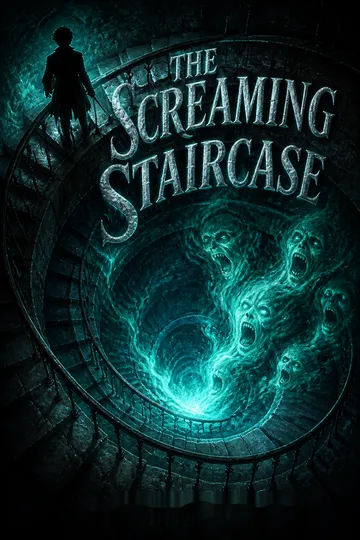
The Screaming Staircase
Beyond the hidden passage, the agents glimpse the ghost of Sam McCarthy, the Fittes boy who vanished during an earlier expedition. A spiral stair leads them down, and Lucy’s touch awakens the sound of men being dragged toward their deaths.
The staircase begins to scream, overwhelming all three. At its foot, they find a chamber with a deep well, the monks’ bones, and Sam’s remains. The scream drives Lucy into ghost-lock and toward the well, but Lockwood pulls her back and realizes the well is the haunting’s central Source.
With their supplies nearly spent, he throws iron chains and silver seals into it, then drops in an industrial-strength flare. The blast destroys the Source. Afterward, the team follows escaping smoke through a cracked wall and finds a way out.
The staircase transforms historical violence into an attack on the present, making the monks’ terror contagious rather than merely observable. Lucy’s near fall into the well shows how ghost-lock exploits the wish to end unbearable sensation; Lockwood’s intervention restores a human connection strong enough to interrupt it. The Source is not defeated by superior force alone. It is identified through the team’s accumulated research, then attacked with the last of their protection. Sam’s remains also give the earlier failed expedition a human identity and consequence.
Annie Faces Her Killer
A photograph from the Archives shows young Fairfax beside Annabel, revealing that he lied about knowing her. When Fairfax and his armored assistant, Percy Grebe, confront the agents, Lockwood deciphers the locket’s inner reference as a passage from Hamlet, where Fairfax and Annabel had acted together.
Fairfax admits that he killed her in a jealous quarrel and hid her body in the chimney. He demands the locket, but Lucy removes it from its silver-glass case and releases Annabel’s ghost.
The apparition overwhelms Fairfax with ghost-lock and ghost-touch, killing him. Grebe tries to escape, but Barnes arrives with DEPRAC officers, summoned by Lockwood’s message through the driver. The agents survive, though the killer’s confession will not become public truth.
Fairfax’s confession frames murder as the consequence of possessive love, but his language cannot soften the choice he made to conceal Annabel and protect his inheritance. Lucy’s final action is a gamble, not a guaranteed command of the ghost. She uses the evidence Fairfax wants to suppress and trusts her reading of Annabel’s intent. Lockwood’s secret message to Barnes supplies a second form of protection, one based on planning rather than force. The resolution joins psychic justice to legal intervention, though they will not remain equally visible.
After the Well Goes Quiet
DEPRAC recovers the seven monks’ bones from the well, along with Sam McCarthy’s remains, and later clears the Hall’s weaker hauntings. Fairfax’s relatives sell the estate, which becomes a school.
To protect the powerful Fairfax Iron business, DEPRAC suppresses the truth about Fairfax and publishes a version that clears Hugo Blake while presenting Fairfax’s death as a heart attack. Lockwood accepts the cover story in public, though Lucy objects to the lost justice. The agency gains clients from its publicity and can continue working.
At their small celebration, George reveals that he took Fairfax’s strange goggles. Later, a jarred ghost briefly warns Lucy that death is approaching and that the world’s natural order is changing. She shuts off its voice and returns upstairs to her friends.
The ending refuses a clean equivalence between justice and public truth. Annabel’s killer is punished, and the Hall’s dead are released, but the institutions that control the record preserve a powerful company at the cost of an honest account. Lockwood treats the compromise as a practical bargain; Lucy sees the human remainder it leaves behind. The ghost’s warning interrupts the celebration without undoing it. The team has won a future, but the world that made their work necessary remains unstable.
Epilogue
A week after Combe Carey, Lockwood & Co. celebrates in its crowded kitchen with food, streamers, and news of a promising new case. Lucy and Lockwood speak privately about her instincts, and he tells her that he trusts her judgment.
When Lucy goes to the basement for more doughnuts, she accidentally loosens the ghost-jar’s seal. The trapped spirit warns her of coming danger and a world turned out of balance. Lucy closes the seal again, refuses to let the warning spoil the party, and climbs back toward George and Lockwood’s laughter.
The final scene restores the domestic warmth that danger repeatedly interrupts: food, teasing, and the relief of being among people who know one another. Yet the jar preserves a voice from the book’s larger supernatural world, suggesting that the solved cases are local victories rather than explanations of the Problem. Lucy’s decision to silence the ghost is not proof that she dismisses danger. It is a choice to return, for now, to the living relationships that give her courage and a reason to keep working.
Analysis
The novel makes childhood both an asset and an institutional vulnerability. Lucy, Lockwood, and George are trusted with lethal work because their psychic senses remain sharp, yet adults and bureaucracies often treat their judgment as immature. The resulting power imbalance appears in Jacobs’s refusal to enter the mill, Barnes’s coercive use of Lucy’s talent, and Fairfax’s insistence on controlling the terms of the Hall investigation. The children’s competence is real, but competence does not erase their exposure.
The book’s mysteries are solved through a combination of sensation, archives, physical objects, and architectural reading. Lucy’s psychic impressions are emotionally precise but legally uncertain. George’s documents can establish a pattern without explaining its human meaning. Lockwood moves between these modes, though his ambition sometimes makes him conceal information or rush ahead. None of them is sufficient alone. Their most effective work occurs when the three kinds of knowledge correct one another.
Annabel’s story tests the moral limits of treating ghosts as hazards to remove. Her spirit is dangerous, but the locket preserves the emotional history that turns a haunting into an investigation of a person and a crime. Lucy’s empathy does not make Annabel harmless; it makes her harder to reduce to a target. That distinction allows the book to hold compassion and accountability together.
The resolution is deliberately compromised. Annabel reaches her killer, the monks’ remains are recovered, and the Hall becomes safer, but DEPRAC hides Fairfax’s crime to protect powerful interests. Lockwood accepts a public version that sustains the agency, while Lucy recognizes the cost of that bargain. Their victory is therefore practical rather than pure: they gain work, companionship, and a future, but remain inside a society willing to control the truth as carefully as it controls the dead.
Review Summary
The Screaming Staircase is a thrilling middle-grade novel featuring a ghost-hunting agency run by children in a haunted London. Readers praise the well-developed characters, witty dialogue, and genuinely scary atmosphere. The book blends elements of horror, mystery, and fantasy, with many comparing it favorably to Harry Potter. While some found the pacing slow at times, most were captivated by the unique premise and engaging writing style. Reviewers consistently recommend the book for both younger and older readers, highlighting its broad appeal.
People Also Read





Characters
Lucy Carlyle
The gifted ListenerLucy is a young agent whose strongest psychic gift is hearing the dead, though she can also see apparitions and read emotional traces through touch. Raised in a crowded northern family and put to work young, she has learned competence faster than self-trust. She is brave, sharp-tongued, and deeply responsive to other people’s suffering, qualities that can make her both perceptive and vulnerable. Her past with Agent Jacobs leaves her alert to the cost of ignored warnings. At Lockwood & Co., Lucy wants to become a reliable partner without surrendering her own judgment or her compassion for the people behind each haunting.
Anthony Lockwood
The magnetic team leaderLockwood is the youthful founder of an independent agency and the owner of the Portland Row home that serves as its headquarters. Charismatic, stylish, and unusually skilled with a rapier, he thrives on difficult cases and carries himself as though confidence can make danger manageable. He makes fast decisions and often hides his reasoning, which gives his leadership an edge of recklessness. Beneath the charm is a serious commitment to his team and a fierce ambition to build a respected agency without adult supervision. His privacy hints at losses he does not easily discuss, while his ability to rally Lucy and George gives the company its center.
George Cubbins
The relentless researcherGeorge is Lockwood’s deputy, the agency’s archivist, and its most thorough researcher. His untidy appearance and blunt manner make him easy to underestimate, but he notices patterns in records and architecture that others miss. He prefers evidence, preparation, and time to investigate, often clashing with Lockwood’s instinct to act quickly and Lucy’s impatience with paperwork. His curiosity can lead him into ethically questionable experiments, yet his caution is rooted in responsibility rather than timidity. George’s loyalty appears through work more readily than warmth, but he repeatedly risks himself beside his colleagues and brings the team’s scattered observations into a usable theory.
Annabel Ward
The vanished socialiteAnnabel is a young woman from London’s fashionable society whose disappearance becomes central to the agency’s work. She had ambitions in acting and moved among wealthy circles, leaving behind personal objects that carry unusually vivid emotional traces. Through Lucy’s psychic sensitivity, Annabel’s inner life emerges in fragments rather than a simple, stable account. She is not merely a case file or a frightening apparition: her memories and attachments shape how the agents interpret the evidence. Her story tests whether the living can recognize a person’s humanity without excusing the harm that person may have caused.
John William Fairfax
The industrialist clientFairfax is the wealthy chairman of Fairfax Iron, a commanding elder with theatrical interests and a taste for control. He approaches Lockwood & Co. with a lucrative, urgent assignment at his ancestral estate, presenting himself as both patron and practical businessman. His wealth gives him unusual influence over agencies and officials, while his pride makes him impatient with limits. Fairfax is accustomed to setting the terms of an encounter, whether he is discussing business, his property, or the people who work for him.
Hugo Blake
The polished society manBlake is a fashionable figure from Annabel Ward’s social circle and a former romantic companion whose name appears in the old investigation into her disappearance. His carefully cultivated image contrasts with the unsettling impression he leaves on Lucy when she sees him years later. For the agents, his connection to Annabel makes him a compelling lead, but a lead is not the same as proof. He represents the difficulty of separating a persuasive public story from what can actually be established.
Inspector Montagu Barnes
The rule-bound investigatorBarnes is a DEPRAC inspector who monitors agencies and expects them to follow official procedures. He is suspicious of Lockwood’s independence and unimpressed by the team’s youthful confidence, but he is also a practical investigator who pursues the evidence available to him. His brusque manner can make cooperation feel like another form of interrogation. Barnes embodies the state’s desire to contain both ghosts and the people who investigate them, often treating procedural control as more important than the agents’ judgment.
Percy Grebe
Fairfax’s armed assistantGrebe is Fairfax’s chauffeur and personal assistant, a physically imposing former agency operative with training in swordplay. He carries out Fairfax’s orders efficiently and serves as the industrialist’s muscle when persuasion fails. His past in the agency world gives him practical familiarity with the dangers the children face, making his willingness to oppose them all the more consequential.
Bert Starkins
The wary caretakerStarkins has cared for Combe Carey Hall for decades and knows its grounds, stories, and local reputation intimately. A severe, solitary man, he treats service to the estate as his purpose and is reluctant to approach its haunted wing after dark. His knowledge is rich in legends, though the agents must distinguish folklore from useful evidence. Starkins gives the Hall a human witness shaped by long proximity to its dangers.
Quill Kipps
Lockwood's agency rivalKipps is a Fittes team leader and a former colleague of George’s, now old enough that his own psychic abilities have faded. He takes pride in the prestige and resources of his agency and looks down on Lockwood’s small operation. His rivalry with Lockwood is sharpened by professional resentment and by the risks that come with supervising young agents. Kipps’s public confidence masks a record that George is more than willing to challenge.
Agent Jacobs
Lucy’s former supervisorJacobs runs the local agency where Lucy began her career. Once respected, he has grown fearful of active hauntings and increasingly relies on child operatives to face dangers he avoids. His authority shapes Lucy’s early training, but his inability to heed her warnings leaves her with lasting guilt and distrust of supervision.
Sam McCarthy
The missing Fittes boySam was a twelve-year-old Fittes operative who disappeared during an earlier investigation of Combe Carey Hall. His fate becomes a question the team carries into the estate, giving the Hall’s history a personal human cost.
Suzie Martin
The reluctant client’s daughterSuzie is the daughter of the woman who commissions the Sheen Road investigation. An anxious adult representative, she worries that Lockwood and Lucy are too young for the assignment, but gives them the access and information they need.
Mr Potter
The dismissive clientMr Potter hires the agency to investigate a garage apparition after his young granddaughter becomes afraid of the space. He is skeptical of her account and more concerned with the inconvenience of a haunting than its possible cause.
Plot Devices
Sight, Listening, and Touch
Different ways to detectThe young agents possess psychic talents that reveal different evidence. Sight detects apparitions and death-glows, Listening catches voices and echoes, and Touch reads emotional or sensory traces from objects connected to the dead. The abilities overlap but are not interchangeable. Lucy’s Listening locates a haunting’s clues, while her Touch lets her experience emotional histories that other agents cannot access. These talents drive the investigations and create a recurring tension between what a Sensitive feels and what can be verified by research or accepted by authorities.
Sources and iron defenses
Contain ghosts, protect agentsA ghost remains connected to a Source, which may be an object, a body, or a place tied to its death. Agents locate and neutralize Sources with iron, silver, salt, and specialized seals. Rapiers and chains can repel apparitions, while silver-glass containers safely hold dangerous objects. These rules provide practical stakes: protection can fail when equipment is forgotten, a barrier is broken, or the investigators misunderstand what the true Source is. The method also makes each haunting a material puzzle, not only a confrontation with a frightening figure.
Annabel's locket
A memory becomes evidenceThe gold necklace found with Annabel Ward’s remains carries powerful psychic traces and becomes the object around which the murder investigation turns. Lucy’s Touch reads the emotional history attached to it, while inscriptions on the locket point toward the people and memories connected to Annabel. Its importance makes it both evidence and a dangerous supernatural link. The agents’ choices about who should possess it expose tensions between procedure, ambition, empathy, and the desire to preserve a victim’s story.
Combe Carey floor plans
Architecture reveals buried historyGeorge compares an old priory plan with a later plan of the Hall and notices that the end walls are too thick to match the building’s visible rooms. The discrepancy leads the team to suspect sealed passages and hidden spaces. Historical records also supply names, deaths, and legends that help them distinguish the Hall’s many hauntings. The plans are not merely background research. They turn the building into evidence, directing the agents toward a concealed route and the physical center of the haunting.
The ghost epidemic
A society built around dangerThe Problem has made ghosts common enough to reshape daily life across Britain. Curfews, ghost-lamps, iron wards, lavender, and running-water barriers protect ordinary people, while agencies send gifted children into dangerous night work because their psychic abilities are strongest when young. This world-building determines who has authority and who bears risk: adults govern, but children detect and confront the dead. It also gives Lockwood & Co.’s independence practical meaning, since its young operatives work outside the large agencies and their systems of supervision.
Lockwood & Co. Series
About the Author
Other books by Jonathan Stroud
Download PDF
Download EPUB
.epub digital book format is ideal for reading ebooks on phones, tablets, and e-readers.








