

Key Takeaways
Emancipation did not end slavery when courts could sell a man's labor
Green's path to the mine. On March 30, 1908, Green Cottenham, a 22-year-old Black man, was arrested in Alabama for vagrancy. The charge was flimsy, but court fees turned a short sentence into months of hard labor. Shelby County then leased him to a subsidiary of U.S. Steel. At Slope No. 12, he dug coal under guard, in chains, and at risk of whipping. He died there five months later; the company doctor recorded his name incorrectly.
Freedom in name only. The system differed from antebellum chattel slavery: it usually did not bind a person for life or automatically enslave their children. But people were seized, sold, forced to work without real choice, and subjected to physical violence. Blackmon uses Cottenham's nearly voiceless life to show how emancipation's promise was reversed in practice.
The distinction between legal status and lived freedom is central here. A person can be formally free while institutions make exit impossible, a pattern also visible in debt bondage and coercive labor systems elsewhere. Cottenham's short sentence, inflated by fees and transferred to a company, makes that contradiction concrete. The comparison to slavery is strongest when it identifies coercion and sale, while retaining the book's own distinction: this was not identical to hereditary chattel slavery. Precision sharpens rather than weakens the indictment.
Trace the fees: local justice turned petty arrests into a labor market
A profitable arrest. John Davis, a Black Alabama farmer, traveled by freight train in 1901 to visit his sick wife. A local constable confronted him, invented a debt, and helped send him before a compliant local judge. Davis could not pay the charges. John Pace paid $75, then made Davis sign a contract to work for him for ten months. Davis could not read the document and had little practical choice.
Fees multiplied coercion. Sheriffs, judges, clerks, witnesses, and others could collect charges for each step in a case. If a defendant could not pay, those costs extended the time he was forced to work. Counties also received payments for leased prisoners, while officials sometimes profited from feeding budgets. Arrests often rose with buyers' demand for labor, not with evidence of a crime wave. Law enforcement became a supply chain for captive workers.
This arrangement resembles a perverse incentive system: officials who controlled arrest and judgment could also benefit from the labor those decisions produced. The point is not merely that individuals were corrupt. The rules made exploitation routine and distributed its gains among public offices and private businesses. Modern institutional analysis often asks who bears a decision's costs and who collects its benefits. Here, the answer is stark: the arrested person bore the physical cost, while others could earn money from the process.
Control labor by criminalizing movement, contracts, and ordinary Black life
Routine acts became offenses. Southern laws and local practices made Black mobility dangerous. A person might be arrested for vagrancy, riding a freight train, carrying a weapon, leaving an employer, or violating a labor contract. Some laws were written broadly and enforced overwhelmingly against Black people. In Alabama, changing employers without permission could become a crime, while officials also used accusations such as disorderly conduct or false pretenses to seize particular workers.
The threat reached beyond prisoners. Sharecroppers and tenants could be trapped by debt, restricted in where they worked, and threatened with arrest if they left. Disenfranchisement removed much of their ability to challenge the system politically. The result was coercion on two levels: some people were directly confined and sold, while many others stayed under white control because they knew how easily a sheriff or judge could send them to forced labor.
The system's reach depended on the threat being credible, not on every Black person being arrested. That is a familiar feature of coercive institutions: exemplary punishment can discipline a much larger population. The book also shows how criminal law can convert a labor dispute into a public offense, especially when one party controls local enforcement. The important nuance is that not every tenant arrangement was identical to forced labor. The threat of criminal capture, however, narrowed the freedom to refuse or leave.
Industrial growth did not replace slavery; it found a cheaper legal wrapper
The mines had precedents. Before the Civil War, enslaved people were already used in Alabama's mines, furnaces, railroads, and factories. They helped build and operate the industrial infrastructure that supplied the Confederacy. After emancipation, business leaders and public officials reused familiar practices of leasing labor, organizing work gangs, and enforcing discipline through violence, now under the label of convict labor.
Captive labor fueled expansion. In Birmingham, companies including Tennessee Coal, Iron & Railroad used prisoners to dig coal and produce coke for iron and steel. Convicts also weakened workers' ability to organize: a mine could keep operating when free miners struck. By 1910, Alabama's mines held more than 3,000 prisoners, mostly Black men. Company records and private correspondence show that forced labor was not an accidental blemish on industrial growth; it helped make production cheaper and more dependable.
The book's strongest economic insight is that modern industry and coercive labor were not opposites. The mines joined state power to corporate production, while prisoner labor could undercut free workers' bargaining power. This challenges a tidy story in which industrialization naturally dissolves older forms of domination. At the same time, the history is not simply one company's policy or one region's business model. Blackmon traces a network of firms, officials, and local buyers, which makes responsibility systemic without making every participant interchangeable.
A paper trial can make kidnapping look like lawful punishment
The 1903 test. A federal investigation into forced labor in Alabama produced 99 indictments against 15 people. Witnesses described arrests on invented charges, sham hearings, beatings, and workers sold to farms and businesses. John Pace pleaded guilty to holding Black laborers, including Davis, and received concurrent five-year sentences. He was allowed to remain free on bond and was later pardoned by President Roosevelt. Two Cosbys received prison sentences after pleading guilty. A jury deadlocked in Fletcher Turner's case, and Turner later pleaded guilty to a lesser resolution.
Legal form survived the challenge. Federal Judge Thomas Jones ruled that coerced labor contracts and fraudulent proceedings could violate federal law. Yet his instructions also helped make the practice harder to prosecute when courts recorded judgments and contracts more formally. The Supreme Court's 1905 decision against a related federal challenge further weakened enforcement. Paperwork could make coercion look regular without making it voluntary.
The trials expose a basic problem of procedural justice: a record of a hearing does not prove that a hearing was fair. When a defendant lacks counsel, literacy, or power to contest the accuser, procedural form can lend legitimacy to an outcome fixed in advance. Jones's effort shows both the value and limits of legal reform. A rule can clarify what counts as abuse, yet still leave a path open for institutions to reproduce the same outcome with cleaner documentation.
A national retreat from Reconstruction made local terror governable
Repression gained official cover. The Supreme Court's 1896 Plessy decision approved racial separation under the claim that facilities were equal. Alabama's 1901 constitution then effectively excluded most Black citizens from voting. In 1901, Roosevelt's dinner with Booker T. Washington provoked furious white backlash, revealing how even a modest public gesture toward Black equality was treated as a threat.
Knowledge could be buried, too. In 1906, W. E. B. Du Bois and a team of researchers interviewed more than 21,000 Black farmers in Lowndes County, Alabama, documenting land, labor, family, education, and political life. The federal study was not published; officials eventually told Du Bois its material had been destroyed because its conclusions touched political matters. The book places these events within a broader retreat from federal protection, not a uniquely southern problem that the rest of the country resisted.
The evidence here makes national silence part of the story. Local violence was easier to sustain when courts narrowed federal authority, political leaders sought sectional reconciliation, and research that challenged the dominant account failed to circulate. The suppressed Du Bois study is particularly revealing because exclusion can operate through control of knowledge as well as law. The argument should not flatten every white institution into one motive. It does show how institutions with different aims could converge on the same result: leaving Black people exposed to local power.
Measure the system by what it did to families, not only prisoners
Captivity had a wider radius. A worker's arrest could leave a spouse, children, and aging relatives without income or protection. At John Pace's farm, Black children as young as ten were listed as workers, and two brothers were taken from their mother to work off a debt she supposedly owed. Escape could bring retaliation against people who sheltered the fugitive. Women faced forced labor as well as sexual exploitation, while family members often had no reliable way to learn where a prisoner had been sent.
Fear organized daily life. Black families saw that a petty accusation could lead to a mine, a farm, or a chain gang. The 1901 voting restrictions and unequal schools narrowed routes to independence as well. Such pressure helps explain why some people endured abusive arrangements or avoided speaking to investigators. Silence was not proof of consent; it could be a survival strategy in a system built to punish resistance.
A carceral system is often measured by its official population, but its social reach includes everyone who adjusts behavior around the possibility of arrest. This account makes that wider unit of analysis unavoidable: families lose labor, income, mobility, and confidence in public institutions. The distinction between silence and consent is especially important when testimony carries risk. Historians must still avoid treating every family's experience as identical. The surviving stories show varied choices made under sharply unequal constraints.
Reforms ended state leases before they ended forced labor
Abolition was uneven. Georgia voters approved ending the state's convict lease system in 1908, but forced labor continued through chain gangs and county arrangements. Alabama's state use of prisoners in private coal mines ended in 1928, while local governments continued to send people into coerced labor. In 1921, Georgia farmer John S. Williams murdered eleven Black workers to conceal his forced-labor operation, showing that the practice remained dangerous even after earlier reforms.
Federal policy shifted in wartime. After Pearl Harbor, Attorney General Francis Biddle directed federal prosecutors in December 1941 to pursue slavery and involuntary servitude more directly, rather than narrowing cases to technical definitions of debt peonage. A 1942 Texas prosecution of Alex and Susie Skrobarcek helped signal the new approach. The change did not instantly erase racial coercion, but it marked a federal turn toward treating forced labor as a crime the national government had to confront.
The timeline cautions against equating a reform statute with a transformed labor system. Institutions can change their vocabulary and venue while preserving coercion through new mechanisms. The book's wartime turning point also reveals how political priorities can create enforcement momentum: officials recognized that racial abuse weakened the country's claims about freedom. That motive was strategic as well as moral. The resulting federal action mattered, but it came after decades in which local victims had little reason to expect protection.
Read archives against the officials who created the record
The paperwork was partial. Blackmon reconstructs events from county dockets, sheriff's ledgers, federal files, company records, newspaper accounts, and oral histories. These sources often contradict one another. Some courts kept no reliable records; some workers disappeared under nicknames; and some deaths were entered under misspelled names. Official claims that prisoners were well treated often came from people who profited from, or oversaw, the system.
Absence has a history. The book's central figure, Green Cottenham, left almost no personal record. His family's memories and the surviving records around him let Blackmon rebuild a life without pretending to recover Cottenham's own voice. Du Bois's destroyed study offers another warning: historical evidence can be lost through neglect or suppressed when inconvenient. Reading critically means asking who made a record, what they wanted it to prove, and whose experience it leaves out.
This is a practical lesson in historical method: archives are not neutral containers but products of institutions. Official records can be precise about fees and ownership while nearly silent about fear, family, or consent. Triangulating them with testimony and material traces helps expose the gap. Yet reconstruction has limits. Cottenham cannot be made to speak through inference, and the historian must distinguish documented fact from plausible interpretation. The book's restraint about his missing inner life gives the evidence more credibility.
Demand honest records from institutions that profited from forced labor
The past entered modern institutions. The book traces connections between forced-labor enterprises and later corporate histories, including U.S. Steel's Alabama subsidiary and Atlanta businesses built with convict labor. Some modern companies told Blackmon they knew little about the practices or did not accept responsibility for events before their own involvement. The author does not argue that descendants inherit personal guilt simply by family or corporate succession.
Acknowledgment can change the present. Wachovia, after researching predecessor banks' ownership of enslaved people before the Civil War, issued an apology and supported discussion and scholarship. Blackmon calls not for financial reparations in this book, but for a fuller public account of the past and its links to wealth, institutions, and distrust. Remembering the system is not a substitute for remedy; it is a necessary condition for discussing what remedy could mean.
The distinction between inherited guilt and inherited benefit is analytically useful. People today are not responsible for choices they did not make, but institutions can still investigate how earlier practices shaped assets, reputations, and public trust. Environmental law offers one comparison: successor organizations may inherit duties tied to predecessor conduct, even when current leaders were absent. The analogy does not settle what obligations are just in racial history. It helps pose the question clearly: what forms of disclosure, repair, or preservation are owed when legal liability has expired?
Analysis
Blackmon's central achievement is to make a supposedly marginal history legible as a system. The narrative begins with one man's arrest and follows the links outward: ambiguous laws, fee-dependent courts, county revenue, private labor demand, corporate expansion, and political acquiescence. That structure matters because it resists the comforting explanation that Green Cottenham's fate was an isolated abuse by a few cruel men. The machinery required many ordinary acts, each made easier by the next institution's willingness to accept it.
The book also makes a difficult but necessary distinction. Convict leasing and debt bondage were not identical to hereditary chattel slavery. Their duration and legal form differed. Yet the ability to seize people, transfer their labor, restrict movement, and enforce work through violence makes the label slavery morally and analytically intelligible. Precision depends on holding both truths together, rather than treating the comparison as either exact equivalence or rhetorical excess.
Its archive is part of the argument. The abundance of records about transactions and officials contrasts with the scarcity of victims' own accounts. That imbalance is not merely a research obstacle; it reflects who had literacy, power, and control over public memory. Blackmon's reconstruction is persuasive when it states what documents establish and acknowledges where Cottenham remains unknowable.
The ending is deliberately unsettled. State leasing declined or ended in some places, yet forced labor persisted through local courts, chain gangs, and debt arrangements. Federal enforcement gained strength during World War II, partly because the contradiction between democratic claims and racial subjection became politically costly. That timing complicates any simple story of moral progress. The book's lasting challenge is to treat emancipation as a legal beginning, not proof that freedom had become real.
Review Summary
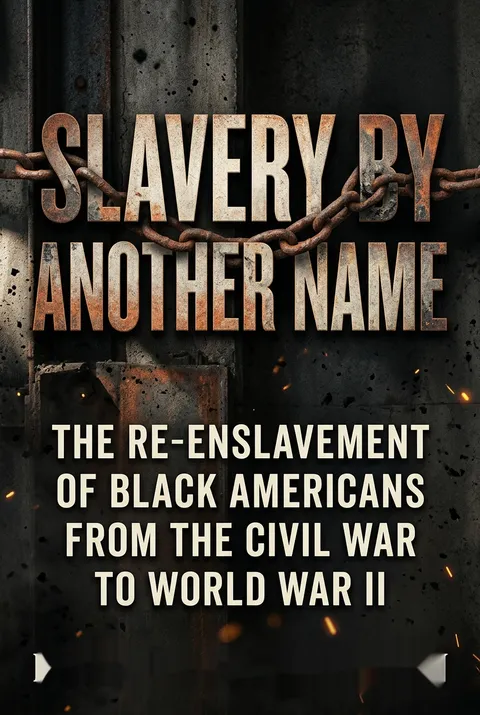
Slavery by Another Name reveals how forced labor continued in the American South for decades after the Civil War through convict leasing systems. Reviewers praise Blackmon's meticulous research documenting how African Americans were arrested on false charges like vagrancy, then sold to corporations and forced into brutal labor conditions worse than antebellum slavery. The book exposes widespread participation by major companies, government officials, and the justice system. Readers found it eye-opening, emotionally difficult, and essential reading, though some criticized repetitive writing. Most emphasized it fills crucial gaps in American history education.
People Also Read


Glossary
Convict leasing
Prisoners rented to employersA system in which state or county governments transferred prisoners to private businesses or individuals in return for payments. Employers controlled the workers and often supplied their housing, food, discipline, and labor. In the South after the Civil War, Black people were disproportionately arrested under minor, vague, or racially targeted laws and then leased into mines, farms, lumber camps, and other workplaces.
Peonage
Forced labor tied to debtA legal term for compelling a person to work to repay a debt. In the cases described in the book, supposed debts or court costs could be fabricated or inflated, and workers could be prevented from leaving. Federal law prohibited peonage, but officials often interpreted the prohibition narrowly, making prosecution difficult even when the underlying labor was plainly coercive.
Confess judgment
Accept judgment before trialA court procedure in which a defendant acknowledged liability before a full trial, often allowing another person to pay the fine or bond. In the South described by Blackmon, a white landlord or buyer could pay charges for a Black defendant and receive a labor contract in return. The apparent legal agreement could conceal coercion, especially when defendants faced biased courts and had little ability to refuse.
Vagrancy
Being without accepted employmentA broadly defined offense used to arrest people who could not prove they were employed or otherwise met local expectations. After emancipation, southern authorities applied vagrancy laws disproportionately to Black people, including men who were unemployed, traveling, or seeking work. Conviction could lead to fines and fees that an impoverished person could not pay, creating a route into forced labor.
Age of Neoslavery
Post-emancipation forced labor eraBlackmon's proposed name for the long period in which slavery's coercive practices survived emancipation through convict leasing, debt peonage, fraudulent prosecutions, chain gangs, and coercive labor contracts. The term emphasizes that formal abolition did not bring immediate freedom in practice. It is a historical interpretation, not a claim that every labor arrangement after the Civil War was identical to antebellum chattel slavery.
Download PDF
Download EPUB
.epub digital book format is ideal for reading ebooks on phones, tablets, and e-readers.








