

Key Takeaways
Read slavery as an engine of modern capitalism, not a relic outside it.
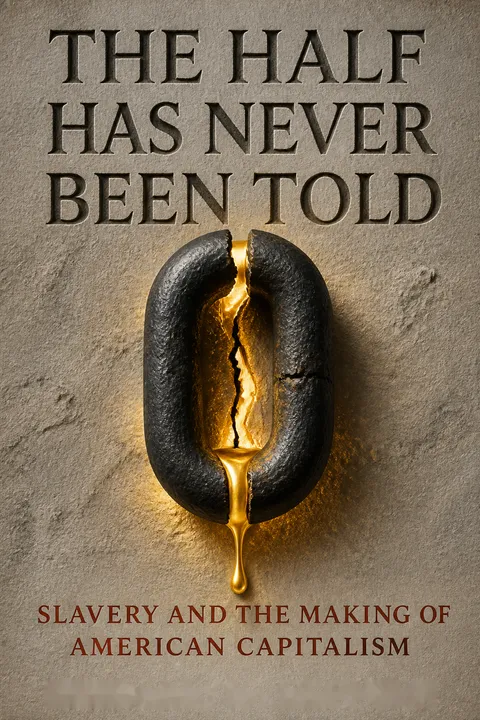
The central correction. Edward Baptist argues that slavery was not an archaic institution standing apart from modern economic growth. After the Revolution, enslavers expanded from coastal districts into the Mississippi Valley, forcing about one million people west and south. Between 1783 and 1861, the enslaved population grew roughly fivefold, while US cotton production rose from almost nothing in 1790 to nearly two billion pounds by 1860.
One connected system. Cotton profits enriched enslavers, merchants, bankers, manufacturers, and consumers. The book therefore rejects a split history in which racial violence is treated as one story and American modernization as another. The same expanding system produced both.
What's striking is the change in scale: the book makes the cotton economy, not the plantation alone, the unit of analysis. That shift reveals how violence can travel through ordinary institutions such as credit, transport, and trade. It also clarifies an important distinction: showing that slavery helped generate wealth does not make that wealth socially beneficial or morally legitimate. Economic success measures returns to owners, not the total human cost or the distribution of gains.
Follow the forced march to see how American power acquired its map.
Territory by design. After independence, the United States was indebted and divided, with contested claims to western lands. Constitutional bargains protected slaveholders' political influence and delayed a ban on the African trade. The 1787 Northwest Ordinance prohibited slavery north of the Ohio River, while the Southwest Ordinance left it open south of the river.
Violence opened routes. The Haitian Revolution defeated Napoleon's effort to rebuild French power in Louisiana, helping make the 1803 Louisiana Purchase possible. Later, Andrew Jackson's campaigns dispossessed Native nations, including the Creek, and opened more cotton country. Forced migration of Black people and the seizure of Indigenous land were not side effects of expansion. They were among its methods.
The account treats geography as a political achievement rather than a neutral backdrop. Roads, river access, land titles, and military victories created the conditions in which slavery could expand. This is a useful corrective to stories that begin with settlers already in place and ask only what they produced. It also makes the comparison between forced Black migration and Indigenous dispossession visible without suggesting their histories were identical.
Trace cotton from enslaved hands to the mills, banks, and consumers it enriched.
A global supply chain. By 1820, cotton made up 42 percent of US export value. Around 80 percent of US cotton was shipped across the Atlantic, much of it to British textile mills. In 1832, Lowell's mills used 5.5 million pounds of cleaned cotton, requiring an estimated 100,000 days of enslaved labor to produce.
Beyond the fields. Cotton sales also supported shipping, insurance, banking, factory investment, and markets for tools and clothing. Baptist estimates that in 1836, direct and indirect activity connected to cotton accounted for nearly half of US economic activity. That figure is an estimate, but it captures the breadth of the system: the crop linked plantation labor to industrial growth and everyday consumption.
The supply-chain view is more revealing than a simple North-versus-South map. It shows how one region's coercive production could supply another region's industry, while credit and commerce connected both to overseas markets. The accounting also raises a question about what economic measures leave out. A crop's value can be counted precisely, while broken families, injury, and stolen time remain outside the ledger.
Count the whip as production technology, not merely punishment.
A labor-control system. The pushing system was a cotton-field regime that used close supervision, a fast pace, and violence to make each worker cultivate more land. Overseers set a lead row, then drove everyone else to match it. At day's end, scales and slates recorded each person's cotton, and shortfalls could bring whipping.
Output climbed. The book cites estimates that cotton-picking productivity in the southwestern states rose about 361 percent from 1811 to 1860. The increase came without a mechanical picker. Enslaved people developed faster techniques under pressure, while quotas rose to match their results. The whip did not replace machinery in a factory; it forced human beings to supply its function in the field.
The account forces a distinction between output and efficiency understood as human well-being. A system can produce more per worker while destroying health, autonomy, and family life. The more unsettling point is that coercion did not eliminate skill. It extracted skill, then used measurement and punishment to make workers apply it against their own interests. That is a sharper analysis than calling the labor merely unskilled or backward.
Watch credit turn enslaved lives into collateral, then spread the crash.
People secured loans. Louisiana's 1827 Consolidated Association of the Planters of Louisiana let borrowers mortgage land and enslaved people, then raise money through bank stock and bonds sold to investors. Similar institutions spread across the cotton states. Investors received claims on future plantation income, while the enslaved could be seized if borrowers defaulted.
Risk traveled outward. By 1837, southwestern bank lending had more than doubled from its 1832 level. When cotton prices fell, merchants and banks failed, and enslaved people listed as collateral faced sale. The financial system had distributed risk among distant investors, taxpayers, and borrowers, but its harshest consequences landed on people who had never consented to the loans.
This history makes financial innovation morally legible. A loan secured by a person can look like a technical instrument in a ledger, yet it depends on coercive authority over that person's body and future. The arrangement also resembles a familiar political pattern: investors can collect gains when things go well, while losses are shifted onto less powerful parties. The book's point is not that credit itself is abusive, but that its design determines who bears failure.
Build kinship and culture where sale and distance try to erase both.
New bonds, not easy harmony. Forced migration separated families and placed people from different regions and language communities together. At Charles Ball's South Carolina labor camp, Nero and Dinah welcomed him into their crowded household and shared food and work. Such ties offered practical care, but they also helped people rebuild identities after sale.
Music made room. Corn-shucking gatherings and Saturday-night dances let enslaved people improvise songs, display individual skill, and recognize one another as more than labor units. A song helped the nearly broken Lucy Thurston rejoin the people around her. These communities could contain conflict and mistrust, yet cooperation gave many people a reason and a means to survive.
The book's account of solidarity avoids making community sound automatic. Sharing food, care, and performance required choices among people whom the system often forced into competition. This resembles the way social networks can provide both material support and a shared interpretation of events. The distinction matters: solidarity did not undo coercion, but it created relationships and meanings that enslavers could not fully dictate.
Name enslavement as theft to expose the fraud hidden inside property law.
A counter-history in one word. Enslaved people repeatedly described sale and forced movement as being stolen. That language rejected the claim that legally recorded transactions made ownership legitimate. It also connected separate personal experiences into a shared account of kidnapping, family separation, and profit.
Black critique traveled. David Walker's 1829 Appeal condemned slavery and its defenders, while fugitives and free Black activists carried accounts of the trade into abolitionist newspapers and meetings. The language of theft reframed slavery as an intentional crime, not a regrettable flaw or a system that would naturally fade away. It challenged the legal vocabulary that treated human beings as transferable property.
The shift from property to theft is a shift in moral framework. Law can describe a transaction as valid without settling whether the transaction is just. By centering the perspective of the people sold, the book exposes how legal categories can conceal the coercion on which they depend. The testimony also functions as a counterarchive: it preserves interpretations that official records, designed to document ownership, were not built to contain.
White democracy repeatedly protected equality for white men by expanding Black bondage.
A bounded democracy. Andrew Jackson's political movement widened participation for white men while excluding Black people and dispossessing Native nations. Cotton expansion helped bind ordinary white voters to wealthy enslavers, even when those groups disagreed about banks and political privilege. The result was a mass politics that could challenge elites while preserving racial hierarchy.
The bargain weakened. Northern merchants and manufacturers also benefited from cotton, but more Northerners resisted when slaveholders demanded continued expansion and greater control over national policy. The Missouri crisis, the Mexican War, and the Compromise of 1850 all showed how difficult it was to balance those interests. Political conflict increasingly concerned who could shape the nation's future, not only whether slavery was morally wrong.
This is a useful account of democracy as both inclusion and boundary-making. A political system can expand participation for one group while depending on the exclusion of another. It also explains why economic benefit did not guarantee political loyalty forever: alliances shift when one partner's power starts to threaten another's voice. The analysis is strongest when it treats racism and class conflict as intertwined, rather than assuming one cancels out the other.
See secession as a bid to secure slavery's future, not abstract states' rights.
Expansion became the fault line. The Kansas-Nebraska Act repealed the Missouri Compromise's restriction on slavery in much of the Louisiana Purchase. The Supreme Court's Dred Scott decision then asserted that Congress could not bar slaveholders from taking enslaved people into federal territories. These measures strengthened the claim that slavery should be nationally protected.
The stakes were explicit. By 1859, US cotton output had reached about four million bales, and enslavers expected the system to keep growing. After Abraham Lincoln won the 1860 election on a platform opposing further expansion, cotton-state leaders chose secession. Their own declarations cited slavery and white supremacy. The book therefore rejects the later story that the war was simply about an abstract principle of state sovereignty.
The crucial distinction is between immediate abolition and stopping expansion. Many Northerners opposed expansion for reasons that did not include racial equality, while Southern leaders saw limits on expansion as a threat to slavery's long-term security. That imperfect coalition still mattered. Political change often begins when groups with different motives converge on one policy, even if they disagree sharply about the justice they ultimately seek.
Treat emancipation as enslaved people's action, not history's automatic drift.
Freedom was pressed from below. During the Civil War, enslaved people fled to Union lines, weakening Confederate labor and forcing federal authorities to confront slavery. The Emancipation Proclamation declared freedom in rebel-held areas, and nearly 200,000 African Americans served in Union forces. About 40,000 Black soldiers died. Their military service helped sustain the Union war effort and made claims to citizenship harder to dismiss.
A decisive change. The Thirteenth Amendment abolished slavery throughout the United States in 1865. The book's narrative begins and ends with people whose movements and choices altered events: from the men who escaped to Fortress Monroe in 1861 to soldiers such as Cade McCallum, who left a Louisiana plantation to enlist. Emancipation was not simply a gift from political leaders.
The emphasis on self-emancipation corrects a history that can make enslaved people appear only as recipients of policy. Their flight changed military conditions, and their enlistment joined freedom to public service and citizenship. The account also keeps a necessary complication in view: Union authorities sometimes directed refugees into controlled labor, so the path out of slavery was uneven. Agency here means consequential action under constraint, not complete control.
Track slavery's wealth into a postwar South where freedom lacked assets.
Legal freedom, unequal resources. Emancipation ended ownership of people, but freedpeople generally did not receive the land they sought. Many were pushed into wage contracts or sharecropping, working land they did not own and often buying supplies on credit. White leaders also restricted Black voting and built Jim Crow segregation, weakening the political power that might have changed those conditions.
The economic afterlife. Cotton production recovered slowly after the war, and the South remained poor and dependent on a narrow economy. The book argues that wealth generated by enslaved labor and its financing continued to benefit white households, while Black households held very little wealth. The institution ended, but unequal ownership, political exclusion, and the profits built from slavery did not disappear with it.
The distinction between legal status and material capacity is essential. Freedom removes the owner's claim over a person, but it does not automatically transfer land, savings, or political leverage to that person. The book connects those postwar limits to the earlier concentration of wealth without claiming that every later inequality has a single cause. Its most durable question is who inherited the assets, institutions, and opportunities created by coerced labor.
Analysis
The book's central achievement is to make forced migration the connective tissue of a history often divided into slavery, capitalism, territorial expansion, and sectional politics. Its narrative begins with Lorenzo Ivy's memory of chained people leaving Virginia and follows the process across generations, linking intimate scenes of separation to constitutional bargains, commodity markets, and war. The body-part chapter structure gives this immense history a human scale, while its recurring figures, especially Charles Ball, let readers experience change as a process rather than a static condition.
Its evidentiary method is deliberately broad. Baptist combines slave narratives and later oral histories with deeds, notarial records, planter ledgers, financial papers, and production estimates. That mixture makes it possible to see both how enslavers represented people as assets and how enslaved people interpreted the same transactions as theft. The quantitative claims are most powerful when used to show scale and connection: cotton revenues, migration, credit, and labor demand moved together. They are more debatable when the evidence is asked to establish precise causes of productivity growth or to assign a single share of national growth to slavery. The book makes a strong case for slavery's centrality, but estimates of indirect economic effects necessarily depend on assumptions about how far the accounting chain should extend.
The most important analytical distinction is between efficiency for owners and human welfare. Higher output per worker can coexist with shorter lives, hunger, family rupture, and terror. This challenges accounts that treat productivity as a neutral measure of progress. The book also refuses inevitability: slavery's end was not guaranteed by an allegedly backward economy, but followed political conflict, enslaved people's actions, and war. The result is not only a revision of economic history. It is a demand to ask who made growth possible, who controlled its rewards, and whose suffering was omitted from the national story.
People Also Read





Glossary
second slavery
modern, expanding slave systemBaptist's term for the rapidly growing nineteenth-century slave system centered on cotton and sugar production in the United States and other regions. Unlike earlier plantation systems, it was deeply connected to industrial demand, expanding credit, territorial conquest, and financial markets. Its growth depended on forced migration and increasingly intensive labor, linking slavery to modern economic development.
coffle
chained forced-migration columnA group of enslaved people forced to travel together under guard, often with men linked by chains and women restrained by ropes. Traders used coffles to move people from older slave states toward the expanding cotton regions. The journey could last weeks and separate people from family, community, and familiar surroundings.
hand
enslaved labor unitA market and plantation term that reduced a person to a unit of labor available for purchase, calculation, and control. In the cotton economy, enslavers used the category to estimate how much land a worker could cultivate and how much cotton they could pick. Baptist emphasizes how the label obscured each person's skills, relationships, and identity.
pushing system
pace-driven labor regimeA labor-control system used on cotton plantations in which an overseer set a rapid pace, often through a lead worker or fore row, and pressured the rest of the group to keep up. Close surveillance, long workdays, rising quotas, and violence enabled enslavers to extract more labor from each person.
right-handed power
direct power to commandBaptist's name for overt power that imposes outcomes through ownership, law, force, and command. Enslavers and entrepreneurs used this power to move people, control land, and direct labor. The term contrasts with the covert forms of survival and resistance developed by people with less formal power.
left-handed power
covert survival and resistanceBaptist's term for the hidden knowledge and tactics used by people subject to domination. Enslaved people could slow work, protect information, help one another, escape, or improvise new skills. On cotton plantations, however, enslavers used quotas and punishment to capture some of that creativity and redirect it toward greater production.
whipping-machine
violence-driven productivity systemBaptist's metaphor for the linked practices that used measurement and torture to increase cotton production. Scales recorded daily output, slates tracked quotas, and whipping punished shortfalls while pushing workers to exceed previous totals. The phrase describes a system of control, not a single literal machine.
substantive due process
constitutional property-rights doctrineA constitutional argument developed by John C. Calhoun and other proslavery politicians. It held that due process protected fundamental property rights, not merely fair legal procedures. Applied to slavery, the doctrine claimed that governments could not prevent enslavers from taking or holding enslaved people in federal territories. The book notes that later legal thinkers adapted versions of the idea to defend other property claims.
faith bonds
state-backed slave-mortgage securitiesBonds issued by banks whose loans to planters were secured by land and enslaved people, with state governments promising to repay investors if the banks failed. Sold in domestic and overseas markets, these securities connected investors to plantation income. They also shifted risk onto enslaved people, borrowers, taxpayers, and distant bondholders.
G.T.T.
gone to TexasAn abbreviation for Gone to Texas, used when indebted slaveholders moved themselves and enslaved people across the Texas border to escape creditors and legal collection. The practice made enslaved people into portable assets in white debt disputes, often separating families and placing the people moved beyond the reach of their former communities.
Download PDF
Download EPUB
.epub digital book format is ideal for reading ebooks on phones, tablets, and e-readers.








