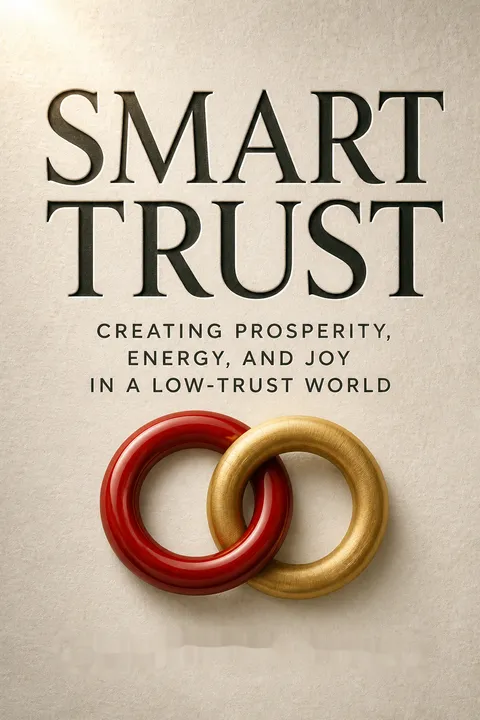


Key Takeaways
Practice Smart Trust through judgment, not blind faith
The middle path. Smart Trust is the disciplined choice to begin with a willingness to trust, then use judgment to limit exposure. In Bangladesh, Muhammad Yunus found 42 poor craftspeople trapped in a cycle of debt to local traders. Their combined borrowing was less than $27. Banks refused to lend, so Yunus made the loans himself. Grameen Bank later built on the idea, using small repayments and borrower groups to support accountability. The bank reported that 98 percent of borrowers repaid.
Trust with structure. Yunus did not assume every person would always act well. He designed a system around the possibility that most people would act responsibly, while helping borrowers keep their commitments. The book's central argument is that trust can create opportunity, but it works best when paired with thoughtful safeguards.
What's striking is that the Grameen story treats trust as a practical design choice, not merely a feeling. Lending practices based on conventional collateral excluded people who had little money but strong reasons to repay. Yunus changed the test of creditworthiness and built a group structure around the new assumption. This resembles a broader lesson in institutional design: rules can either screen people out or help them succeed. The case does not prove that trust alone eliminates default, and the reported repayment rate belongs to this particular model and context. Its sharper lesson is that risk should be managed, not used as an excuse to deny possibility.
Treat trust as operating infrastructure, not a soft interpersonal extra
The cost of suspicion. The authors argue that trust affects both the speed and cost of work. When people expect bad faith, they add checks, duplicate effort, delay decisions, and spend energy defending themselves. The book calls these burdens a low-trust tax. When trust is stronger, collaboration and decisions can move faster, creating what it calls a high-trust dividend.
Performance and well-being. A cited Watson Wyatt study reported that high-trust organizations outperformed low-trust organizations in shareholder returns by 286 percent. The book also cites research associating workplace trust with employee satisfaction: a 10 percent increase in trust had an effect comparable to a 36 percent pay increase. Trust can also support engagement and the open exchange of ideas that innovation requires.
Trust is economically consequential because organizations spend real resources managing uncertainty. That insight connects to transaction-cost economics, which studies the time and expense required to coordinate exchanges. Trust can reduce those costs, while psychological safety, the sense that speaking up will not invite punishment, can help teams share problems and ideas sooner. The impressive performance comparisons should still be read cautiously. High-performing organizations may also find it easier to invest in trust, and a correlation does not establish which factor came first. Trust is not a substitute for good products, sound strategy, or competent execution. It can make those capabilities easier to use together.
Balance an open-hearted default with evidence about risk and credibility
Two dimensions. The Smart Trust Matrix maps a willingness to trust against the quality of one's analysis. High trust with little analysis becomes gullibility. Low trust with intense analysis becomes suspicion. Low levels of both produce indecision. Smart Trust combines a willingness to trust with careful assessment.
Assess the situation. The book recommends examining three variables: the opportunity, meaning what another person is being trusted to do; the risk, including possible outcomes and their consequences; and credibility, the person's character and competence. A newspaper honor box presents a different risk from a nuclear submarine, so sensible safeguards should differ too. Smart Trust is a judgment process, not a rule that everyone deserves equal access to every responsibility.
The framework is useful because it separates a general attitude toward people from a particular decision about exposure. That distinction resembles risk management: a person may be trusted to handle a routine task but not a safety-critical one without training and checks. It also helps explain why suspicion can masquerade as rigor, even when the evidence is weak. The important challenge is calibration. People often misjudge both likelihood and consequence, especially after a vivid betrayal or a recent success. Good judgment therefore needs feedback: review what happened, update the assessment, and adjust safeguards without turning one incident into a verdict on everyone.
Build your own credibility before asking anyone else to trust you
Character plus competence. In this book, credibility has two parts. Character includes integrity and intent. Competence includes relevant skills and a record of results. Either part alone is insufficient: a capable deceiver is dangerous, while a well-meaning but unqualified person may still cause harm.
Trust yourself first. The authors argue that self-trust grows when people act consistently with their principles and keep promises to themselves and others. Isadore Sharp, founder of Four Seasons, learned this from his father, who honored a construction bid after realizing he had misunderstood the plans and priced the job far too low. He completed the work and spent years paying off the loss. His conduct made trustworthiness visible when keeping his word was costly.
This emphasis connects trust to the alignment between stated values and repeated behavior. Such alignment is more persuasive than a polished self-description because other people can observe it over time. The distinction between character and competence is especially valuable in hiring and delegation: sincerity does not establish technical readiness, and expertise does not establish ethical intent. There is a further caution. People can overestimate their own integrity or ability, so self-trust should not mean self-certainty. Feedback, transparent standards, and domain-specific evidence help prevent confidence from becoming another form of blind trust.
Make your motive visible, then give others room to mean well
Explain what and why. Declaring intent means telling people not only what is planned, but why. This gives others context instead of leaving them to guess at hidden motives. After a hurricane damaged schools in Charlotte County, Florida, the superintendent said employees would keep getting paid and would not be laid off. The district followed through, and later negotiations with unions took two hours rather than months.
Begin generously. The paired practice is to assume positive intent in others unless there is reason not to. Indra Nooyi described using this approach to listen rather than react defensively. It does not require ignoring evidence of harmful behavior. It changes the starting point, leaving room to understand a person's reasons before deciding what the evidence means.
Making motives explicit can reduce the ambiguity that fuels defensive interpretation. In social psychology, people often explain their own actions through circumstances but explain another person's actions through character. Clear statements of purpose can interrupt that asymmetry by providing information that is otherwise missing. Still, disclosure is not proof of good intent. A persuasive explanation can be strategic, and an admirable motive cannot erase harmful effects. The strongest version of this practice joins transparency to observable follow-through. Assuming good intent is most useful as a starting hypothesis, not a permanent conclusion that blocks accountability.
Make fewer, clearer promises, then deliver or renegotiate early
Words need actions. A declared promise creates an expectation. Fulfilling it turns that expectation into evidence of reliability. The authors call the paired behaviors say and do: state an intention, then carry it out. They also describe SayDoCo, a practical sequence: say what will be done, do it, and communicate promptly if circumstances make the commitment impossible.
Repair through conduct. A new owner of a business with a deeply cynical workforce made 14 commitments at a staff meeting. Two weeks later, he reported on every one. He had completed 12 and explained the progress on the other two. That visible follow-up began to restore employee confidence. When a promise cannot be kept, silence and excuses deepen doubt; early communication allows expectations and plans to be reset.
Reliability is a form of coordination technology: when people can predict whether commitments will be honored, they can plan without constant monitoring. This helps explain why small promises matter. Repeated follow-through creates a usable track record, while grand declarations that go unmet teach people to discount future claims. The book's advice should not be mistaken for heroic overwork. A culture that rewards impossible promises can produce burnout and conceal bad planning. Clear limits, realistic commitments, and timely renegotiation are more trustworthy than sacrificing health to preserve the appearance of perfect delivery.
Give people real authority when you extend trust
Trust needs room. The fifth action is to lead by extending trust first, rather than waiting for others to make the first move. But real trust includes authority and clear expectations, not just responsibility without control. BestBuy.com gave employees flexibility to work where and when they chose, provided they completed their work. The company reported a 35 percent productivity increase after adopting the approach.
Build a trusted culture. The authors describe Warren Buffett's Berkshire Hathaway as operating with a small headquarters team overseeing many businesses, relying on carefully chosen managers, high standards, and room to run their companies. The point is not to remove accountability. It is to replace constant supervision with capable people, clear aims, and responsibility for results.
This approach has a close connection to autonomy-supportive management: people often bring more initiative when they have meaningful control over how work is done. Trust can also clarify whether an organization values outcomes or merely visible compliance. Yet delegation without resources, training, or protection is abandonment dressed up as empowerment. The right level of autonomy depends on the task, the person's preparation, and the consequences of error. Clear boundaries and review are compatible with trust when they are proportionate and transparent. The aim is not zero oversight, but oversight that helps people succeed rather than presuming they will fail.
A citizen's trust campaign helped prepare Colombia's national turnaround
One person can start. In 1999, Colombian business leader Pedro Medina asked university students whether they expected to remain in the country. Only 12 of 39 raised their hands. He developed a presentation arguing that Colombia had strengths worth believing in, gave it 256 times in eight months, and founded Yo Creo en Colombia to rebuild confidence.
Trust became a public aim. After Álvaro Uribe became president in 2002, his government made restoring trust a central objective. Over the following decade, the book reports that kidnappings fell by 88 percent and annual foreign investment rose from $500 million to $10 billion. Medina's work did not single-handedly produce those changes. The story shows how a citizen's effort to rebuild belief can help create conditions for broader action.
The story gives trust a civic scale: shared confidence can affect whether people invest, participate, or imagine a future in their own country. Medina's effort also illustrates how a person without formal authority can help shape the public mood and agenda. The statistics describe a major national change, but they do not isolate the effect of his campaign from government policy or other forces. That distinction matters. Trust-building narratives can mobilize people, but they need credible institutions and material improvements to endure. Optimism can open a door; sustained results are what make the new belief durable.
Analysis
Smart Trust's strongest contribution is its refusal of a familiar false choice. Trust is neither a sentimental virtue that requires ignoring danger nor a reckless bet that rules and surveillance can eliminate uncertainty. The book instead treats trust as a decision shaped by willingness, evidence, stakes, and the other party's credibility. That framing is valuable because it makes trust discussable and operational: leaders can ask what is being entrusted, what can go wrong, and what evidence supports confidence.
The five practices form a behavioral sequence. Choose a trusting orientation, develop credibility, make intent legible, keep commitments, and initiate trust rather than waiting for someone else. Together they show how individual behavior can become organizational design. A manager who delegates while preserving clear standards changes more than a relationship. The manager changes how work is structured, where decisions are made, and how much energy is spent proving that work is happening.
The book's evidence is strongest when it explains mechanisms, such as lower coordination costs, clearer expectations, and reciprocal effort. Its corporate success stories and performance statistics are less conclusive as causal proof. High-trust firms may perform well partly because they have strong leadership, favorable resources, or effective systems. Some comparisons also reflect the period in which they were collected. The examples illuminate possibilities, but should not be treated as universal forecasts.
A further distinction is essential: trust in a person is not the same as trust in a system. A good system can make cooperation safer without demanding that every individual be virtuous. Reputation feedback, transparent processes, and independent checks can protect the majority while identifying misconduct. This complements the book's approach, provided safeguards remain proportionate and do not become blanket suspicion.
The most durable reading, then, is not to trust more in every situation. It is to become more capable of trusting well: extend confidence where it can unlock contribution, make expectations visible, and respond to evidence without letting a single failure define everyone. Trust is both a relationship and an institutional choice, and the two reinforce one another when competence, accountability, and care are visible.
Review Summary
Smart Trust receives generally positive reviews, with readers praising its practical advice on building trust in personal and professional settings. Many find the concepts insightful, particularly the emphasis on balancing trust with analysis. Some criticize the book for being repetitive and overly long, suggesting it could have been more concise. Readers appreciate the numerous examples and anecdotes but note that they sometimes feel disconnected from the main points. Overall, the book is seen as a valuable resource for leaders and individuals seeking to foster high-trust environments.
People Also Read








Glossary
Smart Trust
Trust guided by judgmentA way of trusting that combines a willingness to believe people can be trusted with careful assessment of the situation. It aims to reduce avoidable risk while preserving the benefits of cooperation. The book presents it as a practical judgment skill, not as blind faith or automatic suspicion.
Smart Trust Matrix
Map of trust and analysisA framework that compares a person's propensity to trust with the quality of their analysis. High trust with weak analysis can become gullibility; low trust with weak analysis can produce indecision; low trust with strong analysis can become suspicion. Combining willingness to trust with strong assessment is the book's Smart Trust zone.
5 Actions of Smart Trust
Five trust-building practicesThe book's leadership sequence for creating trust: choose to believe in trust, start with self, declare intent and assume positive intent in others, do what one says one will do, and lead out in extending trust. The actions connect personal credibility to communication, follow-through, and the empowerment of others.
High-trust dividend
Benefits of trusted relationshipsThe gains the authors associate with stronger trust, especially faster decisions and lower costs of coordination. They also connect trust with collaboration, engagement, innovation, and well-being. The term is paired with the low-trust tax, the added friction created by suspicion, extra controls, delays, and repeated work.
SayDoCo
Say, do, communicateA technique for making commitments reliably: state what will be done, do what was promised, and communicate promptly if circumstances prevent delivery. The communication step allows expectations to be reset and alternatives to be negotiated. The technique is presented as a way to build accountability and preserve trust when plans change.
Credibility
Character and competenceThe basis on which a person or organization can reasonably be trusted. In the book, credibility combines character, including integrity and intent, with competence, including relevant capabilities and a record of results. The combination matters because good intentions without ability can still cause harm, while skill without integrity can be dangerous.
FAQ
What's Smart Trust about?
- Focus on Trust: Smart Trust by Stephen M.R. Covey and Greg Link emphasizes the critical role of trust in both personal and professional relationships, especially in a world where trust is often lacking.
- Five Actions of Smart Trust: The book outlines five key actions to cultivate trust: choose to believe in trust, start with self, declare your intent, do what you say you’re going to do, and lead out in extending trust to others.
- Trust as a Performance Multiplier: Trust is presented as a performance multiplier that enhances productivity and collaboration while reducing costs associated with low trust, such as bureaucracy and disengagement.
- Cultural Impact: The authors illustrate how a high-trust culture can lead to increased prosperity, energy, and joy, transforming relationships and outcomes in organizations and communities.
Why should I read Smart Trust?
- Relevance in Today's World: In an era marked by distrust and skepticism, Smart Trust provides actionable insights on navigating relationships effectively, making it particularly relevant for leaders.
- Practical Framework: The book offers a proven framework based on extensive research and real-world examples, helping readers apply trust principles in their lives and workplaces.
- Transformational Impact: By reading Smart Trust, you can learn how to thrive in an unpredictable marketplace, leading to greater success and fulfillment.
- Enhancing Relationships: The insights can help improve team dynamics and foster a culture of trust, leading to better performance and satisfaction.
What are the key takeaways of Smart Trust?
- Trust is Essential: Trust is highlighted as a crucial life and leadership skill necessary for navigating the complexities of the 21st-century economy.
- Five Actions: The book provides a roadmap for building and maintaining trust: believing in trust, starting with self, declaring intent, following through, and extending trust to others.
- Trust as a Competitive Advantage: High-trust organizations outperform their low-trust counterparts by nearly three times, underscoring the importance of trust in achieving sustainable success.
- Trust is a Choice: Trust can be cultivated through intentional actions and behaviors, emphasizing that individuals can choose to believe in trust and act accordingly.
What is the definition of "Smart Trust" in [Book Title]?
- Judgment-Based Trust: Smart Trust is defined as a judgment that enables individuals to operate with high trust in a low-trust world, combining a propensity to trust with careful analysis of the situation, risk, and credibility.
- Minimizing Risk, Maximizing Possibilities: While trust involves risk, it also opens up possibilities for collaboration and innovation that would not be available in a low-trust environment.
- Balanced Approach: Smart Trust is not blind trust; it requires a thoughtful balance between trusting others and assessing their credibility and the risks involved.
- Guiding Judgment: The Smart Trust Matrix helps individuals make informed decisions about extending trust by considering both emotional and analytical aspects.
What are the five actions of Smart Trust?
- Choose to Believe in Trust: This foundational action encourages adopting a mindset that most people can be trusted, setting the stage for all other trust-building behaviors.
- Start with Self: Emphasizes the importance of self-trust and personal credibility, urging individuals to assess their own character and competence before expecting trust from others.
- Declare Your Intent: Involves clearly communicating your intentions and the reasons behind them, helping others understand your motives and fostering trust.
- Do What You Say You Will Do: Following through on commitments is crucial for building trust, demonstrating reliability and integrity.
- Lead Out in Extending Trust: Encourages leaders to be the first to extend trust, creating a culture of reciprocity that enhances overall trust within teams and organizations.
How does [Book Title] address the crisis of trust in society?
- Identifying the Crisis: The book discusses the pervasive crisis of trust in various sectors, including business, government, and personal relationships, highlighting the negative impact on society.
- Renaissance of Trust: Despite the crisis, the authors point to a renaissance of trust occurring in many organizations and communities, where leaders are successfully cultivating high-trust environments.
- Actionable Solutions: Smart Trust provides practical strategies for individuals and organizations to rebuild and enhance trust, contributing to a more positive and productive society.
- Cultural Transformation: By fostering a high-trust culture, organizations can transform relationships and outcomes, leading to increased prosperity, energy, and joy.
How can I apply the principles of [Book Title] in my workplace?
- Assess Your Beliefs: Start by evaluating your own beliefs about trust and how they influence your interactions with colleagues. Choose to believe in trust as a foundational principle.
- Communicate Clearly: Practice declaring your intent in meetings and discussions, ensuring that your colleagues understand your motives and objectives.
- Follow Through: Make a commitment to do what you say you will do, which will help build your credibility and encourage others to do the same.
- Lead by Example: Demonstrate trust in your team by extending it to them and modeling the behaviors you want to see, setting the tone for the organizational culture.
What role does self-trust play in [Book Title]?
- Foundation of Credibility: Self-trust is essential for establishing credibility; if you don’t trust yourself, it’s difficult to inspire trust in others.
- Influences Interactions: Your level of self-trust affects how you perceive and interact with others, impacting the overall trust dynamics in your relationships.
- Building Trustworthiness: By developing self-trust through consistent actions that reflect your values and principles, you create a solid foundation for earning the trust of others.
- Self-Reflection: Engaging in self-reflection helps you understand your own beliefs and behaviors regarding trust, identifying areas for improvement.
What is the Smart Trust Matrix?
- Two Key Factors: The Smart Trust Matrix consists of two main factors: the propensity to trust and the analysis of opportunity, risk, and credibility.
- Guiding Judgment: The matrix serves as a guide for leaders and individuals to assess situations and determine the appropriate level of trust to extend.
- Balanced Approach: Encourages a balanced approach that considers both emotional and analytical aspects of trust, helping individuals make informed decisions.
- Application in Decision-Making: By using the Smart Trust Matrix, individuals can navigate complex trust decisions in personal and professional contexts, leading to better outcomes and stronger relationships.
What are the best quotes from [Book Title] and what do they mean?
- “Trust is the essential ingredient for better teamwork.”: Highlights the foundational role of trust in fostering collaboration and effective communication within teams.
- “You can’t talk yourself out of a problem you behaved yourself into.”: Emphasizes the importance of accountability and integrity in maintaining trust; actions speak louder than words.
- “It is better to trust and be disappointed occasionally than to mistrust and be miserable all the time.”: Advocates for the benefits of extending trust, suggesting that the potential rewards of trust outweigh the risks of disappointment.
- “Trust begets accomplishment.”: Reflects the idea that trust is foundational for achieving results, as individuals and teams are more likely to collaborate effectively and reach their goals.
How can I create a culture of Smart Trust in my organization?
- Lead by Example: As a leader, demonstrate trust in your team by extending it to them and modeling the behaviors you want to see, setting the tone for the organizational culture.
- Encourage Open Communication: Foster an environment where team members feel safe to express their thoughts and intentions, helping clarify expectations and build trust among colleagues.
- Recognize and Reward Trust-Building Behaviors: Acknowledge and reward individuals who exemplify trust-building behaviors within the organization, reinforcing the importance of trust.
- Promote Reciprocity: Encourage a culture of reciprocity where extending trust leads to reciprocal trust, creating a positive cycle that benefits everyone involved.
About the Author
Other books by Stephen M.R. Covey

Download PDF
Download EPUB
.epub digital book format is ideal for reading ebooks on phones, tablets, and e-readers.








