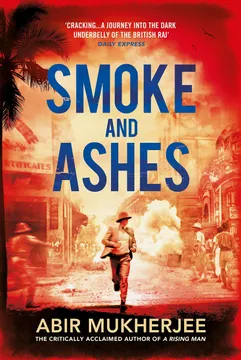


Plot Summary
Blood Above the Opium Den
On a December night in 1921, Captain Sam Wyndham1 slips into a Tangra opium den to quiet the withdrawal shaking his hands. A police raid erupts without warning. A young Chinese woman directs him through a passage to an upper room, where he finds a mutilated man with his eyes removed and two wounds in his chest. The stranger dies as Sam1 tries to help him.
Then officers close in. Unable to explain his presence, or the blood on his clothes, Sam1 takes the man’s curved knife and escapes across the rooftops. A voice he recognizes calls off the pursuit, but Sam1 remains hidden, cold and drug-fogged, with no idea why the raid happened or why the corpse looks deliberately marked.
The opening makes Sam’s compromised position physical: his hands shake, his perception is clouded, and the evidence of a killing is literally on his clothes. His first act of compassion is immediately compromised by self-preservation, since helping the wounded man risks exposing his addiction. The body’s patterned injuries turn what could be a routine police matter into an intrusion on Sam’s private life. The chase also establishes the political and institutional disorder surrounding him: the police are understaffed, the raid is unexplained, and even a fellow officer’s intervention cannot make Sam safe.
The Missing Corpse
Before dawn, Sam1 disguises himself in stolen laundry, dumps the knife in a canal, and returns to his lodgings without waking his sergeant, Surrender-not Banerjee.2 The next day, Vice Division inspector Callaghan says the raid was ordered at the last minute after a tip about Green Gang leader Fen Wang. He reports no body, and Sam1 cannot tell whether the opium has distorted his memory.
That evening, Sam1 returns to the den and finds the room scrubbed, but blood remains in the tile seams. A young constable recalls two khaki-clad officers visiting after the raid. Following the smell of the funeral parlour, Sam1 finds the missing victim hidden among the dead. The crime is real, and Section H has gone to unusual lengths to bury it.
Sam tries to convert fear into procedure: he removes the knife, checks the scene, and tests what he remembers against physical traces. The blood in the grout validates his senses but also makes his own conduct harder to separate from the investigation. The corpse’s concealment turns the mystery outward, toward a government agency with authority to erase evidence. The episode also shows the limits of Sam’s professional identity. He has the instincts of a detective, yet his addiction forces him to act secretly, using a borrowed disguise and a false departmental affiliation.
Das Receives the Warning
At Lal Bazar, Commissioner Taggart8 assigns Sam1 and Surrender-not2 to assess Chitta Ranjan Das,4 Gandhi’s influential lieutenant in Bengal, before the Prince of Wales arrives. The government plans to outlaw the Congress Volunteers, whose disciplined presence has helped keep demonstrations peaceful.
Surrender-not2 knows Das4 through his family, but his own work for the Imperial Police has estranged him from his parents and their circle. At the High Court, the pair encounter protesters being beaten and arrested, then meet Surrender-not’s father,17 who questions whether police service can be separated from serving colonial rule.
Sam1 delivers the warning to Das.4 Das4 refuses to promise compliance, arguing that the Volunteers restrain crowds and that banning them may make the city less safe, not more.
The political conflict is presented through competing claims to public order. The colonial administration regards the Volunteers as a rival authority; Das regards them as a restraint on violence the police may be unable to control. Surrender-not’s father gives that dispute an intimate cost: his son’s professional loyalty has become a family rupture, not an abstract debate. Sam, meanwhile, is asked to read a political leader as though he were a suspect, revealing how the state turns dissent into a security problem. Das’s calm refusal unsettles Sam because it denies him the clarity of an enemy who simply threatens him.
A Brick at Annie’s Door
Annie Grant3 calls Sam1 after someone daubs her door with red paint and throws a brick through a window. The attack reflects rising hostility toward Anglo-Indians, who have become convenient targets amid strikes and political unrest.
Sam1 urges Annie3 to leave her house, but she refuses to be driven out. His concern is tangled with the history between them: Annie3 once challenged his unexplained nightly absences, and he concealed his opium use rather than trust her with the truth.
At home, Sam1 takes an unpleasant gourd remedy prescribed by a local doctor to blunt withdrawal, then returns to the funeral parlour and confirms that the body is still hidden there. The remedy is only temporary, and the case keeps drawing him toward the danger he is trying to conceal.
Annie’s damaged home makes the city’s political crisis personal, but Sam’s response exposes a second threat: his fear of intimacy. He can identify the danger outside her house, yet he cannot admit the danger inside himself. The gourd treatment offers a fragile compromise between recovery and continued use, keeping him functional without requiring him to surrender the habit. His return to the corpse after visiting Annie shows how investigation has become both duty and refuge. He is drawn toward evidence because it gives his guilt a task, even when the task places him at greater risk.
Ruth Fernandes in Rishra
On December 23, Sam1 and Surrender-not2 reach Rishra to investigate Ruth Fernandes,13 a Goan Christian nurse found mutilated near the river. Her missing eyes and paired chest wounds match the Tangra victim’s injuries.
Sergeant Lamont has already moved her body to a clinic to prevent unrest, and he suspects political violence because Ruth13 worked at a military hospital. Sam1 resists that easy conclusion. Ruth’s husband,15 George,15 says she helped local families and had left her shift early, while a wandering holy woman named Mala says she found the corpse after noticing vultures.
At the ferry, boatman Kanai Biswas reveals Ruth13 returned earlier than usual and appeared to meet an unfamiliar man on the riverbank. The murder now has a possible witness and a troubling personal angle.
Ruth’s death tests the authorities’ readiness to make a victim serve a political narrative. Lamont sees a Christian nurse employed by the military and infers nationalist violence; Sam notices that the evidence does not yet support that conclusion. The ferry detail complicates the case without resolving it: Ruth may have had a private appointment, but the stranger could be witness, accomplice, or coincidence. The scene also broadens the social field of the investigation. The holy woman, the boatman, and Ruth’s husband each occupy a different relationship to truth, and Sam must listen across class and cultural assumptions rather than treat any one account as complete.
Three Victims, One Photograph
At the Barrackpore military hospital, Sam1 questions Colonel McGuire12 and nurse Mathilde Rouvel10 about Ruth’s13 employment and learns that Ruth13 left her shift early for a supposed appointment. McGuire12 seems eager to end the interview and disappears without the transport he claimed to need.
Before the inquiry can develop, another victim appears: scientist Alastair Dunlop has been killed in his Park Street home with the same wounds. Section H officers abruptly remove Sam1 and Surrender-not2 from the scene.
During the confrontation, Surrender-not2 steals a photograph from Dunlop’s wall. It shows Dunlop, Ruth,13 McGuire,12 Rouvel,10 and a scarred hospital worker14 together at Barrackpore in 1918. Ruth’s13 service file places her elsewhere at that time, suggesting the record was falsified.
The photograph converts scattered clues into a social network. The victims and witnesses were not merely present in the same city; they shared a past inside a military institution that now refuses police scrutiny. The falsified service record signals that concealment predates the murders, while Section H’s intervention suggests the secret is considered more dangerous than ordinary criminal evidence. Surrender-not’s quick theft is more than cleverness: his willingness to risk discipline shows that his loyalty is to the investigation and its victims, not simply to the chain of command.
A Face in the Mortuary
After spending a night in a military cell and suffering severe withdrawal, Sam1 finally tells Surrender-not2 about his opium dependence and the corpse he found in Tangra. Surrender-not2 argues that Section H’s interest in the den matters more than its questions about Ruth.13
They return to the funeral parlour by climbing across the roofs, evade the watchers, and open the mortuary drawer. The victim is not the Chinese gangster Sam1 assumed he was. Surrender-not2 recognizes the man’s scar from Dunlop’s photograph and identifies him as Prio Tamang,14 a Nepalese hospital worker.
The injuries also match Ruth’s13 broken finger. With Tamang,14 Ruth,13 and Dunlop connected to Barrackpore, the mystery shifts from a gang killing to something buried in the hospital’s wartime past.
Sam’s confession changes the partnership from a professional arrangement into a relationship capable of bearing shame. Surrender-not does not let compassion displace the case; he uses his own insight to redirect their attention toward the stronger pattern. The mistaken identification of Tamang exposes how addiction and expectation can shape perception: Sam saw the kind of victim he anticipated rather than the person in front of him. The photograph corrects that error. Its evidentiary force depends on collaboration, with Surrender-not supplying knowledge Sam lacks and Sam admitting what he had hidden.
Rawalpindi Was a Code
Sam1 and Surrender-not2 confront Rouvel10 at the nurses’ quarters, where she admits Dunlop ran secret research but refuses to explain it. Before she can say more, a short Gurkha in a hospital porter’s disguise9 bursts from her room with a kukri.
He overpowers Surrender-not2 and escapes, leaving Rouvel10 shaken. Sam1 finds her at the river preparing to flee to French Chandernagore. He lets her go after she reveals that Rawalpindi was not a place of service but the code name for experiments conducted at Barrackpore.
Dunlop tested mustard gas on Indian troops, including Gurkhas, and the trials caused severe injuries. The revelations explain the hidden history behind the murders, but Rouvel10 cannot identify the attacker9 or explain why he has returned now.
The attacker’s physical disguise exposes the weakness of institutional categories: a uniform that signals harmless medical service becomes cover for violence. His restraint toward Sam and Surrender-not is as significant as his aggression, suggesting purpose rather than indiscriminate frenzy. Rouvel’s flight reflects a rational calculation that police protection cannot reach beyond military power. Her revelation also reframes the word Rawalpindi, a bureaucratic label that has concealed harm by making a laboratory program resemble a posting. The past is no longer background; it is active, armed, and moving through the present.
The Gas Is Missing
Major Dawson7 finally admits that three mustard gas canisters vanished while wartime stocks were being transferred from Barrackpore to Fort William. Section H suspects the attacker9 is a former test subject and plans to use McGuire12 as bait at a Christmas fair. Sam1 and Surrender-not2 watch from a rooftop, but McGuire12 receives a note, slips past his guards, and disappears.
At McGuire’s12 home, they find his wife bound and question Anthea Dunlop,11 who explains that her husband’s experiments killed Gurung’s9 young son. She names the attacker9 as Lacchiman Gurung,9 a career rifleman whose fatherly grief has become revenge. Gurung9 has killed those he blames and may now possess enough gas to attack the prince’s Christmas gathering.
The case expands from retrospective justice to imminent mass danger. The missing canisters turn private vengeance into a possible public catastrophe, while the authorities’ attempt to use McGuire as bait repeats the instrumental thinking that enabled the experiments. Anthea’s account restores the human scale that military records omit: a child was injured, died, and became a line in a concealed program. Her own guilt is complicated by her belief that Dunlop deserved judgment. Sam must now distinguish understanding Gurung’s grievance from accepting the violence he may unleash.
Basanti Takes the Stage
On Christmas morning, Sam1 and Surrender-not2 warn Das4 that a gas attack may threaten the crowds, but they cannot disclose enough to persuade him. Das4 insists he cannot simply stop a movement he no longer controls. Surrender-not2 learns that his own father17 intends to join the march, adding family to the dangers surrounding the day.
At the Maidan, Das4 appears despite house arrest and Sam1 orders his detention. Basanti Devi6 climbs the stage in his place and announces that the protest will continue; soldiers arrest her too. Her arrest enrages the crowd, and Bose5 directs the protesters toward the town hall while urging them to remain peaceful. The demonstration grows into a moving mass that Sam1 cannot easily control or clear.
The protest makes political agency visible through succession. Arresting Das does not silence the movement; Basanti assumes the public role, and Bose converts the crowd’s anger into continued disciplined action. Surrender-not’s father turns that spectacle into a personal crisis, showing how political allegiance divides households as well as institutions. Sam’s warning fails partly because he withholds evidence, a consequence of a security system that demands secrecy even when secrecy undermines trust. His order to arrest Das is therefore both operational and moral, placing him between an uncertain threat and people exercising a cause he increasingly understands.
Smoke at the Town Hall
At the town hall, Sam1 spots Annie3 and urges her to leave, but she stays to see the prince. The Congress march presses against the military cordon, and Bose5 organizes a controlled burning of foreign clothes to keep the crowd from surging. A device explodes and releases harmless smoke; two more bursts appear near Government House.
Sam1 realizes Gurung9 is using smoke bombs to make the authorities reroute the prince, not to poison the demonstrators. He predicts the convoy will be taken to Fort William, where Gurung’s9 regiment is stationed and where the stolen canisters may already be hidden. Sam1 and Surrender-not2 borrow a judge’s car, persuade the guards to admit them, and race into the fort as it goes into lockdown.
The smoke works because it exploits the authorities’ own assumptions. They expect an attack on the crowd, so they interpret the devices as chemical weapons and choose a predictable escape route. The false alarm is not harmless: it channels the prince toward the very military base where the real danger waits. Sam’s insight comes from treating the explosions as a pattern rather than an isolated assault. Annie’s presence sharpens the stakes, but she remains an agent in her own decision, refusing to exchange her judgment for Sam’s fear.
The Fort Turns Toxic
Inside Fort William, a real mustard gas canister ruptures near the officers’ quarters, and Sam,1 Surrender-not,2 Dawson,7 and Allenby race toward the prince wearing gas masks. Gurung9 has shot the guards and is firing from the stairs.
Sam1 wounds him, but the gunshots above lead to a second shock: McGuire,12 not Gurung,9 holds the prince at gunpoint. McGuire12 reveals that his son also died from gas and that he has joined Gurung’s9 revenge, intending to punish the royal family. He pulls the final canister’s trigger, then shoots himself.
Sam1 smothers the leaking cylinder with a curtain and drags the coughing prince clear, then returns for the wounded Dawson.7 Gurung9 survives long enough to be taken under guard, while the fort’s gas victims receive medical care.
The climax refuses a simple division between a righteous avenger and a corrupt institution. Gurung’s revenge grows from a real atrocity, but McGuire’s grief transforms the same history into a plan to kill a symbolic target. The prince becomes a stand-in for a distant state, just as the Indian soldiers once became instruments in its experiments. Sam’s decisive acts are practical rather than triumphant: he contains the gas and returns for a wounded adversary. His refusal to abandon Dawson marks a moral choice independent of rank, allegiance, or personal resentment.
Leaving Calcutta Behind
Gurung9 is executed at Fort William on December 31, while officials bury the gas attack beneath an account of an accidental chemical release. Basanti’s6 arrest has revived protest and strikes, and the prince leaves India without the public learning what happened.
Dawson,7 injured but alive, explains that Gurung9 and McGuire12 planned the attack together. Sam1 then visits Annie.3 Rather than demand that she leave with him, he accepts her decision to remain in Calcutta and tells her he is going to Assam for treatment.
Annie3 promises to be there when he returns. Surrender-not,2 isolated from his family after the arrests, accepts Sam’s1 advice to visit an aunt in Dacca. Sam1 boards a northbound train with a small supply of the remedy and a chance to begin again.
The resolution gives no public justice for the experiments: the state conceals both its past crime and the danger it nearly caused. Against that institutional erasure, Sam’s recovery is modest but concrete. He chooses treatment and speaks honestly to Annie, abandoning the pattern of keeping her close while withholding the truth. His acceptance of her decision marks a shift from possessive fear toward care that permits another person to choose. Surrender-not’s journey toward family offers a parallel repair, though neither man can undo the political costs of his choices. The ending offers movement, not absolution.
Analysis
Smoke and Ashes makes its mystery inseparable from the institutions that shape the evidence. Sam1 begins by assuming the corpse is a gang victim because that explanation fits the opium den and the tip about a Chinese criminal. The investigation corrects him through physical details, Surrender-not’s2 knowledge, and a photograph whose official date contradicts a personnel file. Each clue is also a record of who has the power to name events: Section H can conceal a body, the military can falsify or restrict records, and the police commissioner8 can assign a murder according to political usefulness.
The novel’s sharpest moral contrast is between stated purpose and human consequence. Dunlop’s research is presented as scientific work for wartime defense, but its subjects are soldiers treated as expendable bodies. Gurung’s9 revenge is understandable because his son suffered and died, yet understanding does not make the planned use of poison gas against civilians defensible. McGuire’s12 grief shows how the same machinery of war can consume those who command it as well as those forced to serve it. The state’s final cover story repeats the original concealment, preserving authority by denying public knowledge.
Sam’s1 personal arc echoes this struggle over truth. He hides his addiction to preserve his position and his image of competence, just as the institutions around him hide violence behind procedure. His confession to Surrender-not2 does not solve his dependence, but it makes recovery possible because he no longer has to maintain the fiction alone. His changed approach to Annie3 matters for the same reason: he stops treating care as a claim over her choices. The ending offers no clean political settlement or instant cure. Instead, it gives Sam1 a first honest step, Surrender-not2 a route back toward family, and Calcutta a future still burdened by the secrets its rulers refuse to face.
Review Summary
Reviews for Smoke and Ashes are overwhelmingly positive, with readers praising the richly atmospheric depiction of 1920s Calcutta, the compelling characters of Captain Sam Wyndham and Sergeant Surrender-Not Banerjee, and the seamless blending of historical detail with gripping mystery. Many consider it the strongest entry in the series. Highlights include the political backdrop of Gandhi's independence movement, Wyndham's opium addiction storyline, and the tense thriller finale surrounding the Prince of Wales' visit. A few critics noted minor pacing issues and a somewhat contrived ending.
People Also Read

Characters
Sam Wyndham
War-scarred detectiveA British captain in Calcutta’s Imperial Police, Sam is sharp at reading people and scenes but much less honest with himself. The war left him with grief, a morphine dependence that has become an opium habit, and a conviction that survival is a debt he cannot repay. His cynicism protects him from disappointment, especially in his complicated relationship with Annie Grant3, yet it can also make him assume the worst before he has evidence. As a detective, he is drawn to victims whom the institutions around him would rather disregard. His defining tension is between the discipline his job demands and the secrecy his addiction requires.
Surrender-not Banerjee
Principled Indian sergeantSurendranath Banerjee, called Surrender-not by British colleagues, is Sam’s1 intelligent and resourceful Indian sergeant. Educated, observant, and deeply knowledgeable about Calcutta, he often sees social and political implications that Sam1 misses. His decision to remain in the police has estranged him from relatives who see the force as an instrument of occupation, though his motives are rooted in a sincere belief that justice requires capable investigators. He balances loyalty to Sam1 with a strong moral independence, and his understated humor keeps him from being reduced to either a dutiful subordinate or a political symbol.
Annie Grant
Independent Anglo-Indian heiressAnnie is an intelligent, socially assured Anglo-Indian woman whose wealth and family history do not protect her from the racial tensions of Calcutta. She has built a life through her own judgment and refuses to be treated as someone Sam1 must rescue or manage. Her attachment to him is tempered by an equally clear view of his evasions and self-destructive habits. She values pleasure, independence, and honesty, qualities that expose how much Sam1 has mistaken brooding for depth. Her relationship with him carries both affection and resistance: she cares about him, but will not let his grief dictate the boundaries of her life.
Chitta Ranjan Das
Bengal’s nationalist leaderA prominent barrister and Gandhi’s leading ally in Bengal, Das has surrendered wealth and professional status to support noncooperation. He believes disciplined, nonviolent resistance can expose the moral weakness of colonial rule, and he accepts personal hardship as part of that strategy. His courtesy is not passivity; he understands how carefully chosen demonstrations can force the government to reveal its priorities. Das is also a husband, family friend, and public figure whose authority rests on the trust ordinary people place in him. His calm conviction frustrates Sam1 because it makes coercion look less like order and more like fear.
Subhash Bose
Young Congress organizerRecently returned from England after declining a place in the civil service, Bose is a disciplined young organizer under Das’s4 guidance. He directs the Congress Volunteers and has the confidence to manage crowds without surrendering their commitment to protest. His earnestness makes him less experienced than Das4, but it also gives him energy and a visible connection to the younger generation entering the independence movement.
Basanti Devi
Leader beside DasDas’s wife4, Basanti Devi, is composed, politically committed, and unwilling to treat independence as her husband’s4 private cause. She understands the risks of arrest and the public meaning of protest, while remaining attentive to family bonds and personal loyalties. Her presence gives the movement a force that cannot be contained by removing its best-known male leader.
Major Dawson
Hard-edged intelligence officerA senior Section H officer, Dawson is secretive, forceful, and accustomed to treating information as a weapon. He knows how to exploit institutional power and does not hesitate to intimidate those he considers obstacles. His experience makes him effective in a crisis, but his loyalty to the military establishment can place operational success above individual lives. Sam’s1 history with him is marked by mutual suspicion.
Lord Taggart
Exhausted police commissionerThe commissioner of police for Bengal, Taggart is a wartime veteran struggling to keep a depleted force functioning amid mass protest and political pressure. He values Sam’s1 experience but expects him to carry out orders that may be impossible or morally compromised. His instinct is strategic, yet the crisis forces him to confront how little control the colonial administration truly has.
Lacchiman Gurung
Career Gurkha riflemanA veteran Gurkha soldier, Gurung is disciplined, physically formidable, and shaped by years of military service. He moves confidently through institutions that depend on soldiers like him while remaining difficult for their officers to read. His bearing suggests a man who acts according to a private code and does not waste effort on empty threats. The mystery surrounding him comes partly from the gap between his professional identity and the violence drawing Sam’s1 attention.
Mathilde Rouvel
French-born hospital nurseA nurse at the Barrackpore military hospital, Rouvel is French-born and raised in the nearby French settlement of Chandernagore. She is professionally capable and guarded about information connected to her workplace. Her caution reflects the unequal power around her: speaking freely could put her in conflict with senior officers and the institution that employs her. Beneath her reserve is a strong instinct for self-preservation.
Anthea Dunlop
Scientist’s devout wifeAnthea is a devout Catholic and the wife of scientist Alastair Dunlop. She has spent years living alongside the consequences of her husband’s work and retains a strong, sometimes unforgiving sense of moral responsibility. Grief and religious conviction shape how she judges acts that others might describe as duty or scientific progress. Her measured manner makes it difficult to know what she believes until she chooses to speak.
Colonel McGuire
Barrackpore hospital directorMcGuire commands the military hospital at Barrackpore and occupies a position between medical staff, servicemen, and the military hierarchy. He is accustomed to protecting the institution’s procedures and maintaining authority, even when personal grief intrudes. His role reflects the way military medicine can be both a place of care and a mechanism serving wartime demands.
Ruth Fernandes
Beloved Goan nurseRuth is a Goan Christian nurse who works at Barrackpore and lives with her husband’s15 family in Rishra. Her kindness to local children and neighbors has made her a trusted presence beyond her workplace. She is a working woman navigating family obligations, military employment, and the expectations placed on women in colonial India. The people around her know different parts of her life, none of them necessarily the whole.
Prio Tamang
Hospital quartermaster aideA Nepalese hospital worker, Tamang has served both as an orderly and in the quartermaster’s office. His ties to the Gurkha community place him between military service and the lives of recruits arriving from the hills.
George Fernandes
Ruth’s mill engineer husbandGeorge is a Goan engineer at the Hastings Jute Mill and Ruth’s13 husband. He supports an extended household and speaks carefully when questioned, leaving Sam1 to distinguish grief and uncertainty from concealment.
Stephen Schmidt
American tea merchantA wealthy American businessman newly arrived in Calcutta, Schmidt is confident, sociable, and openly interested in Annie3. His easy optimism contrasts with Sam’s1 habitual suspicion, and his presence makes Sam1 confront the difference between protecting Annie3 and trying to control her.
Sasadhar Banerjee
Surrender-not’s barrister fatherSurrender-not’s father2 is a respected Bengali barrister who defends people challenging injustice. He loves his son2 but disapproves of his police career, seeing it as service to an occupying power. Their conflict is painful because both men believe they are acting in their country’s interests.
Sandesh
Sam’s watchful manservantThe quiet manservant who shares Sam1 and Surrender-not’s2 lodgings, Sandesh maintains the household through small daily rituals. His understated presence gives Sam1 practical care even as Sam1 conceals the severity of his addiction.
Plot Devices
The hidden Tangra corpse
Evidence hidden in plain sightThe body discovered above a Tangra opium den seems at first to be a Chinese gang victim. Sam’s1 drug-fogged assumptions and the police raid obscure its identity, while Section H’s decision to hide it in the funeral parlour’s mortuary makes the disappearance appear impossible. The corpse provides the investigation with its central physical pattern: gouged eyes, paired chest wounds, and injuries to a finger. Identifying the victim as Prio Tamang14 links the first killing to the military hospital and turns the apparent gang crime into evidence of a buried wartime secret.
The Barrackpore photograph
A past assembled from facesThe group photograph found in Alastair Dunlop’s house gathers the people and places the investigation has encountered separately. Dunlop, Ruth Fernandes13, Prio Tamang14, Mathilde Rouvel10, and Colonel McGuire12 appear together at Barrackpore, while a date on the reverse conflicts with Ruth’s13 official service record. Sam1 and Surrender-not2 use the image as a map of possible victims and as proof that someone altered the historical record. Its importance is not merely identification: it reveals that the crime’s present pattern depends on relationships the authorities have tried to obscure.
Operation Rawalpindi
A wartime secret returnsRawalpindi is the code name for mustard gas experiments carried out at Barrackpore during the war, not the location Sam1 first assumes it to be. The program links Dunlop’s scientific work, McGuire’s12 command, the nursing staff, and Gurkha test subjects. Its concealed records and falsified personnel history prevent the police from understanding why the victims share the same injuries. Once Sam1 learns what the experiments did to the soldiers, the murders become acts of revenge rooted in real institutional violence, and the missing gas canisters make that history an immediate threat to the city.
Kerdū and opium withdrawal
A temporary stay from cravingSam’s1 opium dependence governs his nights, his judgment, and the secrets he keeps from colleagues. An Ayurvedic practitioner gives him a drink made from ash gourd and clarified butter to lessen withdrawal symptoms, but it is no cure. When supplies run out during the strike, Sam’s1 symptoms worsen until Dawson7 detains him and he finally tells Surrender-not2 the truth. The remedy functions as a small practical lifeline and as a measure of Sam’s1 evasion: it helps him continue without yet committing to the difficult treatment he eventually seeks in Assam.
Noncooperation and cloth burning
Protest made visibleThe Congress Volunteers, sit-down demonstrations, and burning of foreign clothing turn political resistance into a public test of the colonial government’s response. Das4 values the Volunteers partly because they keep protests disciplined, while the administration fears their uniforms and influence. Banning them and arresting Das4 and Basanti Devi6 are intended to restore state authority, but the arrests intensify the crowds instead. The clothing fires give the movement a concrete ritual of economic refusal, and the demonstrations force Sam1 to confront how often the police call coercion order while treating peaceful resistance as a threat.
Download PDF
Download EPUB
.epub digital book format is ideal for reading ebooks on phones, tablets, and e-readers.








