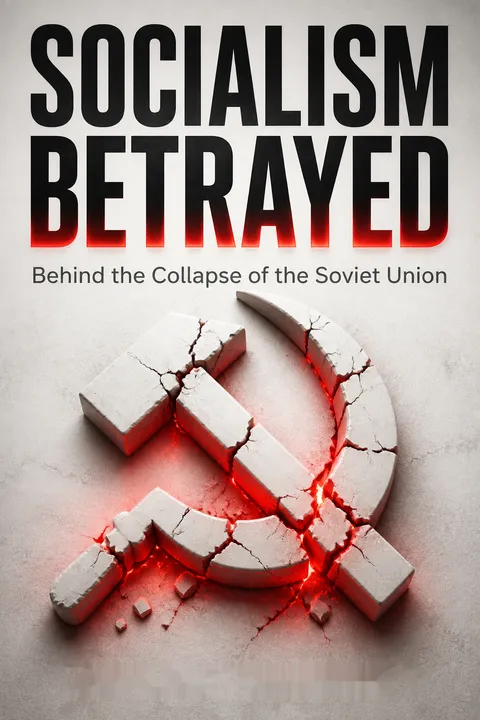


Key Takeaways
Explain the collapse as contingent policy, not socialism's inevitable failure
The book's central case. Roger Keeran and Thomas Kenny argue that the Soviet Union did not collapse because its economy or government had already become unsustainable. They locate the decisive cause in policies adopted under Mikhail Gorbachev, especially after 1986, which weakened the Communist Party, planning, and public ownership. The authors stress that these choices had alternatives, rather than representing history's unavoidable destination.
What was at stake. Their account also recalls Soviet achievements: guaranteed employment, free education and health care, subsidized housing, and comparatively narrow income gaps. They acknowledge serious shortages, political repression, and economic weaknesses. Their point is not that the Soviet system was flawless, but that its problems did not, by themselves, make its destruction inevitable.
What's valuable here is the distinction between a system's weaknesses and the decisions that turn weaknesses into collapse. That distinction is standard in historical explanation: context constrains choices, but does not erase them. The authors make contingency vivid by asking what other policies were available. Their political commitment, however, shapes the argument: Soviet accomplishments receive emphasis, while the failures of planning and political control are treated chiefly as problems that could have been corrected. Contingency challenges inevitability, but does not by itself prove that a viable alternative would have succeeded.
Track how tolerated private profit created a constituency for market reforms
A parallel economy. The authors define the second economy as private economic activity for personal gain, whether legal or illegal, taking place alongside the state-run economy. It ranged from private gardens and repair work to theft from workplaces, black-market sales, bribery, and concealed businesses. Some activity met needs the official system did not serve well. But illegal enterprises could also depend on stolen materials, diverted labor, and protection from corrupt officials.
Growing influence. Estimates vary, but Gregory Grossman estimated that urban households in the late 1970s received about 30 percent of their income from nonofficial sources. Soviet researcher Tatiana Koriagina estimated that illegal activity involved around 30 million people by 1989. The authors argue that this expanding world weakened planning and created people with a material interest in legitimizing private business.
The second economy gives the book a concrete mechanism linking everyday workarounds to national politics. In institutional economics, informal markets can solve immediate shortages while also reducing incentives to improve official allocation. The authors extend this insight to political power: illicit business needs protection, and protection can turn officials into stakeholders. Estimates remain uncertain, and participation in informal exchange does not make every household a capitalist opponent. The more persuasive claim is narrower: tolerated private activity created networks, habits, and opportunities that a market-oriented reform could rapidly enlarge.
Read Soviet reforms through a recurring contest over compromise and control
Two political tendencies. The authors trace Gorbachev's program to a long-running argument about how to build socialism. One tendency favored stronger party leadership, planning, industrial development, and limits on private property. Another favored compromise with markets and private enterprise, and a slower path that retained some capitalist practices. These are the book's political categories, not simple labels for virtuous and wicked leaders.
The argument's history. Lenin's New Economic Policy allowed limited market activity after the upheavals of war and revolution; Lenin described it as a retreat, not a final destination. In the 1920s, Bukharin argued for a more gradual course, while Stalin pushed rapid industrialization and agricultural collectivization. Khrushchev later promoted decentralization and market mechanisms. The authors place Gorbachev in this recurring reform tradition, while noting that each leader faced different conditions.
This historical lens helps explain why policies that sound new can revive older disagreements. It also cautions against treating a party as ideologically uniform simply because it monopolizes political power. The framework is useful, but its left-right map is explicitly Marxist and class-based, not a neutral taxonomy. It can flatten disagreements about efficiency, political freedom, or national development into a single contest over class interests. Readers can use the lineage without accepting every classification, and ask what interests each policy served as well as what outcomes it produced.
Repair planning's failures before assuming markets are the only cure
A different reform path. Yuri Andropov, General Secretary before Gorbachev, diagnosed waste, weak productivity, outdated management, poor incentives, and failure to use new technology. He proposed modernizing production, improving planning, rewarding better work, and enforcing labor discipline. He warned against sudden decentralization and favored testing changes before applying them broadly.
Early signs of improvement. Gorbachev initially followed a similar direction. In 1985 and 1986, the economy showed gains in production and consumption, and the authors report faster productivity growth and rising agricultural output. Some initiatives misfired: the anti-alcohol campaign encouraged bootlegging and reduced state revenue. But these mixed results do not show that moderate reform had failed. The authors argue that Gorbachev shifted toward market-oriented policies before the earlier approach had been fully tested.
The contrast makes a useful point about reform design: a disappointing system does not tell decision-makers which replacement will work. Andropov's emphasis on trials, incentives, and technical modernization resembles contemporary approaches to iterative policy change, where interventions are evaluated before expansion. The reported early improvements strengthen the case that alternatives existed, but a short period of growth cannot establish long-run success. Nor does better planning automatically resolve political grievances. The section is strongest as a rebuttal to the claim that marketization was the only imaginable response.
Make political reform answerable to institutions, not just a leader's momentum
The party loses ground. In 1987, Gorbachev promoted democratization and multi-candidate elections inside the Communist Party. The authors argue that this became a means of bypassing the party rather than making its leadership more accountable. At the 1988 Party Conference, Gorbachev advanced new state institutions that reduced the party's governing role and elevated the state over it. The changes made the process harder for the party to direct or reverse.
A test of dissent. The 1988 Nina Andreyeva controversy illustrates the shift. A teacher's published letter criticized one-sided attacks on Soviet history and the political effects of glasnost. Gorbachev and his allies denounced the letter as a threat to reform, then used the dispute to isolate Yegor Ligachev, a leading internal critic. The authors describe this as a turning point in the party's loss of authority.
The episode raises a general institutional question: can leaders reform an organization by weakening the very channels through which it deliberates and corrects itself? The authors persuasively show how personal control and reform rhetoric can coexist. Yet the party's dominance had itself limited public accountability, and calls for greater pluralism were not merely a trick. A fuller assessment must distinguish genuine demands for political voice from the particular way reforms were designed and managed. The risk lies in replacing an imperfect institution before credible, accountable alternatives exist.
Do not dismantle economic coordination before a workable replacement exists
A sudden market turn. In a planned economy, state orders specified much of what enterprises should produce and guaranteed government purchases at set prices. In 1987, Gorbachev backed reducing those orders from nearly all industrial output to about half, pushing enterprises to buy and sell more through markets. The authors say Prime Minister Nikolai Ryzhkov and Ligachev urged a smaller experiment, but Gorbachev chose the faster change.
Disruption spreads. The state ministries that coordinated supply and production also lost authority, while no stable market system replaced their work. The authors link this sequence to shortages, hoarding, inflation, and falling confidence in supply. Laws permitting cooperatives also enabled private businesses to operate through or alongside state enterprises, sometimes diverting public assets. The book's claim is not that markets can never function, but that this transition removed coordination faster than it built a reliable alternative.
This is a coordination problem, not simply a choice between planning and markets. A complex production network needs rules for prices, ownership, contracts, and supply; changing one part can destabilize others. The authors emphasize the danger of dismantling institutions without replacements, a lesson relevant to privatization and other large transitions. Their account gives less attention to whether a gradual market transition could have solved persistent shortages or improved responsiveness. Still, sequencing matters: an untested market cannot coordinate an economy merely because the plan has been weakened.
Treat national grievances as governing facts, not local irritations
A multinational state. The Soviet Union joined fifteen republics with different languages, histories, and political interests. Earlier governments had promoted education and development in less developed regions, but this did not eliminate grievances over language, representation, migration, and central control. The authors argue that Gorbachev underestimated these tensions and treated the national question as largely settled.
A damaging misjudgment. In December 1986, Gorbachev replaced Kazakhstan's longtime leader, Dinmukhamed Kunaev, with a Russian official who had no experience in the republic. Protests and riots followed in Alma-Ata. The episode did not create Kazakh grievances, but it made central disregard unmistakable. In a 1991 referendum held in most republics, 76.4 percent of voters supported preserving the Union. The authors stress that popular support for unity could not compensate for political institutions losing the capacity to negotiate or enforce a shared settlement.
The episode shows why federal unity depends on more than formal borders: representation, trust, and the perceived fairness of central decisions matter. Political science distinguishes between allowing self-determination and building institutions that make shared government legitimate; a stable federation needs both. The referendum is a striking measure of support for preserving the Union, though it was nonbinding and did not settle what form the Union should take. Its result underlines the gap between public preferences and the weakened institutions meant to translate those preferences into policy.
Do not confuse unilateral retreat with a durable peace settlement
Pressure and choice. The Soviet Union faced serious external pressure, including the Reagan administration's military buildup, support for anti-Soviet forces in Afghanistan, and policies that helped drive down oil prices. The authors treat these as real burdens, but argue that external pressure did not dictate Gorbachev's particular response. Soviet leaders still chose whether to negotiate, retreat, or seek reciprocal terms.
Concessions without guarantees. Gorbachev accepted major arms-control concessions, withdrew Soviet troops from Afghanistan in 1989, and declined to intervene as socialist governments in Eastern Europe fell. The authors argue that these retreats often failed to secure equivalent commitments from the United States or protect Soviet allies. Their criticism is not that peace or arms reduction lacked value, but that diplomatic gains should be measured by concrete security and political outcomes, not by international praise alone.
The section usefully separates the goal of reducing conflict from the strategy used to pursue it. In bargaining theory, a concession can build trust, but it can also weaken leverage when it is not linked to reciprocal commitments. The Soviet case, as the authors tell it, warns against treating favorable publicity as a substitute for negotiated guarantees. The counterpoint is that unilateral restraint may reduce immediate risks even without a matching concession. Evaluating such choices requires weighing both the dangers of escalation and the costs of abandoning allies.
A 76% vote for the Union could not rescue hollowed-out institutions
Public preference, weak machinery. In March 1991, voters in most Soviet republics backed preserving the Union by a 76.4 percent majority. Yet the central party and government bodies had lost authority, while economic shortages and national disputes deepened. Boris Yeltsin gained control of Russia's institutions and advanced a more rapid market transition. The authors argue that the Soviet public's preference did not have a functioning political structure capable of making it decisive.
The final break. The State Committee for the State of Emergency, formed in August 1991 by senior officials, attempted to restore order but acted indecisively and failed. Yeltsin emerged stronger. He banned the Communist Party in Russia that November; the Soviet Union formally ended in December. The authors reject the idea that collapse was inevitable, but their account shows how weakening institutions can make public support politically ineffective.
The referendum captures a core problem of political legitimacy: expressed preferences matter only when institutions can convert them into binding decisions. The book's focus on institutional capacity helps explain why a large majority did not preserve the Union. But a vote for continuation does not tell us whether the public would have accepted every proposed constitutional arrangement, or how minority republics viewed the question. The episode is less a simple verdict on popular will than a warning about the gap between public opinion, governing authority, and the means to reconcile competing claims.
Analysis
The book's most consequential move is to relocate the Soviet collapse from the category of systemic destiny to that of political causation. Its narrative proceeds through linked mechanisms: a tolerated private economy generates interests that favor market reform; Gorbachev's program weakens the party and central coordination; economic disruption and national conflict then narrow the space for political repair. This causal sequence is more useful than a single-factor explanation because it distinguishes long-term pressures from the decisions that converted them into crisis.
The argument is also openly situated. Keeran and Kenny write from a Marxist-Leninist perspective, and they interpret political disagreements primarily through class interests and the survival of socialist institutions. That perspective directs attention to a genuine blind spot in conventional accounts: informal economic activity can be politically consequential even when it is not a separate formal class. Yet their framework risks making a complex coalition look too coherent. Not every participant in private exchange sought capitalism, and discontent over shortages, privileges, or restricted political voice cannot be reduced to petty-bourgeois interest. The strongest evidence in the book concerns sequence and institutional change: the 1987 reduction of state orders, the weakening of party authority, and the rapid spread of shortages offer concrete mechanisms. Its more ambitious claims, including that a different reform course would probably have preserved socialism, are harder to establish. Historical alternatives are useful when they identify real options, but their outcomes remain uncertain. The authors sometimes treat Andropov's brief tenure as evidence of a viable road without enough time to test its durability.
The book therefore works best as a corrective rather than a final verdict. It challenges the assumption that the Soviet Union simply collapsed under its own weight, and insists that institutions, interests, leadership, and sequencing matter. Its account invites a broader question: how can a political system permit criticism and adaptation without dismantling the capacity to coordinate economic life or manage competing national claims? That question extends beyond the Soviet case, even where readers reject the authors' ideological conclusions.
Review Summary
Socialism Betrayed receives mostly positive reviews, with readers praising its Marxist analysis of the Soviet Union's collapse. Many appreciate the book's challenge to popular narratives, citing its focus on internal factors like the "second economy" and revisionist tendencies within the Communist Party. Critics argue it overlooks earlier issues and Stalin's role. Reviewers generally find the book well-researched and insightful, though some question its ideological perspective. It's considered essential reading for those interested in Soviet history and socialist theory.
People Also Read



Glossary
second economy
Private activity alongside state productionThe book's term for private economic activity pursued for personal gain alongside the official, socialized economy. It includes legal work such as private gardening and services, as well as illegal practices such as black-market trade, theft from state enterprises, and bribery. The authors argue that its growth damaged planning, encouraged corruption, and created constituencies for market-oriented reform.
perestroika
Gorbachev's restructuring programMeaning restructuring, perestroika was Mikhail Gorbachev's broad program to change Soviet economic and political life beginning in 1985. The term initially covered efforts to accelerate development and improve the existing system. In the authors' interpretation, it increasingly came to justify market reforms, reduced Communist Party authority, and changes that undermined Soviet planning and public ownership.
glasnost
Openness in public discussionMeaning openness or public visibility, glasnost became Gorbachev's policy of allowing greater discussion of government, party, and social problems. The book distinguishes its initial role in exposing inefficiency and corruption from its later use in opening media platforms to increasingly radical attacks on the Communist Party and Soviet history. The authors argue that the leadership lost control of the process it encouraged.
New Economic Policy
Limited market retreat after revolutionThe New Economic Policy, or NEP, was introduced under Lenin in 1921 after the upheaval of war and revolution. It replaced some grain requisitions with taxation and allowed peasants to sell surplus produce, while permitting limited private enterprise. Lenin regarded it as a temporary retreat to rebuild production and preserve worker-peasant unity, rather than an abandonment of socialism.
democratic centralism
Debate followed by unified actionA principle of Communist Party organization combining discussion and decision-making with common implementation of adopted policy. In the book's account, democratic centralism depended on collective leadership, internal debate, discipline, and accountability. The authors argue that these practices weakened over time, leaving the party less able to deliberate effectively or resist Gorbachev's changes.
state orders
Planned government purchase commitmentsState orders were government-set requirements and purchase commitments that directed much of Soviet industrial production. They linked enterprise output to central planning and guaranteed sales at established prices. In 1987, Gorbachev's government sharply reduced their coverage, giving enterprises more freedom to sell through markets. The authors argue that this weakened coordination before a reliable replacement system existed.
nomenklatura
Party-approved leadership appointmentsThe nomenklatura was the system through which the Communist Party maintained lists and procedures for appointing important government, economic, and social officials. The system linked local leaders to central oversight. Gorbachev's attacks on it, in the authors' account, weakened the center's influence and encouraged officials to prioritize local political pressures over all-Union direction.
right opportunism
Unnecessary retreat under pressureThe book uses right opportunism for a political tendency that makes what it considers unnecessary concessions to a class opponent in pursuit of short-term gains. In socialist politics, the authors associate it with accommodating capitalism, expanding private property and markets, and weakening collective institutions. They distinguish a temporary, strategically necessary retreat from a retreat that abandons the larger political project.
Download PDF
Download EPUB
.epub digital book format is ideal for reading ebooks on phones, tablets, and e-readers.








