

Key Takeaways
Ask your imagined centenarian what today's choice will feel like later
Borrow a longer view. At twenty-two, Dicks was homeless, falsely charged with theft, and later held at gunpoint during a robbery. In those seconds, he thought less about immediate comfort than about everything he had left undone. Years earlier, a teacher had helped him discover that writing could give him a future. These experiences shaped the One-Hundred-Year-Old Plan: consult an imagined older self when making decisions, rather than letting a passing mood decide everything.
He uses that perspective to choose playing with his children over finishing a book, or going to a football game over avoiding a tiring workday. The question is not what feels easiest now, but what will matter in retrospect.
What's powerful is the use of psychological distance to counter present bias, the tendency to overvalue immediate rewards and discount future consequences. Imagining a later self can make abstract priorities emotionally legible. The method is strongest for reversible choices, such as how to spend an evening. It should not become a command to ignore present health, financial needs, or genuine exhaustion. A wiser future self is a perspective, not an infallible authority.
Count minutes as usable building blocks, not scraps to throw away
Make small intervals count. A day contains 1,440 minutes, but people often treat a spare ten minutes as useless and wait for a free afternoon to begin. Dicks asks a prospective novelist how he spent the seven minutes she arrived late: he had written nine sentences and revised a paragraph. Each small session moved the draft forward.
Time choices can also compound. A commute that is twenty-five minutes shorter each way creates fifty extra minutes on a workday. Across 250 days, that is more than 12,000 minutes. The book recommends tracking a day in minutes, then preparing a list of useful ten-minute tasks, from drafting or reading to a quick chore or a restorative pause.
This is a useful correction to the fantasy that meaningful work requires a perfect block of uninterrupted time. Behavioral design often succeeds by making the next action obvious and small. Still, short sessions are not interchangeable with deep focus: frequent switching can impose cognitive costs, especially on complex writing or analysis. The best use of a small interval may be a discrete task, a note that preserves an idea, or deliberate rest, rather than forcing every spare minute into production.
Cut low-value tasks before trying to become faster
Choose the right altitude. The book's Eagle and the Mouse metaphor describes two useful modes. The eagle sees the broad landscape and identifies what matters; the mouse notices details up close. Makers need both, but perfectionism can trap them in details that do not change the result. Dicks timed his repeated dishwasher routine and found a way to save about two minutes each time. He also declined to spend hours negotiating a school schedule that would not affect his teaching.
He recommends removing needless steps, delegating work, and questioning rules whose consequences are negligible. At work, he even tested whether an unused data-entry task mattered by not doing it. Nothing happened for years. The goal is not speed at any cost, but less effort spent where it adds no value.
The distinction resembles a core operations principle: improve the whole system before optimizing one task within it. A beautifully efficient process for unimportant work is still waste. The book's examples also invite a necessary distinction between bureaucracy and safeguards. Some procedures protect fairness, safety, or institutional memory even when their value is not immediately visible. Test low-stakes assumptions, but do not mistake personal inconvenience for proof that a rule serves no one.
Protect sleep quality instead of copying a short sleeper
Improve rest before trimming it. Dicks reports sleeping about five and a half hours, but explicitly presents that as his own pattern, not a universal prescription. His central distinction is between time in bed and time asleep. Reading in bed, tossing before sleep, and lingering after waking can make the first number look larger than the second.
He recommends a stable bedtime and wake time, keeping the bed associated with sleep, reducing bedroom disruptions, and addressing stress through relaxation or meditation. He also suggests reviewing whether sleep can safely be shortened after improving sleep habits. The example of a colleague who woke earlier and felt better is an anecdote, not evidence that everyone needs less sleep.
The useful insight is measurement: time spent in bed is not identical to restorative sleep. Regular schedules and a calmer sleep environment can support healthy rest. The risky leap is treating reclaimed waking time as an automatic gain. Sleep needs vary, and insufficient sleep can impair mood, attention, and health. A reader with persistent insomnia, unusual sleepiness, or a medical condition needs individualized clinical guidance, not a productivity challenge. Rest is part of the work system, not wasted time.
Say yes to experiments before you know their destination
Let opportunity branch. In 1997, Dicks's friend asked him to become a wedding DJ. He knew little about weddings and was already juggling work and two degree programs, but he agreed to try. Over 25 years, the business brought him into contact with people and opportunities he could not have predicted. He became a wedding officiant, began telling stories onstage, and returned to writing fiction.
The point is not to accept every demand forever. A yes can be a trial, and the book suggests giving a new commitment a few days before deciding whether it should become a no. Dicks also urges creators to begin before conditions feel ideal. He wrote wherever time opened up, including a parking-lot median before a dentist appointment.
A yes can function as a low-cost experiment that generates information unavailable through planning alone. This aligns with entrepreneurial effectuation, where people build from available skills and relationships rather than waiting for a complete forecast. But openness needs boundaries: some opportunities carry serious financial, health, or caregiving costs. The practical test is whether the commitment is reversible, affordable, and informative. Curiosity is valuable when it expands options, not when it turns every request into an obligation.
Keep several creative projects alive, and let the finish line move
Allow interests to cross-pollinate. Dicks contrasts a pig, fully committed to one task in a breakfast fable, with a chicken that contributes while remaining free to do other things. For most creators, he argues, several projects and interests can feed one another. His poetry studies helped him find concise lines and vulnerable material that later became spoken stories. His work as a DJ, teacher, comedian, and consultant likewise informs his other roles.
He also treats the intended outcome as flexible. A poem might become a story onstage; a business idea may turn into a different product. This is not an argument for abandoning every difficult project. It is permission to notice when the material, skills, or purpose can succeed in another form.
Cross-disciplinary work can produce genuinely novel combinations because it brings distant ideas into contact. A portfolio of projects can also protect creative momentum when one task stalls. Yet too many active commitments create attention residue, the mental drag of unfinished work. A useful version of the chicken model keeps a small number of projects in view and gives each a next action. Flexibility should preserve the underlying interest, not become an elegant excuse for never finishing.
Make bad work deliberately, then outlast rejection
Treat failure as material. Before publishing his first novel, Dicks abandoned several attempts at fiction and estimates he wrote hundreds of thousands of words that did not work. His early wedding-DJ jobs were also mistakes in public: faulty equipment, missed music cues, and poor pacing. Experience improved the work because he kept practicing rather than waiting to feel ready.
The book offers a cautionary contrast in José Saramago, who stopped writing fiction after a publisher failed to respond to an early manuscript, then returned decades later. The lesson is not that persistence guarantees success. It is that one rejection cannot tell a creator what would have happened after another draft, another submission, or a changed approach.
Deliberate practice requires attempts that expose weaknesses, followed by feedback and adjustment. Separating a flawed product from a person's worth can make that process emotionally survivable. Persistence, however, is not the same as repeating the same strategy indefinitely. Rejection may reflect quality, timing, fit, or institutional taste. The productive response is to inspect the evidence, improve what can be improved, and decide whether the goal still merits effort, rather than treating endurance itself as proof of merit.
Build a candid, kind team that keeps your work moving
Make creation less solitary. While writing his first novel, Dicks assembled trusted readers who could flag confusion, dull stretches, and errors. A later writing problem was solved during a football game: when he told his brother he could not find a plausible target for a character's robbery, his brother suggested a cash-heavy bingo event. Sharing unfinished work created both feedback and a breakthrough.
A team can also provide deadlines and accountability, while celebrations mark progress before outside recognition arrives. But choose supporters carefully. Dicks describes a writing group that responded to his success with envy, and he argues that kindness matters in professional relationships. Reliable collaborators are more useful than an audience that merely applauds, and courtesy helps keep future doors open.
This is a strong account of social infrastructure: creative work improves when it receives both critique and commitment from other people. Psychological safety, the sense that one can share unfinished ideas without humiliation, makes useful disagreement possible. The important caveat is that accountability should not become surveillance, and kindness should not mean tolerating exploitation. The best team combines candor with respect, and shared expectations with enough autonomy for the maker to retain ownership.
Keep evidence of progress so setbacks cannot rewrite your whole story
Preserve proof of capability. Dicks keeps a record of compliments, including messages from former students and readers, and schedules some to return to his inbox later. When a publisher rejected a novel, revisiting those messages did not erase his disappointment, but reminded him that earlier work had mattered to people.
He also retells his own history of overcoming obstacles. On a difficult morning, remembering that teaching once seemed unreachable can make an ordinary workday feel like a hard-won opportunity. The practice pairs optimism with evidence: keep examples of past effort, progress, and support, rather than relying on mood to judge an entire life. Encouragement is not denial of setbacks; it is protection against letting one setback become the whole narrative.
A written record counters the mind's tendency to make recent failure feel representative of everything. In cognitive therapy, examining concrete evidence can interrupt global judgments such as being incapable or doomed. The book's storytelling approach adds identity: a setback becomes one episode rather than the final definition. Still, positive self-talk works best when it remains credible. Inflated reassurance can feel false; specific memories of effort, learning, and help are sturdier than compulsory cheerfulness.
Feed your creativity widely, then turn each finished thing into another
Build from varied inputs. Dicks listens to and reads across storytelling, business, investing, comedy, and screenwriting. Those interests became more than entertainment: studying storytelling led to performance and consulting, while learning about business helped him communicate with corporate clients. The book's claim is that creative ideas often emerge when knowledge from different fields meets.
It also urges makers to reuse their material. A short joke about his father and a childhood dryer game grew into a longer stage story, a blog post, a magazine column, a radio performance, and material for other projects. A completed work is not necessarily exhausted. Reconsider its audience, medium, or format before assuming its value ends at its first release.
Broad learning increases the pool of concepts available for analogy and recombination, while repurposing gives a strong idea more chances to reach people. This resembles the economics of reusable assets: the costly act of creation can support multiple outputs. The constraint is that reuse should adapt to context. A story that works onstage may need substantial revision for print, teaching, or marketing. Broad input is not a substitute for craft, and distribution is not the same as meaningful impact.
Analysis
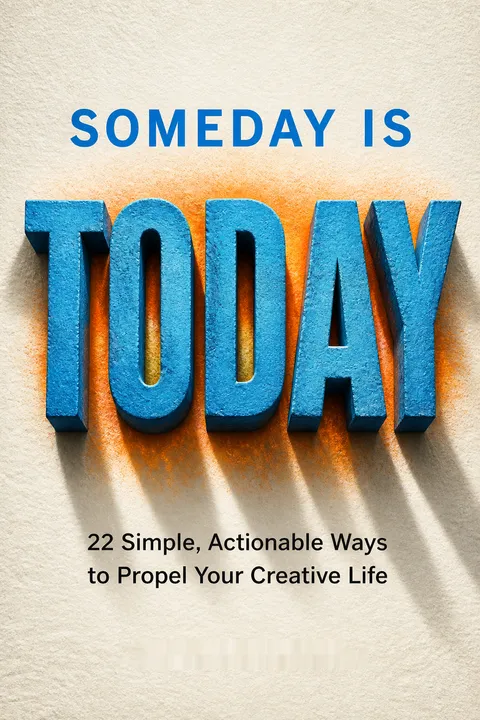
Someday Is Today combines memoir, productivity advice, and a working artist's account of how opportunities accumulate. Its organizing idea is not merely to do more, but to stop postponing valued work until life becomes ideal. Dicks grounds that urgency in a history of homelessness, wrongful accusation, and a violent robbery, then translates personal regret into practical methods: consult an older self, count minutes, reduce friction, begin before certainty, and recruit people who keep the work alive.
The book's strongest contribution is its attention to opportunity cost at ordinary scale. A commute, a repeated chore, an unnecessary meeting, or a default hour of scrolling may seem trivial in isolation; their repeated cost can be substantial. Its account of creative careers is also unusually nonlinear. A wedding-DJ job leads to relationships, public speaking, storytelling, and consulting. The example makes a persuasive case for experimentation rather than rigid career planning.
Its limitations matter. The author's exceptional output is shaped by personal temperament, supportive relationships, professional autonomy, and circumstances not available to everyone. Time can be reclaimed, but not every constraint is a matter of choice. Caregiving, disability, multiple jobs, poverty, and institutional demands can make discretionary time scarce. Some recommendations, especially experimenting with less sleep, should not be generalized from one person's experience. The text occasionally treats efficiency as a moral virtue, although rest, companionship, and unmeasured pleasure can be valuable without producing an artifact.
The most durable reading is therefore experimental, not obedient. Keep the methods that make life more spacious, test assumptions about low-value obligations, and protect the activities that matter even when they are not efficient. The book's central challenge is to make a deliberate choice about time instead of allowing defaults to make it invisibly. Its own stories demonstrate why: a small yes or a brief act of creation can open possibilities that advance planning cannot predict.
Review Summary
Someday Is Today received mixed reviews. Some readers found it inspirational and full of actionable advice for maximizing time and productivity. However, many criticized it as repetitive, self-aggrandizing, and overly focused on the author's personal anecdotes. Common complaints included the author's condescending tone and unrealistic expectations. While some appreciated the core message of not wasting time, others felt the book itself was a waste of time. The writing style and narration were divisive, with some enjoying the storytelling approach and others finding it tedious.
People Also Read







Glossary
One-Hundred-Year-Old Plan
Future-self decision testA decision-making practice in which a person imagines advice from their much older self, near the end of life. The imagined perspective is used to judge whether a choice serves lasting priorities or only a temporary mood. Dicks uses it for both major choices and everyday decisions, including whether to work or spend time with family.
Eagle and the Mouse
Big-picture and detail modesA metaphor for shifting between two useful ways of seeing. The eagle represents broad perspective, prioritization, and awareness of which efforts matter. The mouse represents close attention to particulars. The book argues that creators need both modes, but should not give every detail equal attention when doing so distracts from consequential work.
Deliberate Incuriosity
Ignore irrelevant informationA purposeful decision not to investigate details that cannot affect a person's actions or goals. Dicks uses the example of discarding a foreign sales report after receiving a royalty payment, since knowing the exact sales figures would not change what he could do. The practice aims to conserve attention and decision-making capacity.
Burglar Bag
Ready tasks for spare minutesA prepared collection of materials and small projects to use during unexpected waiting periods or unproductive meetings. It might contain notes to write, work to review, poems to memorize, or a digital task list. Preparation matters because a person can begin immediately instead of spending the reclaimed interval deciding how to use it.
Possibility Tree
Branching opportunities from one yesThe chain of unexpected options that can follow from trying an unfamiliar activity. Dicks's decision to become a wedding DJ led to new relationships and experiences, including officiating ceremonies and telling stories publicly. The concept emphasizes that a first commitment can create opportunities that could not have been identified in advance.
Be a Chicken, Not a Pig
Keep several projects openA fable-based contrast between total commitment to one pursuit and remaining involved in multiple pursuits. Dicks favors the chicken as a model for most creative people, arguing that several interests can cross-pollinate, provide alternatives when one project stalls, and reveal unexpected directions. It does not mean abandoning focus altogether.
First-Look Audience
Early trusted feedback groupA deliberately chosen group that sees creative work before it is finished or publicly released. Members can identify confusing, dull, or promising parts, offer encouragement, and help the creator remain accountable. The audience should be supportive but honest, and should be selected for useful perspective rather than mere approval.
Throwing My Present to the Future
Borrow a calmer future perspectiveA way to manage a temporary difficulty by imagining the point when it will no longer matter, then responding from that anticipated emotional distance. Dicks uses the approach for frustrations such as heat late in the school year. It is intended to reduce disproportionate distress over short-lived problems, not to dismiss serious or persistent harm.
Chasing Zero worksheet
Daily minute accountingA time-use record that starts with the 1,440 minutes in a day and subtracts the minutes spent on each activity until the total reaches zero. The purpose is to reveal untracked time and test assumptions about how long routines, commutes, or screen use actually take. The record can then guide changes to daily priorities.
Performative productivity
Visible effort over resultsWork that looks busy, strenuous, or publicly demonstrative but is not necessarily the most effective way to achieve an outcome. The book contrasts conspicuous effort with strategic methods that use fewer resources. The concept asks people to evaluate the result and the time it requires, rather than treating visible exertion as proof of value.
FAQ
What's Someday Is Today about?
- Focus on Creativity and Action: Someday Is Today by Matthew Dicks emphasizes taking immediate action towards creative goals rather than waiting for the "perfect" moment.
- Actionable Strategies: The book offers 22 simple, actionable ways to enhance productivity and creativity, encouraging readers to make small changes for significant results.
- Mindset Shift: Dicks advocates for a mindset that prioritizes immediate action and values time, urging readers to seize opportunities and make the most of their lives.
Why should I read Someday Is Today?
- Inspiration for Creatives: If you're struggling with procrastination or feeling overwhelmed, this book offers practical tools and a fresh perspective to help you move forward.
- Engaging Storytelling: Dicks shares personal stories and experiences that resonate with readers, making the advice relatable and motivating.
- Transformative Strategies: The book provides concrete strategies that can be implemented immediately, making it a valuable resource for enhancing productivity and creativity.
What are the key takeaways of Someday Is Today?
- Embrace the Present: Dicks emphasizes that "someday" should not be part of your vocabulary when pursuing dreams; action should be taken today.
- Utilize Time Wisely: Recognize the value of every minute and maximize productivity in small increments, as even short bursts of focused work can lead to significant progress.
- Be a Criminal: Dicks advises bending or breaking rules that hinder creativity and productivity, allowing for greater freedom in pursuing passions.
What are the best quotes from Someday Is Today and what do they mean?
- “Only put off until tomorrow what you are willing to die having left undone.”: This quote by Pablo Picasso encapsulates the urgency of pursuing dreams and taking action now.
- “Someday is fool’s gold.”: Dicks uses this phrase to illustrate how the concept of "someday" can lead to inaction and regret, emphasizing the importance of the present moment.
- “You can’t change unless you change.”: This highlights the necessity of taking proactive steps for transformation, reinforcing that change requires action and commitment.
How does Someday Is Today address time management?
- 86,400 Seconds: Dicks emphasizes that each day consists of 86,400 seconds, and how you choose to spend them is crucial.
- Eliminate Time Wasters: Identify and minimize common time-wasting activities, such as excessive social media use, to focus on meaningful pursuits.
- Create Systems for Efficiency: Develop personal systems to streamline tasks and responsibilities, making it easier to manage time effectively.
What specific methods does Matthew Dicks recommend in Someday Is Today?
- The One-Hundred-Year-Old Plan: Consider what your future self would want you to do, helping prioritize long-term happiness over short-term gratification.
- Maximize Small Time Increments: Utilize small pockets of time for productive tasks, rather than waiting for large blocks of time.
- Say Yes: Embrace new opportunities, even if daunting, as this can lead to unexpected and rewarding paths.
How does Matthew Dicks suggest overcoming procrastination?
- Account for Your Time: Use the "Chasing Zero" worksheet to track time usage, identifying where time is wasted and encouraging accountability.
- Set Measurable Goals: Focus on clear, attainable goals that reduce feelings of overwhelm and make it easier to take the first step.
- Embrace Small Steps: Take small, manageable steps towards goals, as even minor progress can build momentum and lead to greater achievements.
What is the "one-hundred-year-old plan" in Someday Is Today?
- Visualizing Your Future Self: Create a visual representation of your future self to guide decisions and remind you of what is truly important.
- Making Better Choices: Consult this future version of yourself to make informed decisions about time and energy, prioritizing what matters most.
- Creating Reminders: Place images of your future self in visible locations to keep goals and aspirations at the forefront of your mind.
What is the significance of "making terrible things" in the book?
- Accepting Failure as Part of Creation: Creating "terrible things" is necessary for growth and learning, viewing failures as opportunities.
- Volume Over Perfection: Producing a large volume of work, even if imperfect, is better than waiting for perfection.
- Building Resilience: Accepting that not every creation will be successful fosters resilience and confidence in abilities.
How does Dicks recommend finding your creative community?
- Identify Your Support Network: Make a list of friends and colleagues who can provide feedback and encouragement.
- Engage with Your Community: Share your work with others and seek their input to refine ideas and improve your craft.
- Be Open to Collaboration: Collaborate with others to gain new ideas and perspectives that enhance the creative process.
How can I apply the lessons from Someday Is Today to my life?
- Start Taking Action: Implement strategies like tracking time and setting measurable goals, focusing on small steps towards aspirations.
- Embrace Imperfection: Allow yourself to create without the pressure of perfection, viewing mistakes as part of the learning process.
- Build a Supportive Network: Surround yourself with people who encourage and support your creative journey, sharing work and seeking feedback.
What role does mindset play in Someday Is Today?
- Shift from Procrastination to Action: Adopt a proactive mindset that prioritizes action over waiting for the "right" moment.
- Overcoming Fear of Failure: Embrace failure as part of the creative process, fostering resilience and persistence.
- Cultivating Optimism: Maintain a positive outlook to enhance creativity and productivity, essential for achieving long-term goals.
About the Author


Download PDF
Download EPUB
.epub digital book format is ideal for reading ebooks on phones, tablets, and e-readers.








