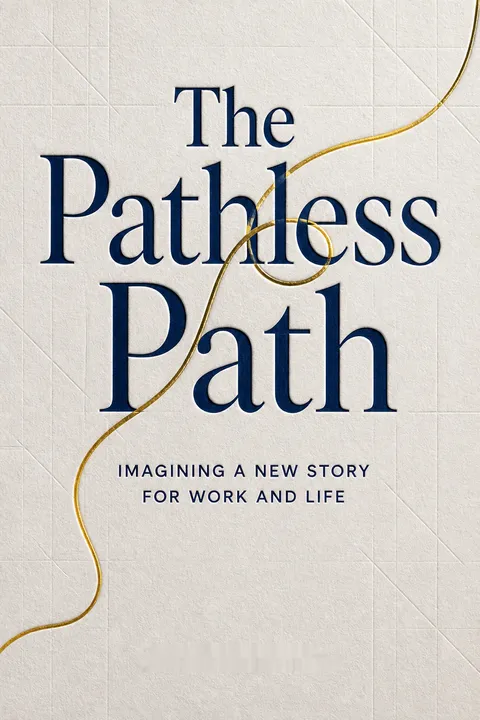


Key Takeaways
Question the polished career story before it becomes your whole identity
A successful-looking trap. Millerd calls the culturally approved sequence of education, a respectable job, and conventional milestones the “default path.” His alternative, the “pathless path,” is not a prescribed career or an argument that everyone should quit. It is a willingness to question the script and explore without knowing the destination. Millerd had reached McKinsey, MIT, and a salary near $200,000, yet wondered whether he was becoming the person his employers needed rather than himself.
Change came gradually. His grandfather’s death sharpened questions about what mattered; a serious illness loosened his grip on achievement. Years of unease, experiments, and difficult choices followed before he left his job. The point is not that success is false, but that borrowed definitions can hide whether a life fits.
What's striking is that the book treats uncertainty not as a personal failure but as evidence that a familiar story may no longer explain a person's experience. That shift can make room for honest exploration without turning dissatisfaction into an instruction to resign. The memoir also reveals an important boundary: questioning the script is easier when people have support and some room to absorb risk. The idea is most useful as permission to investigate, not as a universal verdict against stable employment.
Treat today's career script as a historical accident, not a law
Work acquired its authority. Millerd traces modern work beliefs through religious ideas of duty and vocation, then the postwar boom in stable corporate employment. Earlier traditions often treated work as necessary to meet needs, while valuing contemplation and leisure. After World War II, exceptional economic growth made steady jobs and rising living standards seem like a reliable formula. Research cited in the book found that nine in ten people born just after the war earned more than their parents.
The template outlasted its conditions. Millerd argues that later generations inherited expectations shaped by that unusual period, even as costs, job security, and company loyalty changed. He also describes a “wage-based society,” where paid employment becomes the main measure of contribution, making caregiving and other valuable work less visible.
The historical lens usefully separates a social norm from a timeless human need. A reliable job can provide income, structure, and protection; the mistake is assuming one institutional form is the only respectable way to obtain them. The account also invites scrutiny of whose experience defines the norm. A story built around postwar corporate growth may fit some workers far better than people facing unstable work, caregiving demands, or limited choice. Context complicates the script without making security unimportant.
Prototype a different life before demanding a fearless leap
Small trials reveal real preferences. Millerd argues that bold transitions are often assembled from modest experiments. Before sailing for eighteen months, designer John Zeratsky and his partner took progressively longer trips, testing the life before committing to it. Millerd’s own experiments included coaching clients, writing online, and accepting freelance projects. These trials taught him what working independently felt like and gave him evidence beyond daydreams.
Let evidence accumulate. A prototype can be a temporary change in schedule, a side project, a short trip, or a conversation with someone already living a different way. It need not prove that a whole new life will work. Its value is that it replaces an imagined all-or-nothing decision with firsthand information, while allowing the next step to remain uncertain.
This is a practical application of learning by doing: a person cannot fully know whether a new routine suits them until they experience it. Small trials also make risk more specific, because they expose hidden costs as well as attractions. Still, prototypes are not equally accessible. Time, savings, health, and care responsibilities affect who can test alternatives safely. The principle can be scaled down: a limited trial need not resemble a sabbatical to produce useful evidence.
Make room for non-work before deciding what your life should become
Space changes what becomes visible. In Taipei, Millerd found himself with no immediate work and time to wander, learn, and be present. He connects this to wu wei, or “non-doing”: not laziness, but acting without forcing every moment toward a planned outcome. Breaks from work can expose exhaustion that routine has concealed, revive curiosity, and bring old interests back into view.
Test the future now. Millerd draws on the idea of “mini-retirements,” extended breaks used to sample ways of living rather than postponing all freedom until conventional retirement. He describes planning life in one-to-three-month blocks and choosing a few priorities to test. A break is not a magic cure, and it need not mean abandoning paid work. Its purpose is to learn what a life outside the usual work rhythm feels like.
The useful distinction is between rest as recovery and leisure as an active way of attending to life. A pause can reveal preferences that constant busyness masks, but it can also feel disorienting or financially unsafe. The book's examples therefore work best as experiments, not prescriptions for a minimum sabbatical. Even a modest interruption to routine can create contrast. The important question is what that contrast teaches, rather than whether time away produces a dramatic revelation.
Measure success by work you can keep doing, not applause
Prestige can grade the wrong things. Millerd recalls chasing elite schools and firms partly because their status made achievement legible to others. In workplaces, “bad tests” can reward credentials, politics, or pleasing senior colleagues more than the quality of the work itself. A Gallup survey cited in the book found that 97% of respondents defined personal success as developing their interests and talents, while only 8% thought others used that definition.
Arriving may disappoint. Basketball star Kevin Durant won a championship after joining a stronger team, yet the achievement did not deliver lasting fulfillment. Millerd calls the belief that a milestone will produce enduring happiness the “arrival fallacy.” His alternative is to define “enough” and seek work worth continuing, rather than endlessly raising the status target.
The distinction between public signals and private standards helps explain why impressive milestones can feel strangely thin. Status is not inherently empty: credentials and reputation can open doors, and external recognition can matter. The danger is treating them as reliable measures of fit or fulfillment. A personal definition of enough can interrupt escalation, but it should be revisited as circumstances change. The strongest test is not whether a choice looks unconventional, but whether its costs and rewards match the person's actual values.
Turn vague fears into manageable risks, then find people who understand
Give fear a shape. Millerd describes “fear-setting,” a reflection exercise for a possible change: name the action, list the worst outcomes, identify ways to reduce them, and consider how to recover if they occur. Then ask what a partial success might offer and what inaction may cost over time. This turns a cloud of anxiety into questions that can be examined, while acknowledging that some problems, such as health uncertainty, cannot simply be solved.
Belonging matters too. The book identifies recurring fears about success, money, health, love, and happiness. Millerd found it hard to explain his changing direction to family and friends, and recommends finding people further along a path of interest. Their stories make unfamiliar choices easier to imagine and provide companionship without requiring a polished plan.
The exercise is valuable because fear often collapses probability, severity, and reversibility into one undifferentiated alarm. Writing each down can reveal which risks have practical safeguards and which require acceptance. Social support adds another resource: people can lend perspective when an individual's own story is still changing. Yet encouragement should not replace sober planning. A supportive community is most useful when it makes room for both aspiration and questions about money, health, and obligations.
Define enough before scarcity makes every paycheck feel essential
Money changes emotional scale. After leaving his job, Millerd discovered he had spent almost $6,000 a month in New York, much of it on what he calls a “misery tax,” the spending that helped make an unhappy work life bearable. Moving to Boston and reducing expenses lowered his monthly costs by about $3,000. Later, while living in Taiwan, he tracked spending down to under $1,000 a month.
Less pressure is not the whole answer. When income disappeared, money occupied his attention. A scarcity mindset, the book explains, makes people fixate on what they lack. Cutting costs created more room to experiment, but could also become another form of avoidance. Millerd argues that no bank balance can settle deeper fears about worth or belonging. Financial planning helps; defining what money is for matters too.
The account distinguishes two questions that are often blurred: how much security a person needs, and what emotional reassurance they expect money to provide. Reducing fixed expenses can increase flexibility, but extreme frugality is not automatically freedom if every purchase becomes a source of alarm. The book's emphasis on time ownership is a useful counterweight to income alone. A sound personal threshold should account for real obligations, not simply imitate someone else's low-cost lifestyle.
Create before you know whether your work deserves a paycheck
Expression can precede employment. Millerd argues that creativity is not limited to people with artistic titles. Teaching, organizing, writing, solving problems, and making things all involve creative work. The internet also allows people to publish or share without first receiving permission from traditional gatekeepers. Millerd began writing and podcasting without knowing whether either would become a source of income.
Usefulness gives direction. He gradually found readers who cared about his questions on work and life, and those connections helped his work grow. The aim is not necessarily to build a large audience or monetize every interest. It is to notice what questions keep returning, make something in response, and learn whom it serves. Millerd calls this an evolving conversation with the world, where curiosity and contribution help reveal what is worth continuing.
Creating without immediate payment separates the intrinsic value of an activity from its market value, a distinction that can protect early experimentation from premature optimization. It also gives work a social test: does it help, interest, or connect with someone? However, unpaid creative labor can become exploitative when treated as a substitute for income indefinitely. The book's strongest implication is not that money is irrelevant, but that payment need not be the only reason to begin.
Treat freedom as a skill you practice, not a job you escape
Leaving work is only one kind of freedom. Drawing on Erich Fromm, Millerd distinguishes freedom from external control from freedom to act purposefully and spontaneously. After leaving full-time employment, he still felt guilty when he was not working during normal office hours. The old rules had moved inside his head. Simply removing a manager did not tell him how to use his time.
Agency grows through action. Millerd argues that people learn what they want by trying things, reflecting, and adjusting. This matters in a changing world where identities and skills cannot be assumed to remain fixed. He describes reinvention as a capacity strengthened through new environments and unfamiliar challenges. Freedom, then, is not just having options. It is developing enough agency to choose, act, and revise without needing a complete map first.
This distinction captures a common paradox: a person can escape an institution yet continue obeying its assumptions internally. Purposeful freedom requires habits, relationships, and commitments, not just open time. The argument also resists romanticizing independence, since self-direction can create uncertainty and demand more planning than a structured job. Freedom is therefore better understood as a capacity than a permanent state. Its practical measure is whether a person can make and revise meaningful choices.
Choose aliveness over growth, and make generosity part of the work
Protect the work worth continuing. Millerd's online course began earning about $5,000 a month during 2020. Rather than automatically scaling it, he asked what he wanted the extra growth to make possible and chose to write this book. His guiding test was whether an opportunity would bring him alive, not simply move a number upward. This reframes a career as an ongoing practice rather than a contest with a final winner.
Build connection into the path. Millerd also experiments with generosity, including offering course access at prices people can afford and giving money directly to someone in need. He sees gifts as creating relationships rather than closing a transaction. The aim is not to reject markets, but to make a life around useful work, human ties, and enough income to continue. A sustainable path depends on what it enables a person to keep doing.
The choice not to scale is compelling because it treats attention and energy as scarce resources, not just revenue as a score. Generosity can likewise create trust and reciprocity that transactional measures miss. These principles are not a universal business model: income, dependents, and financial risk constrain what people can give or decline. Their value lies in widening the decision criteria. Growth remains an option, but it must compete with the life it is supposed to support.
Analysis
The book's central move is to replace the question “Which recognized path should I choose?” with “What can I learn by living differently?” That shift is more consequential than its apparent advice to leave a job. Millerd's story shows how prestige, institutional habits, and inherited economic expectations can make a personally unsatisfying life appear objectively successful. His alternative is not a new template, but a practice of noticing discomfort, testing possibilities, and revising what counts as success.
The strongest parts of the argument work together. Historical context makes the default path look contingent rather than inevitable. Small experiments reduce the mystique of dramatic change. Reflection on money, leisure, creativity, and usefulness supplies criteria for choosing among the newly visible options. The narrative matters because these ideas are not presented as a tidy conversion: illness, grief, work experiments, financial anxiety, and relationships shape the direction over years. That temporal realism counters the popular story of a single brave decision.
The book also has a clear scope limit. Millerd benefits from education, marketable skills, supportive relationships, and the ability to work online. Those conditions do not erase his uncertainty, but they make experimentation more feasible than it is for many people. Readers with dependents, debt, unstable health, or few employment alternatives may need security before exploration. The pathless path should therefore be understood as a challenge to the claim that one life script fits everyone, not as proof that independence is inherently superior.
Its deeper contribution is to treat work as one part of a life rather than the organizing measure of a person's worth. The question is not whether work should matter, but whether it is chosen, useful, and compatible with the relationships and capacities a person wants to sustain. A practical reading leaves room for both a stable job and an unconventional life, while encouraging people to test assumptions instead of mistaking familiarity for destiny.
Review Summary
The Pathless Path receives mixed reviews, with ratings ranging from 1 to 5 stars. Positive reviewers find the book inspiring and relatable, praising its honest approach to unconventional career paths. Critics argue it lacks depth, is too self-centered, and doesn't consider privilege enough. Some readers appreciate the author's personal journey and reflections on work-life balance, while others find it mundane and repetitive. The book challenges traditional career paths but may not resonate with everyone, particularly those seeking practical advice or unable to relate to the author's experiences.
People Also Read





Glossary
Default path
Conventional success scriptMillerd's term for a culturally approved sequence of education, employment, and adult milestones that is treated as the standard route to a successful life. The exact milestones vary by society. The book challenges the assumption that this sequence is the only respectable or workable way to organize a life.
Pathless path
Exploration without a fixed routeMillerd's name for an alternative to the default path that accepts uncertainty and proceeds through questioning, experiments, and evolving commitments. It is not a single career model or a recommendation that everyone leave employment. Its defining feature is making choices without requiring a complete plan or socially approved destination.
Wage-based society
Employment as social membershipA society in which paid employment becomes the dominant way people gain recognition as contributors and members. The term, associated in the book with sociologist André Gorz, highlights how this standard can make unpaid caregiving, community work, and other contributions less visible, while treating job numbers as a primary measure of social success.
Non-doing
Unforced, attentive actionMillerd uses the English translation of the Taoist concept wu wei to describe a receptive way of engaging with life without forcing every moment toward a predetermined result. It does not mean laziness or inactivity. It means allowing attention, circumstances, and possibilities to shape action rather than relying only on control and constant striving.
Mini-retirements
Extended breaks to test lifeTim Ferriss's term for breaks, often lasting weeks or months, distributed across a person's working life rather than postponed entirely until conventional retirement. In Millerd's discussion, they are experiments in living, not merely vacations. They can help someone experience a different pace, test future plans, and learn what they want to continue.
Arrival fallacy
Milestones rarely ensure lasting happinessThe expectation that reaching a desired achievement will produce a lasting state of happiness or fulfillment. Millerd uses the idea to explain why promotions, awards, income targets, or championships can disappoint after they are attained. The term challenges the habit of postponing satisfaction until a future milestone.
Fear-setting
Structured review of feared outcomesA reflection exercise associated with Tim Ferriss that makes a possible change less abstract. It asks a person to specify the action, identify worst-case outcomes, consider how to reduce their likelihood, and plan recovery steps. It also asks about the benefits of attempting the change and the cost of remaining inactive.
Scarcity mindset
Fixation on what is lackingA state in which perceived shortage captures attention and encourages persistent focus on the missing resource. Millerd applies the term to money after leaving a salaried job: the loss of a regular paycheck made finances dominate his thinking. Lower spending eased pressure, though it did not by itself resolve deeper anxieties about worth or security.
Positive freedom
Capacity to act purposefullyErich Fromm's distinction between freedom from external control and freedom to develop one's potential and engage actively with life. Millerd uses the concept to show why leaving a job or gaining unstructured time may not be enough. A person also needs agency, creative activity, and commitments that give freedom direction.
Antifragility
Strength gained through disruptionNassim Taleb's term for systems that can benefit from disorder rather than merely withstand it. Millerd applies the idea to livelihood design: multiple sources of income can reduce dependence on any single client, employer, or platform. This does not eliminate uncertainty, but can make the overall arrangement less vulnerable to one source failing.
Infinite game
Play designed to continueJames Carse's distinction between finite games, played to win under defined rules, and infinite games, played so that participation can continue. Millerd treats a sustainable life path as an ongoing game: the aim is not a final career victory, but to preserve the energy, resources, and openness needed to keep exploring and contributing.
FAQ
What's "The Pathless Path" about?
- Exploration of Alternative Paths: "The Pathless Path" by Paul Millerd explores the idea of stepping away from the conventional career path to find a more fulfilling and authentic life.
- Personal Journey: The book is a personal narrative of Millerd's own experiences, including his decision to leave a high-paying consulting job to pursue a life of uncertainty and creativity.
- Challenge to Conventional Wisdom: It challenges the societal norms that dictate success and happiness, encouraging readers to question the default path and consider what truly matters to them.
- Embrace of Uncertainty: The book emphasizes embracing uncertainty and discomfort as a means to discover deeper truths and personal fulfillment.
Why should I read "The Pathless Path"?
- Inspiration for Change: If you're feeling stuck or unfulfilled in your current career, this book offers inspiration and practical advice for making a change.
- Personal Growth: It provides insights into personal growth and self-discovery, encouraging readers to explore their own values and desires.
- Alternative Perspectives: The book offers a fresh perspective on success and happiness, challenging readers to redefine these concepts for themselves.
- Practical Advice: Millerd shares practical tips and strategies for navigating the uncertainties of a non-traditional path, making it a useful guide for those considering a similar journey.
What are the key takeaways of "The Pathless Path"?
- Redefine Success: Success should be defined by personal fulfillment and alignment with one's values, rather than societal expectations.
- Embrace Uncertainty: Stepping into the unknown can lead to personal growth and a more meaningful life.
- Prototype Your Leap: Experiment with small changes before making a big leap to reduce risk and gain confidence.
- Find Your Tribe: Surround yourself with like-minded individuals who support and inspire your journey.
How does Paul Millerd define "The Default Path"?
- Conventional Life Script: The default path refers to the traditional life script of studying hard, getting a good job, and continuously striving for more achievements.
- Cultural Expectations: It is shaped by societal and cultural expectations, often leading individuals to pursue goals that may not align with their true desires.
- Focus on Achievement: This path emphasizes external markers of success, such as prestige, money, and status, often at the expense of personal fulfillment.
- Lack of Reflection: Many people follow the default path without questioning whether it truly makes them happy or fulfilled.
What is the "Pathless Path" according to Paul Millerd?
- Alternative to the Default Path: The pathless path is an alternative to the default path, characterized by embracing uncertainty and exploring personal truths.
- Focus on Being Alive: It prioritizes coming alive over getting ahead, encouraging individuals to pursue what truly brings them joy and fulfillment.
- Embrace of Non-Doing: The pathless path involves letting go of rigid plans and allowing life to unfold naturally, as described by the concept of "wu wei" or non-doing.
- Personal Journey: It is a deeply personal journey that requires introspection, courage, and a willingness to challenge societal norms.
What are some practical steps to embrace "The Pathless Path"?
- Prototype Your Leap: Start with small experiments to test new ways of living and working before making a major change.
- Tame Your Fears: Identify and address fears that may be holding you back, using exercises like Tim Ferriss' "fear setting."
- Find the Others: Connect with like-minded individuals who can support and inspire your journey.
- Reimagine Money: Shift your perspective on money from a source of security to a tool for living a life aligned with your values.
How does Paul Millerd suggest redefining success?
- Personal Fulfillment: Success should be defined by personal fulfillment and alignment with one's values, rather than societal expectations.
- Focus on Being Alive: Prioritize activities and pursuits that make you feel alive and engaged, rather than those that simply advance your career.
- Find Your "Enough": Determine what is truly enough for you in terms of money, possessions, and achievements, and resist the pressure to constantly seek more.
- Embrace Aspiration: Shift from ambition, which is goal-oriented, to aspiration, which is about exploring and expanding your values and interests.
What is the "Meaningful Work Trap" in "The Pathless Path"?
- Expectation of Fulfillment: The meaningful work trap is the expectation that work should be the primary source of fulfillment and identity.
- Cultural Shift: This idea gained popularity in the late 1990s, with the belief that finding a calling would improve life satisfaction.
- Complexity of Meaning: Research shows that meaningful work is complex and often involves mixed emotions, not just joy and happiness.
- Broader Perspective: Millerd suggests broadening the perspective on work to include activities that bring joy and fulfillment outside of traditional employment.
What role does "Non-Doing" play in "The Pathless Path"?
- Concept of Wu Wei: Non-doing, or "wu wei," is a state of being deeply connected with the world without forcing actions or outcomes.
- Letting Go: It involves letting go of rigid plans and allowing life to unfold naturally, embracing uncertainty and spontaneity.
- State of Reflection: Non-doing is not about laziness but about creating space for reflection, creativity, and personal growth.
- Path to Fulfillment: By embracing non-doing, individuals can discover deeper truths and align their lives with what truly matters to them.
How does Paul Millerd address financial concerns on "The Pathless Path"?
- Reimagine Money: Shift your perspective on money from a source of security to a tool for living a life aligned with your values.
- Define "Enough": Determine what is truly enough for you in terms of money and resist the pressure to constantly seek more.
- Embrace Scarcity Mindset: Recognize and address the scarcity mindset that can arise when leaving a traditional job, focusing on abundance and possibility.
- Experiment with Income: Explore diverse ways of making money, such as freelancing or creating digital products, to reduce financial insecurity.
What are the best quotes from "The Pathless Path" and what do they mean?
- "The pathless path is an alternative to the default path. It is an embrace of uncertainty and discomfort." This quote encapsulates the essence of the book, encouraging readers to step away from societal norms and explore their own unique journey.
- "Success should be defined by personal fulfillment and alignment with one's values." This quote challenges conventional definitions of success, urging readers to prioritize what truly matters to them.
- "Prototype your leap." This quote offers practical advice for making life changes, suggesting that small experiments can help reduce risk and build confidence.
- "Find the others." This quote emphasizes the importance of community and connection, encouraging readers to seek out like-minded individuals who can support their journey.
How does "The Pathless Path" suggest dealing with societal expectations?
- Question the Default: Encourage questioning societal norms and expectations, and consider whether they align with personal values and desires.
- Create Your Own Culture: Develop a personal culture that reflects your values and aspirations, rather than conforming to societal pressures.
- Embrace Individuality: Recognize the importance of individuality and the value of experimenting with different ways of living.
- Seek Support: Find a community of like-minded individuals who can provide support and encouragement as you navigate societal expectations.
Download PDF
Download EPUB
.epub digital book format is ideal for reading ebooks on phones, tablets, and e-readers.








